Gymnastics Difficulty A to J: The Hardest Men's Skills Explained
Men's gymnastics difficulty from A (0.1) to J (1.0): every I- and J-rated skill in the FIG 2025-2028 Code, vault's 5.6 top value and how D-scores add up.
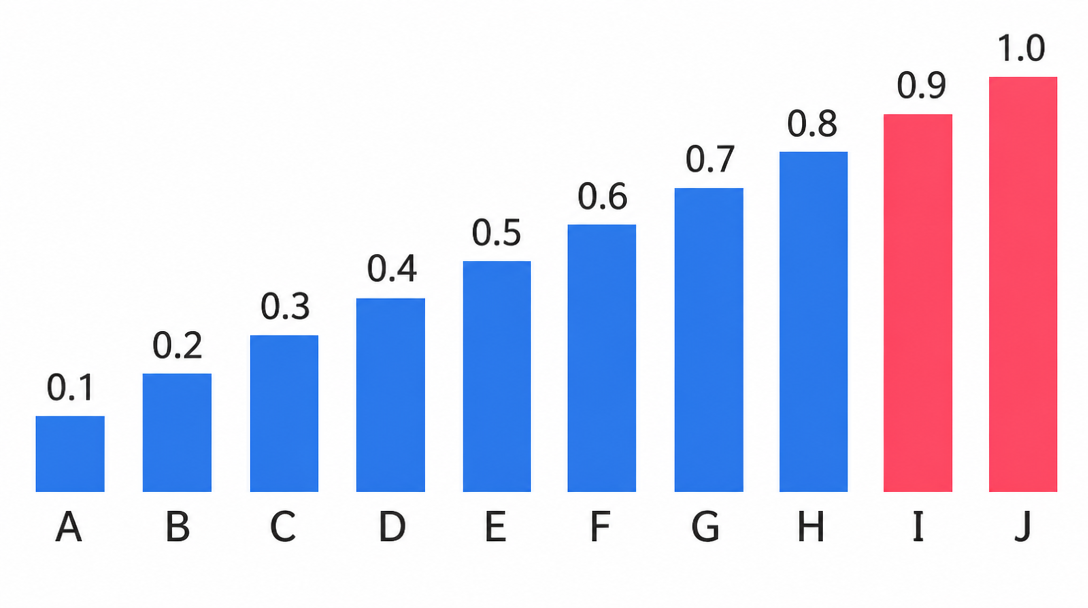
In men's artistic gymnastics, difficulty runs on a ten-step scale from A (0.1) to J (1.0). The FIG Men's Artistic Gymnastics Code of Points 2025–2028 applies that scale on floor, pommel horse, rings, parallel bars and high bar, and the only J-rated skills sit on floor. When a commentator calls something "an I-rated skill," they mean the second-highest rung on the ladder, worth 0.9 points on its own.
This guide explains how to read the men's difficulty table, what each letter from A to J is worth, which skills carry I and J values (and who they are named after), why vault uses a different system, and how difficulty actually becomes a D-score. Everything is checked against the FIG Code itself and the Japan Gymnastics Association's Men's Gymnastics Information No. 32 (July 2025).
What Difficulty Means in Gymnastics: The A to J Scale and Point Values
Difficulty is a ranking given to every skill
In artistic gymnastics, "difficulty" is the rating assigned to each individual element. The FIG Code of Points contains a set of Difficulty Tables for every apparatus, and each skill gets a letter value plus a unique identification number. Article 7.1 of the Code adds that any skill not yet listed must be submitted in advance so the Technical Committee can rate it before it counts.
Difficulty values are the building blocks of the D-score (the difficulty or content score). They are separate from the E-score, which judges execution and starts from 10.0 before deductions. For the full picture of how the two combine, see our guide to how gymnastics scoring works.
If you want to check what letter a favorite skill carries, or what a whole routine adds up to, the Gymnastics AI D-score calculator is built on the 2025–2028 Code. Pick the skills and it totals difficulty values and element group points for you.
A (0.1) to J (1.0): the value table
Article 7.1 of the men's Code sets the following values. Each letter step adds exactly 0.1.
Difficulty | Value | Rough meaning |
|---|---|---|
A | 0.1 | Basic element |
B | 0.2 | Basic element |
C | 0.3 | Intermediate element |
D | 0.4 | Threshold for 0.5 element group credit |
E | 0.5 | Advanced element |
F | 0.6 | Advanced element |
G | 0.7 | Elite-level skill |
H | 0.8 | Elite-level skill |
I | 0.9 | Performed by very few gymnasts |
J | 1.0 | Highest value in men's gymnastics |
The "rough meaning" column is our own shorthand for readers. The Code itself only defines the letter-to-value relationship.
Vault uses scores, not letters
Vault does not use the A–J scale. In the vault section of the Code (Section 13), each vault is assigned a direct score such as 5.6 or 5.2. Because a single vault forms the whole D-score, there is nothing to add up the way there is on the other five apparatus. Our vault difficulty guide walks through how those values are set.
The Highest Difficulty in Gymnastics Is J: Every I- and J-Rated Skill Explained
J-rated skills (floor)
In the 2025–2028 difficulty tables, the J-rated (1.0) skills we could confirm are these two. Both are in floor's backward acrobatic group (Element Group III).
Skill | Apparatus | Description | Value |
|---|---|---|---|
Nagornyy | Floor | Triple back salto piked | J (1.0) |
Jarman | Floor | Double back salto stretched with 3½ twists | J (1.0) |
- Nagornyy: Russia's Nikita Nagornyy debuted the triple back pike at the 2021 European Championships (Wikipedia: Nikita Nagornyy). The body stays piked through all three rotations.
- Jarman: Great Britain's Jake Jarman first performed the 3½-twisting double layout at the 2023 World Challenge Cup in Paris, and the skill was named after him (Wikipedia: Jake Jarman).
I-rated skills (floor, rings, high bar)
I-rated (0.9) skills appear in the floor, rings and high bar tables. The best-known examples are below.
Skill | Apparatus | Description | Value |
|---|---|---|---|
Liukin | Floor | Triple back salto tucked | I (0.9) |
Shirai 3 | Floor | Double back salto stretched with 3/1 twist | I (0.9) |
Whittenburg | Rings | Triple back salto piked dismount | I (0.9) |
Miyachi | High bar | Layout Kovacs with double twist (release) | I (0.9) |
- Liukin: Valeri Liukin of the Soviet Union performed the first triple back on floor at the 1987 European Championships (Wikipedia: Valeri Liukin).
- Shirai 3: one of three floor skills named after Japan's Kenzo Shirai (Shirai, Shirai 2 and Shirai 3).
- Whittenburg: Donnell Whittenburg of the USA first performed this rings dismount at the Koper World Challenge Cup in May 2017 (USA Gymnastics).
- Miyachi: Japan's Hidetaka Miyachi performed this release at the 2017 World Championships in Montreal (AGU Gymnastics). It holds the highest value on the high bar table.
You can look up the value of any other skill by apparatus in our gymnastics skills database.
Some values differ from older Codes
Values are reviewed with every new Code, so the rating you find online may not match the current table.
- The Nagornyy was rated I when it was first named (Wikipedia). The 2025–2028 table lists it as J.
- The Jarman was also reported as an I when it entered the Code in 2023 (Wikipedia).
- The Whittenburg was approved as an H in 2017 (FloGymnastics). It is an I in the 2025–2028 Code.
Whenever you check a skill's value, confirm which edition of the Code the source uses. International competition currently runs on the 2025–2028 Code.
Highest Difficulty by Apparatus: Why the Same Skill Can Have Different Values
Top values on floor, rings and high bar
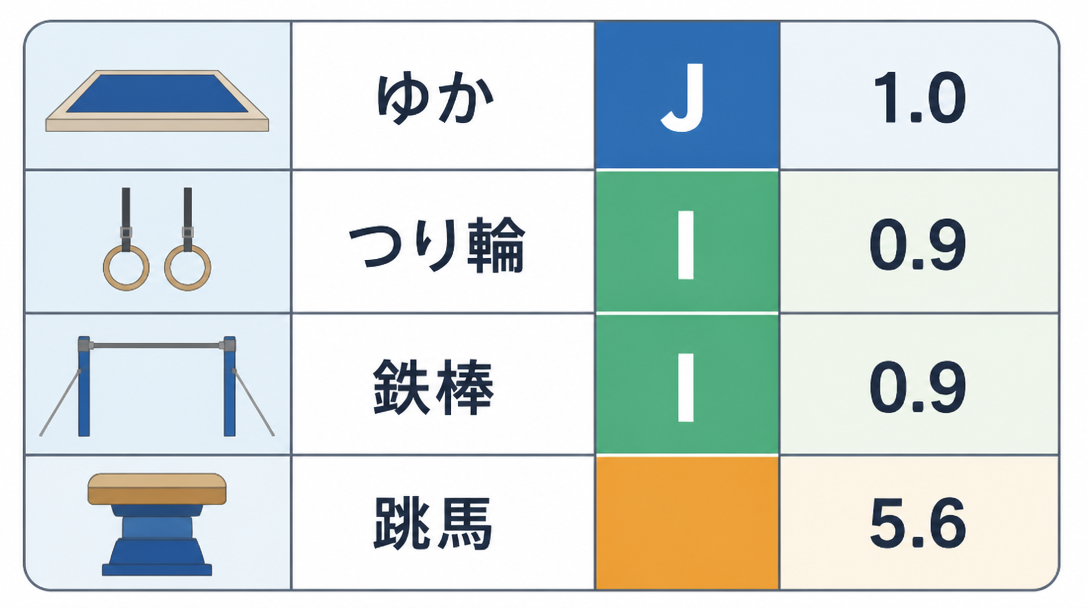
These are the highest values we can confirm in each apparatus table.
Apparatus | Highest value | Examples |
|---|---|---|
Floor | J (1.0) | Nagornyy, Jarman |
Rings | I (0.9) | Whittenburg (triple back piked dismount) |
High bar | I (0.9) | Miyachi (layout Kovacs with double twist) |
Vault | 5.6 points | Yang Hak Seon, Ri Se Gwang, Shirai 2, Yonekura and others |
On pommel horse and parallel bars, H-rated elements are described as the top tier (gymnasticscoaching.com).
A triple back is not worth the same everywhere
Value also depends on where a skill is performed. The triple back salto is the clearest example.
- Triple back tucked on floor (Liukin): I
- Triple back tucked dismount on rings: G
- Triple back piked dismount on rings (Whittenburg): I
On floor the gymnast has to generate all the height from the punch off the floor, while on rings the swing provides much of the momentum. Same number of rotations, different physical demands, so the tables rate them separately.
On high bar, twists push releases up the scale
Within the Kovacs family of releases, body shape and twists raise the value step by step. Lining up the FIG values makes the pattern obvious.
Skill | Description | Value |
|---|---|---|
Kovacs | Double back tucked over the bar | D (0.4) |
Kolman | Kovacs with full twist | E (0.5) |
Cassina | Layout (or piked) Kovacs with full twist | G (0.7) |
Bretschneider | Kovacs with double twist | H (0.8) |
Miyachi | Layout Kovacs with double twist | I (0.9) |
For more detail, read our explainer on the Cassina on high bar and our overview of high bar release moves.
The top vault value is 5.6
In the 2025–2028 vault value table, the highest score is 5.6. Vaults at that value include:
- Yang Hak Seon: handspring front layout with triple twist
- Ri Se Gwang: Tsukahara double back tucked with full twist
- Ri Se Gwang 2: handspring double front piked with half twist
- Shirai 2: Yurchenko layout with 3½ twists
- Yonekura: Tsukahara layout with 3½ twists
The Shirai 2 was worth 6.0 under an earlier Code (Wikipedia: Kenzo Shirai). Vault values change between editions too, so always check the current table.
How Difficulty Becomes a D-Score
Only the top eight elements count
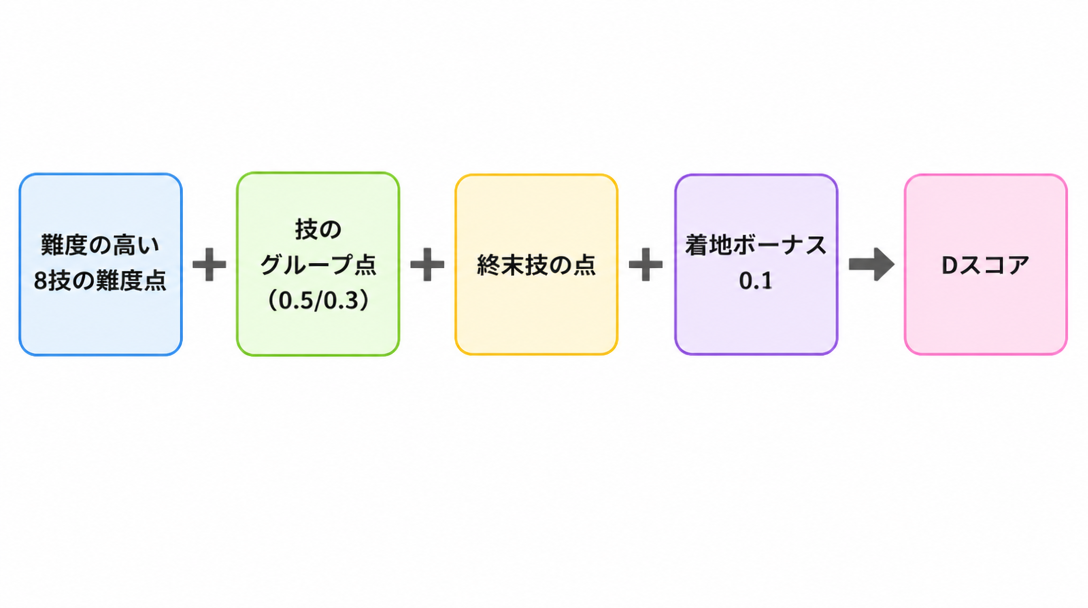
Not every skill in a routine adds to the D-score. Under the 2025–2028 Code, judges count the dismount plus the seven highest-value elements, for eight in total, with no more than four from the same element group. Floor also counts eight.
The Japan Gymnastics Association's Information No. 32 calls the drop from ten counted elements to eight a major change and says dismount difficulty and landing precision will become extremely important. With fewer counting elements, a single I- or J-rated skill now carries more relative weight.
Element group credit: 0.5 or 0.3
On top of difficulty values, each apparatus rewards fulfilling its element groups (Article 7.2).
- Group fulfilled with a D or higher element: 0.5
- Group fulfilled with an A–C element: 0.3
- Exception: Element Group I earns 0.5 with an element of any value
That is why D is often called the threshold value. For D-rated skills on every apparatus, see our D-difficulty skills list.
The dismount value counts twice
Under the 2025–2028 Code, the dismount group credit equals the dismount's difficulty value. The Code's own example: an F dismount earns 0.6 for difficulty and another 0.6 as element group credit.
So a Whittenburg (I) off rings brings 0.9 in difficulty plus 0.9 in group credit. Because dismount value now counts twice, choosing the dismount matters more than before.
The fastest way to see how difficulty, group credit and dismount value stack up is to build a routine and calculate it. Gymnastics AI totals difficulty values, element group points, connection bonuses and dismount value automatically, so you can test how one I-rated skill changes a D-score.
A stuck landing adds 0.1
The 2025–2028 Code awards a 0.1 D-score bonus for a stuck landing on a dismount of C value or higher (Article 7.2.9). Vaults with saltos also qualify; pommel horse is the only exception. This "stick bonus" means landing precision now affects the D-score as well as the E-score. Our article on landing technique and deductions covers the E-score side.
Difficulty in Junior Competition (U-15, Japan)
U-15: everything E and above is worth 0.50
Junior competitions in Japan use age-group rules adapted from the FIG Code. The Japan Gymnastics Association's 2025 U-15 men's application rules (revised September 1, 2026) set difficulty values as follows.
Difficulty | FIG (senior) | JGA U-15 men |
|---|---|---|
A | 0.10 | 0.10 |
B | 0.20 | 0.20 |
C | 0.30 | 0.30 |
D | 0.40 | 0.40 |
E and above | 0.50–1.00 | 0.50 flat |
Element count and group credit also differ
The U-15 rules differ from the senior Code in other ways too.
- The D-score counts seven elements (six plus the dismount)
- Element group credit is 0.50 for C or higher and 0.30 for A or B
- Dismount group credit equals the dismount's value (an E-or-higher dismount gives 0.50 + 0.50)
Because anything rated E or higher is capped at 0.50, juniors usually gain more from performing E-level skills cleanly than from chasing G or H elements. When watching a junior meet, check which age-group rules apply; it makes the scores far easier to interpret.
How to Look Up Gymnastics Difficulty and Watch It Live
Three ways to check a skill's value
- The FIG Code of Points (English): the difficulty tables in the MAG Code of Points 2025–2028 list every element with its value and number, drawn as stick figures with English abbreviations.
- Japan Gymnastics Association bulletins: the Men's Gymnastics Information series summarizes Code amendments and difficulty rulings in Japanese.
- A skills database: our skills database lets you search by skill name or apparatus.
What to watch for when you hear "I-rated"
When a commentator mentions an I- or H-rated skill, these points help you read the routine.
- That one skill is worth 0.8–0.9: the equivalent of eight or nine A elements
- It interacts with group and dismount credit: as a dismount, the same value is added again as group credit
- The risk is high: a fall costs 1.0 from the E-score, so harder skills always involve a trade-off with consistency
Balancing difficulty and execution
The final score is D plus E. A harder skill that triggers bigger execution deductions can lower the total. Top gymnasts choose difficulty they can hit reliably and build routines that minimize errors. For signature skills on each apparatus see our gymnastics skills list, and for the women's scale see how to read the women's difficulty table.
Summary
- Men's gymnastics difficulty runs on ten steps from A (0.1) to J (1.0). Vault uses direct scores instead, topping out at 5.6
- The J-rated skills in the 2025–2028 Code are the Nagornyy and Jarman on floor. I-rated skills include the Liukin, Shirai 3, Whittenburg and Miyachi
- The same triple back can be rated differently depending on apparatus and body shape
- The D-score counts eight elements, the dismount value doubles as group credit, and a stuck landing adds 0.1
- Age-group rules such as Japan's U-15 cap everything E and above at 0.50
To calculate a favorite gymnast's routine or your own, try the Gymnastics AI D-score calculator. It follows the FIG 2025–2028 Code and is free on iOS and Android.