Cassina on High Bar: G-Rated Kovacs Skill, Value and Origin
What is the Cassina on high bar? A full-twisting layout Kovacs rated G (0.7) in the FIG 2025-2028 Code. Its origin, Kovacs family values and connection bonuses.
The Cassina is a high bar release in which the gymnast lets go of the bar, travels back over it in a stretched (layout) double back salto with a full twist, and catches the bar again. In the FIG Men's Artistic Gymnastics Code of Points for 2025–2028 it is rated a G element (0.7 points), and you will see it in many of the strongest high bar routines in the world.
This guide covers what the Cassina is, its value in the current code, how it compares with the Kovacs, Kolman, Bretschneider and Miyachi, the gymnast it is named after, and how it can raise a D-score through connection bonuses. Everything here comes from the original text of the FIG MAG Code of Points 2025–2028 (April 2025 revision).
What Is the Cassina on High Bar? A Layout Kovacs with a Full Twist
How the FIG Code of Points defines the Cassina
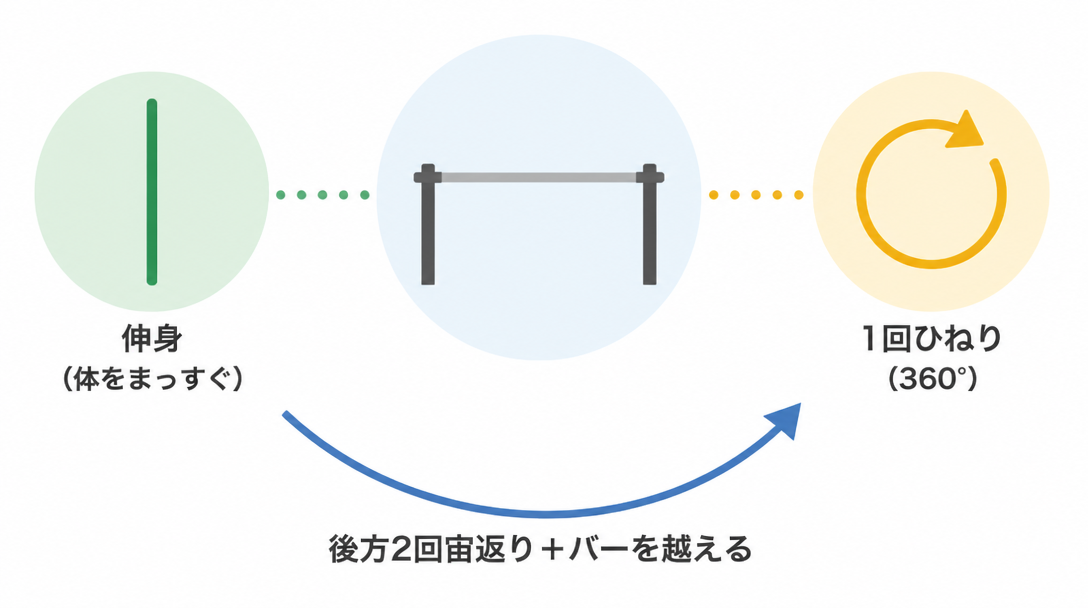
In the high bar difficulty tables, the Cassina is element 96 in Element Group II (flight elements). The official wording is "Kovacs straight or piked with 1/1 turn." In other words, it is a Kovacs performed in a straight (or piked) body position with one full twist added. Some coaches simply call it a "full-twisting layout Kovacs."
The basic Kovacs is a tucked double back salto over the bar, ending with the gymnast catching the bar again. The Cassina makes it harder in two ways:
- the body is straight (layout) instead of tucked, and
- a full twist (360 degrees) is added during the double salto.
Those two additions are what lift it from a D to a G.
The Cassina in three phases
When you watch a Cassina, it helps to split it into three phases.
- Release: using the momentum of a giant swing, the gymnast lets go of the bar and rises high.
- Flight: with the body held straight, the gymnast performs a double back salto with a full twist while travelling back over the bar.
- Regrasp: the gymnast catches the bar again as he comes down on the other side and continues swinging.
The code also states that any flight element with a salto over the bar must be followed by a giant swing, or the E-panel deducts 0.3 (Article 15.2.1). So when a giant swing comes right after a Cassina, the gymnast is building his routine around that rule.
The piked version is also listed as the "Pineda"
In the 2025–2028 tables, box 96 shows the name "Cassina" next to "Pineda - piked." The straight and piked versions share the same number and the same G value. The piked version simply has a second gymnast's name attached to it.
If you want to check what each skill in a high bar routine is worth, try Gymnastics AI, a D-score calculator app. It follows the FIG 2025–2028 Code of Points and has a database of more than 790 skills, the Cassina included. Pick the skills and the app adds up the difficulty values for you.
Cassina Difficulty Value: G (0.7) in the 2025–2028 Code of Points
A G element is worth 0.7
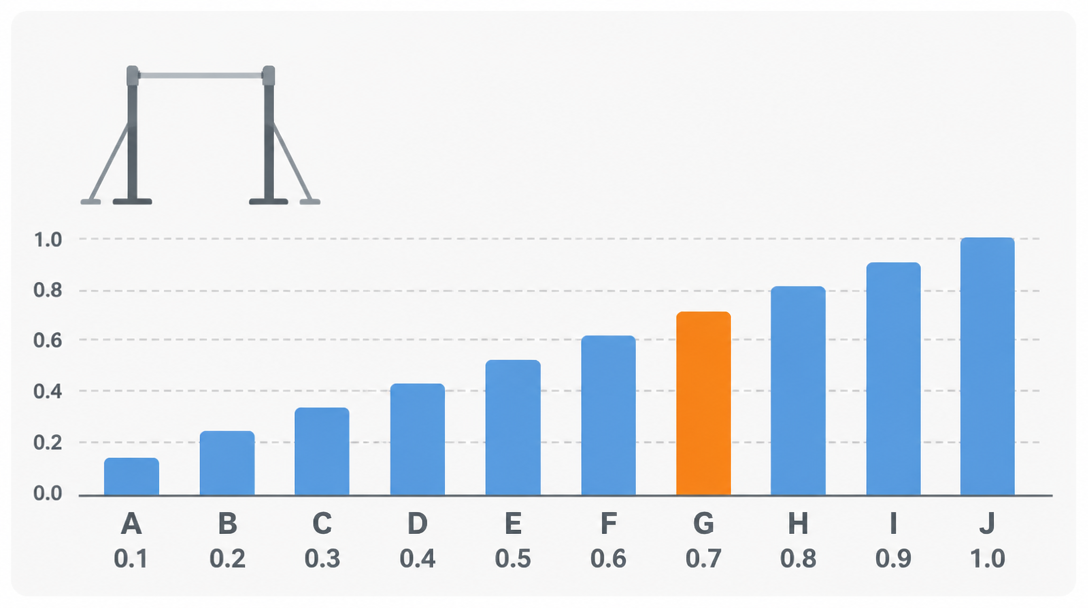
On floor, pommel horse, rings, parallel bars and high bar, the men's code rates skills from A to J. Values rise by 0.1 per letter, from 0.1 for an A to 1.0 for a J (FIG Code of Points, Article 7.1). The Cassina is a G, so once the D-panel credits it, it adds 0.7 to the D-score.
Letter | A | B | C | D | E | F | G | H | I | J |
|---|---|---|---|---|---|---|---|---|---|---|
Value | 0.1 | 0.2 | 0.3 | 0.4 | 0.5 | 0.6 | 0.7 | 0.8 | 0.9 | 1.0 |
How much the Cassina weighs in a D-score
Under the 2025–2028 code, a high bar D-score counts eight elements, including the dismount: the dismount plus the best seven other skills. The previous code counted ten, so every single skill now carries more weight (Inside Gymnastics' breakdown of the 2025–2028 men's code).
The D-score is the sum of three parts:
- Difficulty value: the total value of the eight counting skills (0.7 for a Cassina)
- Element group requirements: 0.5 for each group filled with a D or higher skill (0.3 for an A, B or C). The dismount group is worth the same as the dismount's value
- Connection value (CV): 0.1 or 0.2 for specific skills performed in direct connection
The Cassina is a G-rated skill in Element Group II, so on its own it also fills the flight element requirement worth 0.5.
Reading the element number and the tables
Each page of the FIG tables has columns A to F. When a box in column F carries a letter such as "G," "H" or "I," that letter is the skill's value. Box 96, the Cassina, is marked "G." In Japan, the national federation published a Japanese summary of the main changes in the April 2025 revision (Japan Gymnastics Association: 2025 MAG Code of Points information), and domestic competitions use the revised code too.
You can look up the value of any skill, on high bar or any other apparatus, in the skills database.
Cassina vs Kovacs, Kolman, Bretschneider and Miyachi: Difficulty Table
The Kovacs family compared
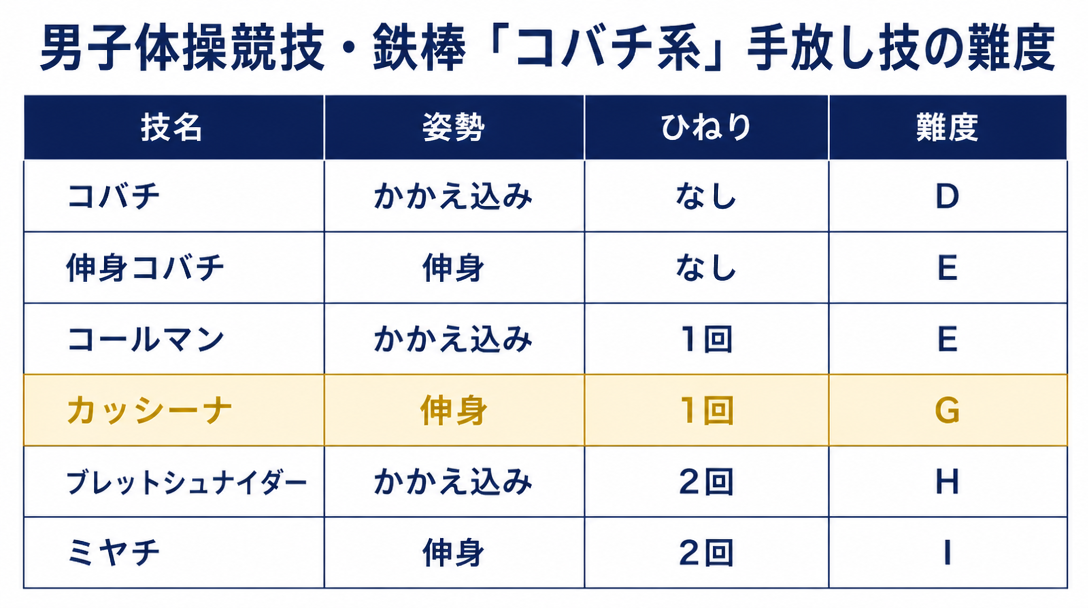
The Cassina belongs to the "Kovacs family" of release skills. This is how the family appears in the 2025–2028 difficulty tables.
Skill | FIG wording (number) | Body position | Twist | Value |
|---|---|---|---|---|
Kovacs | Double salto bwd. t. over the bar (II.88) | Tucked | None | D (0.4) |
Piked/straight Kovacs | Kovacs piked or straight (II.95) | Piked or straight | None | E (0.5) |
Kolman | Kovacs with 1/1 t. (II.89) | Tucked | Full | E (0.5) |
Cassina | Kovacs straight or piked with 1/1 turn (II.96) | Straight or piked | Full | G (0.7) |
Bretschneider | Kovacs with 2/1 t. (II.90) | Tucked | Double | H (0.8) |
Miyachi | Kovacs straight with 2/1 turn (II.102) | Straight | Double | I (0.9) |
Shaham | Kovacs with 3/2 t. to mix grip (II.108) | - | 1.5 (to mixed grip) | G (0.7) |
Names, numbers and values are taken from the high bar tables of the FIG MAG Code of Points 2025–2028 (April 2025 revision).
How body position and twists raise the value
The table shows that Kovacs-family values climb along two lines:
- Body position: going from tucked (Kovacs, D) to piked or straight (E) adds one letter.
- Twist: going from no twist to a full twist to a double twist adds more.
The Cassina combines both a straight body and a full twist. That is why it sits two letters, or 0.2 points, above the Kolman, which has the same full twist but is tucked. Add a second twist and you get the tucked Bretschneider (H) and the straight Miyachi (I).
Telling the Cassina apart from the Kolman and Miyachi
To tell Kovacs-family skills apart while watching, first check whether the body is straight or tucked, then count the twists.
- Tucked with one twist: Kolman (E)
- Straight with one twist: Cassina (G)
- Straight with two twists: Miyachi (I)
For the wider picture of high bar releases, including the Tkachev family, see our guide to high bar release skills. For signature skills across all six men's events, see our men's gymnastics skills list.
Who Is the Cassina Named After? Igor Cassina and Athens 2004
Igor Cassina of Italy
The skill is named after the Italian gymnast Igor Cassina, born on 15 August 1977 and known above all as a high bar specialist. He was the first gymnast to perform a straight Kovacs with a full twist, and the skill has carried his name since 2002. The table of eponymous skills on his Wikipedia page lists it as added to the Code of Points at the 2002 World Championships.
Olympic high bar gold in Athens 2004
Cassina won the high bar gold medal at the 2004 Athens Olympics. In the final he tied with Paul Hamm of the United States on 9.812, and Cassina was awarded the gold. Isao Yoneda of Japan took bronze with 9.787 (results of the 2004 Olympic men's horizontal bar).
At the World Championships he also won high bar silver in Anaheim in 2003 and high bar bronze in London in 2009 (Japanese Wikipedia: Igor Cassina).
How skills get named after gymnasts
In artistic gymnastics, when a gymnast is the first to successfully perform a new skill at a major FIG competition and the FIG accepts it, the skill enters the Code of Points under that gymnast's name. High bar is full of these names: besides the Cassina, there is the Kovacs, named after Péter Kovács of Hungary, and the Miyachi, named after Hidetaka Miyachi of Japan. To learn how the naming process works and which skills carry Japanese names, read our article on how gymnastics skills get their names.
Cassina Connections and the D-Score
When connection value (CV) is awarded
On high bar, connecting two flight elements, or a flight element with a skill from another group, earns connection value. These are the conditions in the 2025–2028 code (FIG Code of Points, Article 15.2.2):
Combination | Condition | CV |
|---|---|---|
Flight + flight | C + D or higher (or vice versa) | 0.10 |
Flight + flight | D + D | 0.10 |
Flight + flight | D or higher + E or higher (or vice versa) | 0.20 |
EG I or III skill + flight | D or higher + D | 0.10 |
EG I or III skill + flight | D or higher + E or higher (or vice versa) | 0.20 |
Connection value is only awarded when every skill in the connection is one of the eight counting elements.
What a Cassina connection is worth
Applying the table to a G-rated Cassina gives these connection values:
- Cassina (G) + Kovacs (D): 0.10
- Cassina (G) + Kolman (E): 0.20
- Cassina (G) + a C-rated Tkachev-family skill: 0.10
For example, if a gymnast connects a Cassina directly to a Kolman and both are among the counting eight, he earns 0.7 + 0.5 in difficulty plus 0.20 CV, a total of 1.4 from those two skills. To see how a real routine's D-score changes, give Gymnastics AI a try. Choose and order the skills, and the app works out difficulty values, element group credit and connection bonuses automatically.
Limits on the number of release skills
A gymnast cannot simply stack as many releases as he likes. The 2025–2028 high bar rules set these limits (FIG Code of Points, Article 15.2.2):
- Only two Tkachev & Piatti, Kovacs, Gienger, Jäger, Markelov or forward-salto-over-the-bar style flight elements are permitted.
- A fifth flight element is allowed only if at least two flight elements are connected (minimum C + C).
So when a Cassina goes into a routine, it has to be balanced with any other Kovacs-family skill, such as a Kolman, across the whole composition.
Famous Cassina combinations
The gymnast best known for Cassina combinations is Epke Zonderland of the Netherlands. The routine that won him high bar gold at the London 2012 Olympics included a triple combination of Cassina, Kovacs and Kolman. At the 2018 World Championships in Doha he won again with two double combinations, Cassina to Kovacs and Kolman to Gaylord 2, becoming the first man to win three World high bar titles (Wikipedia: Epke Zonderland). Both routines were scored under the codes of their time, which had different rules from today's.
Why Gymnasts Choose the Cassina for Their High Bar Routines
The Kovacs family is at the heart of high bar releases
Kovacs-family skills have been a staple of elite high bar for a long time. A study of high bar release skills (Samuels et al., 2009) reported that Kovacs variations made up 50% of the release skills at the 2000 Sydney Olympics and 40% after the qualification round at the 2006 Aarhus World Championships (ISBS paper: "Trend analysis of complex release and re-grasp skills on the high bar").
One skill covers the flight group and adds a high value
A single Cassina does several jobs at once:
- 0.7 in difficulty value as a G element
- 0.5 for fulfilling the flight element group (EG II) requirement
- 0.20 in connection value when linked with an E or higher skill
Now that the 2025–2028 code counts only eight skills, one high-value skill like this matters even more.
Cassina, Bretschneider or Miyachi?
Within the Kovacs family, the double-twisting Bretschneider (H) and Miyachi (I) are worth even more, but only a handful of gymnasts can perform them. Which skill goes into a routine depends not only on difficulty but also on how reliable the regrasp is and how it balances against E-score deductions. For an overview of the scoring system and how the D-score and E-score fit together, see our guide to the gymnastics Code of Points: D-score and E-score.
Summary
- The Cassina on high bar is a straight (or piked) Kovacs with a full twist, rated G (0.7) in the FIG 2025–2028 Code of Points.
- Kovacs-family values rise with body position (tucked to straight) and twists (none, full, double): Kolman E, Cassina G, Bretschneider H, Miyachi I.
- The skill is named after Igor Cassina of Italy, the 2004 Athens Olympic high bar champion.
- Connecting it to an E or higher flight element earns 0.20 CV, but only two Kovacs-family flight elements are permitted.
- With only eight counting skills under the current code, a single high-value skill like the Cassina carries more weight.
Want to see what a high bar routine with a Cassina adds up to? Try Gymnastics AI. It runs on iOS and Android and is free to use.