Gymnastics Skills List: Famous Named Men's Elements by Apparatus
A men's artistic gymnastics skills list by apparatus: famous named elements like the Tkatchev, Yurchenko and Shirai, plus how difficulty (A–I) and eponyms work.
体操競技
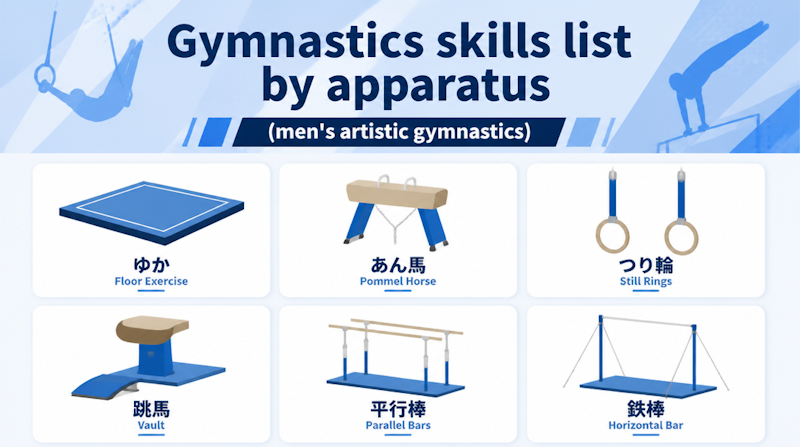
Looking for a clear gymnastics skills list organized by apparatus? This guide walks through the signature named elements of men's artistic gymnastics across all six apparatus—floor, pommel horse, rings, vault, parallel bars, and high
bar—along with how they got their names and how difficulty works. Hundreds of skills carry a gymnast's name (an eponym), from the Tkatchev to the Yurchenko, and each apparatus has its own families of elements. Use this as an entry point, then dive into the detailed per-apparatus guides linked throughout.
Before You Read the Skills List: Difficulty (A–I) and Eponyms
Two ideas make any gymnastics skills list far easier to read: how difficulty is graded, and how skills get their names.
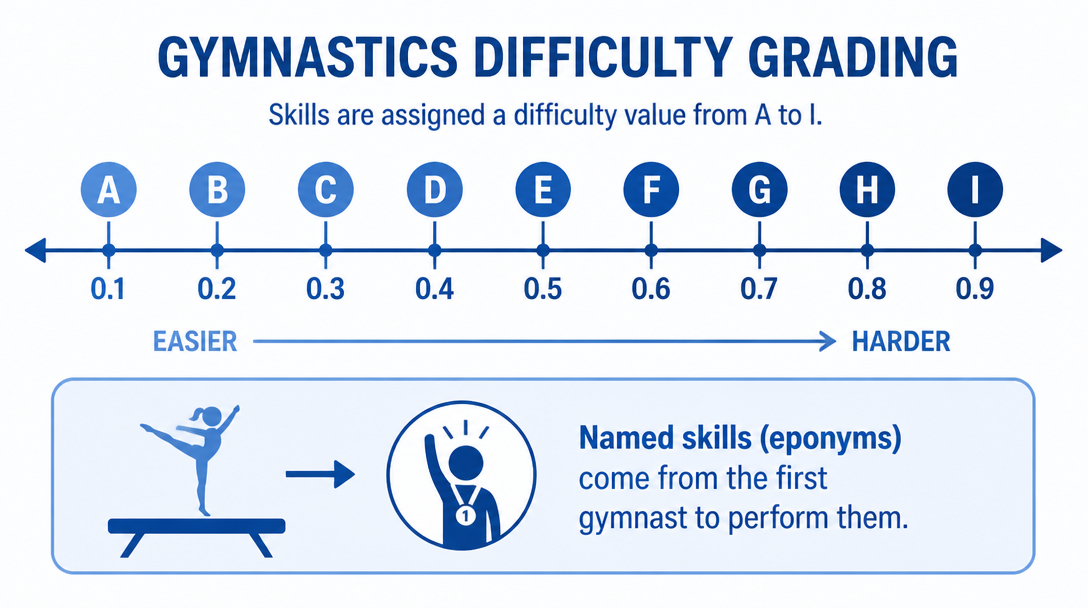
Difficulty Is Graded by Letter (A–I)
In men's artistic gymnastics, every element is graded by the International Gymnastics Federation (FIG) Code of Points from easiest to hardest with letters. In the 2025–2028 Code, each letter maps to a value:
Difficulty
Value
Rough level
A
0.1
Basic
B
0.2
Developing
C
0.3
Intermediate
D
0.4
Entry advanced
E
0.5
Advanced
F
0.6
High difficulty
G
0.7
Top tier
H
0.8
Extreme
I
0.9
A handful of skills
A routine's D-score (difficulty score) adds these values to element-group requirements, connection bonuses, and dismount bonuses. For the full picture, see our guide to the Code of Points: how the D-score and E-score work.
If you want to check what a routine would score, the Gymnastics AI D-score calculator is handy. It follows the FIG 2025–2028 Code and includes a database of 790+ skills, so you just tap to build a routine and it computes the difficulty automatically—a perfect companion to this list.
Skills Are Named After the Gymnast Who Landed Them First (Eponyms)
Many elements—Tkatchev, Yurchenko, Kovacs—carry a gymnast's name. These eponyms are entered in the Code of Points when a gymnast is the first to perform the skill at a
major international competition. To be named, a gymnast submits video in advance, the skill must meet a difficulty threshold (generally C or higher), and it must be performed without a major fault (Gymnastics Now on the 2025 newly named skills).
In 2025 alone, the men's side added the "Hall" (parallel bars), the "Moore" (pommel horse), and the "Olfati" (vault). Skills named for U.S. gymnasts are catalogued by USA Gymnastics.
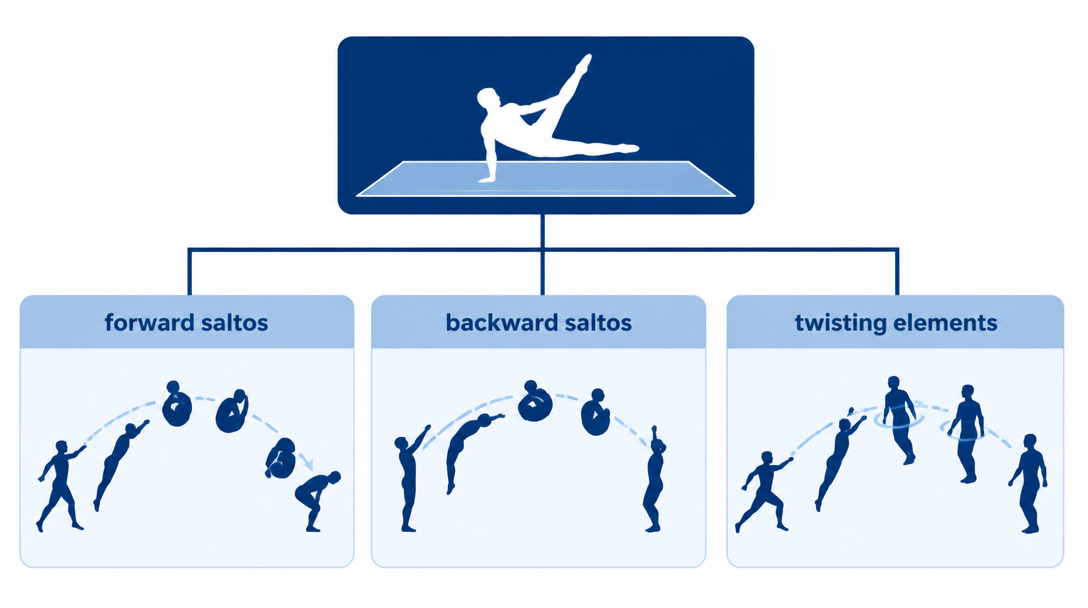
Difficulty Changes Between Codes: Treat the List as a Guide /h3> Note that difficulty values shift when the Code is revised (roughly every four years). Skills that become common are often downgraded, and unusually dangerous skills may be capped. So use this list to learn what exists and which family a skill belongs to, and confirm exact current values in the Code of Points or the D-score calculator. Floor Exercise: Signature Skills Floor is built on acrobatics—saltos and twists. Elements fall into forward, backward, and twisting families, and both the number of twists and the landing decide the score. Twisting Elements: The Shirai Twists drive floor difficulty. Japan's Kenzo Shirai first landed elements such as a quadruple-twisting layout and has six skills named after him across floor and vault, making "Shirai" almost a synonym for high-speed twisting. Backward triple-twisting layout: a core high-difficulty twist Backward quadruple-twisting layout (Shirai): first landed by Shirai Forward twisting elements: hard to switch body shape mid-air Salto Families: Forward and Backward Multi-Rotations Multiple saltos without twists also anchor floor routines and can be linked for higher difficulty. Our D-difficulty skills map by apparatus helps plan a sensible learning order. Pommel Horse: Signature Skills On pommel horse the gymnast supports the whole body on the hands while circling without stopping the legs. Often called the toughest apparatus, it divides into circles, travels, and dismounts. Circle Family: Roth, Stöckli, Busnari, Magyar The heart of the event is the continuous circle and its variations—flairs and travelling circles carry gymnasts' names: SkillFamilyFeature RothCircle + turna circle with an added turn StöckliTravel/turnchanging direction across the horse BusnariCombined circlesa high-difficulty composite Magyar / SivadoLengthwise traveltravelling end to end on the hands The technique behind these circles is covered in pommel horse circles: Roth and Stöckli basics. Travels, Flops and Scissors Scissors (split leg swings) and flop sequences are pommel highlights. See pommel horse flops and scissors. In 2025 the "Moore" was added on this apparatus. Still Rings: Signature Skills On rings the gymnast hangs from two rings and mixes static strength holds with swing elements, demanding huge core and upper-body strength. Elements split into strength holds and swing skills. Strength Holds: Cross, Planche, Azarian The iron cross (arms out to the sides) and the planche (body held horizontal) define the rings. Each hold must be still for two seconds or it is deducted. Iron cross: the signature hold with arms straight out L/V planche and support holds: body held horizontal or angled up Azarian: a strength pull into a cross position Judging criteria for strength holds are detailed in rings strength holds: cross and planche. To test how a routine with these holds scores, try the Gymnastics AI D-score calculator—tap to build a routine and it computes difficulty and bonuses automatically. Swing Elements: Yamawaki, Honma Swing elements use momentum to salto and re-grasp the rings; the "Yamawaki" and "Honma" (named for Japanese gymnasts) are classic examples. The difference between swing and backward-salto families is explained in rings swing elements vs backward saltos. Vault: Signature Skills Vault is a single explosive skill off the run. Elements are classified by the entry onto the table—so the entry's name becomes the family name. Classified by Entry: Yurchenko, Tsukahara, Lopez FamilyEntryNamed after Yurchenkoround-off, back handspring onNatalia Yurchenko Tsukaharaquarter/half turn on, backward offMitsuo Tsukahara Handspringforward handspring onforward family Lopez / Driggsforward twisting variantsnamed for gymnasts For the technical and difficulty differences between the Yurchenko and Tsukahara families, see vault difficulty: Yurchenko vs Tsukahara. A broader overview of named vaults is in FloGymnastics' guide to named vaults. High Difficulty: Li Xiaopeng, Shewfelt, Shirai Adding twists and saltos to an entry raises vault difficulty sharply. Named skills like the "Li Xiaopeng" and "Shewfelt" are prime examples, and Kenzo Shirai also has vaults named after him. These are covered in high-difficulty vaults: Li Xiaopeng and Shewfelt. Parallel Bars: Signature Skills On parallel bars the gymnast blends supports, hangs, and saltos across two rails, balancing big swing elements with turning support skills. Support and Turn Family: Diamidov, Healy, Tippelt Turns from handstand carry many names. The classic is the "Diamidov"—from a handstand, release one hand and turn a full 360° before regrasping in handstand. Others include the "Healy" and "Tippelt," and 2025 added the "Hall." Salto Family: Morisue, Belle Release-and-regrasp saltos are the showpieces here—the "Morisue" (named for a Japanese gymnast) and tucked-backward "Belle" are examples. How to order these to maximize the E-score is covered in parallel bars composition: maximizing the E-score. High Bar: Signature Skills High bar is built on giant swings, with release moves and grip changes layered on top. Its flying release skills are the sport's showstoppers—and the apparatus with the most named elements. Release Moves: Tkatchev, Kovacs, Jäger, Gaylord SkillFamilyMotion Tkatchevbackward over the barcounter-movement over the bar to the back Kovacsbackward salto over barsalto over the bar and re-grasp Jägerforward saltoforward salto to re-grasp Gaylordforward over the barforward salto over the bar to re-grasp The "Tkatchev" was first performed by Aleksandr Tkachyov in 1977 and remains one of the most popular release moves. The "Gaylord" is named for a U.S. gymnast (USA Gymnastics list); deeper difficulty comparisons are in high bar release moves: Tkatchev, Kovacs, Rybalko. A fuller catalogue is on this named high bar skills list. Giants and Grip Changes: Endo, Adler, Markelov To land release moves safely, the giants and grip changes around them are essential. The "Endo," "Adler," and "Markelov" name these families. Their differences are organized in high bar: Endo, Adler and Markelov compared. Gymnastics Skills FAQ How many gymnastics skills are there? The men's Code of Points lists hundreds of elements across the six apparatus. The Gymnastics AI D-score app has 790+ skills in its database, searchable by apparatus, group, and difficulty—useful for gauging the total. Are men's and women's skills different? Yes—the events themselves differ. Men compete on six apparatus (floor, pommel, rings, vault, parallel bars, high bar); women on four (vault, uneven bars, beam, floor), under separate Codes. See men's vs women's gymnastics compared. Where can I confirm exact difficulty? The FIG Code of Points is the primary source. For quick checks and calculations, the D-score calculator shows current values as you build a routine. Summary Organized by apparatus, a gymnastics skills list reveals each event's own families and signature named skills. Key points: Difficulty is graded A–I (0.1–0.9) and can change between Codes Named skills (eponyms) come from the gymnast who first landed them internationally Floor = twists/saltos, pommel = circles, rings = strength and swing, vault = classified by entry, parallel bars = supports and saltos, high bar = release moves Confirm exact current difficulty in the Code of Points or the D-score app Found a skill you want to explore? Read the detailed per-apparatus guides—and if you want to see how a routine's D-score changes, try the Gymnastics AI D-score calculator. Just tap to build a routine; it's free on iOS and Android. Related reading Code of Points basics: how the D-score and E-score workD-difficulty skills map by apparatusThe 6 men's apparatus and the physical demands of each
Author
Daito Iwasaki
Gymnast (Japan National Championships qualifier), AI developer, and musician. Creating across three fields with 15+ years of competitive gymnastics experience.