Morisue on Parallel Bars: E Value, Belle & Japanese Skills
What is the Morisue on parallel bars? Its FIG 2025-2028 value (E), how it differs from the Belle and Huang Liping, and 10 skills named after Japanese gymnasts.
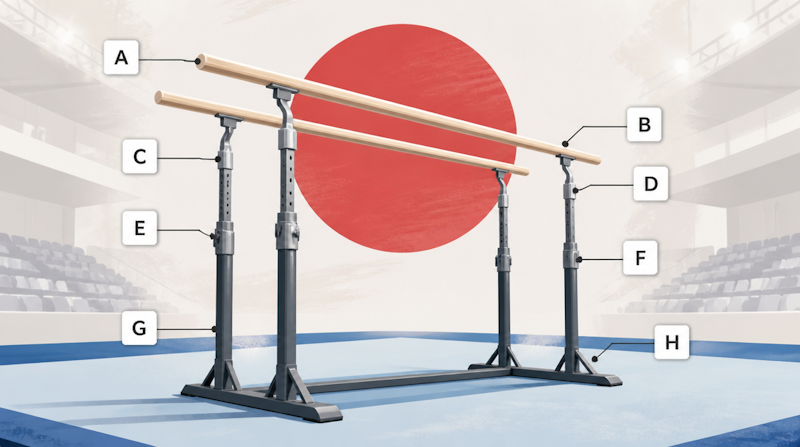
The Morisue is a parallel bars skill named after Shinji Morisue, Japan's horizontal bar gold medalist at the 1984 Los Angeles Olympics. From a swing in support, the gymnast performs a tucked double salto and catches the bars on his upper arms. This guide explains what the Morisue is, its value in the FIG 2025–2028 Code of Points, how it differs from the Belle and the piked Morisue (Huang Liping), and lists the parallel bars skills named after Japanese gymnasts such as the Tanaka, Yamamuro and Gushiken, with their element group and number.
What Is the Morisue on Parallel Bars? The Skill and the Gymnast
The basic shape of the Morisue
The Morisue is a salto element in men's artistic gymnastics on parallel bars. The gymnast starts in support on both rails, builds a big swing, performs a double salto in a tucked position (knees pulled to the chest), and regrasps in upper arm hang, with the bars caught under the armpits along the upper arms. Japanese sources describe it as a backward tucked double salto above the bars to upper arm support (Shinji Morisue, Japanese Wikipedia).
In the parallel bars difficulty tables of the FIG Men's Artistic Gymnastics Code of Points 2025–2028, the Morisue is listed as follows:
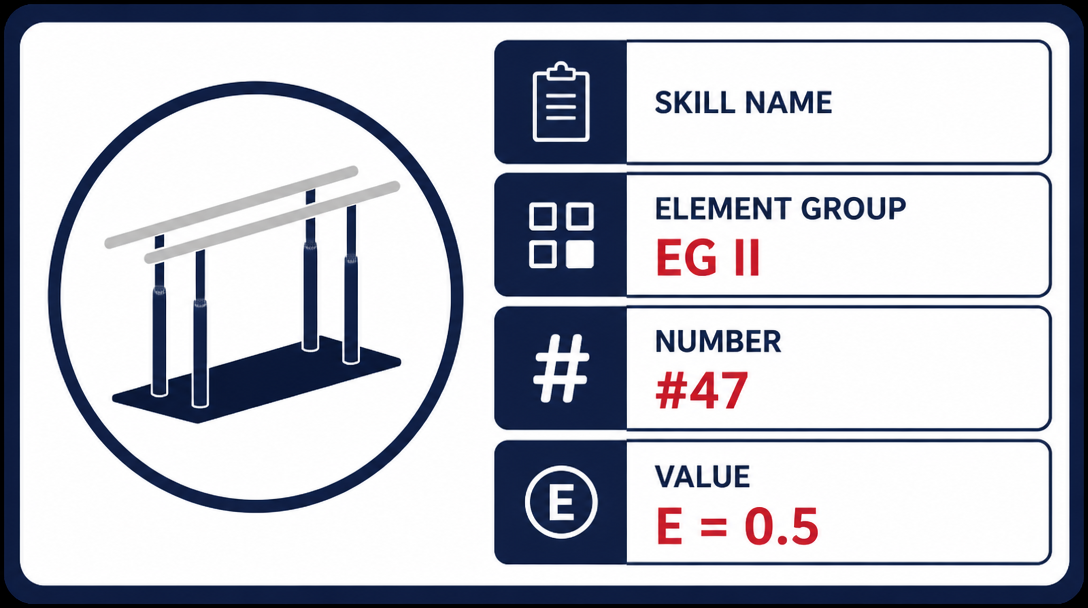
- Name: Morisue
- FIG description: Double salto tuck to upper arm hang
- Element group and number: EG II (elements in support or through support on 2 bars), #47
- Difficulty: E (0.5)
- Juniors: prohibited (marked with a red dot in the table)
Shinji Morisue, the gymnast behind the name
Shinji Morisue was born on 22 May 1957 in Okayama, Japan. According to his Olympedia profile, he won gold on horizontal bar, silver on vault and bronze with the team at the 1984 Los Angeles Olympics. His English Wikipedia entry states that the parallel bars skill Morisue is named after him.
The Japanese Wikipedia entry adds that he completed the skill before the Los Angeles Games, after a former coach from his Nippon Sport Science University days showed him a drawing of the movement and asked whether he could do it. If you want to know how gymnasts get skills named after them, see our guide to how gymnastics skills are named.
A quick way to check the Morisue's value
On parallel bars, the D-score is built by adding the values of the counting elements. If you want to check the value of skills like the Morisue, or see how a routine's D-score changes when you add it, Gymnastics AI, our D-score calculator app, makes it easy. It follows the FIG 2025–2028 Code of Points and includes more than 790 skills across all six men's apparatus. You can also browse parallel bars skills in our skills database.
Morisue Difficulty Value: E in the 2025–2028 Code of Points
The four element groups on parallel bars
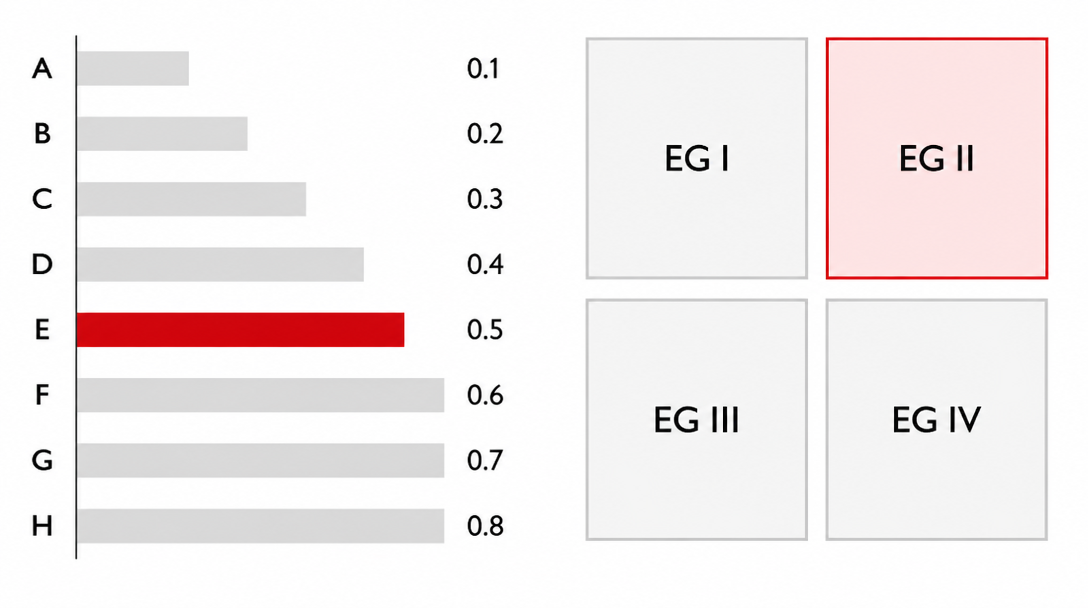
Section 14 (Parallel Bars) of the 2025–2028 Code of Points divides skills into four element groups (Art. 14.2.2). The Morisue belongs to EG II.
Group | FIG definition | Examples |
|---|---|---|
EG I | Elements starting in upper arm position | Yamawaki, Harada, Watanabe |
EG II | Elements in support or through support on 2 bars | Morisue, Diamidov, Healy, Kato |
EG III | Long swings in hang on 1 or 2 bars and underswings | Belle, Tanaka, Yamamuro, Kenmotsu, Gushiken |
EG IV | Dismounts | Hiroyuki Kato |
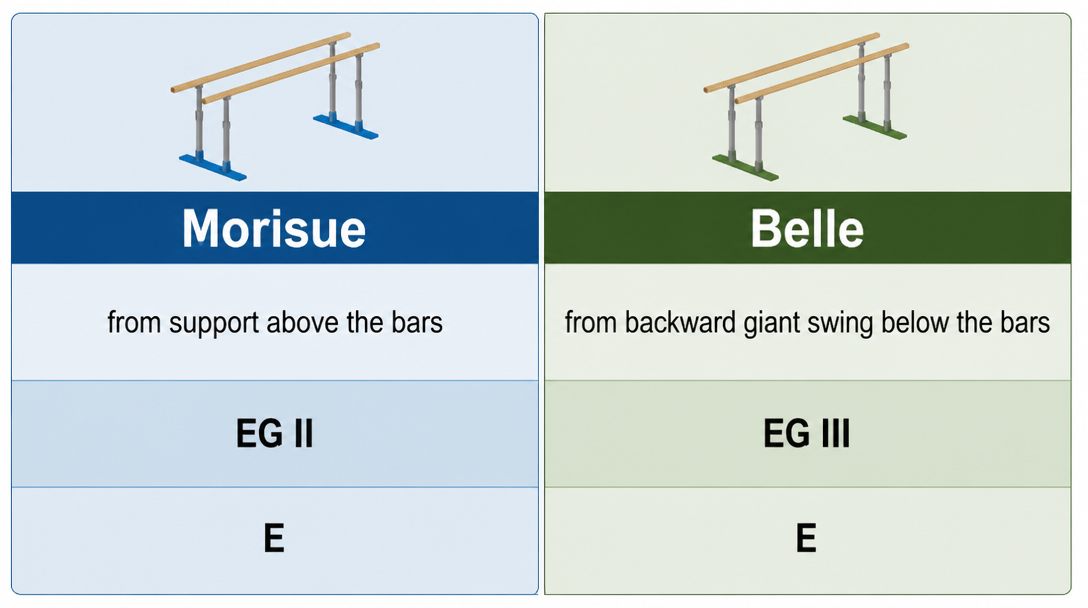
Two skills that both end with a double salto to upper arm hang can sit in different groups depending on where they start. The Morisue starts from support above the bars, so it is EG II. The Belle starts from a backward giant swing below the bars, so it is EG III.
The Morisue is worth 0.5
The difficulty values are A=0.1, B=0.2, C=0.3, D=0.4, E=0.5, F=0.6, G=0.7 and H=0.8, as shown in the column headers of the parallel bars tables. As an E element, the Morisue adds 0.5 to the D-score when it is one of the counting elements.
Many Japanese-language explanations still call the Morisue a D element. In the current 2025–2028 Code it is an E (0.5). Values found online often come from older editions, so always check which edition a table is based on. For the full A-to-J scale, see our men's gymnastics difficulty chart.
How the Morisue counts in a routine
- Eight elements count: the best seven plus the dismount, with a maximum of four from the same element group (Art. 6.1)
- The Morisue counts as an EG II element
- A tucked Morisue and a piked Morisue in the same routine count only once; the higher value is taken (special repetition rule in the parallel bars section)
The same "one body position variation only" rule is written for the Belle (tucked or piked). If you want to test which elements count and what the resulting D-score would be, try Gymnastics AI. Pick skills, put them in order, and the app calculates difficulty, element group values and the dismount value automatically.
Morisue vs Belle vs Piked Morisue (Huang Liping)
The piked Morisue is the Huang Liping, an F
When the Morisue is performed piked (legs straight, body folded at the hips), it becomes a separate element in the tables. The FIG description is "Double salto pike to upper arm hang", the name is Huang Liping, the number is #48 and the value is F (0.6).
In Japan it is often simply called the "piked Morisue". Our skills database has separate pages for the Morisue and the piked Morisue.
The Belle differs in where the salto starts
A skill that looks similar to the Morisue is the Belle. Both are tucked double saltos caught in upper arm hang, but they start differently.
Skill | FIG description (summary) | Group and number | Value |
|---|---|---|---|
Morisue | Double salto tuck to upper arm hang (from support) | EG II #47 | E (0.5) |
Huang Liping (piked Morisue) | Double salto pike to upper arm hang | EG II #48 | F (0.6) |
Belle | From giant swing bwd., double salto tuck to upper arm hang | EG III #59 | E (0.5) |
Belle pike | Belle in piked position | EG III #60 | F (0.6) |
Belle with 1/1 turn | Belle with a full twist | EG III #66 | H (0.8) |
The Morisue starts from a swing in support above the bars. The Belle starts from a backward giant swing below the bars. They share the same E value but sit in different groups, so a routine with both can use them toward EG II and EG III. For the Belle and other big parallel bars skills, see our parallel bars skills guide.
Juniors cannot perform it
The parallel bars section of the Code states that saltos with reception in upper arms and/or bent arm support are not permitted for juniors (Art. 14.2.1). The Morisue, the Huang Liping and the Belle are all marked with the red "prohibited for juniors" dot in the tables.
- Morisue (#47): prohibited for juniors
- Huang Liping (#48): prohibited for juniors
- Belle (#59), Belle pike (#60) and Belle with 1/1 turn (#66): prohibited for juniors
Also note that, unless otherwise indicated, elements that deliberately regrasp in bent arm support have the same number and value as those that regrasp in upper arm hang (Art. 14.2.2).
Parallel Bars Skills Named After Japanese Gymnasts: 10 Skills and Their Values
Japanese names in the FIG Code of Points
The parallel bars tables contain many skills named after Japanese gymnasts. The list below shows the ones found in the 2025–2028 Code (pages 96 to 112), from the lowest to the highest value.
Skill | FIG description (summary) | Group and number | Value |
|---|---|---|---|
Watanabe | Roll bwd. with 1/2 t. from upper arm hang, or fwd. uprise to Kato hop to support | EG I #8 | B (0.2) |
Kato | Bent arm swing fwd. to hop 1/2 t. to support | EG II #2 | B (0.2) |
Yamawaki | Bwd. uprise and 5/4 salto fwd. tucked to upper arm hang | EG I #51 | C (0.3) |
Kenmotsu | Giant swing bwd. to handstand | EG III #21 | C (0.3) |
Gushiken | Giant swing bwd. with 1/2 t. to upper arm hang | EG III #39 | C (0.3) |
Harada | Roll bwd. with 1/2 t. tuck to upper arm hang | EG I #34 | D (0.4) |
Morisue | Double salto tuck to upper arm hang | EG II #47 | E (0.5) |
Tanaka | Giant swing bwd. with 1/2 t. and 3/2 salto fwd. to upper arm hang | EG III #72 | G (0.7) |
Yamamuro | Felge through handstand to Makuts | EG III #120 | G (0.7) |
Hiroyuki Kato | Double salto bwd. tucked with 1/1 t. (dismount) | EG IV #36 | G (0.7) |
The descriptions are short summaries of the FIG text. Check the original Code and its drawings for the exact definitions. You can also look up each value in our parallel bars skills database.
The gymnasts behind the names
Here are the gymnasts whose records we could confirm:
- Kenmotsu: Eizo Kenmotsu. According to Olympedia, he competed at three Olympics and won team gold each time, and he won parallel bars gold at the 1974 World Championships.
- Kato: the skill is attributed to Sawao Kato. Olympedia lists 12 Olympic medals, including eight golds, with parallel bars titles in 1972 and 1976. He was inducted into the International Gymnastics Hall of Fame in 2001.
- Gushiken: Koji Gushiken. According to Olympedia, he won parallel bars gold at the 1981 World Championships and the all-around gold at the 1984 Los Angeles Olympics.
- Yamawaki: Kyoji Yamawaki. Olympedia shows he was on Japan's team at the 1984 Los Angeles Olympics and won team bronze.
How to read the list
- Groups: Japanese-named skills appear in all four element groups, so they are also used to fulfil element group requirements
- Range of values: from basic B elements to G-level skills
- Junior restrictions: the Harada, Yamawaki, Morisue and Tanaka carry the junior prohibition dot because they are saltos caught in upper arm hang
For how element groups and composition requirements work, see our guide to composition requirements.
Tanaka and Yamamuro: G-Value Japanese Skills on Parallel Bars
The Tanaka belongs to Hikaru Tanaka
The parallel bars Tanaka is named after Hikaru Tanaka, who represented Japan at the 1996 Atlanta Olympics. According to Japanese Wikipedia, he described the skill as a forward swing in hang with a twist into a tucked forward double salto to upper arm support, which was valued F at the time. He asked for it to be called "Hikaru X", but that name was not accepted and it became "TANAKA".
He is a different person from Kazuhito Tanaka, the parallel bars specialist who won team silver at the 2012 London Olympics. The two are easy to mix up because they share a family name.
Skill | FIG description (summary) | Number | Value (2025–2028) |
|---|---|---|---|
Tanaka | Giant swing bwd. with 1/2 t. and 3/2 salto fwd. to upper arm hang (tucked) | EG III #72 | G (0.7) |
Esparza | Tanaka in piked position | EG III #78 | H (0.8) |
In the 2025–2028 Code the Tanaka is a G (0.7). Performed piked, it becomes a separate skill called the Esparza, valued H (0.8).
The Yamamuro was recognized in 2015
The Yamamuro is named after Koji Yamamuro, a member of Japan's team that won gold at the 2016 Rio de Janeiro Olympics. According to Japanese Wikipedia, his new parallel bars skill was recognized and named "Yamamuro" in 2015.
The FIG description is "Felge through handstand to Makuts". The gymnast performs a felge (an underswing below the bars) through handstand and goes straight into a Makuts, which is a 3/4 Diamidov followed by a 3/4 Healy on the other hand to support. It is EG III #120 and valued G (0.7).
The Hiroyuki Kato is a G dismount
In the dismount group (EG IV) there is the Hiroyuki Kato. The FIG description is "Double salto bwd. t. with 1/1 t.", a tucked backward double salto with a full twist. It is #36 and valued G (0.7). The Code writes both his given name and family name, and it is a different skill from the EG II "Kato" (#2).
On parallel bars dismounts, sticking the landing also matters for the score. For landing deductions, see our guide to landing technique and deductions.
Checking the Morisue Value: Old Editions and Alternative Names
Values change between editions of the Code
The value of a parallel bars skill can change when the Code is revised. For the skills in this article:
Skill | Value you often see | 2025–2028 Code |
|---|---|---|
Morisue | D (common in Japanese explanations) | E (0.5) |
Tanaka | F (at the time Tanaka performed it) | G (0.7) |
Online tables and older books may show values from previous editions. Always check the latest Code before you rely on a number. Named skills on other apparatus have also changed value between editions; see our articles on the Cassina on horizontal bar and the Kasamatsu vault.
Watch out for alternative names and shared names
- Piked Morisue = Huang Liping: the Japanese name and the FIG name differ
- Kato and Hiroyuki Kato: parallel bars has two skills with the Kato name (EG II #2 and EG IV #36)
- Morisue on horizontal bar: Japanese Wikipedia notes that a skill with the same name exists on horizontal bar. It is a different skill from the parallel bars Morisue
How to check the correct value
- Open the latest FIG MAG Code of Points (2025–2028)
- In Section 14 (Parallel Bars), find the skill's element group and number (for example EG II #47)
- Read the value from the column header (A=0.1 to H=0.8). F, G and H share one column; G and H are marked with a letter
- A red dot means the element is prohibited for juniors
Searching by name alone can be confusing because of alternative names and shared family names. Checking by number is the reliable way.
Summary
Key points about the Morisue and Japanese parallel bars skills
- The Morisue is a parallel bars skill named after Shinji Morisue: from support, a tucked double salto caught in upper arm hang
- In the FIG 2025–2028 Code it is EG II #47, valued E (0.5). The piked version is the Huang Liping (#48, F)
- The Belle starts from a backward giant swing and is in EG III (#59, E), a different group from the Morisue
- Japanese-named parallel bars skills include the Watanabe and Kato (B), Yamawaki, Kenmotsu and Gushiken (C), Harada (D), Morisue (E), and Tanaka, Yamamuro and Hiroyuki Kato (G)
- The Tanaka belongs to Hikaru Tanaka, not Kazuhito Tanaka. Saltos caught in upper arm hang are prohibited for juniors
Check your own D-score
If you want to calculate the D-score of a parallel bars routine yourself, try Gymnastics AI. It follows the FIG 2025–2028 Code of Points and is free on iOS and Android.