Kasamatsu Vault Explained: Values, Tsukahara Rule & Named Vaults
What is the Kasamatsu vault? Its FIG 2025-2028 values (2.4 tucked, 3.6 layout), why it equals a Tsukahara with one more twist, and the Akopian-Yonekura chain.

The Kasamatsu vault is a men's artistic gymnastics vault named after Japan's Shigeru Kasamatsu, and it is the base for several of the hardest twisting vaults performed today. This guide explains what a Kasamatsu is, its difficulty value under the FIG 2025–2028 Code of Points, how it differs from the Tsukahara, and the named vaults that grew out of the layout Kasamatsu: the Akopian, Driggs, López and Yonekura. Every value comes with its official vault number.
What Is the Kasamatsu Vault? A Twisting Branch of the Tsukahara Family
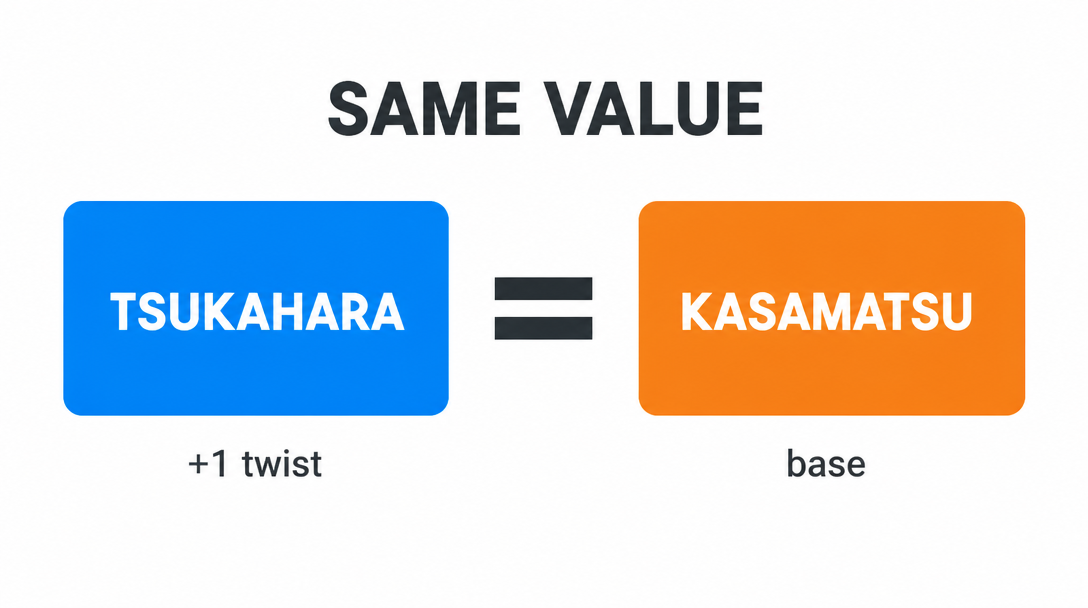
The basic shape of a Kasamatsu
The Kasamatsu is a vault on men's vault. After the run and take-off, the gymnast changes the direction of the body during the first flight phase (from the board to the table) and places the hands on the table from a sideways position. In the second flight phase (from the table to the landing) the salto is combined with a twist. The entry belongs to the same family as the Tsukahara; the twist in the post-flight is what makes it a Kasamatsu.
In the difficulty table of the Fédération Internationale de Gymnastique's Men's Artistic Gymnastics Code of Points 2025–2028, the tucked Kasamatsu is vault #119 with a value of 2.4. The same box also lists "Tsukahara tucked with 1/1 twist", so the Code treats the two as the same vault.
- Name: Kasamatsu
- FIG number and value: #119, 2.4 (tucked)
- Group: Element Group I (single salto vaults with complex twists)
- Equivalent vault: Tsukahara tucked with a full twist
Shigeru Kasamatsu, the gymnast behind the name
Shigeru Kasamatsu is a Japanese gymnast born in 1947. According to his Olympedia profile, he won team gold, silver on parallel bars and bronze on floor and high bar at the 1972 Munich Olympics. At the 1974 World Championships in Varna, Bulgaria, he won both the all-around and the vault title, scoring 19.325 on vault (1974 World Championships results).
The International Gymnastics Hall of Fame notes that Kasamatsu "gave his name to a twisting technique that serves as the base for some of today's most difficult vaults." How gymnasts get skills named after them is covered in our guide to how gymnastics skills are named.
A quick way to check Kasamatsu values
On vault, the value of the vault you perform is your D-score. If you want to check the value of a vault you train or one you just watched, Gymnastics AI, a D-score calculator app, makes it easy. It follows the FIG 2025–2028 Code of Points and includes more than 790 skills across all six men's apparatus.
Kasamatsu Difficulty Values in the 2025–2028 Code of Points
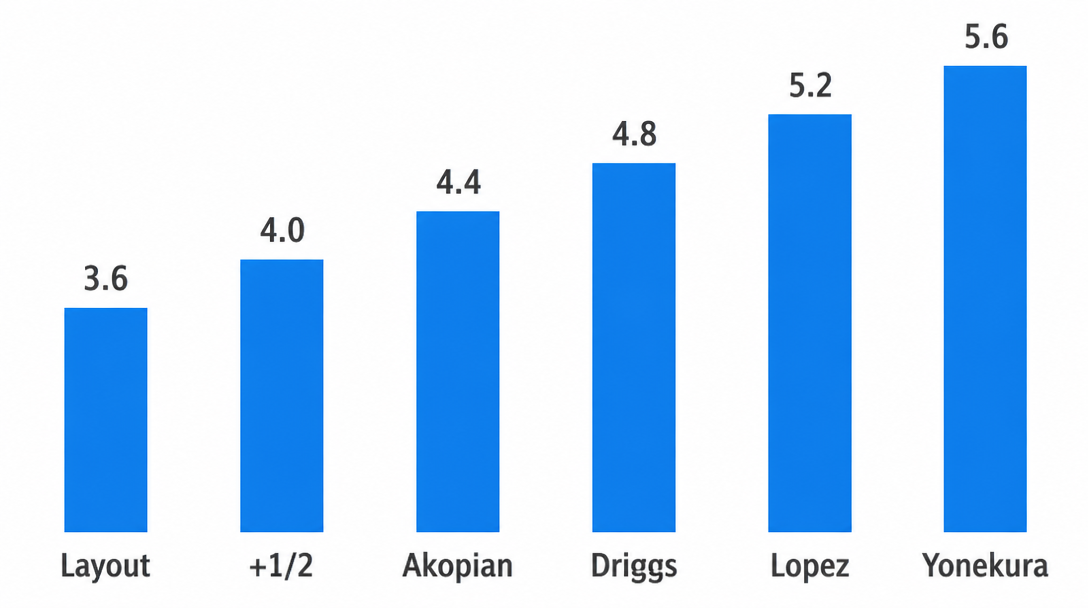
The tucked Kasamatsu series
In the Group I difficulty table of the 2025–2028 Code (pp. 84–85), the tucked series looks like this. Note how each Kasamatsu sits in the same box as a "Tsukahara plus twist."
No. | Vault (FIG wording) | Value |
|---|---|---|
#119 | Kasamatsu tucked = Tsukahara tucked with 1/1 twist | 2.4 |
#120 | Kasamatsu tucked with 1/2 twist = Tsukahara tucked with 3/2 twist | 2.8 |
#121 | Tsukahara tucked with 2/1 twist (Barbieri) | 3.2 |
#122 | Tsukahara tucked with 5/2 twist | 3.6 |
The layout Kasamatsu is worth 3.6
The frequently searched layout (stretched) Kasamatsu is #125 with a value of 3.6, in the same box as the Tsukahara layout with a full twist. Each extra half twist on the layout Kasamatsu adds 0.4, up to 5.6 for the Yonekura with two and a half twists.
No. | Vault (FIG wording) | Name | Value |
|---|---|---|---|
#125 | Kasamatsu layout = Tsukahara layout with 1/1 twist | - | 3.6 |
#126 | Kasamatsu layout with 1/2 twist = Tsukahara layout with 3/2 twist | - | 4.0 |
#127 | Kasamatsu layout with 1/1 twist = Tsukahara layout with 2/1 twist | Akopian | 4.4 |
#131 | Kasamatsu layout with 3/2 twist | Driggs | 4.8 |
#132 | Kasamatsu layout with 2/1 twist | López | 5.2 |
#133 | Kasamatsu layout with 5/2 twist = Tsukahara layout with 7/2 twist | Yonekura | 5.6 |
How to read the table
- Body position: with the same twist, the layout is worth more than the tuck (#119 at 2.4 versus #125 at 3.6)
- Twist: in the Kasamatsu series, each extra half twist adds 0.4
- Counting twists: a "Kasamatsu with X twists" has the same value as a "Tsukahara with X+1 twists." It helps to think of the Kasamatsu name as already containing one full twist
For the bigger picture, including handspring and Yurchenko vaults, see our vault difficulty guide and the vault skills database.
Kasamatsu vs Tsukahara: Entry, Group and Value
What is a Tsukahara?
The Tsukahara is named after Mitsuo Tsukahara. According to his Olympedia profile, he won the vault title at the 1970 World Championships, where he first performed the vault in competition. The original version was "a quarter-on entry handspring followed by a salto backwards in tuck position."
In the 2025–2028 Code, the basic tucked Tsukahara is in Group III as #307, worth 1.8. The piked version is #308 (2.0) and the layout is #313 (2.8) (p. 89).
The "same value" rule
The relationship between the two vaults is written directly in the rules. Article 13.2.2 of the FIG Code lists these general principles for vault values:
- Kasamatsu vaults have the same value as the equivalent Tsukahara vaults
- Yurchenko vaults have the same value as the analogous Tsukahara vaults
- Cuervo vaults have the same value as equivalent handspring salto vaults with twists
So choosing a Kasamatsu or a Tsukahara does not change the score by itself. What changes the value is the body position and the amount of twist.
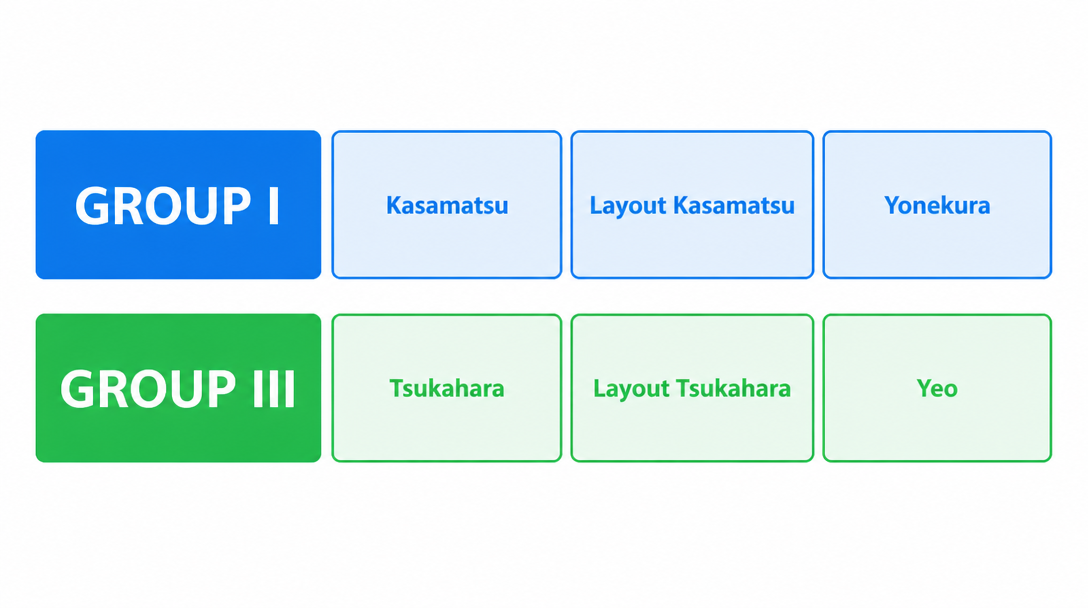
Different groups: EG I and EG III
Even with equal values, the two families can sit in different groups. The 2025–2028 grouping looks like this:
Group | FIG definition | Examples |
|---|---|---|
Group I (EG I) | Single salto vaults with complex twists | Kasamatsu (#119), layout Kasamatsu (#125), Yonekura (#133) |
Group III (EG III) | Handspring sideways and Tsukahara vaults with or without simple twists, and all double salto backward | Tsukahara (#307), layout Tsukahara (#313), Yeo (#319), Ri Se Gwang (#321) |
Tsukahara vaults with a full twist or more join the Kasamatsu in Group I. Group III keeps the untwisted and half-twisting Tsukaharas and the double back saltos. That difference matters for the "two vaults" rule in the vault final, explained below.
Named Vaults Built on the Kasamatsu
The Akopian and the Driggs
Add twists to the layout Kasamatsu and you reach a run of named vaults. In the FIG table, the layout Kasamatsu with a full twist (#127, 4.4) is named the Akopian, and the layout Kasamatsu with one and a half twists (#131, 4.8) is named the Driggs.
Both are built on the Kasamatsu. That chain of harder vaults is exactly why the Hall of Fame describes the Kasamatsu as the base for some of today's most difficult vaults.
The López (layout Kasamatsu double twist)
The layout Kasamatsu with a double twist is #132, worth 5.2, and is named the López. Counted as a Tsukahara, it equals a layout Tsukahara with three twists, which puts it among the vaults in the 5-point range.
Men's vault has other famous named vaults as well, such as the Li Xiaopeng and the Shewfelt. Those come from different families and are covered in our guide to high-difficulty vaults.
The Yonekura (layout Kasamatsu with 2.5 twists)
The highest-valued vault in the Kasamatsu series is the Yonekura, named after Japan's Hidenobu Yonekura. FIG lists it as "Kasamatsu layout with 5/2 twist or Tsukahara layout with 7/2 twist" (#133), worth 5.6 in the 2025–2028 Code.
According to his profile, he landed the vault at the 2019 FIG World Cup in Melbourne, and it was added to the Code of Points in April 2019. Yonekura won vault silver at the 2021 World Championships. In qualification there he scored 14.933 with the Yonekura (Number Web, in Japanese).
- Yonekura: #133, 5.6 (Group I)
- Other vaults also worth 5.6: Yang Hak Seon (#118), Ri Se Gwang (#321), Ri Se Gwang 2 (#232), Shirai 2 (#409)
5.6 is the top value on men's vault. The hardest skills on all six apparatus are summarized in our men's difficulty table guide.
How the Kasamatsu Counts in Vault Scoring and the D-Score
On vault, the D-score is the vault's value
On floor or high bar the D-score is built from many skills. On vault, the value of a single vault is the D-score. A layout Kasamatsu gives a D-score of 3.6, and a Yonekura gives 5.6. The execution score (E-score) is then added to give the final score.
Under Article 13.2.2, the vault number must be shown to the D-Jury on a flashboard before each vault. In #319, for example, the "3" is the group and the "19" is the number within the group. A Kasamatsu is shown as #119 and a Yonekura as #133.
If you want to see how the D-score builds up on the other apparatus, Gymnastics AI is a handy tool. Pick and order the skills and it calculates difficulty values, element group requirements, connection value and the dismount bonus automatically.
Vault finals require two vaults from different groups
In qualification, the team final and the all-around final, a gymnast performs one vault. For vault final qualification and the vault final, the gymnast performs two vaults, and they must come from different groups. The final score is the average of the two (Article 13.2.2).
- Example: a Kasamatsu-family vault (Group I) as the first vault, and a double Tsukahara (Group III) or a Yurchenko vault (Group IV) as the second
- Two vaults from the same group: 2.00 deducted from the second vault (Article 13.3 table)
- Repeating the first vault: that vault scores 0
Because twisting Tsukaharas share Group I with the Kasamatsu, a "Kasamatsu plus twisting Tsukahara" pair does not meet the rule. Choosing the group of the second vault is part of the vault-final strategy.
Unclear shape or short twists lower the value
The intended value is not always awarded. The Code includes these rules:
- The tucked, piked or straight body position must be shown clearly. If it is not distinct, the vault may not be recognized or may be credited as a lower-valued vault
- Twists must be completed before landing. If a twist is short by 90° or more, the vault is credited as a lower-valued vault
- A vault with no support phase (only one hand or no hands on the table) or one not landed feet first is invalid and scores 0
The gap between a layout Kasamatsu (3.6) and a tucked Kasamatsu (2.4) is 1.2. If the body shape breaks and the layout is not recognized, the D-score drops sharply. Landing deductions are explained in our landing technique guide.
Checking Kasamatsu Values: Older Codes Give Different Numbers
The Yonekura went from 6.0 to 5.6
Vault values change when the Code is revised. The Yonekura, for example, was worth 6.0 when it was added to the Code in 2019 (Hidenobu Yonekura profile). In the 2025–2028 Code it is worth 5.6.
Because the same vault can carry a different value in each edition, always check which edition a difficulty table online is based on.
The groups have changed too
In the 2025–2028 Code, men's vault is divided into five groups:
Group | FIG definition (summary) |
|---|---|
Group I | Single salto vaults with complex twists (the Kasamatsu family is here) |
Group II | Handspring salto vaults with or without simple twists, and all double salto forward |
Group III | Handspring sideways and Tsukahara vaults with or without simple twists, and all double salto backward |
Group IV | Round-off entry and single salto vaults with complex twists |
Group V | Round-off entry vaults with or without simple twists, and all double salto forward or backward |
Older material sometimes says the Kasamatsu is in the same group as the Tsukahara. In the 2025–2028 Code, groups are split by twist complexity, so check carefully.
How to find the correct value
- Open the current FIG Men's Code of Points (2025–2028) on the FIG website
- Find the vault's number (#119, #125 and so on) in the Vault Value Table
- Read the value next to the number, and the group (the hundreds digit of the number)
Searching by name alone is confusing because some vaults have two names, like the Kasamatsu and the Tsukahara. Checking by number is the reliable way. Named skills on other apparatus have also changed value between editions; for a high bar example, see our Cassina guide.
Summary
Key points about the Kasamatsu
- The Kasamatsu is a vault named after Shigeru Kasamatsu: a Tsukahara-style entry with a twisting salto
- In the FIG 2025–2028 Code, the tucked Kasamatsu is #119 (2.4) and the layout Kasamatsu is #125 (3.6)
- A Kasamatsu has the same value as the equivalent Tsukahara: Kasamatsu with X twists = Tsukahara with X+1 twists
- Vaults built on the layout Kasamatsu: Akopian (4.4), Driggs (4.8), López (5.2) and Yonekura (5.6)
- The Kasamatsu family is in Group I and the basic Tsukahara in Group III; vault finals need two vaults from different groups
Check D-scores yourself
If you want to calculate vault values and D-scores on the other apparatus yourself, give Gymnastics AI a try. It follows the FIG 2025–2028 Code of Points and is free on iOS and Android.