2026 Youth Olympic Gymnastics: Japan's Silvers, Nishihara Bronze
Japan won three silvers and a bronze in Youth Olympic gymnastics in Dakar. A D-score look at the 0.234 team gap, junior difficulty caps and the "Minamino".
This article reflects information as of November 13, 2026. It is written from the perspective of a former Japanese gymnast and the developer of a D-score app, with a focus on how the junior Code of Points shaped the results.
Artistic gymnastics at the 2026 Youth Olympic Games took place in Dakar, Senegal, from November 7 to 11. Japan won silver in the men's team, women's team and mixed team events, and Ikki Nishihara took bronze in the men's all-around, for a total of three silvers and one bronze. This article lays out the Youth Olympic gymnastics results in score tables, breaks down the 0.234-point gap between Japan and China in the women's team final apparatus by apparatus, and explains the junior rules that capped D-scores and banned certain skills.
2026 Youth Olympic Gymnastics Results: Japan Wins 3 Silvers and 1 Bronze

Dates and venue
The 4th Summer Youth Olympic Games (Dakar 2026) ran from October 31 to November 13, and artistic gymnastics was held at the Dakar Expo Center. Based on reporting by International Gymnast and CGTN, the gymnastics schedule looked like this:
- From November 7: qualification (six apparatus for men, four for women; the men qualified on November 7)
- November 9: men's and women's team finals
- November 10: men's and women's all-around finals
- November 11: mixed team event (one man and one woman per nation)
Eligibility was limited to men aged 16–17 (born between November 14, 2008 and October 31, 2010) and women aged 14–15 (born between November 14, 2010 and October 31, 2012), according to the FIG Rules for the Youth Olympic Games 2026. Many of the medalists in Dakar are therefore part of the generation aiming at LA 2028 and the senior cycle beyond it.
Japan's medals at a glance
Event | Result | Japanese gymnasts | Score |
|---|---|---|---|
Men's team | Silver | Hiroto Fujimoto, Ikki Nishihara, Naoto Shiroiwa | 156.230 |
Women's team | Silver | Yume Minamino, Kanon Nakashima, Nanami Togo | 107.564 |
Men's all-around | Bronze | Ikki Nishihara | 79.065 |
Mixed team | Silver | Ikki Nishihara, Yume Minamino | 25.966 (final round) |
China won both team titles. According to Kyodo News (via Kumamoto Nichinichi Shimbun), Fujimoto and Nishihara both attend Seifu High School in Osaka, and Shiroiwa attends Ichiritsu Funabashi High School in Chiba. Russia's Daniil Smirnov won the men's all-around and Russia's Polina Dmitrieva won the women's all-around (International Gymnast: men's AA, women's AA).
How Japan picked its men's team
Under the Japan Gymnastics Association selection procedures (in Japanese), up to two of the three men's spots went to gymnasts who had earned a place at the NHK Trophy, and the rest went to the top finishers at a national selection meet in May. The selection meet explicitly applied the junior provisions of the Code of Points, so the Japanese boys were already competing under Youth Olympic-style rules at home.
If you want to see what kind of difficulty these junior routines carry, Gymnastics AI, a D-score calculator app, lets you build a men's routine from the FIG 2025–2028 Code of Points and see the D-score instantly.
Youth Olympic Gymnastics Format: Two Up, Two Count in the Team Final
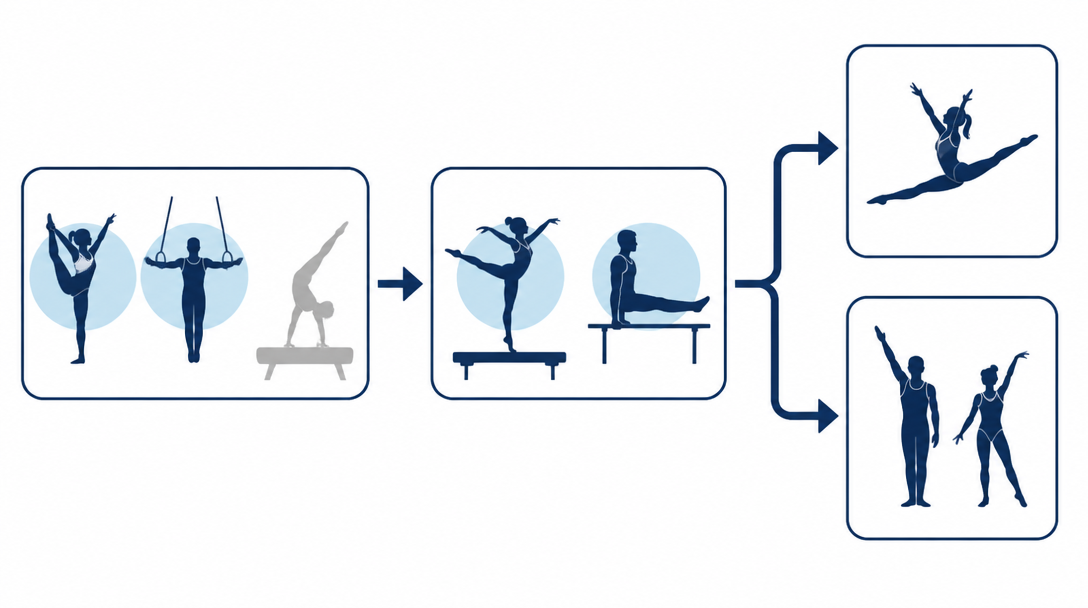
Qualification counts the top two of three; the final counts every routine
Dakar 2026 was the first Youth Olympics to hold men's and women's team events (CGTN). Each team had three gymnasts and no reserves. The FIG Youth Olympic rules use different counting systems in qualification and the final:
- Qualification: up to three gymnasts compete on each apparatus and the best two scores count (3-up, 2-count)
- Team final: the top eight teams advance; two gymnasts compete on each apparatus and both scores count (2-up, 2-count). Qualification scores do not carry over
At the senior World Championships, teams have five members and the final is 3-up, 3-count. In Dakar's 2-up, 2-count final, a single fall goes straight into the team total with nothing to drop. For the basics of team scoring, see how gymnastics team scores are calculated.
Two per country in the all-around final
The top 18 all-around gymnasts from qualification reached the all-around final, with a limit of two per country. Scores restart from zero in the final.
That rule cost Japan's women a finalist. According to The Gymternet, Yume Minamino placed fourth in all-around qualification (52.465), Nanami Togo fifth (52.399) and Kanon Nakashima eighth (51.332), but only Minamino and Togo could advance.
The mixed team: three knockout rounds
The mixed team event paired one man and one woman from each of the top 12 nations, based on qualification scores. As International Gymnast described, in each round the man and the woman each performed on one apparatus, and the field was cut from 12 to 8 to 4 before the medal round.
- Men could choose floor, parallel bars or high bar
- Women could choose uneven bars, balance beam or floor
- No apparatus could be repeated from an earlier round, and a man and a woman from the same nation could not both choose floor
Apparatus selection became part of the strategy, which makes this format unique to the Youth Olympics.
Women's Team Final: Japan Misses Gold by 0.234
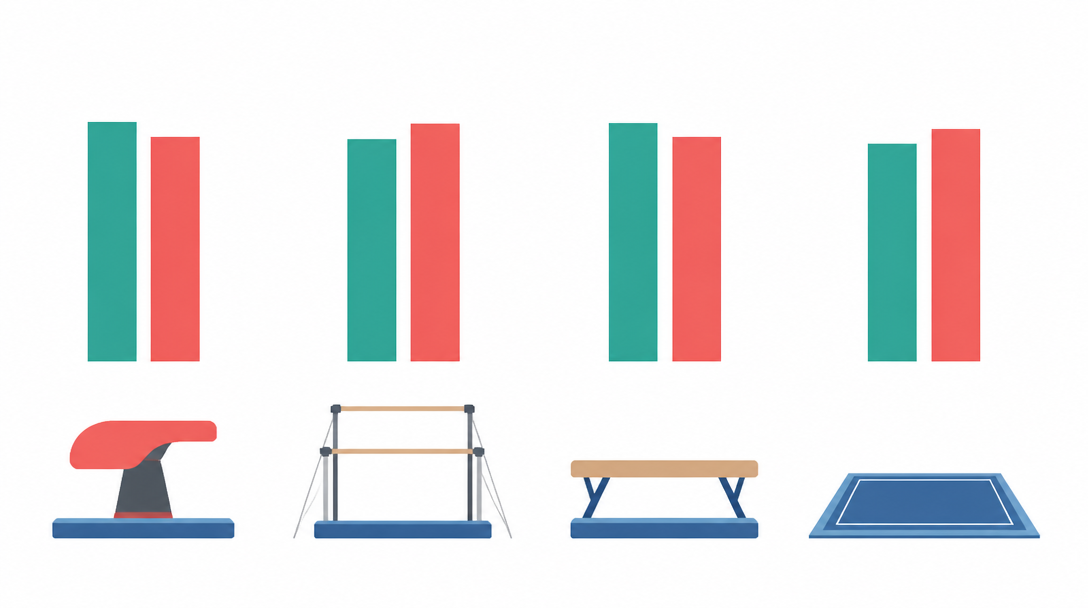
Apparatus-by-apparatus comparison
The women's team final finished China 107.798, Japan 107.564, France 105.231. China had also led qualification, finishing 0.500 ahead of Japan (CGTN). Using The Gymternet's results, here are the team totals on each apparatus:
Apparatus | China | Japan | Gap (Japan − China) |
|---|---|---|---|
Vault | 26.033 | 27.566 | +1.533 |
Uneven bars | 28.366 | 27.566 | −0.800 |
Balance beam | 28.366 | 26.466 | −1.900 |
Floor | 25.033 | 25.966 | +0.933 |
Total | 107.798 | 107.564 | −0.234 |
Japan won vault and floor, lost bars and beam
Japan built a 1.533 lead on vault and a 0.933 lead on floor, 2.466 in total. It gave back 0.800 on bars and 1.900 on beam, 2.700 in total, which leaves the final margin of 0.234.
Beam was the biggest swing. China's Chen Ziyan scored 14.266 and Zhong Qi 14.100, so both counting scores were above 14. Japan's counting scores were Minamino's 13.566 and Nakashima's 12.900. In a format where both routines count, every tenth lost shows up in the total. China's bars and beam totals were identical at 28.366.
Minamino competed all four events for Japan: vault 13.866, bars 13.700, beam 13.566 and floor 12.866. Nakashima took bars (13.866, Japan's best score of the final) and beam, while Togo took vault (13.700) and floor (13.100).
Floor rewarded the more complete performances
China scored only 25.033 on floor, and Japan outscored them by 0.933. Women's floor combines dance elements such as leaps and turns with tumbling, all performed to music, and artistry is judged as part of execution. Whether a gymnast's music and choreography have been developed from the junior years shows up in exactly these moments. For help with competition floor music and routine structure, see custom competition floor music by a former gymnast and artist.
Men's Team Silver and Ikki Nishihara's All-Around Bronze
Men's team: 2.233 behind China
The men's team final finished China 158.463, Japan 156.230, Great Britain 153.763 (International Gymnast). China had also topped qualification with 159.228. According to Xinhua (published by China.org.cn), China had the highest team scores on floor and high bar and tied Japan for the best score on parallel bars. Apparatus-level scores for the men's final were not available at the time of writing, so only the totals are given here.
All-around bronze, 0.067 from silver
Rank | Gymnast | Nation | Score |
|---|---|---|---|
1 | Daniil Smirnov | Russia | 81.298 |
2 | Uzair Chowdhury | Great Britain | 79.132 |
3 | Ikki Nishihara | Japan | 79.065 |
4 | Yang Lanbin | China | 78.465 |
5 | Naoto Shiroiwa | Japan | 76.265 |
6 | Li Lezheng | China | 74.964 |
According to International Gymnast, Nishihara posted the top high bar score of the final, 13.766, and finished just 0.067 behind Chowdhury. Chowdhury led the field on rings (12.900) and parallel bars (14.200), and Smirnov led on pommel horse (13.966). Shiroiwa finished fifth, so both Japanese finalists placed in the top five.
The D-scores Nishihara showed at Junior Asians
In June 2026, Nishihara won four gold medals, including the all-around, at the Junior Asian Championships in Zunyi, China (International Gymnast). The apparatus final results published by the Japan Gymnastics Association show him beating China's Yang Lanbin, the second-best qualifier in the Dakar all-around, on both parallel bars and high bar.
Final (2026 Junior Asians) | Gymnast | D | E | Score | Rank |
|---|---|---|---|---|---|
Parallel bars | Ikki Nishihara | 4.8 | 9.100 | 13.900 | 1 |
Parallel bars | Yang Lanbin | 4.4 | 9.066 | 13.566 (incl. +0.1 bonus) | 2 |
High bar | Ikki Nishihara | 5.1 | 9.000 | 14.100 | 1 |
High bar | Yang Lanbin | 4.7 | 8.833 | 13.533 | 3 |
D is the difficulty score and E is the execution score. Nishihara carried a 5.1 D-score on high bar while still earning a 9.000 E-score, which shows he combines difficulty with clean execution. His 0.600-point margin over Yang in the Dakar all-around is consistent with those strengths.
Curious how a 5.1 high bar routine is built? Try laying out the elements yourself in Gymnastics AI. Pick the skills and the app calculates difficulty values, element group requirements, dismount value and connection bonuses for you.
Junior Rules and the D-Score at the Youth Olympics
Women: anything above E is capped at 0.50
The Youth Olympic rules state that junior modifications are set out in each discipline's 2025–2028 Code of Points (FIG Youth Olympic rules). In the WAG Code of Points 2025–2028, the junior modifications cap any F, G, H, I or J element at a maximum of 0.50. At senior level an F is worth 0.60 and a G 0.70, but for juniors everything above E counts the same as an E.
- Difficulty value: F–J elements are capped at 0.50 (DV restriction)
- Connection value (CV): calculated with the DV restriction applied
- Dismount bonus (+0.20 for a D or higher dismount): not awarded to juniors
- Vault: vaults with double saltos are prohibited
So for junior women, owning one very hard skill doesn't separate gymnasts much. The contest is about how many skills up to E they can fit in, and how cleanly. For the full value scale, see how to read the women's difficulty table.
The "Minamino" on uneven bars
Yume Minamino already has her name in the FIG WAG Code of Points. Her piked Jaeger with a full turn to hang on the high bar was named the "Minamino" (#3.608, F value) after she performed it at the 2025 Junior World Championships in Manila, where she also won the all-around title.
At senior level that skill counts as an F worth 0.60. Under the junior cap it is worth 0.50. At an event like the Youth Olympics, having a big skill adds little, and precision on everything else decides the result. To learn how skills get named after gymnasts, see where gymnastics skill names come from.
Men: some skills are banned for juniors
The MAG Code of Points 2025–2028 also includes junior provisions on each apparatus. For example, juniors may not perform:
- Rings: elements that include a backward salto in hang
- Parallel bars: saltos caught in upper-arm support, including the Japanese-named "Morisue" (double salto backward tucked to upper-arm hang)
For more on Japanese-named skills on parallel bars, see what the Morisue is.
Women's All-Around and Mixed Team Results
Women's all-around: Minamino 5th, Togo 6th
Rank | Gymnast | Nation | VT | UB | BB | FX | Total |
|---|---|---|---|---|---|---|---|
1 | Polina Dmitrieva | Russia | 13.066 | 14.500 | 14.133 | 12.966 | 54.665 |
2 | Louane Plisson | France | 13.333 | 13.666 | 13.833 | 12.833 | 53.665 |
3 | Zhong Qi | China | 12.833 | 14.533 | 14.200 | 11.633 | 53.199 |
5 | Yume Minamino | Japan | 13.333 | 13.700 | 13.766 | 11.800 | 52.599 |
6 | Nanami Togo | Japan | 13.500 | 13.466 | 12.666 | 12.900 | 52.532 |
Source: The Gymternet. Minamino finished 0.600 behind bronze medalist Zhong Qi. She had scored 13.066 on floor in qualification but only 11.800 in the final, a drop of 1.266 on that one event. Togo's 13.500 vault was the best vault score among the Japanese finalists.
Mixed team silver for Minamino and Nishihara
Japan's mixed team paired Ikki Nishihara with Yume Minamino. According to The Gymternet's mixed team results, Japan won the first round with 26.600 and placed second in the second round with 26.333 to reach the medal round. In the final round, China (Chen Ziyan and Yang Lanbin) scored 27.832 and Japan 25.966, giving Japan silver. Israel took bronze with 24.366.
Japan's lineup put its two leaders together: the men's all-around bronze medalist and the reigning junior world all-around champion.
What It Means for Japanese Gymnastics
Matching China on team depth
China won both team golds, but Japan finished 0.234 behind in the women's final and 2.233 behind in the men's, and both Japanese teams finished more than two points clear of third place. A 2-up, 2-count final on every apparatus rewards depth directly, and finishing second in both events shows the strength of Japan's junior generation.
What changes when these gymnasts turn senior
When the women turn senior, F-and-above elements count at full value and the dismount bonus comes back into play. The men gain access to skills that are banned for juniors. Gymnasts like Minamino, who already own an F-value skill, are well positioned to raise their D-scores as soon as they move up.
- Women: with the DV cap lifted, F and above are worth 0.60 or more
- Women: +0.20 dismount bonus for D-value and higher dismounts
- Men: skills such as saltos to upper-arm support become legal
Gymnasts to watch
On the men's side, watch Ikki Nishihara, who already combines strong D and E scores on high bar and parallel bars. On the women's side, watch Yume Minamino with her named skill, Nanami Togo, who scored for the team on vault and floor, and Kanon Nakashima, who posted Japan's best bars score. To compare with how seniors compete, see our analysis of the 2026 Worlds men's team final.
Summary
- At the 2026 Youth Olympics, Japan won silver in the men's, women's and mixed team events, and Ikki Nishihara won bronze in the men's all-around, for four medals in total
- Japan's women lost the team final to China by 0.234: they gained 2.466 on vault and floor but lost 2.700 on bars and beam
- Nishihara finished 0.067 behind silver in the all-around and posted the top high bar score, 13.766
- The team final used a 2-up, 2-count format, so every mistake counted
- For junior women, any element above E is capped at 0.50, which limits the value of big skills like the F-rated "Minamino"
If you'd like to see how a men's routine's D-score changes as you swap elements, give Gymnastics AI a try. It's free on iOS and Android.