Balance Beam Skills List: Difficulty Values, CV and Bonuses
Balance beam skills list with FIG 2025-2028 difficulty values for leaps, turns, saltos and dismounts, plus connection value, series bonus and a D-score example.
This guide is a balance beam skills list with difficulty values, organised according to the FIG (International Gymnastics Federation) Women's Artistic Gymnastics Code of Points 2025–2028. Every skill performed on the 10 cm wide beam falls into one of two families: dance elements such as leaps, jumps and turns, and acro elements such as saltos and back handsprings. Each is rated on a scale from A to J.
Beyond the skills tables, the article explains the parts of the score that decide close beam finals: connection value (CV), the series bonus, composition requirements (CR) and the dismount bonus. Everything is checked against the original Code of Points text, so it works both for fans who want to understand why one routine starts higher than another and for gymnasts and coaches building a routine.
Balance Beam Skills Basics: Apparatus, 90 Seconds and the Eight Counting Skills
The apparatus and the time limit
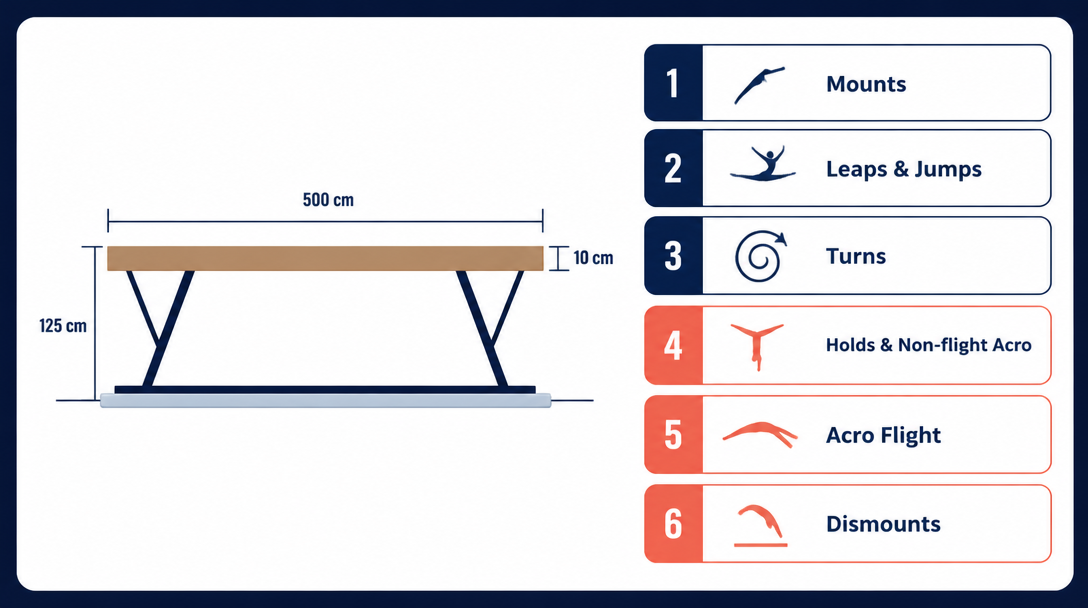
Balance beam is contested only in women's artistic gymnastics. According to the FIG Apparatus Norms, the beam is 500 cm long, its upper surface is 10 cm wide, and that surface sits 125 cm above the floor. On that narrow strip, a gymnast has to fit her leaps, turns and saltos into a routine of no more than 90 seconds.
Section 12 of the FIG Women's Artistic Gymnastics Code of Points 2025–2028 sets the maximum duration at 1:30. A routine that lasts 1:31 or longer receives an overtime deduction. A warning signal sounds ten seconds before the limit and again at 90 seconds; if the dismount lands at the second signal, there is no deduction.
- Length: 500 cm
- Width of the upper surface: 10 cm
- Height: 125 cm (floor to upper surface)
- Time limit: 90 seconds (deduction from 91 seconds)
- Fall interruption: up to 10 seconds (penalty beyond that; the exercise is terminated after 60 seconds)
For beam fundamentals, balance tips and what to watch for as a spectator, see our companion piece, Balance Beam Tips: Skill Types, Highlights and Scoring Basics. This article goes one level deeper into skill values and bonus rules.
Dance elements and acro elements
The Code's Table of Elements divides beam skills into six groups. A useful detail: in each element number, the digit before the decimal point is the group and the first digit after the decimal point is the difficulty (1 = A, 2 = B, 3 = C and so on). For example, element 5.312 is a group 5 (acrobatic flight) skill rated C.
Group | Content | Type |
|---|---|---|
1.000 | Mounts | Dance or acro, depending on the skill |
2.000 | Leaps, jumps and hops | Dance |
3.000 | Turns (pirouettes) | Dance |
4.000 | Holds and non-flight acro | Acro |
5.000 | Acro with flight (saltos, flic-flacs and more) | Acro |
6.000 | Dismounts | Acro |
Mounts marked "(D)" in the table count as dance elements. The dance/acro split matters because it controls both the make-up of the eight counting skills and the connection bonuses described later.
Up to eight skills count (at least three dance and three acro)
The beam D-score (difficulty score) adds up the difficulty values of the eight highest-valued skills, including the dismount, plus composition requirements, connection value and bonuses. Under Section 12.2, those eight must contain at least three dance and at least three acro elements; the remaining two are optional.
Value | A | B | C | D | E | F | G | H | I | J |
|---|---|---|---|---|---|---|---|---|---|---|
Points | 0.10 | 0.20 | 0.30 | 0.40 | 0.50 | 0.60 | 0.70 | 0.80 | 0.90 | 1.00 |
The letter-to-points scale is the same on all four women's events. For a full walkthrough of how to read the difficulty table, see How to Read the Women's Gymnastics Difficulty Table.
Beam has no music, but the same gymnasts perform floor to music. If you need help choosing, editing or composing a floor routine track, former gymnast and artist Daito Iwasaki offers custom floor music production for competitive gymnasts.
Balance Beam Skills List: Dance Elements (Leaps, Jumps and Turns)
Common leaps and jumps and their values
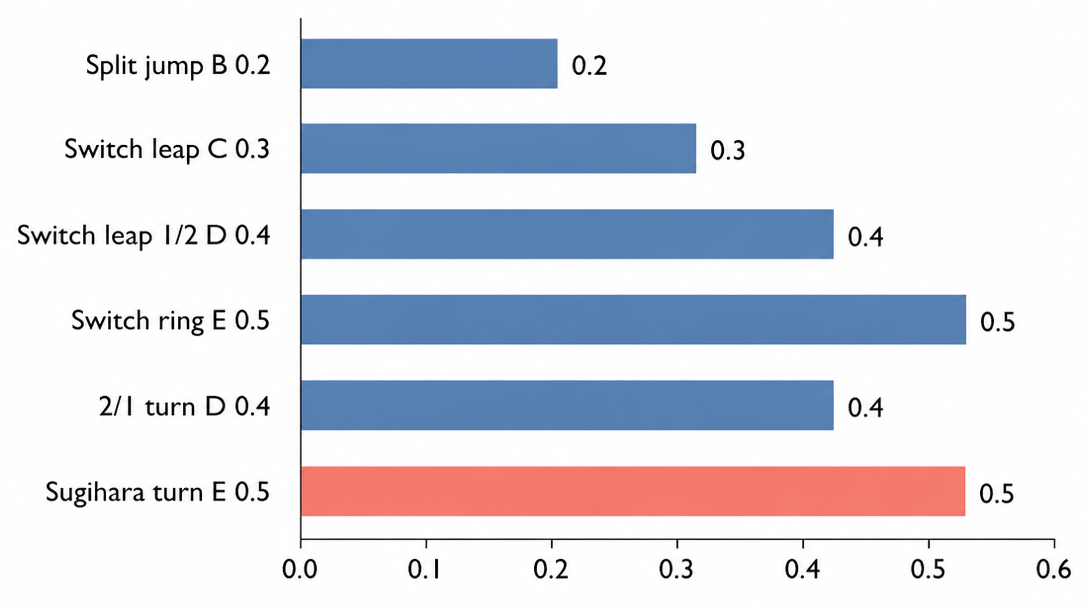
The backbone of beam dance work is the 180° split. On beam, a jump performed in side position is credited one value higher than the same jump in cross position (Section 7.2.1). The values below are for cross position.
Skill | Number | Value |
|---|---|---|
Split jump | 2.202 | B (0.20) |
Split jump with ½ turn | 2.302 | C (0.30) |
Split jump with 1/1 turn | 2.402 | D (0.40) |
Straddle pike jump | 2.203 | B (0.20) |
Straddle pike jump with 1/1 turn | 2.403 | D (0.40) |
Switch leap | 2.305 | C (0.30) |
Switch leap with ½ turn | 2.405 | D (0.40) |
Switch leap to ring position (switch ring) | 2.505 | E (0.50) |
Tour jeté (fouetté hop with leg change to cross split) | 2.404 | D (0.40) |
Wolf jump with 1/1 turn | 2.412 | D (0.40) |
Adding a turn or changing the shape to a ring raises the value. For split, straddle and ring elements, turning leaps and jumps on beam are credited in 180° increments (Section 8.2.2), so each extra half turn can move the skill up a letter.
Common turns and their values
Turns are performed on the toes of one foot, and on beam they are credited in 180° increments. A turn that is not completed is credited as a different, lower-valued element.
Skill | Number | Value |
|---|---|---|
1/1 turn on one leg (free leg below horizontal) | 3.101 | A (0.10) |
1½ turn on one leg | 3.201 | B (0.20) |
2/1 turn on one leg | 3.401 | D (0.40) |
3/1 turn on one leg (Okino) | 3.501 | E (0.50) |
1/1 turn with free leg held upward in 180° split | 3.305 | C (0.30) |
Same, 1½ turn (Galante) | 3.405 | D (0.40) |
Same, 2/1 turn (Sugihara) | 3.505 | E (0.50) |
2/1 or 2½ turn in tuck stand (Humphrey) | 3.407 | D (0.40) |
3/1 turn in tuck stand (Mitchell) | 3.507 | E (0.50) |
The "Sugihara" is named after Japan's Aiko Sugihara. According to a December 2017 report from the Asian Gymnastics Union, the FIG recognised her new element at the same time as Hidetaka Miyachi's high bar skill. Her Wikipedia profile also lists it as an E-rated beam turn. To learn how a skill gets named after a gymnast, read How Gymnastics Skills Get Their Names.
Recognition rules to keep in mind for dance elements
Small changes in shape can lower a dance element's value or make the judges treat it as the same skill. The key points in Section 7.2.1 are:
- Different dance elements in the same numbered box receive value only once
- Only one turn in tuck stand on one leg receives value per routine
- Split and straddle leaps and jumps are recognised up to 1½ turns (540°); complex jumps and leaps up to 1/1 turn (360°)
- Take-off from one or both feet does not create a different element if the leg position is the same
- A jump in side position is worth one value more than in cross position (performing both still earns value only once)
To score more with dance elements, a gymnast has to choose skills with different numbers, add turns or ring shapes, and use side-position jumps. For a comparison with floor, see Women's Floor Leaps, Jumps and Turns Explained.
Balance Beam Skills List: Acro Elements (Saltos and Flic-Flacs)
Acro with hand support (round-off and flic-flac)
The foundation of beam acro is the hand-supported skill. The flic-flac (back handspring) and the round-off are both B elements, and almost every gymnast uses them to build momentum into a salto.
Skill | Number | Value |
|---|---|---|
Flic-flac landing on both feet | 5.202 | B (0.20) |
Flic-flac with step-out | 5.204 | B (0.20) |
Round-off | 5.208 | B (0.20) |
Handspring forward | 5.201 | B (0.20) |
Flic-flac with 1/1 twist to cross straddle sit (Rulfova) | 5.407 | D (0.40) |
Section 12.4 makes a special exception for five B skills: flic-flac with legs together, flic-flac with step-out, gainer flic-flac, round-off and handspring forward. These may be performed a second time in the routine to earn CV and the series bonus, but the repeat cannot be used to fulfil a composition requirement.
Saltos backward, forward and sideways
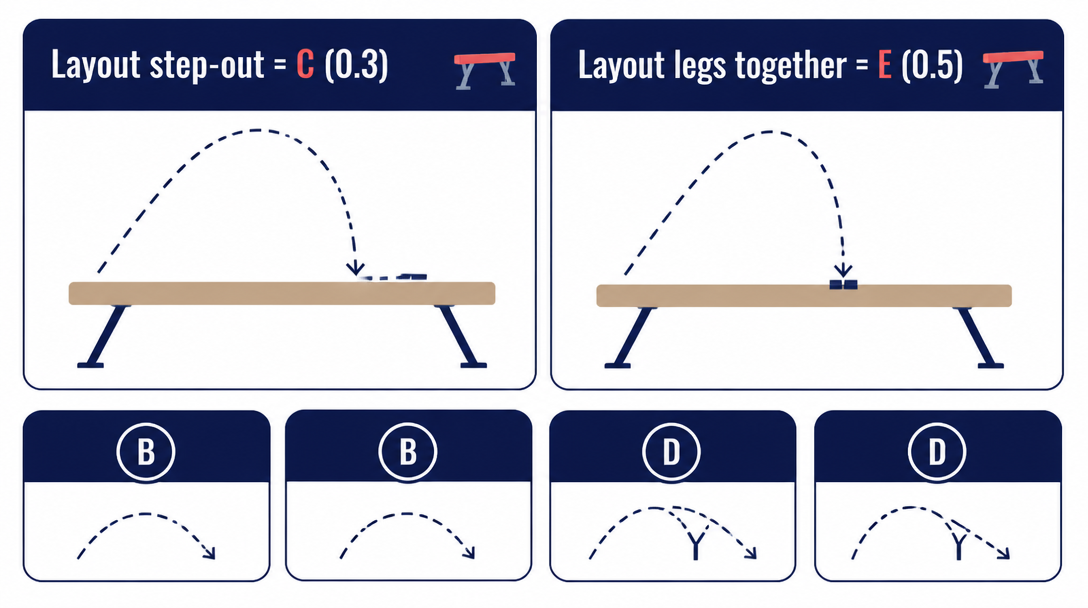
Most of the big skills on beam are saltos without hand support. The landing makes a huge difference: a layout performed with a step-out is rated C, while the same layout landed with legs together is rated E.
Skill | Number | Value |
|---|---|---|
Salto backward tucked, piked or stretched (step-out) | 5.312 | C (0.30) |
Salto backward stretched with legs together | 5.512 | E (0.50) |
Salto backward tucked with 1/1 twist (Shishova) | 5.612 | F (0.60) |
Salto forward tucked, take-off from one leg (Liukin) | 5.310 | C (0.30) |
Salto forward tucked to cross stand | 5.410 | D (0.40) |
Free (aerial) cartwheel | 5.408 | D (0.40) |
Free (aerial) walkover forward | 5.409 | D (0.40) |
Arabian salto tucked (Lobaznyuk) | 5.611 | F (0.60) |
Body position also defines the element. Stretched, piked and tucked saltos are different skills, and judges credit the position actually shown. If the hips bend during a layout, it is credited as a piked salto, so the same intended skill can earn a different value depending on execution (Section 8.1.1).
How mounts are treated
The routine begins the moment the gymnast leaves the springboard or mat. Mounts appear in the Table of Elements, and a mount with a difficulty value can be one of the eight counting skills. If the gymnast touches the springboard or the beam on her first attempt, she must start her routine and the mount receives no value.
- Only one acro element may precede the mount
- Skills listed both as mounts and as elements (rolls, handstands, holds) receive value only once
- Handstands and holds must be held for 2 seconds, or they are credited one value lower or not at all
Mounts often fall outside the top eight, but salto mounts, such as a round-off into a salto onto the beam, carry high values and are a showcase for elite gymnasts.
Balance Beam Dismounts List and Difficulty Values
Common dismounts and their values
The dismount is a salto off the end of the beam, and it is judged through to the landing. The table below lists representative skills from group 6.000.
Dismount | Number | Value |
|---|---|---|
Salto backward tucked, piked or stretched | 6.104 | A (0.10) |
Salto backward with 1/1 twist | 6.204 | B (0.20) |
Salto backward with 1½ twist / 2/1 twist (Domingues / Mordenti) | 6.304 | C (0.30) |
Salto backward stretched with 2½ twist | 6.404 | D (0.40) |
Salto backward stretched with 3/1 twist | 6.604 | F (0.60) |
Double salto backward tucked | 6.405 | D (0.40) |
Double salto backward piked | 6.505 | E (0.50) |
Double salto backward tucked or piked with 1/1 twist | 6.705 | G (0.70) |
Double salto backward tucked with 2/1 twist (Biles) | 6.805 | H (0.80) |
The highest-rated beam dismount on this list is the H-rated "Biles", named after Simone Biles of the United States. Her Wikipedia profile lists it as an H-value beam dismount: a double-twisting double tucked salto.
The 0.20 dismount bonus for D and above
Under Section 7.4.3, on uneven bars, beam and floor a dismount rated D or higher and performed without a fall earns a 0.20 bonus. On beam, the double tuck and the stretched salto with 2½ twists sit right on that threshold.
- Dismount rated D or higher, no fall: bonus 0.20
- Dismount rated C or lower: no bonus (difficulty value only)
- Fall on the dismount: no bonus
A double twist (C) and a 2½ twist (D) differ by only 0.10 in difficulty value, but with the bonus the gap becomes 0.30. That is why upgrading the dismount to D is so valuable.
What happens when the dismount fails
Section 12.6 spells out how failed dismounts are handled. The outcome depends on whether the salto had already started.
- Fall before the salto begins: no value (only seven skills count), a "no dismount" penalty and a fall deduction from the E-panel
- Salto begun but not landed feet first: no value (only seven skills count) and a fall deduction from the E-panel
- Landing feet first and then falling: the difficulty value is still awarded (Section 8.1.3)
For the size of fall and landing deductions, see Women's Gymnastics Deductions: Falls, Landings and Out of Bounds.
Balance Beam Composition Requirements (CR): Four Requirements Worth Up to 2.00
The four composition requirements
Composition requirements are the types of skill every routine must include. Beam has four, each worth 0.50, for a maximum of 2.00 added to the D-score (Section 12.3).
No. | Requirement | Value |
|---|---|---|
CR1 | A connection of at least two different dance elements, one of them a leap or jump with a 180° split (cross or side) or straddle position | 0.50 |
CR2 | A turn (group 3), or one of the listed rolls or flairs | 0.50 |
CR3 | One acro series of at least two flight elements, one of them a salto (the elements may be the same) | 0.50 |
CR4 | Acro elements in different directions (forward/sideward and backward) | 0.50 |
The Wikipedia article on the balance beam summarises the same four requirements: a dance connection, a turn, an acro series and acro elements in different directions.
Common CR mistakes
A requirement the gymnast believes she has met is not always credited. The most important notes in the Code are:
- CR1 to CR4 must be performed on the beam (mounts and dismounts do not fulfil them)
- Handstands and holds cannot fulfil a CR
- One element may fulfil more than one CR, but an element may not be repeated to fulfil another CR
- Only elements from the Table of Elements can fulfil a CR
For example, a flic-flac into a layout step-out is an acro series of two flight elements with one salto, so it meets CR3 and also covers the backward half of CR4. To finish CR4, gymnasts often add a forward or sideward skill such as an aerial cartwheel or an aerial walkover.
FIG newsletter clarifications and junior rules
Besides the Code itself, the FIG publishes interpretations in newsletters. The February 2026 Women's Technical Committee newsletter stated that, in the junior "Youth Competition Programme", beam CR2 cannot be fulfilled by a roll or flair, and that only the bonuses listed in that programme can be awarded, not the CV in the Code. These are separate from the senior Code (where certain rolls and flairs can fulfil CR2), so always check which rules a competition uses.
For Japanese domestic competitions, the Japan Gymnastics Association rules page publishes the latest notices on rules and their application.
Balance Beam Connection Value (CV) and Series Bonus
What counts as a direct connection
On beam, connection value is awarded for direct connections, meaning skills linked without interruption. Section 7.4.1 says a connection is not direct if any of the following happens:
- A stop between elements
- An extra step between elements
- A foot touching the beam between elements
- A lack of balance between elements
- An obvious leg or hip extension after the first element, before the take-off for the second
- Additional or excessive arm swing
Elements used for CV do not have to be among the eight counting skills (Section 7.4). A connection that includes a fall earns neither CV nor the series bonus, and grasping the beam also cancels both.
Acro connection values
To earn CV in an acro connection, two flight elements must be linked with a rebound: the gymnast lands from the first skill and immediately uses the spring of the beam to take off into the second. Mounts can be included, but dismounts cannot.
CV | Combinations (acro flight elements) |
|---|---|
0.10 | C+C / B+D (travelling backward, in this order only) / B+E |
0.20 | C/D + D or more / B+D (both elements forward) / B+F |
For example, a flic-flac (B) rebounded into a layout with legs together (E) is B+E and earns 0.10. A flic-flac (B) into a layout step-out (C), however, is B+C and earns no CV. The same salto changes value with its landing, and that in turn decides whether the connection pays, which is one of the most interesting details of beam scoring.
Dance and mixed connection values
Dance-to-dance connections, and "mixed" connections of dance elements with acro flight elements, also earn CV (dismounts excluded).
CV | Combinations (dance / mixed) |
|---|---|
0.10 | C+C or more (dance) / A+C (turns only) / B+D (mixed) |
0.20 | D+D or more |
A switch leap (C) into a split jump with ½ turn (C) earns 0.10 and meets CR1 at the same time. A switch ring (E) into a split jump with 1/1 turn (D) is "D+D or more" and earns 0.20. When connecting turns, the gymnast must step into the next turn on the opposite leg; a demi-plié on one or both feet is not permitted.
Connections are rewarded only when they flow. Section 12.5 deducts for insufficient variation in rhythm and tempo and for disconnected elements. On floor, where the routine is set to music, linking skills to accents in the music matters just as much. If you want a floor track edited or composed around a routine, you can consult a custom floor music service built around the Code of Points.
The series bonus (0.10)
When three or more elements are connected, a series bonus (SB) of 0.10 may be added on top of CV. The condition is a series of B+B+C or more, in any order, and it can be a dance/mixed series or an acro series. Acro series qualify whether or not they are rebounding.
- Example: flic-flac (B) + flic-flac (B) + layout step-out (C) earns SB 0.10
- Non-flight acro elements rated B or higher may be used (except holds)
- The same acro element may be repeated within one connection
- Mounts and dismounts (minimum C) may be included
Putting two flic-flacs before the salto earns the series bonus and builds momentum at the same time. In a connection of three or more elements, the second element may be used once as the last element of one connection and again as the first element of a new one (Section 7.4f).
Balance Beam D-Score Example: Building a Score from the Skills List
Example: a basic routine with a 5.00 D-score
Using the skills lists and rules above, here is a D-score calculation. The routine is hypothetical, for illustration only.
# | Skill | Type | Value | Note |
|---|---|---|---|---|
1 | Switch leap | Dance | C 0.30 | Connected to 2: CV 0.10, CR1 |
2 | Split jump with ½ turn | Dance | C 0.30 | |
3 | 2/1 turn on one leg | Dance | D 0.40 | CR2 |
4 | Flic-flac | Acro | B 0.20 | Series with 5: CR3 |
5 | Layout step-out | Acro | C 0.30 | Backward |
6 | Aerial walkover forward | Acro | D 0.40 | Forward: CR4 |
7 | Straddle pike jump with 1/1 turn | Dance | D 0.40 | |
8 | Double tuck (dismount) | Acro | D 0.40 | Dismount bonus 0.20 |
The calculation:
- Difficulty values (eight skills): 0.30 + 0.30 + 0.40 + 0.20 + 0.30 + 0.40 + 0.40 + 0.40 = 2.70
- Composition requirements: all four met = 2.00
- Connection value: switch leap + split jump ½ (C+C) = 0.10
- Dismount bonus: D-rated dismount = 0.20
- D-score: 2.70 + 2.00 + 0.10 + 0.20 = 5.00
How changing a connection changes the score
Now keep everything the same but change the acro series in skills 4 and 5 to flic-flac (B) + layout with legs together (E). The salto rises from C to E, adding 0.20 in difficulty, and the rebounding B+E connection adds 0.10 CV. That is 0.30 more, for a D-score of 5.30.
Add one more flic-flac in front to make B+B+E and the series meets the "B+B+C or more" condition, adding a 0.10 series bonus for 5.40. On beam, changing how skills are linked can be worth 0.10 to 0.30, not just upgrading a single skill. That is why elite gymnasts stack connections on beam.
- Salto upgraded from C to E: +0.20 difficulty
- Rebounding B+E connection: +0.10 CV
- Extra flic-flac for B+B+E: +0.10 SB
- Dismount upgraded from C to D: +0.10 difficulty and +0.20 bonus
Beam-specific execution deductions
A high D-score can be lost through execution, scored by the E-panel as deductions from 10.00. Section 12.6 lists these beam-specific deductions:
- Poor rhythm in a connection (with difficulty value): 0.10
- Pause of 2 seconds or more: 0.10
- Additional support of the leg against the side of the beam: 0.30
- Grasping the beam to avoid a fall: 0.50
- Additional movements to maintain balance: 0.10 / 0.30 / 0.50
USA Gymnastics' Gymnastics 101 guide to women's scoring explains the same structure: the difficulty score includes skill values, connection value and composition requirements, while the execution score includes artistry on beam and floor. Balancing a strong D-score with clean execution is what wins on beam.
Summary
This article covered the balance beam skills list, difficulty values and connection bonuses according to the FIG Women's Code of Points 2025–2028.
- Beam skills split into dance elements (leaps, jumps, turns) and acro elements (saltos, flic-flacs and more), rated from A (0.10) to J (1.00)
- The D-score is the top eight skills including the dismount (at least three dance and three acro) plus composition requirements (up to 2.00), CV and bonuses
- Acro CV requires a rebounding direct connection: 0.10 for combinations such as B+E or C+C, 0.20 for D+D or more and similar
- A series of B+B+C or more earns a 0.10 series bonus, and a dismount rated D or higher earns a 0.20 bonus
- The same salto can change value and CV depending on its landing (step-out or legs together)
The sense of rhythm and tempo built on beam carries over to floor, where it meets the music. If you would like to discuss choosing, editing or composing a floor routine track, visit our competitive floor music production page.