2026 Worlds Men's Apparatus Finals: How Oka Won High Bar Silver
A D/E-score breakdown of the 2026 Worlds men's apparatus finals: the tie-break behind Oka's high bar silver and why Japan finished fourth four times.

As of October 27, 2026. Scores are taken from the official FIG/Longines data published on Gym Art's 2026 Worlds results. Live results provided by Gym Art (gymart.org), the gymnastics scoring and results platform.
The men's apparatus finals at the 2026 World Artistic Gymnastics Championships in Rotterdam were held on October 24 and 25. Japan's Shinnosuke Oka won silver on high bar with 14.800 — Japan's only men's apparatus medal of these Worlds — while the team collected four fourth places: Ryosuke Doi on floor, Oka on rings, Daiki Hashimoto on parallel bars and Shohei Kawakami on high bar. This analysis, written from the perspective of a former Japanese gymnast and the developer of a D-score calculator, splits every final into difficulty (D) and execution (E). It explains the tie-break that gave Oka silver, exactly where each fourth place lost the bronze, and what changed between qualification and the finals.
2026 Worlds Men's Apparatus Finals Results: All Six Podiums
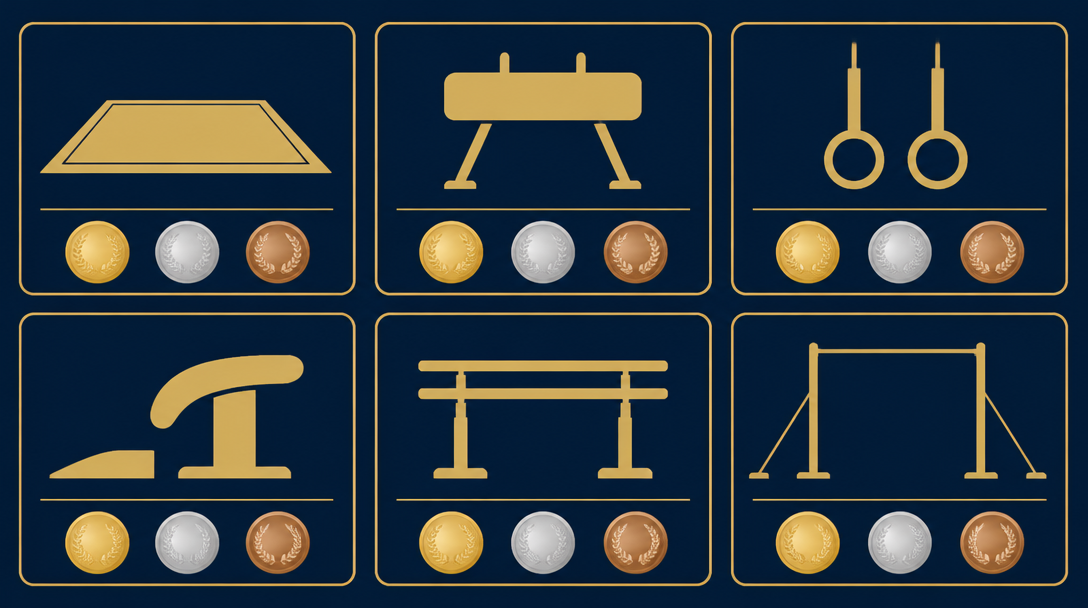
Gold, silver and bronze with D-scores
Day one (October 24) featured floor, pommel horse and rings; day two (October 25) featured vault, parallel bars and high bar. The top eight from qualification advanced to each final, with a limit of two gymnasts per country. Here are the medalists (scores from Gym Art's apparatus final results; vault scores are the average of two vaults).
Apparatus | Gold | Silver | Bronze |
|---|---|---|---|
Floor | Frederick Richard (USA) 14.633 (D5.7) | Jake Jarman (GBR) 14.600 (D6.3) | Artem Dolgopyat (ISR) 14.466 (D5.8) |
Pommel horse | Hamlet Manukyan (ARM) 15.300 (D5.9) | Gabriele Targhetta (ITA) 15.233 (D5.9) | Mamikon Khachatryan (ARM) 15.000 (D5.8) |
Rings | Lan Xingyu (CHN) 14.766 (D6.0) | Eleftherios Petrounias (GRE) 14.333 (D5.7) | Artur Avetisyan (ARM) 14.233 (D5.4) |
Vault | Artur Davtyan (ARM) 14.850 | Jake Jarman (GBR) 14.650 | Sebastian Sponevik (NOR) 14.366 |
Parallel bars | Zou Jingyuan (CHN) 15.733 (D6.0) | Illia Kovtun (CRO) 14.900 (D6.0) | Daniel Marinov (neutral) 14.866 (D5.9) |
High bar | Tang Chia-Hung (TPE) 14.966 (D6.6) | Shinnosuke Oka (JPN) 14.800 (D5.8) | Sergei Naidin (neutral) 14.800 (D6.4) |
Gymnasts listed under "WG1" or "WG2" in the results competed as neutral athletes rather than representing a national federation. They are labeled "neutral" in this article.
Japan: one silver and four fourth places
Japan reached all six men's finals and performed eight routines in total. The only medal was Oka's high bar silver, but Japan finished fourth four times — and two of those were just 0.1 away from bronze. Jiji Press noted that the silver was Oka's first individual-apparatus podium at a World Championships.
- Silver: Shinnosuke Oka (high bar) 14.800
- 4th: Ryosuke Doi (floor) 14.366, Shinnosuke Oka (rings) 14.133, Daiki Hashimoto (parallel bars) 14.600, Shohei Kawakami (high bar) 14.600
- 5th: Shinnosuke Oka (parallel bars) 14.566
- 8th: Daiki Hashimoto (pommel horse) 13.466, Shohei Kawakami (vault) 13.333
For the earlier part of the championships, see our breakdowns of the men's team final and Daiki Hashimoto's fourth straight all-around title. If you want to check how many D-score points a routine is worth, Gymnastics AI — D-Score Calculator makes it easy. It follows the FIG 2025–2028 Code of Points and lets you pick from more than 790 skills to calculate difficulty automatically.
2026 Worlds High Bar Final: How Execution Decided Oka's Silver
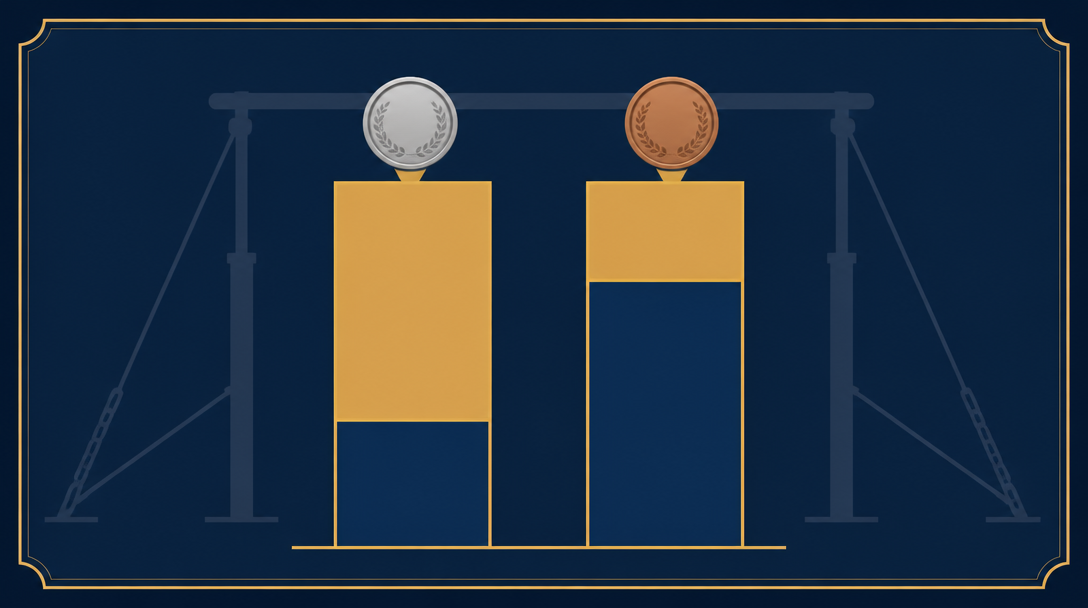
Tang Chia-Hung wins his first world title with a 6.6 D-score
Tang Chia-Hung of Chinese Taipei won the high bar final with 14.966. Gymnastics Now's event final recap describes it as his first world title. Tang qualified second with D6.0 and 14.566, then raised his difficulty to D6.6 in the final and executed for 8.366. No other high bar finalist raised his D-score by 0.6 between qualification and the final.
Breaking down the 0.166 gap between Tang and Oka:
- D-score: Tang 6.6 − Oka 5.8 = Tang +0.8
- E-score: Tang 8.366 − Oka 8.900 = Oka +0.534
- Bonus: Oka +0.1 (Tang 0)
Oka won back 0.634 through execution and the landing bonus, but it was not enough to close a 0.8 difficulty gap. For more on how release combinations build the D-score on high bar, see our guide to famous men's gymnastics skills on all six apparatus.
The tie-break behind the two 14.800s
Oka and neutral athlete Sergei Naidin both scored 14.800, but their scores were built in opposite ways.
Gymnast | D | E | Bonus | Final score |
|---|---|---|---|---|
Shinnosuke Oka | 5.8 | 8.900 | 0.1 | 14.800 |
Sergei Naidin | 6.4 | 8.400 | — | 14.800 |
Under the FIG 2026 Technical Regulations (Section 2, Art. 7.2.3), when final scores are tied in an apparatus final on any apparatus except vault, the gymnast with the higher E-score ranks higher; if still tied, the higher D-score prevails. Oka's E-score was 8.900 against Naidin's 8.400, so Oka took silver. International Gymnast also reported that Oka won the silver on execution.
Oka's 0.1 bonus is the stick bonus defined in the FIG Men's Code of Points 2025–2028: when a gymnast sticks the landing of a dismount of at least C value, the D-jury adds 0.1 (pommel horse excluded). That single tenth is what created the tie in the first place.
Kawakami: first in qualification, fourth in the final (D6.3 to 5.9)
Shohei Kawakami topped high bar qualification with D6.3 and 14.600, but his final routine was valued at D5.9. His E-score rose from 8.300 to 8.600 and he added a stick bonus, so his final score was 14.600 — identical to qualification. He finished 0.2 behind bronze. On paper, his qualification D-score combined with his final E-score would have been enough for a medal, although in practice a harder routine often costs execution, so this is only a breakdown, not a prediction.
Oka used D5.8 in both rounds. He went from 14.500 in qualification to 14.800 in the final through +0.2 in execution and +0.1 in bonus, moving from third to second.
Parallel Bars and Vault: Zou's Fifth Title and Japan's Results
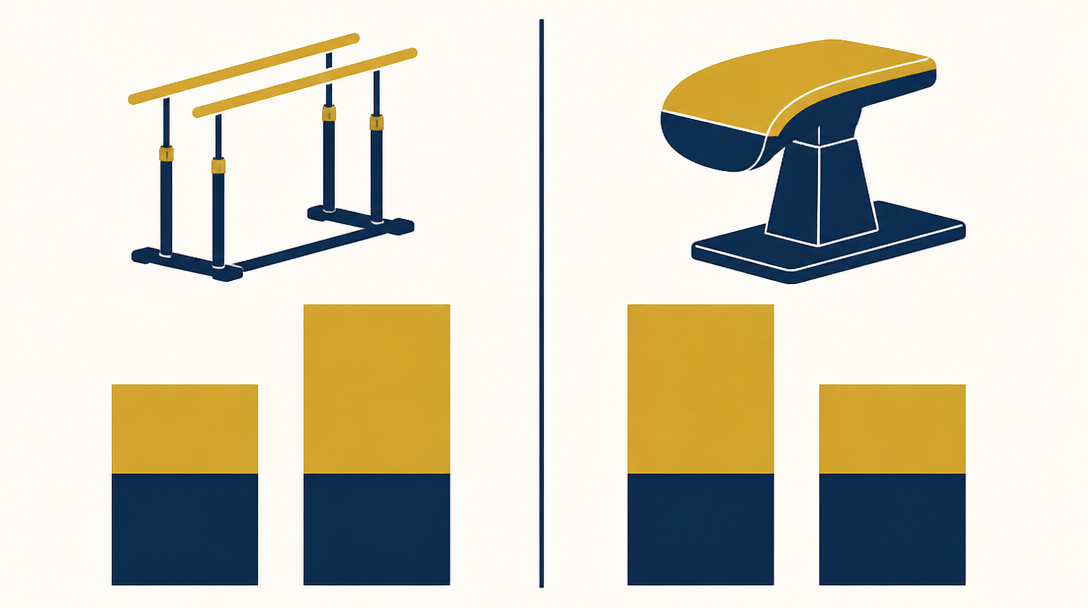
Zou matched Kovtun's 6.0 D-score and won by 0.733 in execution
China's Zou Jingyuan won parallel bars with 15.733. According to CGTN, it was his fifth world title on the event.
Zou and runner-up Illia Kovtun of Croatia had the same D-score of 6.0. The 0.833 margin came from execution (9.633 vs 8.900, a difference of 0.733) and a 0.1 stick bonus. In qualification Zou had D5.8 and E9.566, so in the final he raised both his difficulty and his execution.
Hashimoto 4th, Oka 5th, 0.266 short of bronze
Japan placed three gymnasts in the top four in qualification, but only two per country may enter a final, so Oka and Hashimoto competed.
Gymnast | Qualification (D / E / score) | Final (D / E / score) | Final rank |
|---|---|---|---|
Daiki Hashimoto | 5.6 / 9.100 / 14.800 | 5.6 / 8.900 / 14.600 | 4th |
Shinnosuke Oka | 5.6 / 9.166 / 14.866 | 5.6 / 8.966 / 14.566 | 5th |
(Ref.) Marinov — bronze | 5.9 / 8.800 / 14.700 | 5.9 / 8.966 / 14.866 | 3rd |
Both Japanese gymnasts kept the same D5.6 and lost 0.2 in execution. Because bronze medalist Marinov's routine was worth 0.3 more in difficulty, even Hashimoto's qualification execution would have produced 14.800 — still 0.066 short of bronze. Our guide to parallel bars skills, difficulty values and connections explains how gymnasts build difficulty on this apparatus.
Kawakami 8th on vault
Kawakami qualified fifth on vault (14.283) but scored 13.333 for eighth in the final. His first vault was D5.2 / E8.000 for 13.200; his second was D5.2 / E8.566 with a −0.3 neutral deduction (ND, a penalty for violations such as stepping out of the landing area or attire) for 13.466. Champion Artur Davtyan of Armenia also performed two vaults valued at 5.2 and received E-scores of 9.500 and 9.600. With identical difficulty, the execution gap translated directly into the ranking.
Day One — Floor, Pommel Horse and Rings: Fourth by a Tenth
Doi on floor: the 0.1 gap to bronze equals his ND
On floor, Frederick Richard of the USA won with 14.633. According to NBC Sports, he is the first American man to win a world floor title since 2003. He beat Jake Jarman by 0.033: Jarman's routine was worth 0.6 more in difficulty, but Richard was 0.533 higher in execution and earned a 0.1 stick bonus.
Here is how Ryosuke Doi (4th, 14.366) compared with bronze medalist Artem Dolgopyat (14.466):
- D-score: both 5.8 (no difference)
- E-score: Doi 8.566, Dolgopyat 8.666 (Doi −0.1)
- Bonus: Doi +0.1
- ND: Doi −0.1
The bonus and the neutral deduction cancelled each other out, leaving only the 0.1 execution gap. Compared with qualification (D5.7, 14.033, tied 7th), Doi raised his difficulty by 0.1 and his execution by 0.333. Japanese broadcaster NHK also reported that Doi and Oka (rings) both finished just off the podium in fourth.
Oka on rings: the best E-score in the final, but 0.3 down in D
China's Lan Xingyu won rings with D6.0 and 14.766. Oka finished fourth with 14.133, 0.1 behind bronze medalist Artur Avetisyan (14.233). Oka's E-score of 8.933 was the highest of all eight finalists and he added a stick bonus, but his routine was valued at D5.1 compared with Avetisyan's 5.4.
On rings, difficulty comes from combining strength holds, swing elements and the dismount. Winning back 0.1 in execution and 0.1 in bonus was not enough to cover a 0.3 difficulty deficit.
Hashimoto on pommel horse: D-score down 0.9 from qualification
Armenia's Hamlet Manukyan won pommel horse with 15.300. International Gymnast reported that he went last and delivered to edge Italy's Gabriele Targhetta. Hashimoto, who qualified eighth, scored 13.466 for eighth place. His routine was valued at D5.7 in qualification but D4.8 in the final — 0.9 lower — and his E-score dropped from 8.833 to 8.666. He finished 1.534 behind bronze (15.000). Pommel horse has no stick bonus, which makes it the hardest event on which to make up a difficulty deficit elsewhere.
If you want to see how swapping a single element changes a pommel horse or rings D-score, try Gymnastics AI. Just select and order the skills, and it calculates difficulty values, element group requirements and the dismount value automatically.
2026 Worlds Japan Men's Team Members: Apparatus Final Results
Results for all five team members
Japan's men's team at the 2026 Worlds consisted of Daiki Hashimoto, Shinnosuke Oka, Shohei Kawakami, Ryosuke Doi and Fusuke Maeda. Japan won the team gold, Hashimoto won his fourth straight all-around title and Oka finished eighth in the all-around (Kumamoto Nichinichi Shimbun, Kyodo News). Here is how each of them did in the apparatus finals.
Gymnast | Apparatus finals | Other key results |
|---|---|---|
Daiki Hashimoto | Parallel bars 4th (14.600), pommel horse 8th (13.466) | Team gold, all-around champion (4th straight) |
Shinnosuke Oka | High bar silver (14.800), rings 4th (14.133), parallel bars 5th (14.566) | Team gold, all-around 8th |
Shohei Kawakami | High bar 4th (14.600), vault 8th (13.333) | Team gold, 1st in high bar qualification |
Ryosuke Doi | Floor 4th (14.366) | Team gold |
Fusuke Maeda | Did not reach a final (22nd in high bar qualification, D6.3) | Team gold |
Maeda posted the same D6.3 as Kawakami in high bar qualification, but an E-score of 7.266 left him 22nd with 13.566 — a clear example of why difficulty only pays when it is executed. Our pre-competition outlook is in the men's apparatus finals preview, and qualification is covered in our men's qualification analysis.
Four fourth places, 0.666 points in total
Here is the breakdown of the gap to bronze in each of Japan's four fourth-place finishes.
Event / gymnast | Gap to bronze | D gap | E gap | Bonus / ND |
|---|---|---|---|---|
Floor — Doi | −0.100 | 0 | −0.100 | +0.1 / −0.1 |
Rings — Oka | −0.100 | −0.3 | +0.100 | +0.1 |
Parallel bars — Hashimoto | −0.266 | −0.3 | −0.066 | +0.1 |
High bar — Kawakami | −0.200 | −0.5 | +0.200 | +0.1 |
In three of the four events, the Japanese gymnast was 0.3 to 0.5 behind in difficulty and won part of it back through execution or bonus. The four gaps add up to 0.666. Japan clearly had the execution to compete, but on the apparatus podiums in Rotterdam, the difficulty gap remained.
Reading the D-Score in the Apparatus Finals — and What Comes Next
Japan's pattern: behind on D, catching up on E
In these finals, no Japanese gymnast won a medal by out-scoring a rival on difficulty. Even Oka's silver came from beating the D6.4 of Naidin on execution. Many of the medalists, by contrast, held or raised their difficulty in the final (Tang +0.6 on high bar, Zou +0.2 on parallel bars).
- Apparatus finalists perform only one routine, so many bring their highest-difficulty versions
- When scores are tied, the higher E-score ranks higher, so execution can be the final decider
- The largest execution margin a Japanese gymnast gained here was 0.534 (Oka vs Tang on high bar). A 0.8 D gap could not be closed; a 0.6 gap (Oka vs Naidin) was closed to a tie with the help of the stick bonus
What to watch next
Japan delivered in the team and all-around competitions and finished in the top five in six of its eight apparatus final routines. At upcoming international events, a key question is whether gymnasts can bring the difficulty they have already shown into the finals — such as Kawakami's D6.3 on high bar or Hashimoto's D5.7 on pommel horse from qualification. Full results are also summarized on the Wikipedia page for the 2026 World Championships and in Japanese coverage such as the Chunichi Shimbun.
Summary
- Japan's only medal in the men's apparatus finals at the 2026 Worlds was Shinnosuke Oka's high bar silver (14.800). Japan finished fourth four times
- Oka and Naidin tied on 14.800 on high bar. Under FIG rules the higher E-score ranks higher, so Oka (E8.900) took silver
- Champion Tang Chia-Hung raised his D-score by 0.6 from qualification to 6.6. His 0.166 margin over Oka was a 0.8 D advantage minus Oka's 0.634 gain in execution and bonus
- Doi on floor and Oka on rings both missed bronze by 0.1. The four fourth places added up to a 0.666 gap, mostly from difficulty
- Zou Jingyuan won his fifth world parallel bars title, matching Kovtun's D6.0 and winning on a 0.733 execution margin
If you want to rebuild a top gymnast's routine and see how the D-score adds up, give Gymnastics AI a try. It is free on iOS and Android.