Parallel Bars Skills Explained: Element Groups and Difficulty
A clear guide to men's parallel bars skills: the FIG element groups (I-IV), named moves like the Diamidov and Tippelt, and how connections build the D-score.
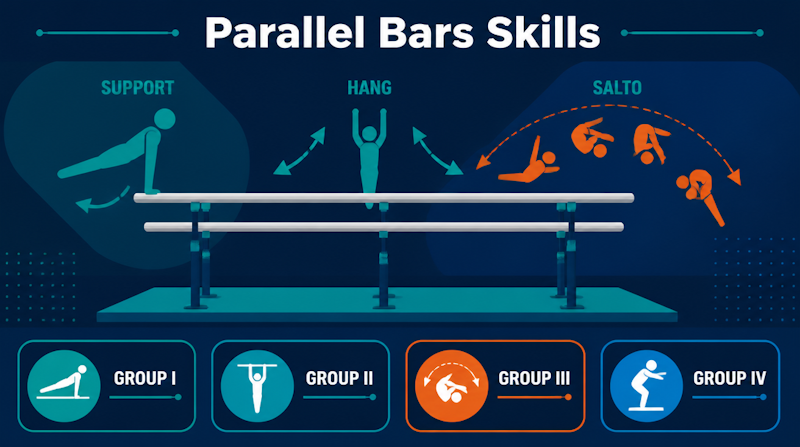
Men's parallel bars is an event where a gymnast links support, hang and salto elements across two bars set roughly shoulder-width apart. Compared with high bar or pommel horse, the skill names can be hard to follow, so spectators often struggle to tell what the skills are and why they are difficult. This guide organises parallel bars skills by the element groups of the FIG (International Gymnastics Federation) Code of Points, covering named moves like the Diamidov and Tippelt, spectacular release skills and dismounts, along with a rough guide to their difficulty. You will come away watching parallel bars with a sharper eye.
What Parallel Bars Is: Apparatus and Scoring Overview
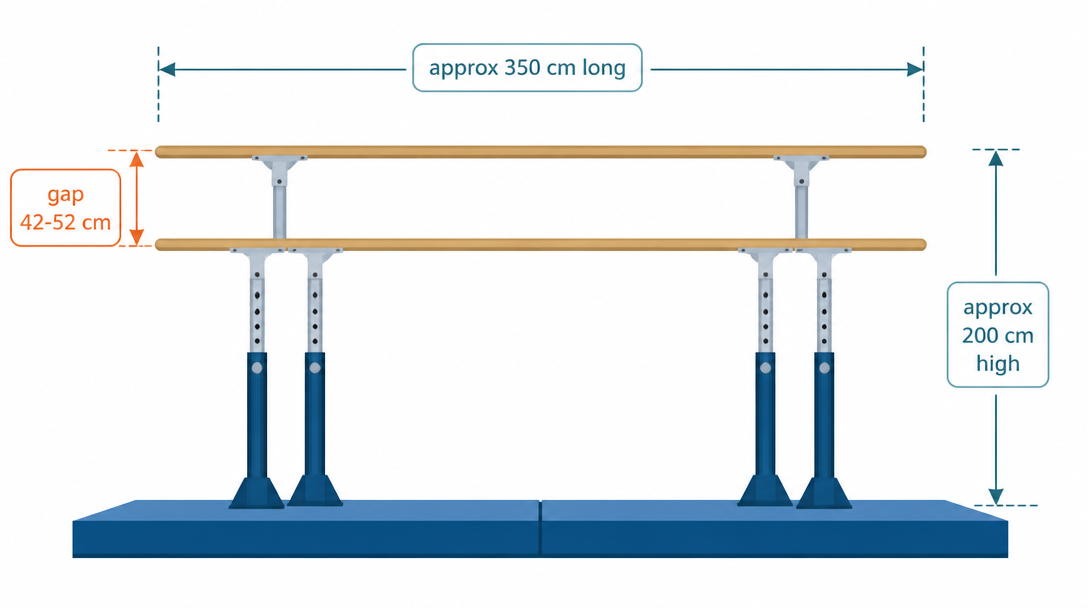
Before the individual skills, let's set the foundation. Knowing the apparatus dimensions and how scoring works makes it clearer why certain skills are rewarded.
Apparatus Dimensions
Parallel bars consists of two rails about 350 cm long set roughly 200 cm above the floor. The gap between the bars is adjustable from 42 to 52 cm, and each rail has an oval cross-section of about 5 cm by 4 cm (Wikipedia: Parallel bars). The rails are wood reinforced with fiberglass so they flex and rebound under the gymnast's weight, enabling large swinging and salto elements.
How D-Score and E-Score Work
A gymnastics score splits into the D-score (difficulty value), which reflects how hard the routine is, and the E-score (execution), which rates how cleanly it is performed. On parallel bars the two are added for the final mark. For the full picture of scoring, see our guide to the Code of Points (D-score and E-score). If you want to add up the D-score for parallel bars and the other men's events just by selecting skills, the Gymnastics AI D-score app is handy: it follows the FIG 2025–2028 Code of Points and includes a database of over 790 skills.
The Idea of Element Groups
A parallel bars routine must include a balanced mix of different families of skills. FIG defines these as "element groups," and a routine must contain at least one element from each group (Wikipedia: Parallel bars). In other words, parallel bars rewards the composition skill of showing support, upper-arm, hang and dismount actions in balance.
Understanding the Parallel Bars Element Groups (I-IV)
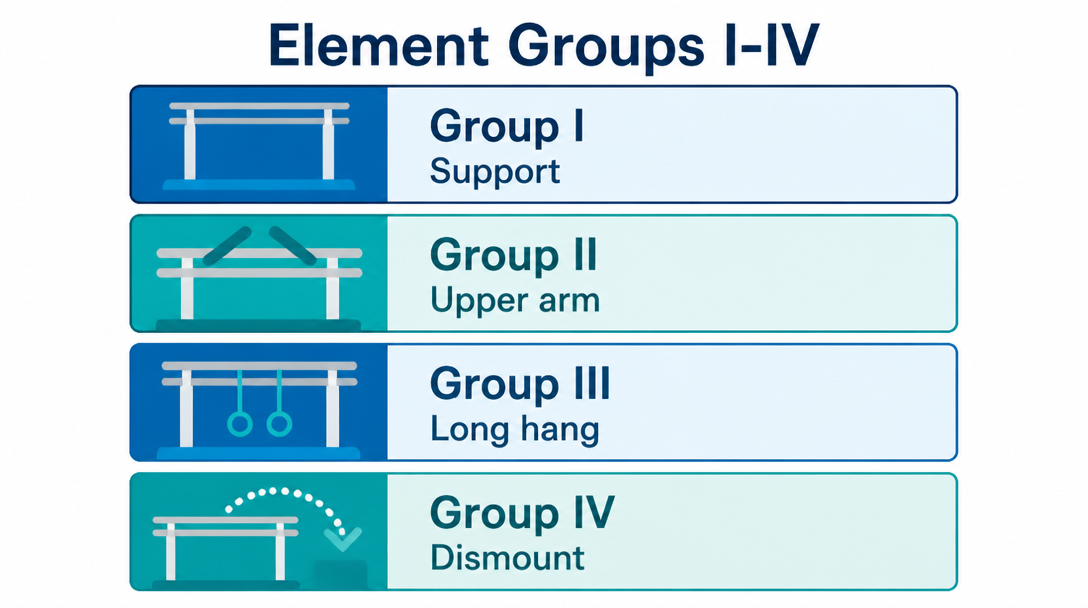
Parallel bars skills fall into four broad groups in the FIG Code of Points. Grasping this framework first makes it easy to place any individual skill.
Group I: Support Elements on Both Bars
Group I covers elements performed in support on both bars, or passing through support (Wikipedia: Parallel bars). These include big forward and backward support swings and turns that finish in handstand. The Diamidov and Healy, described below, are signature named skills in this support family.
Group II: Elements From the Upper-Arm Position
Group II elements begin from the "upper-arm" position, with the upper arms resting on the bars. A basic example is swinging from upper-arm support up to support or handstand, and more advanced salto skills grow out of this. The upper-arm position loads the shoulders, and the technique of flowing smoothly from it into the next phase is part of what makes parallel bars distinctive.
Group III: Long Hang Elements
Group III covers long swings in hang below the bars and underswings that drive upward (Wikipedia: Parallel bars). Swinging from a hang on one or two bars up to handstand, and release moves where the gymnast lets go and changes shape in the air, belong here and give parallel bars its dynamism.
Group IV: Dismounts
Group IV is the dismount that ends the routine. The gymnast leaves the bars, adds saltos and twists, and lands firmly on the floor. Double saltos backward or forward are the mainstream, and whether the landing is stuck heavily affects the E-score. Our overview of men's gymnastics skills is a useful companion for seeing which skills sit in each group.
Signature Named Skills: Diamidov, Healy and Tippelt
Parallel bars has many "eponymous" skills named after the gymnast who first landed them. Here are three you will often hear on a broadcast, with an explanation of each movement. First, here is a quick reference of the representative skills covered in this article and their rough difficulty.
Skill | Family | Rough difficulty |
|---|---|---|
Diamidov | Support / turn | C |
Healy | Support / turn | Depends on routine |
Tippelt | Long hang / uprise | D |
Belle | Salto release (to upper arm) | E (piked F) |
Double back pike dismount | Dismount (Group IV) | D |
Note: the difficulty guide follows the FIG 2025-2028 Code of Points as a general reference and can change with rule revisions or added shapes and twists. Check the official rules or a calculator app for exact current values.
Diamidov
The Diamidov swings forward in support and turns the body a full turn around one arm, finishing in handstand (SPAIA: Parallel bars skill types). Named after the Soviet gymnast Sergei Diamidov, it is generally rated C and is a foundational turning skill on parallel bars. Supporting the whole body on one arm while turning precisely demands a stable core and strong shoulders.
Healy
The Healy turns in the opposite rotational sense out of handstand, carrying the arm backward and swinging down into rear support. Where the Diamidov "turns forward to handstand," the Healy uses the reverse rotation, and combinations of the two gave rise to advanced skills such as the Makuts. It is a delicate turning skill through handstand, and a miss leads to heavy deductions.
Tippelt
The Tippelt is named after Sven Tippelt of former East Germany, a multiple Olympic medallist (Wikipedia: Sven Tippelt). FIG features the element in its official "Elements explained" series, describing it as an underswing driving up through to an uprise (FIG: Elements explained — The Tippelt). Generally rated D, its appeal is the sharp drive from hang up to support and handstand. To see how stacking skills like these changes the D-score, the Gymnastics AI app lets you build a routine just by selecting and ordering skills, auto-calculating difficulty, group bonus and connection value.
The Big Skills: Belle, Makuts and Salto Releases
The highlights of parallel bars are not only quiet handstands. The release skills, where the gymnast lets go and spins in the air, are the moments that bring the crowd to its feet.
Belle
The Belle is a bold double front salto with twist from a swing, caught in upper-arm support. It is generally rated E, and the piked version ("piked Belle") sits even higher at F (SPAIA). The gymnast must spin twice in the air while catching the bars precisely, so the smallest timing error can mean a fall—a high-risk, high-reward skill.
Makuts and Catch-to-Support Skills
The Makuts is known as a composite turning skill that blends Diamidov-to-one-rail and Healy actions. Such "catch-to-support" skills show their value not by stopping in handstand but by flowing seamlessly into the next element. Japan, too, has parallel bars skills tied to its gymnasts; for instance, a tucked double back with a full twist dismount is documented (SPAIA).
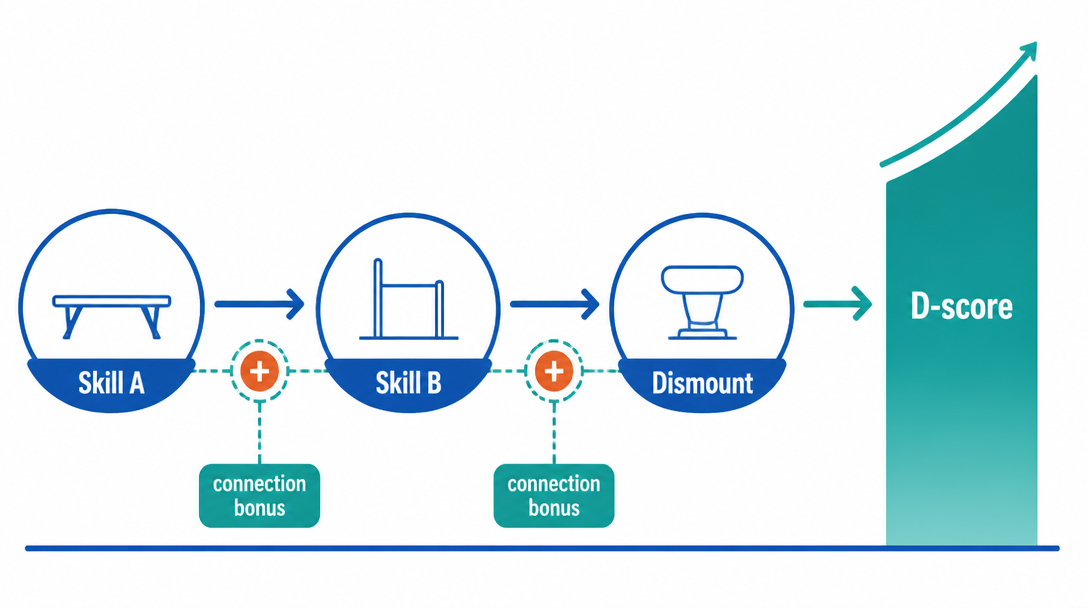
Why Connections Build the D-Score
The real thrill of parallel bars is not just single big skills but "connections" that link elements without a pause. Chaining high-difficulty skills earns connection bonuses and builds the D-score efficiently. This composition logic carries over to other events: for release skills on high bar see our guide to high bar giant-swing skills, and for rings swing and strength construction see our guide to rings swing and backward salto skills.
Dismount Types and What to Watch
The dismount that closes the routine is the most legible highlight for spectators. Here is what dismounts exist and where to look.
Backward Dismounts
The classic parallel bars dismount is the double back pike, launching off the front of the bars into two backward saltos in a piked shape. It is generally rated D and closes the routines of many top gymnasts (SPAIA). Adding a twist raises the difficulty, and the beauty of the aerial shape plus a steady landing becomes the deciding factor.
Forward Dismounts
There are also forward double saltos. Forward dismounts hide the landing from view, so controlling the rotation and the landing is considered harder. Gymnasts choose a dismount based on their preferred rotation direction and the balance of the whole routine.
Landing and Deductions
No matter how difficult the dismount, a step on landing means a deduction, and sitting down means a heavy one. Landing deductions are common across events, as explained in our guide to landing technique and avoiding deductions. The higher the D-score you chase, the more decisive the ability to stick the landing—a core truth of gymnastics.
Learning From the King: Zou Jingyuan's Routine and Connections
The gymnast who embodies what parallel bars should look like is China's Zou Jingyuan. His routine, from the strongest parallel bars specialist competing today, reveals the essence of the event.
Zou Jingyuan's Dominant Record
Zou won back-to-back Olympic parallel bars titles at Tokyo 2020 (held in 2021) and Paris 2024, and has four World Championships golds on the apparatus, in 2017, 2018, 2022 and 2025 (Wikipedia: Zou Jingyuan). In the Paris final he scored a total of 16.200 to take his second consecutive Olympic gold (Wikipedia: 2024 Olympics Men's parallel bars).
Difficulty and Precision Together
Zou's strength is meeting a high D-score and flawless execution at the same time. In the Paris 2024 final he lined up a D-score of 6.9 while keeping his handstands and landing immaculate (Wikipedia: 2024 Olympics Men's parallel bars). Because higher difficulty tends to disturb execution, doing both is the condition for reaching the top.
One to Watch at the 2026 Rotterdam Worlds
Zou is a central figure to watch on parallel bars at the 2026 World Championships in Rotterdam, Netherlands, held 17-25 October 2026 (Gymnastics Now). For Japan's men's outlook at the 2026 Worlds, see our article on Japan's men's team for the 2026 Worlds. If you want to build your own parallel bars routine and estimate the D-score, try selecting skills in Gymnastics AI.
Summary
Parallel bars is a deep event that rewards the composition skill of linking different families of elements smoothly. Here are the key points.
- Parallel bars skills fall into Group I (support), Group II (upper arm), Group III (long hang) and Group IV (dismounts), with at least one element required from each
- Named turning skills such as the Diamidov (around C), Healy and Tippelt (around D) are the foundation of parallel bars
- Salto releases like the Belle (around E) are the biggest highlight, and the thrill is building the D-score through connections
- The double back pike is the classic dismount, and a steady landing decides the E-score
- Difficulty ratings follow the FIG 2025–2028 Code of Points as a guide and are revised each cycle; check the official rules or a calculator app for exact current values
If you want to simulate the D-score of a parallel bars routine easily, give Gymnastics AI a try. Available on iOS and Android, it auto-calculates difficulty and connection bonuses just by selecting skills.