Women's Gymnastics: The 4 Events, Rules and Highlights
A beginner's guide to women's artistic gymnastics: the four events (vault, uneven bars, balance beam, floor), their sizes, rules, scoring, and highlights.
Women's artistic gymnastics is contested on four events: vault, uneven bars, balance beam, and floor exercise. Each apparatus demands very different skills, so knowing the rules and highlights of all four makes the sport far more enjoyable to watch. This guide walks through the four women's events—their apparatus sizes, rules, scoring basics, and what to look for—written for beginners and the parents of young gymnasts alike.
Women Compete on Four Events: The Big Picture
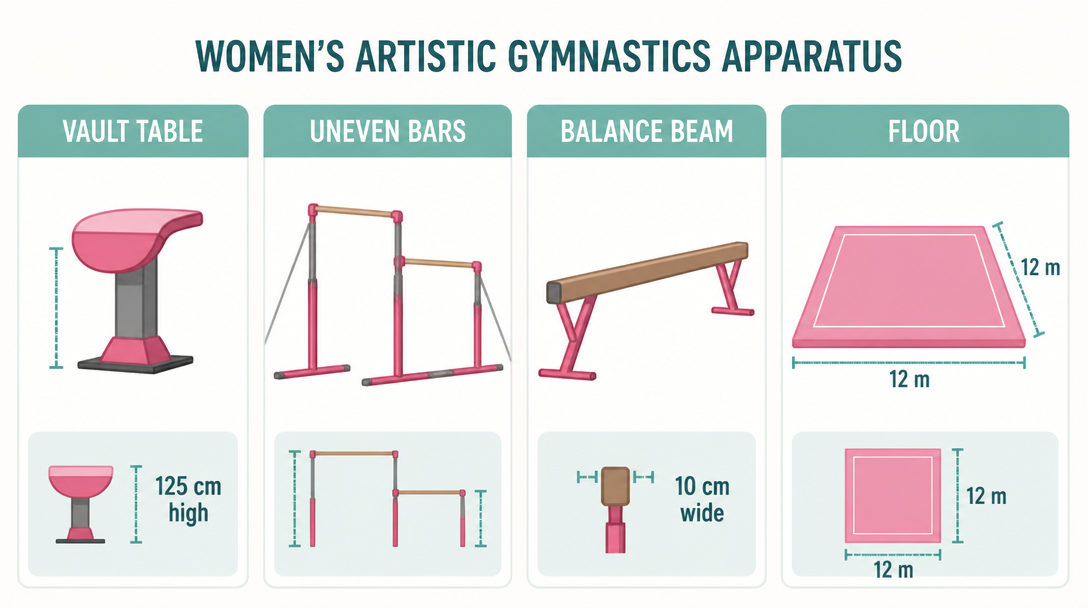
Let's start with an overview. While men contest six events, women compete on four, with apparatus and a performance style all their own.
The Four Women's Events (Vault, Uneven Bars, Balance Beam, Floor)
Women's Artistic Gymnastics is made up of vault, uneven bars, balance beam, and floor exercise (Wikipedia: Artistic gymnastics). Vault and floor also exist in men's gymnastics, but the uneven bars and balance beam are women's-only events. Japan's national bodies describe the women's program the same way (Japan Gymnastics Association).
- Vault: a speed event decided by a single explosive skill
- Uneven bars: a women's-only aerial event using two bars at different heights
- Balance beam: a women's-only event on a surface just 10 cm wide
- Floor: the only event performed to music
How It Differs From the Men's Six Events
Men compete on floor, pommel hor se, rings, vault, parallel bars, and horizontal bar, with a strong emphasis on strength and swing. Women's gymnastics blends acrobatics with leaps, turns, and dance, prioritizing rhythm and elegance. For a full comparison of the rules and scoring, see our article on the differences between women's and men's gymnastics. Women's floor is also the only event performed to music.
How a Competition Unfolds
At major meets, everyone competes all events in qualification, followed by team final, all-around final, and event finals (Wikipedia: Artistic gymnastics). The all-around crowns the best over all four events, while event finals decide the champion on a single apparatus. For the music that shapes a floor routine, a competition floor music production service—run by a former gymnast and artist—can help with song choice and structure.
Scoring Basics: D-Score (Difficulty) and E-Score (Execution)
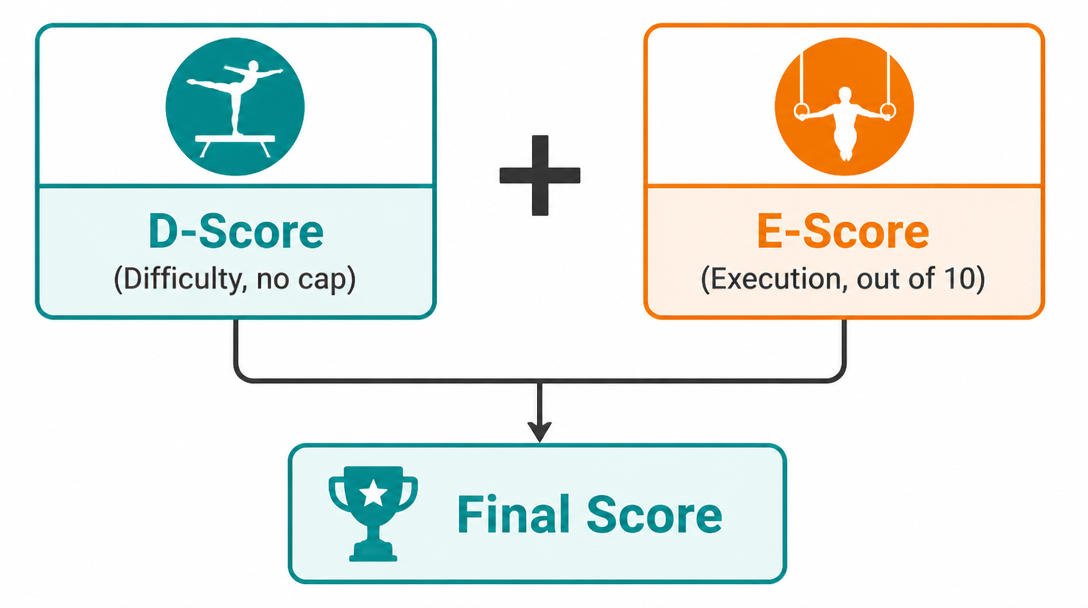
All four events share the same scoring framework. Modern gymnastics separates difficulty from execution using a two-panel system.
The Two-Panel System (Since 2006)
Since 2006, gymnastics has combined a D-score (Difficulty) and an E-score (Execution) (Wikipedia: Artistic gymnastics). The D-score has no upper limit, while the E-score starts from a maximum of 10 and is reduced by deductions. That is why the old "perfect 10" no longer exists.
What Goes Into the D-Score
The D-score reflects the difficulty value of skills, event-specific composition requirements, and connection bonuses. For a concrete breakdown on floor, see our article on how women's floor is scored (D-score, composition requirements, difficulty).
The E-Score and Deductions
The E-score deducts from 10 for form breaks, poor landings, and balance errors, and on beam and floor it also reflects artistry. A fall generally costs a full 1.00 deduction, with each event defining its own deduction rules (Wikipedia: Balance beam).
Vault: Rules and Highlights
Now to the individual events, starting with the fastest one—vault, where a single explosive effort decides everything.
Apparatus Size (125 cm for Women)
The vaulting table is about 120 cm long and 90 cm wide, set to 125 cm high for women (135 cm for men) (Wikipedia: Vault). The runway is roughly 25 m, which gymnasts sprint down before hurdling onto the springboard (USA Gymnastics event descriptions). Vault rules are essentially the same for men and women apart from table height.
The Sequence (Run, Flight, Landing)
A vault is a single skill completed through run-up, board contact, hand support, flight, and landing (USA Gymnastics). Yurchenko-family vaults, for example, use a round-off onto the board before contacting the table. Gymnasts perform one vault in qualification and all-around, and two vaults from different groups in event finals, where the scores are averaged.
What to Watch and How It's Judged
Look for the height and distance of the twisting or somersaulting flight, and a "stuck" landing. Any step on landing draws a deduction, which is what gives vault its all-or-nothing tension.
Uneven Bars: Rules and Highlights
Next is the uneven bars, a women's-only aerial event defined by its dynamic use of two bars at different heights.
Apparatus Size (High Bar and Low Bar)
The uneven bars use two bars of different heights: the high bar is about 250 cm (2.5 m) and the low bar about 170 cm (1.7 m), with a bar diameter of roughly 4 cm and an adjustable gap of about 130–190 cm (Wikipedia: Uneven bars). It resembles the men's horizontal bar, but the movement between two bars is unique to women (Japanese Olympic Committee).
Release Moves, Transitions, and Giants
Routines must flow without pauses; extra swings or supports are penalized. They combine release skills (letting go and re-grasping the bar), transitions between the bars (such as the Pak salto), and giant swings (Wikipedia: Uneven bars). For the range of skills and how they connect, see our article on uneven bars skills and connections.
What to Watch
Watch for chains of release moves and seamless bar-to-bar transitions. A momentary gap means deductions, so continuous rhythm and precise aerial timing are what earn marks—elegance and power at once.
Balance Beam: Rules and Highlights
Then comes the balance beam, performed on a surface just 10 cm wide—arguably the most nerve-testing of the four.
Apparatus Size (Just 10 cm Wide)
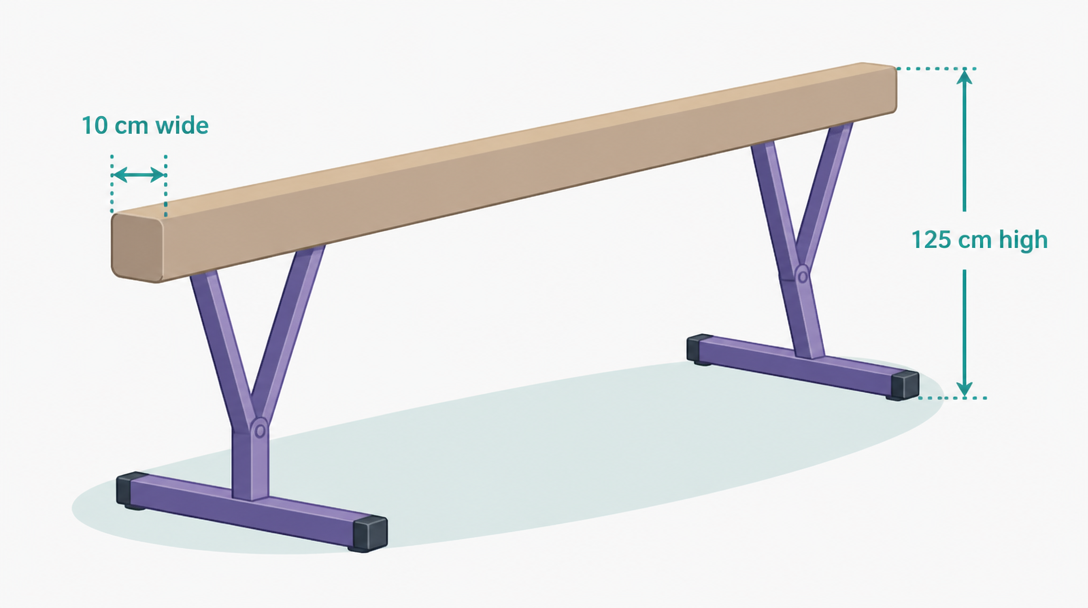
The beam is 500 cm (5 m) long, 10 cm wide, and 125 cm high—a women's-only event (Wikipedia: Balance beam). Leaping and turning on a surface only 10 cm wide magnifies even the smallest wobble (JOC).
Required Elements and Time Limit
A beam routine must include an acrobatic series (two skills connected, one a salto), a dance series (with a 180-degree split leap), a full turn on one foot, and a dismount (USA Gymnastics). The routine may last up to 1:30, with a warning tone at 1:20 and a deduction for going over (Wikipedia: Balance beam).
Deductions and What to Watch
A fall costs 1.00, and wobbles or pauses are finely penalized. That is exactly why smooth rhythm, precise turns, and unbroken connections on such a narrow beam are the highlights. For skills and judging cues, see our guide to balance beam tips and highlights.
Floor Exercise: Rules and Highlights
Finally, the floor exercise—the only event set to music, where acrobatics and expression come together as the climax of women's gymnastics.
Floor Size and Time (90 Seconds)
Floor is performed on a 12 m × 12 m (1,200 cm) sprung area, and a women's routine lasts up to 90 seconds (Wikipedia: Floor). Gymnasts use the diagonals to combine tumbling passes, jumps, turns, and dance. Men's floor, by contrast, has no music and lasts up to 70 seconds.
Music Rules (Lyrics and the NCAA Difference)
Women's floor is performed to music, but under FIG and Japanese rules, music with lyrics (sung words or speech) is not allowed—only instrumental tracks (Wikipedia: Floor). In U.S. collegiate gymnastics (NCAA), however, lyrics are permitted, so the rules differ. See our article on whether lyrics are allowed in floor music. Because song choice shapes the whole routine, a competition floor music production service can help with rules-aware selection, editing to 90 seconds, and original composition.
What to Watch (Tumbling and Expression)
Look for high-difficulty tumbling paired with expression synchronized to the music. Floor requires a dance connection (with a 180-degree split), saltos forward/sideways and backward, double saltos, and twisting saltos (Wikipedia: Floor). Both the power of the skills and the "wow" of choreography and music count toward the score.
Enjoying Women's Gymnastics More: Watching and Music
Once you know the four events, watching and training both gain depth. Here is a quick summary of what to watch and the role of music.
Event-by-Event Quick Reference
The table below summarizes the main apparatus dimensions and highlights of each event as a viewing checklist.
Event | Main Dimensions | Key Highlights |
|---|---|---|
Vault | 125 cm high / ~25 m runway | Twists, height, stuck landing |
Uneven Bars | High ~250 cm / Low ~170 cm | Release moves and transitions |
Balance Beam | 10 cm wide / 500 cm long / 125 cm high | Balance and turns on a narrow beam |
Floor | 12 m square / 90-second routine | Tumbling and musical expression |
The Role of Music and Audio
On floor, song choice and structure define a routine's identity. The same skills can leave a very different impression depending on how the music is synced and built. Editing after selection, fitting to 90 seconds, and shaping the climax all make the audio part of the performance. To compare scoring across artistic, rhythmic, and trampoline, see our article on the scoring differences of the three disciplines.
Summary
Women's gymnastics is four very different stages, each with its own apparatus and demands. Grasping the big picture makes both watching and training richer.
- The four women's events are vault, uneven bars, balance beam, and floor (bars and beam are women's-only).
- Scoring uses a two-panel system: D-score (difficulty, no cap) and E-score (execution, out of 10).
- Vault is 125 cm and all-or-nothing; bars feature releases and transitions; beam is balance on a 10 cm surface; floor is a 90-second routine to music.
- Women's floor allows no lyrics under FIG/Japan (instrumental only), while the NCAA permits lyrics.
- Dive deeper into each event via the linked articles, and into song choice via competition floor music production.
If you are unsure about song choice or audio for women's floor, a competition floor music production service can guide selection, structure, and editing in line with the Code of Points—maximizing the appeal of the routine.