2026 Worlds Women's Team Final: Japan's First Medal in 60 Years
Japan won women's team bronze at the 2026 Worlds with 164.063, its first world team medal since 1966. D/E breakdowns and what changed since qualifying.

*This article reflects information as of October 22, 2026. Scores are taken from a live results site that publishes the official FIG/Longines data.
The women's team final at the 2026 World Artistic Gymnastics Championships took place in Rotterdam on October 21 (local time). Japan won the bronze medal with 164.063, its first world team medal in women's gymnastics since 1966 — a 60-year gap. China won gold with 165.764 and the United States took silver with 165.531, and all three podium teams earned team spots for the 2028 Los Angeles Olympics. Japan had qualified only fifth. This analysis, written from the perspective of a former Japanese gymnast and the developer of a D-score app, explains how Japan climbed from fifth to third, using the published D-scores (difficulty), E-scores (execution), neutral deductions and the apparatus-by-apparatus change from qualification.
Japan's single biggest gain came on floor, the only women's event performed to music. How a 90-second routine is built around its music affects both the score and the performance. Gymnasts and coaches who want help with music selection and editing can work with a former gymnast who is also a recording artist through custom floor music for competition.
2026 Worlds Women's Team Final Results: China Wins Gold, Japan Ends a 60-Year Wait

Final standings (the eight finalists)
Here are the final standings of the team final (full women's team final scores with D, E and ND breakdowns). The D and E totals are the sums of the twelve routines that counted for each team.
Rank | Team | Total | D total | E total | Neutral deductions |
|---|---|---|---|---|---|
1 | China | 165.764 | 66.700 | 99.064 | 0.0 |
2 | United States | 165.531 | 68.000 | 97.731 | -0.2 |
3 | Japan | 164.063 | 67.300 | 96.763 | 0.0 |
4 | France | 161.130 | 64.300 | 97.130 | -0.3 |
5 | Brazil | 159.730 | 63.700 | 96.130 | -0.1 |
6 | World Gymnastics 2 (Russia's neutral team) | 159.394 | 65.400 | 94.094 | -0.1 |
7 | Italy | 158.129 | 63.800 | 94.329 | 0.0 |
8 | Canada | 158.096 | 63.800 | 94.596 | -0.3 |
Japan finished 2.933 points ahead of fourth-place France, so the bronze was never seriously in danger at the end. The gap to the United States was 1.468, and the gap to China was 1.701.
The first medal in 60 years and a ticket to LA28
According to Jiji Press, Japan's last world team medal in women's gymnastics came in 1966, when the team finished third for the second championships in a row, and this is only the third time Japan has stood on a world team podium (Jiji Press report via nippon.com, in Japanese). The Japan Times, carrying an AFP-Jiji story, described it as Japan ending a 60-year drought (The Japan Times report).
- Japan's five-member team: Aiko Sugihara, Rina Kishi, Mana Okamura, Misa Nishiyama and Haruka Nakamura
- The top three teams (China, the United States and Japan) earned team spots for the Los Angeles 2028 Olympics
- Japan's men had won the team title the day before, so both Japanese teams secured their LA28 team spots in Rotterdam
Team final format: three up, three count
Under the event directives, the eight best teams from qualification contest the team final. Three gymnasts compete on each apparatus and all three scores count. The team final is also the first Olympic qualification event for Los Angeles 2028, with the three highest-ranked teams qualifying (2026 Worlds Directives). In qualification four gymnasts compete and the best three scores count, so the final is the less forgiving format: a fall cannot be dropped. For a full explanation of how team scores are calculated in qualification and in the final, see our guide to gymnastics team scoring.
How Japan Climbed From Fifth in Qualification to Third
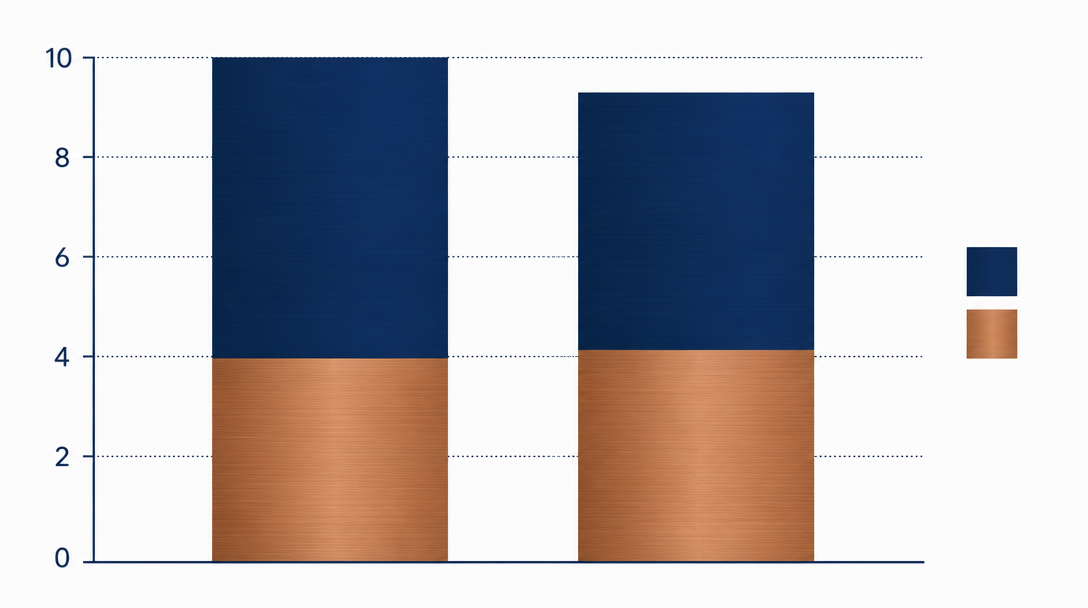
Qualification vs. final, apparatus by apparatus
The table compares Japan's team scores in qualification (full women's team qualification scores) and in the final. Qualification figures are the sums of the three counting scores.
Item | Qualification | Final | Change |
|---|---|---|---|
Vault | 41.466 | 42.132 | +0.666 |
Uneven bars | 41.133 | 40.432 | -0.701 |
Balance beam | 40.899 | 41.066 | +0.167 |
Floor | 38.132 | 40.433 | +2.301 |
D total | 65.900 | 67.300 | +1.400 |
E total | 96.430 | 96.763 | +0.333 |
Neutral deductions | -0.7 | 0.0 | +0.7 |
Total | 161.630 | 164.063 | +2.433 |
Of the 2.433-point improvement, 2.301 came from floor alone. Japan improved on three apparatus and dropped only on uneven bars. Among the eight finalists, Japan improved the most from qualification (China +0.768, the United States +1.002, France -0.300).
Floor +2.301 and zero neutral deductions
In our 2026 Worlds women's qualification results analysis published on October 20, we found that Japan's gap to the leaders came down to a lower D total and -0.7 in neutral deductions (the most among the top eight teams), mostly from out-of-bounds landings on floor. Both problems were fixed in the final.
- Neutral deductions went from -0.7 to 0.0: no out-of-bounds or other neutral penalties, worth 0.7 on its own
- The D total rose by 1.400: from 65.900 to 67.300, as lineup changes put higher-difficulty routines in the counting positions
- All three counting floor scores were in the 13s: the two 12s from qualification (Nishiyama 12.566, Kishi 12.466) were replaced by Okamura's 13.300 and Kishi's 13.233
The third- and fourth-place qualifiers stumbled
There was a second factor. World Gymnastics 2, third in qualification, dropped 4.268 points from 163.662 to 159.394, and Italy, fourth in qualification, dropped 4.301 from 162.430 to 158.129. According to the Gymnastics Now live blog, WG2 had a fall from Liudmila Roshchina on uneven bars, and Italy counted two falls on balance beam (Gymnastics Now women's team final live recap). Italy scored 37.732 and WG2 38.498 on beam, roughly three points below Japan's 41.066.
2026 Worlds Women's D-Score Analysis: Japan Out-Difficulted China; the Gap Was Execution
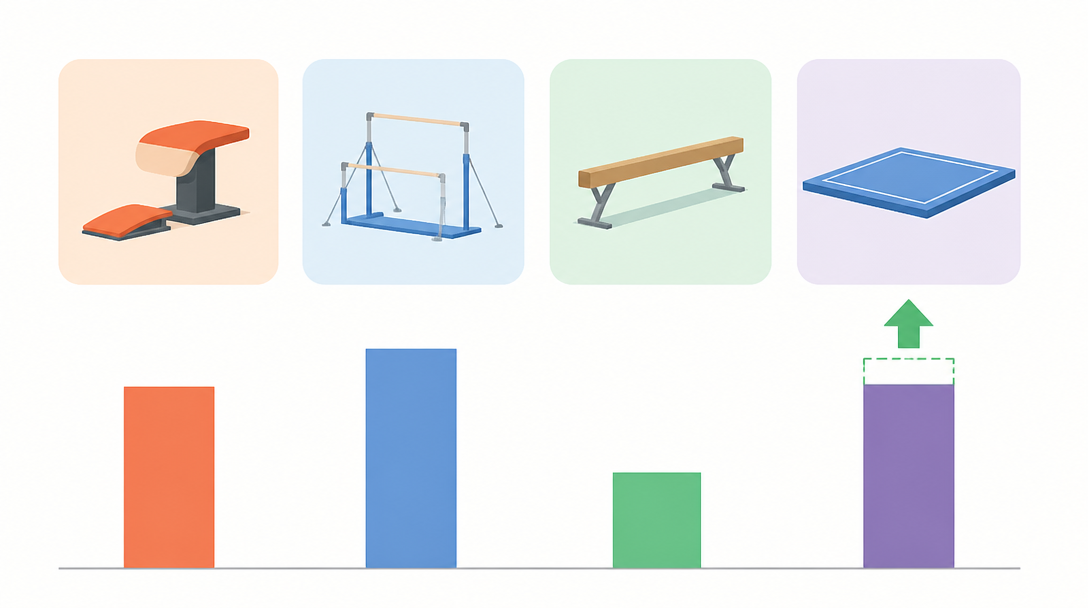
D and E totals of the medalists
Japan's D total in the final was 67.300, second only to the United States and 0.600 higher than gold medalist China (66.700).
Team | D total | E total | Neutral deductions | Gap to Japan |
|---|---|---|---|---|
China | 66.700 (3rd) | 99.064 (1st) | 0.0 | +1.701 |
United States | 68.000 (1st) | 97.731 (2nd) | -0.2 | +1.468 |
Japan | 67.300 (2nd) | 96.763 (4th) | 0.0 | — |
Break down the 1.701-point gap to China and Japan was ahead by 0.600 on difficulty and behind by 2.301 on execution. In other words, the entire gap to gold was execution. The 1.468-point gap to the United States is D -0.700, E -0.968 and +0.200 in neutral deductions. Because the E-score is a deduction from 10.000, a step on landing, a form break or a fall (-1.0) translates directly into that gap.
Team rank on each apparatus
Ranking each apparatus total among the eight finalists shows that Japan was in the top five on all four events.
Apparatus | Japan | Rank of 8 | Best team |
|---|---|---|---|
Vault | 42.132 | 2nd | USA 42.633 |
Uneven bars | 40.432 | 5th | USA 42.766 |
Balance beam | 41.066 | 3rd | China 43.366 |
Floor | 40.433 | 2nd | USA 40.933 |
China was only sixth on floor (38.966) but scored 43.366 on beam, two full points ahead of second-best France, and held on with the highest execution. For Japan the picture is clear: strong on vault and floor, with uneven bars as the weak spot.
What separated Japan from silver
Japan's bars total of 40.432 included a 12.533 from Misa Nishiyama, who fell in the final rotation according to Gymnastics Now. If Nishiyama had matched her qualification bars score (13.933), Japan's total would have been 165.463, just 0.068 behind the United States. Competitions are never that simple, but the numbers show that Japan was within reach of silver.
Floor scores are decided not only by difficulty but by how well the movement matches the music, how the 12 x 12 m area is used, and whether the composition keeps landings away from the boundary. Music editing or original composition with the Code of Points in mind is available through custom floor music edited or composed for competition.
Japan's Twelve Routines, Gymnast by Gymnast
Rotation order: beam, floor, vault, bars
Japan started on balance beam, then went to floor, vault and finally uneven bars. Jiji Press reported that Japan moved into third after floor in the second rotation and then posted high scores across the board on vault. The Gymnastics Now live blog had Japan's vault total at 42.132, led by Sugihara's 14.200 and two 13.966s. Even with a fall on bars in the last rotation, the margin Japan had built was enough to keep third place.
Individual scores
Gymnast | Vault | Bars | Beam | Floor | Total |
|---|---|---|---|---|---|
Mana Okamura | — | 13.933 | 13.700 | 13.300 | 40.933 |
Misa Nishiyama | 13.966 | 12.533 | 13.233 | — | 39.732 |
Haruka Nakamura | — | 13.966 | 14.133 | — | 28.099 |
Aiko Sugihara | 14.200 | — | — | 13.900 | 28.100 |
Rina Kishi | 13.966 | — | — | 13.233 | 27.199 |
No Japanese gymnast competed all four events. Okamura and Nishiyama each did three, and the other three gymnasts did two each. Eight of the twelve routines scored 13.700 or higher, and the top score was Sugihara's 14.200 on vault.
Nakamura's 14.133 on beam and the lineup changes
The lineup changes from qualification showed up in the scores. In qualification Nakamura competed only on floor (12.466, not counted). In the final she was used on uneven bars and balance beam, and her 14.133 on beam was Japan's second-highest score after Sugihara's vault. International Gymnast also singled out Nakamura's beam and Sugihara's floor as the highlights of Japan's consistent performance (International Gymnast women's team final report).
- Beam: from the qualification counting trio (Okamura, Kishi, Sugihara) to Nakamura, Nishiyama and Okamura in the final
- Floor: from the qualification counting trio (Sugihara, Nishiyama, Kishi) to Sugihara, Okamura and Kishi in the final
- Vault: Nishiyama (13.966) replaced Okamura's counting score from qualification, worth +0.700
Three floor routines in the 13s
Sugihara scored 13.900 on floor, up 0.800 from 13.100 in qualification. As covered in our qualification analysis, a -0.4 line deduction in qualification cost the reigning world floor champion her place in the floor final, but in the team final she posted Japan's best floor score. Floor rewards difficulty, but artistry and the quality of a composition built around the music also feed into the E-score. For a full explanation of women's floor scoring, see our guide to women's floor exercise scoring.
The Battle for Gold: China's First Title in 20 Years Stops a U.S. Streak
China turns it around on beam
The United States led after strong vault and bars rotations and was ahead of China by nearly two points at the halfway mark. The meet turned in the third rotation on balance beam. According to International Gymnast, reigning world beam champion Zhang Qingying scored 15.066, the best beam mark of the final, while Dulcy Caylor of the U.S. fell on her dismount. China led by 2.200 going into the last rotation.
A 0.233 margin decided by the final routine
The United States fought back on floor with Claire Pease's 13.933, the highest floor score of the final, but China's last gymnast, Qiu Qiyuan, needed more than 12.600 and delivered 12.833 to clinch gold by 0.233 (The Japan Times). NBC Sports noted that it was the first time in 16 years that a nation other than the United States won the women's world team title — the last was Russia in 2010 — ending a run of seven straight U.S. titles since 2011 (NBC Sports women's team final report). It was China's first world team title since 2006.
- United States: the highest D total of the final (68.000), but a fall and deductions on beam (39.199, fifth on the event)
- China: no major errors across twelve routines; its E total of 99.064 was the only one above 99
- Inside Gymnastics quoted U.S. technical lead Chellsie Memmel pointing to E-scores, artistry, beam difficulty and floor landings as areas to work on (Inside Gymnastics report)
What's Next at the 2026 Worlds: Women's All-Around and Apparatus Finals
Finals with Japanese gymnasts expected to compete
Based on the qualification results, these are the finals Japanese gymnasts are expected to compete in (2026 Worlds schedule; Rotterdam time shown, with Japan time in brackets. The Netherlands switches to winter time on October 25).
Final | Rotterdam time (Japan time) | Japanese gymnasts (qualifying rank) |
|---|---|---|
Women's all-around final | Fri Oct 23, 19:30 (Sat Oct 24, 2:30) | Rina Kishi (13th), Aiko Sugihara (21st) |
Women's balance beam final | Sun Oct 25, 14:42 (Sun Oct 25, 22:42) | Mana Okamura (4th) |
Women's floor final | Sun Oct 25, 16:30 (Mon Oct 26, 0:30) | No Japanese gymnast (Sugihara qualified 17th) |
Lessons for the road to LA28
With the team spot secured, Japan's women can now focus on what it will take to contend for medals in Los Angeles. The numbers from Rotterdam point to three questions.
- Execution: Japan's D total is level with the top two teams. How much of the 2.301 E-score gap to China can it close?
- Uneven bars: fifth of eight in the final, about two points behind the U.S. and China
- Floor consistency: -0.7 in neutral deductions in qualification, 0.0 in the final. Can the team keep its floor compositions inside the lines at every meet?
NBC Sports noted that the next world team competition will be held in 2027 in Chengdu, China. For our pre-meet look at the team, see the 2026 Worlds Japan women's team preview.
Summary
- China won the 2026 Worlds women's team final with 165.764, the United States took silver with 165.531, and Japan won bronze with 164.063, its first world team medal since 1966. All three teams earned LA28 team spots
- Japan improved by 2.433 from qualification, the biggest jump among the eight finalists. Floor accounted for 2.301, and neutral deductions went from -0.7 to 0.0
- Japan's D total of 67.300 was higher than China's 66.700; the 1.701-point gap to gold was entirely execution
- Japan ranked 2nd on vault, 2nd on floor, 3rd on beam and 5th on bars. Nakamura's 14.133 on beam was second only to Sugihara's 14.200 on vault
- Next up: the women's all-around final (Oct 23, 19:30 Rotterdam time, with Kishi and Sugihara) and the beam final (Oct 25, 14:42, with Okamura)
Floor was where Japan found the points that won this medal. If you would like to discuss music built around a floor routine, or editing a track to fit 90 seconds, visit our custom floor music for competition page.