Women's Vault List: Yurchenko, Amanar & Cheng Values Explained
Every major women's vault in the FIG 2025-2028 Code: the five groups, values for the Yurchenko, Amanar, Cheng and Biles, scoring, and the new 0.20 bonus.

Every women's vault in artistic gymnastics comes from a single table in the FIG Code of Points. The table sorts vaults into five groups and gives each one a fixed difficulty value. Names you hear on broadcasts, such as the Yurchenko, Tsukahara, Amanar, Cheng and Biles, are all entries in that table. This guide uses the vault table in the 2025–2028 Women's Artistic Gymnastics (WAG) Code of Points to list the main women's vaults and their values and to explain how vault is scored. It also looks at the vaults and contenders to watch at the 2026 World Championships in Rotterdam.
Note: all difficulty values below come from the vault table in the FIG Women's Artistic Gymnastics Code of Points 2025–2028 (PDF). Competition information is current as of October 16, 2026.
What Is Women's Vault? Phases and Basic Rules
A vault is judged in four phases
Women's vault is decided in a few seconds: the run, the take-off from the springboard, a push off the vaulting table with both hands, and the landing. Once the gymnast leaves the springboard, the Code of Points evaluates the vault in four phases:
- First flight (pre-flight): from the springboard to the hands touching the table
- Support: the moment both hands push off the table
- Second flight (after-flight): from leaving the table to the landing. Saltos and twists happen here
- Landing: arriving feet first on the mat and coming to a stable stand
The name and value of a vault are set mainly by two things: how the gymnast enters the table in the first flight, and how many saltos and twists she performs in the second flight.
Run-up and table rules in women's vault
The FIG women's Code of Points sets out these basic vault rules:
- The run is a maximum of 25 meters, measured from the front edge of the table to the end of the runway mat
- The take-off from the springboard is always with two feet, facing forward or backward
- Every vault must be performed with a push from both hands off the table
- No vault with a sideways landing may be submitted
- Round-off entry vaults require the proper use of the safety collar supplied by the organizers
- A hand placement mat may be used only for Yurchenko-type vaults (groups 1, 4 and 5)
Every vault has a number, and before each attempt the gymnast must show the number of the vault she intends to perform. When a scoreboard shows "4.35", that is the vault's number in the table.
How vault differs from the other three events
Women's gymnastics has four events: vault, uneven bars, balance beam and floor exercise. Vault is the only one judged as a single jump rather than a routine. On bars, beam and floor, gymnasts link many skills into an exercise; on vault, each attempt is one specific vault from the table. For an overview of all four events, see our guide to the four women's events and their rules.
Floor is also the only one of the four events performed to music. Vault lasts a few seconds, but most vaulters also compete on floor at the same meet, where they build a 90-second routine around their music. Floor music selection and editing can be discussed through our competition floor music production service, run from the combined perspective of a former gymnast and an artist.
List of Women's Vaults: The Five Vault Groups
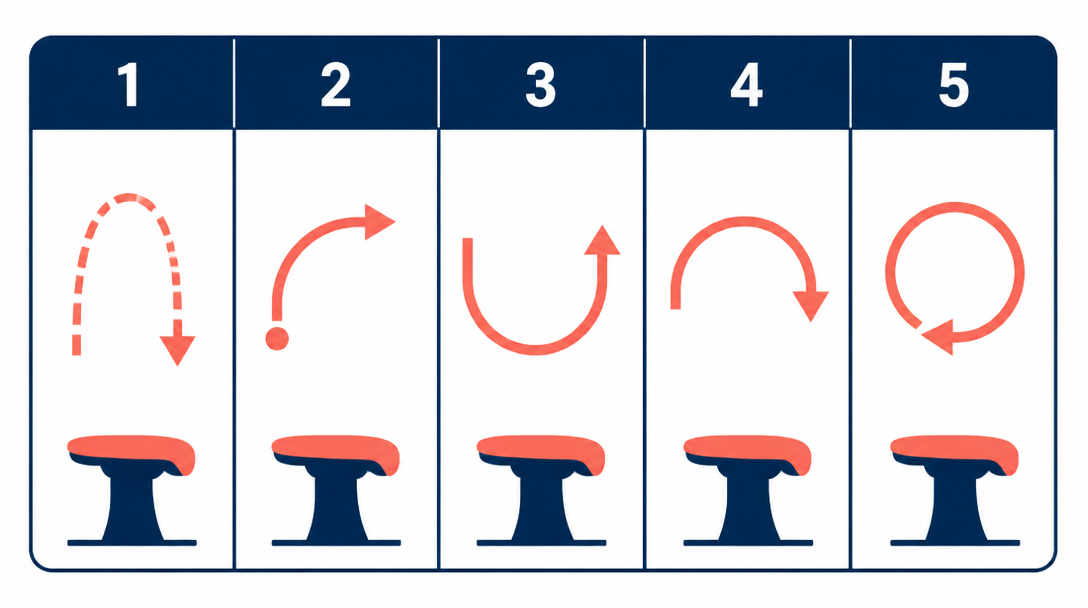
Vault groups 1 to 5
Women's vaults fall into five groups depending on how the gymnast enters the table and whether she performs a salto. Summarized from the Code of Points:
Group | Entry (first flight) | Second flight | Well-known vaults |
|---|---|---|---|
1 | Handspring, Yamashita or round-off, with or without turns | No salto | Handspring, Yamashita |
2 | Handspring forward, with or without a full turn | Salto forward or backward, with or without twist | Produnova, Rudi |
3 | Handspring with a 1/4–1/2 turn onto the table (Tsukahara) | Salto backward, with or without twist | Tsukahara, Zamolodchikova |
4 | Round-off (Yurchenko), with or without a 3/4 turn | Salto backward, with or without twist | Yurchenko, Amanar, Biles |
5 | Round-off with a 1/2 turn onto the table | Salto forward or backward, with or without twist | Cheng, Biles (group 5) |
The groups matter because, in the vault final, a gymnast's two vaults must come from different groups. Knowing which vault belongs to which group makes it much easier to predict what a gymnast will choose as her second vault.
Forward and backward saltos
The direction of the salto in the second flight splits vaults into forward and backward families. Yurchenkos (group 4) and Tsukaharas (group 3) finish with backward saltos. Handspring front vaults (group 2) and the Cheng (group 5) finish with forward saltos.
That direction became more important in the 2025–2028 Code. A gymnast who performs one forward and one backward vault in the vault final now earns a 0.20 bonus, explained in detail below.
Most vaults are named after the first gymnast to compete them
Most vault names belong to the gymnast who first performed the vault at a major international competition, and the vault table lists those names next to the descriptions. Some of the best-known examples:
- Yurchenko: round-off, back handspring onto the table, tucked salto backward off. The name is also used for the whole family of round-off entry vaults
- Tsukahara: a handspring with a 1/4–1/2 turn onto the table, then a salto backward. Named after Japan's Mitsuo Tsukahara
- Amanar: Yurchenko entry, stretched salto backward with 2½ twists
- Cheng: round-off with a 1/2 turn onto the table, stretched salto forward with 1½ twists
- Produnova: handspring forward onto the table, tucked double salto forward off
The Yurchenko and Tsukahara families are just as central on the men's side. For how their values compare in men's gymnastics, see our Yurchenko vs. Tsukahara vault guide.
The vault number tells you the vault and its value
Because every gymnast shows her vault number before she runs, you can read the vault in advance. If the board shows "4.34", the next vault is a Yurchenko double twist (5.00); "5.33" means a Cheng (5.60). The first digit of the number is the vault group, so you can match it against the tables in this article and know the difficulty before she leaves the runway.
Yurchenko Vaults (Group 4) and Their Difficulty Values
What is a Yurchenko?
In a Yurchenko, the gymnast does a round-off onto the springboard, arrives backward, places her hands on the table during a back handspring and then performs a salto backward. The entry turns the speed of the run into rotation and makes twisting relatively accessible, which is why it is the most common vault family in women's gymnastics today. It is also the only family for which the Code allows a hand placement mat.
Yurchenko difficulty values
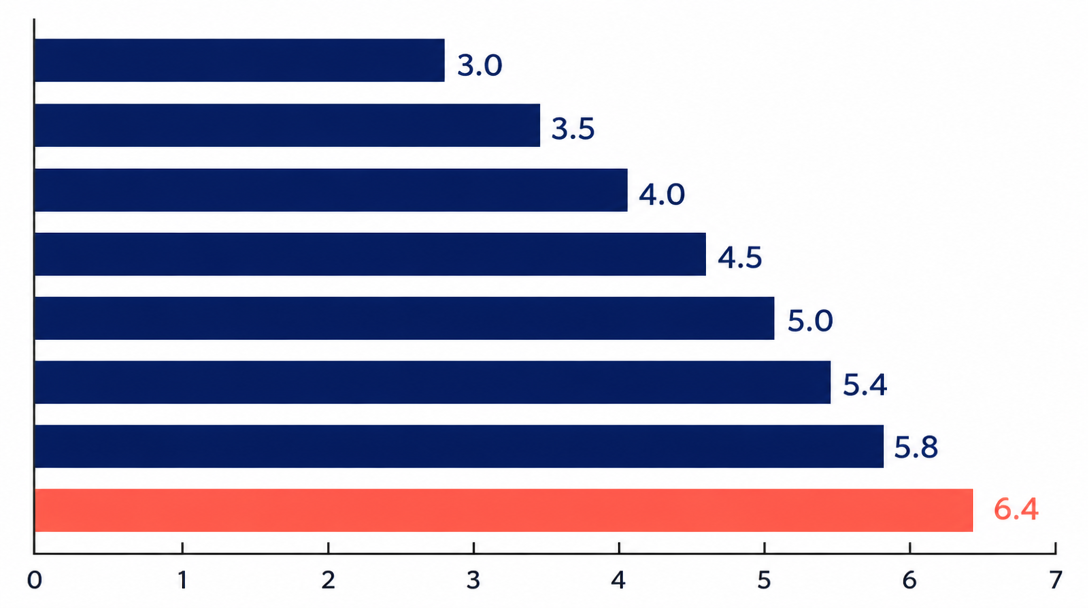
The main group 4 vaults and their values in the 2025–2028 WAG vault table:
No. | Second flight | Name | Value |
|---|---|---|---|
4.10 | Tucked salto backward | Yurchenko | 3.00 |
4.20 | Piked salto backward | – | 3.20 |
4.30 | Stretched salto backward | – | 3.60 |
4.32 | Stretched salto backward with 1/1 twist | – | 4.20 |
4.33 | Stretched salto backward with 1½ twist | – | 4.60 |
4.34 | Stretched salto backward with 2/1 twist | Baitova | 5.00 |
4.35 | Stretched salto backward with 2½ twist | Amanar | 5.40 |
4.63 | Double piked salto backward | Biles | 6.40 |
The basic step is 0.40 for every extra half twist. From the layout Yurchenko (3.60) up to the Amanar (5.40), each half twist adds the same amount.
The Yurchenko double twist and the Amanar are different vaults
The vault you will see most in competition reports is the "Yurchenko double twist", often shortened to DTY. Many top gymnasts use it as their main vault. In the table it carries the name Baitova and a value of 5.00.
The Amanar has 2½ twists and is worth 5.40. Some summaries online equate the Amanar with the Yurchenko double twist, but in the table they are half a twist and 0.40 points apart. When reports say "DTY", they mean the 5.00 double twist.
The Biles (6.40): the hardest women's vault
A Yurchenko entry finished with a double piked salto backward is the Biles, valued at 6.40, the highest value in the women's vault table. According to Gymnastics Now, Simone Biles of the United States first performed the vault at the 2021 U.S. Classic, and it was officially named after her once she competed it at the 2023 World Championships in Antwerp, Belgium. Because Biles has two vaults named after her, this one is widely called the "Biles II".
In the Paris 2024 Olympic vault final, Biles scored 15.700 on the Biles II and won gold with a two-vault average of 15.300. Rebeca Andrade of Brazil took silver with 14.966, and Jade Carey of the United States took bronze with 14.466 (USA Gymnastics results report).
Handspring, Tsukahara and Cheng Vaults (Groups 2, 3 and 5)
Handspring front vaults (group 2): the Produnova is 6.00
Group 2 vaults start with a front handspring onto the table, facing it, and finish with a salto forward (including vaults that half-turn into a backward salto). The main values:
No. | Vault | Name | Value |
|---|---|---|---|
2.10 | Handspring, tucked salto forward | – | 3.60 |
2.30 | Handspring, stretched salto forward | Evdokimova | 4.40 |
2.32 | Handspring, stretched salto forward with 1/1 twist | – | 5.00 |
2.33 | Handspring, stretched salto forward with 1½ twist | Chusovitina (commonly "Rudi") | 5.40 |
2.34 | Handspring, stretched salto forward with 2/1 twist | Yeo | 5.80 |
2.50 | Handspring, tucked double salto forward | Produnova | 6.00 |
At 6.00, the Produnova is second only to the Biles (6.40). The Code adds a note: if the second salto is not completed and the gymnast lands on her feet and another body part at the same time, the vault is credited as a handspring tucked salto forward (3.60).
Tsukahara vaults (group 3)
Group 3 vaults turn 1/4 to 1/2 during the handspring onto the table and finish with a salto backward. The family carries the name of Japan's Mitsuo Tsukahara. Women's values:
No. | Vault | Name | Value |
|---|---|---|---|
3.10 | Tsukahara tucked | Tourischeva | 3.20 |
3.20 | Tsukahara piked | – | 3.40 |
3.30 | Tsukahara stretched | – | 3.80 |
3.33 | Tsukahara stretched with 1½ twist | – | 4.80 |
3.34 | Tsukahara stretched with 2/1 twist | Zamolodchikova | 5.20 |
3.35 | Tsukahara stretched with 2½ twist | – | 5.60 |
The same "stretched double twist" is worth 5.00 from a Yurchenko entry (Baitova) but 5.20 from a Tsukahara entry (Zamolodchikova). The entry changes the value.
Round-off half-on vaults (group 5): the Cheng is 5.60
Group 5 vaults start with a round-off, then a 1/2 turn so the hands reach the table facing it, followed by a salto, usually forward. The best-known example is the Cheng, which has become a fixture among the vault medal contenders in recent years.
No. | Second flight | Name | Value |
|---|---|---|---|
5.10 | Tucked salto forward | Ivantcheva | 3.80 |
5.20 | Piked salto forward | Omelianchik | 4.00 |
5.30 | Stretched salto forward | – | 4.60 |
5.31 | Stretched salto forward with 1/2 twist | – | 4.80 |
5.33 | Stretched salto forward with 1½ twist | Cheng | 5.60 |
5.34 | Stretched salto forward with 2/1 twist | Biles | 6.00 |
The Cheng is a forward salto vault, so pairing it with a Yurchenko double twist (backward, 5.00) meets the conditions for the 0.20 bonus described below.
Vaults without a salto (group 1)
Group 1 vaults push off the table from a handspring, Yamashita or round-off and land without a salto. Values are low (a handspring is 1.60 and a Yamashita 2.00) and they are mostly used at the developmental stage. Adding turns raises the value: a handspring with 2½ turns off is worth 4.00.
How Women's Vault Is Scored: D-Score and E-Score
On vault, the D-score is simply the vault's value
A gymnastics score is the D-score (difficulty) plus the E-score (execution), minus neutral deductions such as stepping out of bounds. The women's Code states that the D-score on vault is the difficulty value of the vault in the vault table.
On uneven bars, balance beam and floor, the D-score adds up the eight highest-valued elements, the composition requirements, connection value and bonus. Vault is the only event where the D-score is decided by which single vault the gymnast performs. For how floor's D-score is built, see our guide to women's floor scoring: D-score, composition requirements and difficulty.
What the E-panel looks for
The E-score starts at 10.00 and judges deduct for faults. The vault-specific deduction table in the Code covers each phase:
- First flight: missing degrees of the prescribed turn, body alignment (hip angle or arch), bent knees, leg or knee separations
- Support: staggered hand placement in groups 1, 2 and 5, bent arms or shoulder angle, failure to pass through vertical, starting the turn too early on the table
- Second flight: height, exactness of the tuck, pike or stretched position, bent knees, leg separations, under-rotation, insufficient distance, deviation from a straight line, dynamics
- Landing: the general landing deductions (steps, hand touches and so on)
The landing mat also has a marked corridor along the direction of the vault, and touching outside it with a foot, hand or body part is penalized. A hard vault can still lose a lot on height, body shape and landing, so top vaulters choose their vaults by balancing difficulty against execution.
Vaults that score zero
The Code lists the cases in which a vault is invalid and scores 0.00:
- Neither hand touches the table
- The safety collar is not used properly on a round-off entry vault
- A coach spots the vault
- The gymnast does not land feet first
- The vault is so poorly executed that it cannot be recognized, or the gymnast pushes off the table with her feet
- A prohibited vault is performed (straddled legs, a prohibited pre-element before the springboard, an intentional sideways landing)
- In qualification for the vault final or in the final itself, the first vault is repeated as the second vault
Every vault scored 0.00, and any vault performed with support from one hand only, is automatically reviewed on video by the D-panel and the Apparatus Supervisor.
Vault vs. floor: a few seconds vs. a 90-second routine
A vault lasts a few seconds and is performed without music. Floor is a routine of up to 90 seconds, built around a piece of music. Both events reward height and a stuck landing, but on floor the structure of the routine, with skills and poses placed on the high points of the music, also shapes how the performance is judged.
There are several ways to prepare floor music, from cutting and editing a commercial track to original composition. Editing that takes the Code of Points into account and building a 90-second structure can be discussed through our competition floor music production service.
Two Vaults in Apparatus Finals and the New 0.20 Bonus
One vault in qualification, team and all-around; two in apparatus finals
How many vaults a gymnast performs depends on the phase of the competition:
- Qualification, team final and all-around final: one vault. In qualification, the first vault's score counts toward the team and all-around totals
- Qualification to the vault final, and the vault final itself: two vaults, averaged for the final score
In apparatus finals, the two vaults must come from different vault groups. If both come from the same group, 2.00 is deducted from the second vault before averaging. Repeating the first vault as the second vault scores 0.00 for the second vault.
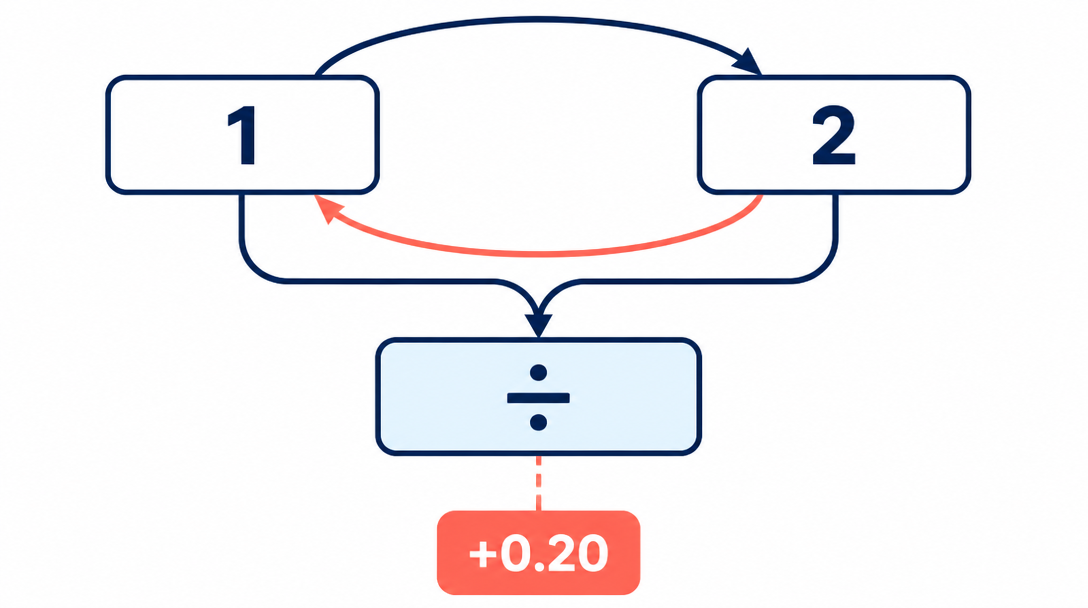
One forward and one backward vault earns +0.20
The 2025–2028 Code added a 0.20 bonus to the two-vault average when the two vaults have saltos in different directions (forward and backward) in the second flight. Both vaults must be performed without a fall to earn it. "Cuervo"-type vaults (a front handspring entry that half-turns into a backward salto off the table) count as forward vaults.
Gymnastics Coaching's summary of the women's code changes describes the bonus as an incentive to perform vaults from contrasting families. FIG's WAG Help Desk (2nd edition, August 2026, PDF) collects the official clarifications on how the rule is applied.
Examples of two-vault combinations
Using the values in the vault table, common pairings work out as follows (simple average of the two D-scores plus bonus; actual scores also depend on the E-score and neutral deductions):
Vault 1 | Vault 2 | Groups | Directions | Average D + bonus |
|---|---|---|---|---|
Cheng (5.60) | Yurchenko double twist (5.00) | 5 and 4 | Forward + backward | 5.30 + 0.20 |
Yurchenko double twist (5.00) | Round-off half-on, layout front with 1/2 twist (4.80) | 4 and 5 | Backward + forward | 4.90 + 0.20 |
Rudi (5.40) | Tsukahara layout with 1½ twist (4.80) | 2 and 3 | Forward + backward | 5.10 + 0.20 |
Amanar (5.40) | Tsukahara layout with 2/1 twist (5.20) | 4 and 3 | Backward + backward | 5.30 (no bonus) |
As the last row shows, two vaults from different groups do not earn the bonus if both finish with a backward salto. Part of the reason top vaulters now pair a backward Yurchenko with a forward vault such as the Cheng is to collect this bonus.
Women's Vault at the 2026 World Championships: Contenders and Their Vaults
Women's schedule (local time and Japan time)
According to International Gymnast's competition schedule, the main women's sessions in Rotterdam are as follows (Japan time is local time plus seven hours):
Session | Rotterdam time | Japan time |
|---|---|---|
Women's qualification (Japan in subdivision 2) | Oct 18, 17:50–19:10 | Oct 19, 0:50–2:10 |
Women's team final | Oct 21, 19:30–22:00 | Oct 22, 2:30–5:00 |
Women's all-around final | Oct 22, 19:30–22:00 | Oct 23, 2:30–5:00 |
Apparatus finals day 1 (incl. women's vault and uneven bars) | Oct 24, 14:00–18:00 | Oct 24, 21:00–1:00 |
The women's vault final is on October 24. The gymnasts with the highest two-vault averages in qualification advance. For the full schedule and storylines, see our 2026 Worlds Rotterdam schedule and viewing guide.
Vaults seen in podium training
International Gymnast's report on the first day of women's podium training on October 15 described these vaults. Matched against the vault table:
Gymnast (country) | Vaults in podium training | Value and group | Bonus condition |
|---|---|---|---|
Claire Pease (USA) | Cheng / Yurchenko double twist | 5.60 (G5) / 5.00 (G4) | Met (forward + backward) |
Karina Schönmaier (Germany) | Yurchenko double twist / round-off half-on, layout front half-off | 5.00 (G4) / 4.80 (G5) | Met (backward + forward) |
Lisa Vaelen (Belgium) | Handspring Rudi / Tsukahara layout with 1½ twist | 5.40 (G2) / 4.80 (G3) | Met (forward + backward) |
Aiko Sugihara (Japan) | Yurchenko double twist | 5.00 (G4) | – (one vault reported) |
Sabrina Voinea (Romania) | Yurchenko double twist | 5.00 (G4) | – (one vault reported) |
The report says Pease landed both her Cheng and her Yurchenko double twist, and that Voinea's double twist was somewhat untidy in the air. Which vaults each gymnast actually submits will only be confirmed by the numbers she shows in qualification.
Vault medal contenders
International Gymnast's women's preview named these gymnasts as the main vault contenders:
- Rebeca Andrade (Brazil): a world and Olympic vault champion, whose execution and amplitude on both vaults set her apart from the field
- Angelina Melnikova: the defending world vault champion
- Claire Pease (USA): debuted a Cheng at the U.S. world team selection event
- Yeo Seo-jeong (South Korea): world and Olympic vault bronze medalist and a strong medal contender
- Karina Schönmaier (Germany) and Ellie Black (Canada): credentials to challenge for a place in the final
Japan: Aiko Sugihara's Yurchenko double twist
The same podium training report described Aiko Sugihara's Yurchenko double twist as "one of the finest" in the world, and noted that Japan delivered an exceptionally consistent session across all events. Sugihara is the reigning world floor champion, and a clean 5.00 vault from her is an important building block for Japan's team total. For Japan's roster and the team medal race, see our article on Japan's women's team at the 2026 Worlds.
Summary
This guide listed the main women's vaults, their difficulty values and how vault is scored, based on the vault table in the FIG WAG Code of Points 2025–2028.
- Women's vaults fall into five groups based on the entry onto the table and whether there is a salto
- On vault, the D-score is the vault's value in the table: Yurchenko double twist 5.00, Amanar 5.40, Cheng 5.60, Produnova 6.00, Biles 6.40
- One vault in qualification, team and all-around; two vaults from different groups, averaged, in apparatus finals
- Since 2025, one forward and one backward vault without a fall earns a 0.20 bonus
- The women's vault final at the 2026 Worlds is on October 24 (14:00 in Rotterdam)
Floor, which most vaulters also compete, is judged together with its music. If you would like to talk about song choice, editing or a 90-second structure, take a look at our competition floor music production, offered from the perspective of a former gymnast and an artist.