Zhang Boheng Out of 2026 Worlds: D-Score Impact on China, Japan
Zhang Boheng has withdrawn from the 2026 Worlds and Lan Xingyu replaces him. We break down the Asian Games team final to see what it means for China and Japan.
This article reflects information available as of October 12, 2026.
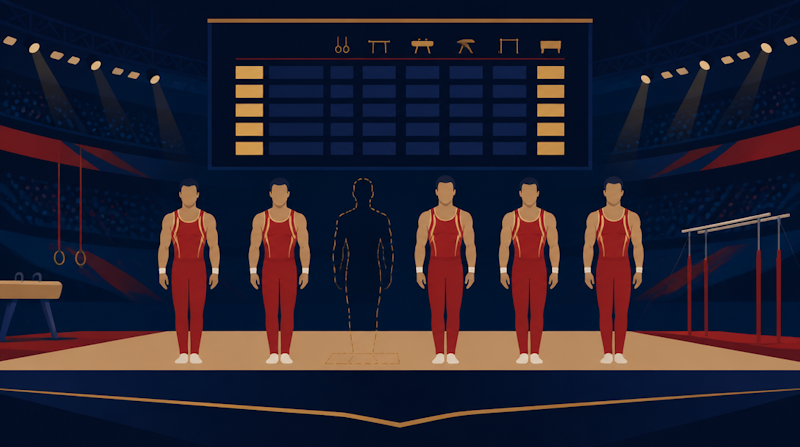
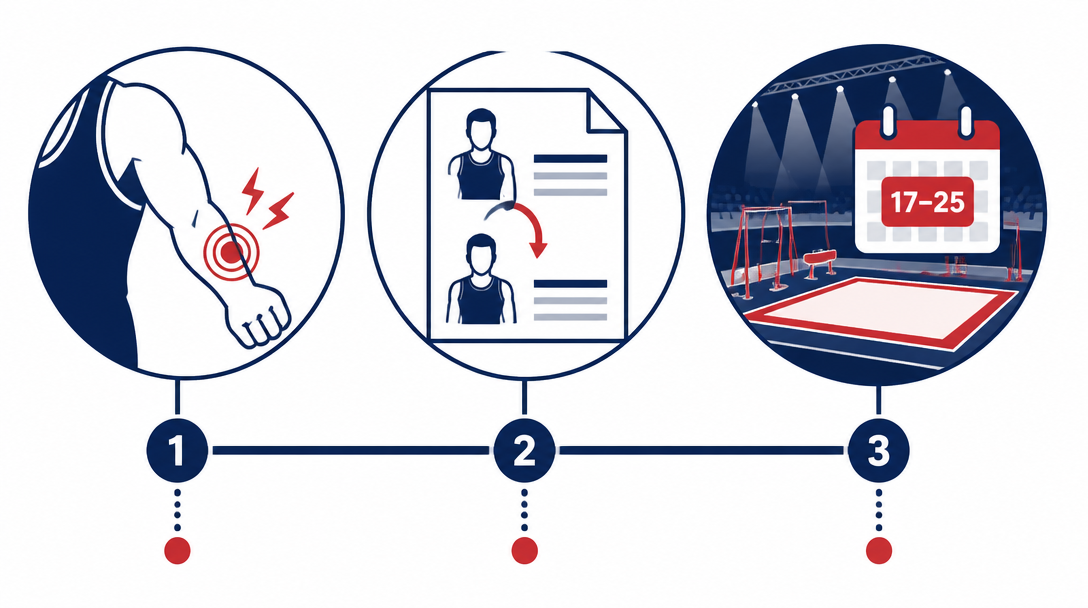
China will go to the 2026 World Artistic Gymnastics Championships in Rotterdam without Zhang Boheng. Its all-around star has withdrawn with an arm injury picked up before the Asian Games. The updated entry lists now include Lan Xingyu, the 2021 world rings champion, in his place. In Rotterdam, the top three men's teams earn team places at the LA28 Olympics, and China's lineup for its gold-medal fight with Japan changed less than two weeks before the opening day.
This is an analysis written from a Japanese perspective by the developer of a D-score calculator for men's artistic gymnastics. Instead of simply repeating the news, we break down the Asian Games team final apparatus by apparatus and use the logic of the D-score (difficulty value) to look at what Zhang's absence really changes for China, and for Japan.
Zhang Boheng Withdraws from the 2026 Worlds: What Happened
Lan Xingyu replaces Zhang on the entry list
Gymnastics Now's list of every competitor announced for the 2026 Worlds (updated October 11) shows China's men's team as Lan Xingyu, Zou Jingyuan, Yang Haonan, Tian Hao and Li Hongyan. Zhang Boheng is not on it. International Gymnast's Rotterdam men's preview confirms that Lan will replace Zhang, who is out injured.
International Gymnast also writes that losing Zhang strengthens Japan's position in the team competition. That is not an overstatement. Zhang won all-around silver at the 2025 World Championships in Jakarta and then took both the team and all-around gold medals at the Asian Games in Nagoya in September. Losing him affects the whole men's competition, not only China.
An injury carried through the Asian Games
According to a September 28 report by Sina Sports, Zhang strained the biceps of his left arm about two weeks before the Asian Games. He also reacted badly to athletic tape, so he could not protect the arm in the usual way. He still competed in the team final and the all-around and won both, then pulled out of the apparatus finals.
When he withdrew, Zhang said that "the team always comes before the individual," and made it clear that he wanted to recover for the team final at the World Championships (Sina Sports, September 24). In the end, Rotterdam came too soon.
The 2026 Worlds schedule and the LA28 team places
The 2026 World Championships run from October 17 to 25 at Rotterdam Ahoy. Men's qualification takes place on October 17 and 18, the men's team final on October 20, the men's all-around final on October 22, and the apparatus finals on October 24 and 25 (overview of the 2026 World Championships).
- Men's qualification: October 17–18
- Men's team final: October 20 (7:00 p.m. local time, 2:00 a.m. on October 21 in Japan)
- Men's all-around final: October 22
- Apparatus finals: October 24–25
As International Gymnast notes, the top three teams in both the men's and women's team finals qualify full teams for the 2028 Los Angeles Olympics. For China, an Olympic team place is on the line, just as it is for everyone else. For the full schedule and storylines, see our guide to the 2026 Worlds in Rotterdam.
If you want to see for yourself how routine construction changes a team's difficulty, try Gymnastics AI, our D-score calculator. It follows the FIG 2025–2028 Code of Points and includes a database of more than 790 skills, so you can build a routine on any of the six men's apparatus and see its D-score.
China's Men's Team for the 2026 Worlds: What Changed After the Asian Games
The five Chinese gymnasts heading to Rotterdam
Here is China's team for Rotterdam, with each gymnast's main credentials. Hong Yanming is listed as the alternate (championships overview).
Gymnast | Main credentials and role |
|---|---|
Zou Jingyuan | Parallel bars specialist; 2026 Asian Games parallel bars champion |
Lan Xingyu | Rings specialist; 2021 world rings champion, 2025 world rings bronze, 2026 Asian Games rings champion |
Tian Hao | 2026 Asian Games high bar champion |
Yang Haonan | Described by International Gymnast as China's national champion |
Li Hongyan | Member of China's 2026 Worlds team |
Lan's career is summarized in his profile. He became world rings champion in Kitakyushu in 2021 and won team and rings gold at the 2022 Asian Games in Hangzhou. He has been China's leading rings worker for years.
How the lineup differs from the Asian Games team
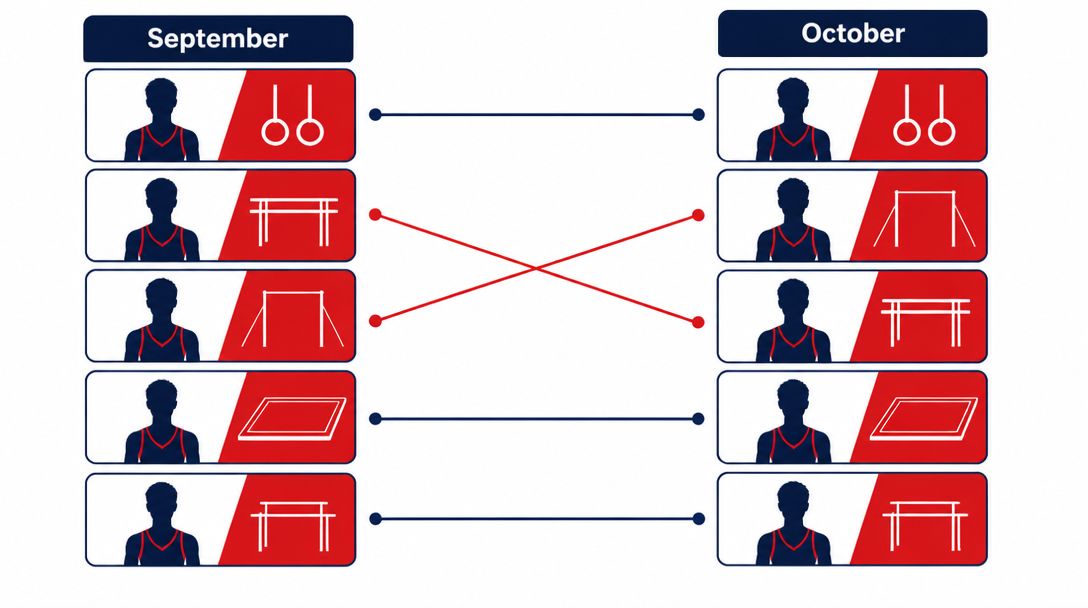
China's team gold at the Asian Games came from Zou Jingyuan, Zhang Boheng, Lan Xingyu, Sun Wei and Tian Hao (Sina Sports). Compared with the Rotterdam roster:
- On both teams: Zou Jingyuan, Lan Xingyu, Tian Hao
- Asian Games only: Zhang Boheng, Sun Wei
- Worlds only: Yang Haonan, Li Hongyan
In other words, China keeps all three of its Asian Games apparatus champions (parallel bars, rings and high bar) but loses its all-around champion. The next section uses the actual team final scores to show where that matters. For background on China's generational change, see our D-score analysis of China's Asian Games selection.
Breaking Down the Asian Games Team Final: Where China's 1.269-Point Lead Came From
Apparatus totals, side by side
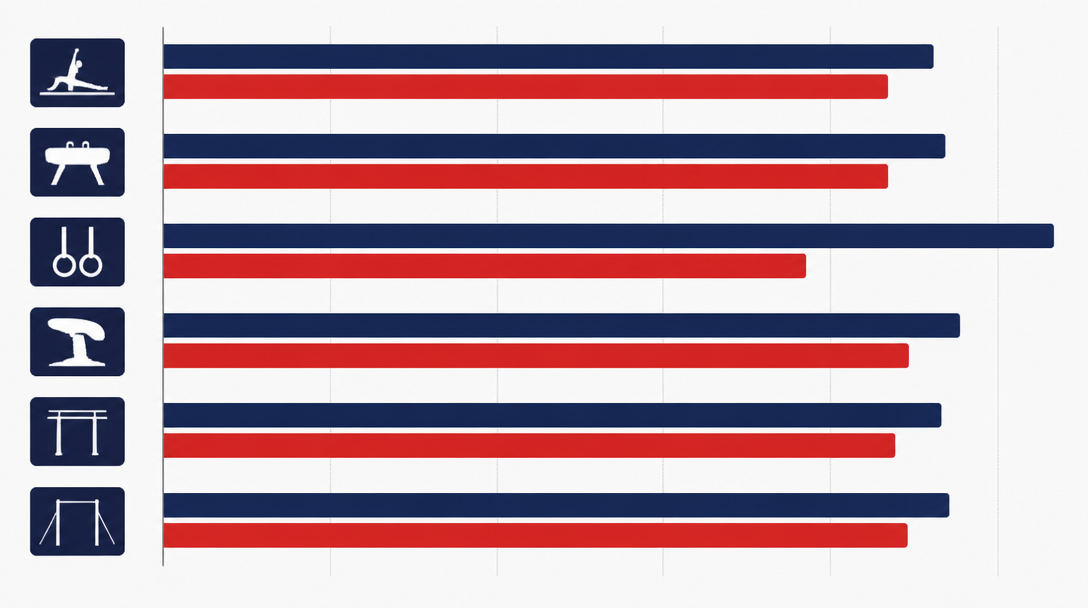
In the men's team final at the Asian Games on September 23, China won gold with 255.095 and Japan took silver with 253.826. The apparatus totals reported by THE DIGEST (via Yahoo! News Japan) show exactly where the gap opened.
Apparatus | Japan | China | Difference (Japan − China) |
|---|---|---|---|
Floor | 41.699 | 41.365 | +0.334 |
Pommel horse | 41.265 | 41.433 | −0.168 |
Rings | 43.066 | 44.099 | −1.033 |
Vault | 42.899 | 43.399 | −0.500 |
Parallel bars | 43.132 | 43.699 | −0.567 |
High bar | 41.765 | 41.100 | +0.665 |
Total | 253.826 | 255.095 | −1.269 |
China's edge: rings, parallel bars and vault
China outscored Japan by a combined 2.268 points on four apparatus, and almost half of that, 1.033 points, came on rings alone. Parallel bars added 0.567 and vault 0.500. Rings and parallel bars are the events of Lan Xingyu and Zou Jingyuan, the Asian Games champions on those apparatus, and both of them are going to Rotterdam.
Japan's edge: floor and high bar
Japan won two apparatus, floor (+0.334) and high bar (+0.665), for a total of 0.999 points. In the team final format, three gymnasts compete on each apparatus and all three scores count ("three-up, three-count"), so every fall and every tenth of difficulty goes straight into the team total. For how the qualification and final formats differ, see how team scores are calculated in gymnastics.
What Zhang's Absence Means, Read Through the D-Score
China loses a gymnast it could use on all six apparatus
Zhang won the Asian Games all-around with 85.065, ahead of Shinnosuke Oka (84.698) and Daiki Hashimoto (83.865), with all three medalists within half a point (Qatar Tribune). A gymnast who scores well on all six apparatus gives a head coach freedom: on every event, the coach can pick the three best options.
In a three-up, three-count final, the choice of who goes up where decides how much difficulty a team puts on the scoreboard. Remove one all-arounder and the options narrow, especially on apparatus such as floor, pommel horse, vault and high bar, where China has fewer specialists and needs a reliable third routine. China's lead at the Asian Games came on rings, parallel bars and vault, while Japan was already ahead on floor and high bar. Zhang's absence is therefore most likely to widen the gaps on the apparatus where Japan was already stronger.
You can test this kind of swap yourself with Gymnastics AI. Pick skills, put them in order, and the app calculates difficulty values, element group requirements, connection bonuses and the dismount value automatically, which makes it easy to compare lineups before the competition starts.
Lan Xingyu's 5.9 D-score on rings
Lan brings one of the highest difficulty values in the world on rings. In the rings final at the 2025 Worlds in Jakarta he scored 14.500 (D 5.900, E 8.600) for bronze (NetEase Sports). At the 2026 Asian Games he won the rings final with 14.933.
In that same 2025 rings final, fourth place went to Zhang Boheng with 14.466. So China also loses a strong rings routine, but with Lan in the lineup it should be able to keep the rings advantage that produced the largest single gap at the Asian Games (+1.033).
In a three-up, three-count final, 0.1 per routine adds up to 1.8 points
A team final adds up 18 routines: six apparatus times three gymnasts. A difference of just 0.1 per routine becomes 1.8 points over 18 routines. At the Paris 2024 Olympics, Japan won the men's team final with 259.594 to China's 259.062, a margin of only 0.532 (Paris 2024 men's team final results). China's 1.269-point win at the Asian Games works out to only about 0.07 per routine. Even a small drop in China's average per routine without Zhang would be enough to change the result.
What It Means for Japan in the Team and All-Around Finals
Japan defends its titles from a stronger position
Japan are the reigning Olympic (Paris 2024) and world (2023) team champions, and International Gymnast names them the leading contender for team gold. Japan's team is Daiki Hashimoto, Shinnosuke Oka, Shohei Kawakami, Ryosuke Doi and Fusuke Maeda (Gymnastics Now competitor list). The lineup is not identical to the one that won Asian Games silver. We look at each gymnast's role in our analysis of Japan's 2026 Worlds team.
The all-around race now centers on Hashimoto and Oka
At the 2025 Worlds in Jakarta, Hashimoto won the all-around with 85.131 and Zhang took silver with 84.333, a gap of 0.798 (World Journal). Zhang then beat both Japanese stars at the Asian Games. Without him, the fight for all-around medals is far more likely to revolve around Hashimoto and Oka.
Japan has its own health questions, though. At the Asian Games, Oka was managing a back injury and left out the skills that hurt or looked likely to hurt, lowering his difficulty (New Straits Times). How much of his difficulty he can put back in Rotterdam will matter in both the team and all-around finals.
China's pillars are still standing
China still brings all three of its Asian Games apparatus champions: Lan on rings, Zou on parallel bars and Tian Hao on high bar. Specialists with very high D-scores will keep producing big numbers, so even with the advantage, Japan will still need to avoid the small errors that decide close team finals. For a team-by-team comparison of the favorites, see our 2026 Worlds men's team preview (written before Zhang's withdrawal).
What to Watch at the 2026 World Championships
The men's team final is on October 20
The men's team final starts at 7:00 p.m. local time on October 20, which is 2:00 a.m. on October 21 in Japan. The top eight teams from qualification (October 17–18) reach the final. In qualification, four of the five gymnasts compete on each apparatus and the best three scores count, so China's use of its new lineup will already be visible in qualification.
Three things to watch
- China's third routine on floor, pommel horse, vault and high bar. Who fills the spots Zhang used to cover? Qualification will show the likely team final lineup.
- The rings and parallel bars gap. These two apparatus produced about 1.6 points for China at the Asian Games. How much difficulty Lan and Zou can deliver is China's lifeline.
- Japan on high bar and floor. These were Japan's winning apparatus at the Asian Games. Extending those margins is the most direct route to team gold.
Knowing the composition requirements (CR) and how difficulty is counted on each apparatus makes the numbers on the scoreboard much easier to read as the competition unfolds.
Summary
- China's all-around star Zhang Boheng has withdrawn from the 2026 Worlds with a left biceps injury, and former world rings champion Lan Xingyu takes his place.
- China beat Japan by 1.269 in the Asian Games team final, but most of that gap came on rings, parallel bars and vault, and China's rings and parallel bars pillars are still on the team.
- What China loses is an all-arounder it could use anywhere, which may widen Japan's existing advantage on floor and high bar.
- In a three-up, three-count final, 0.1 per routine adds up to 1.8 points; the Paris 2024 team final was decided by 0.532.
- The men's team final is on October 20 (2:00 a.m. October 21 in Japan), with LA28 team places for the top three.
If you'd like to simulate each team's routine difficulty before you watch, try Gymnastics AI. It is free and available on iOS and Android.