Women's Floor Tumbling Skills: Types, Names and Difficulty
A guide to women's floor tumbling skills under the FIG 2025-2028 Code: salto groups, body positions, twist counting, named skills like the Silivas and Biles.
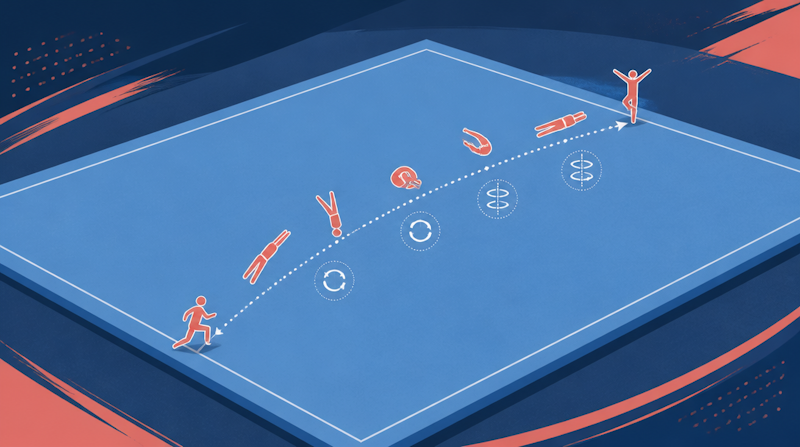
Of all the skills in a women's floor routine, tumbling is what makes an arena roar. In the few seconds between the run and the landing, the direction of the salto, the body shape, the number of rotations and the number of twists decide both the name of the skill and its difficulty value. This guide uses the Table of Elements in the FIG Women's Artistic Gymnastics Code of Points (2025–2028) to explain the main types of floor tumbling skills, what they are called, how much they are worth and how judges evaluate them.
Commentators say "Biles" or "Silivas" as if everyone knows the difference. Once you understand how floor skills are grouped and named, you will watch the 2026 World Championships in a completely different way.
What Is Floor Tumbling? The Basics Before the Skill List
Acro Elements vs. Dance Elements
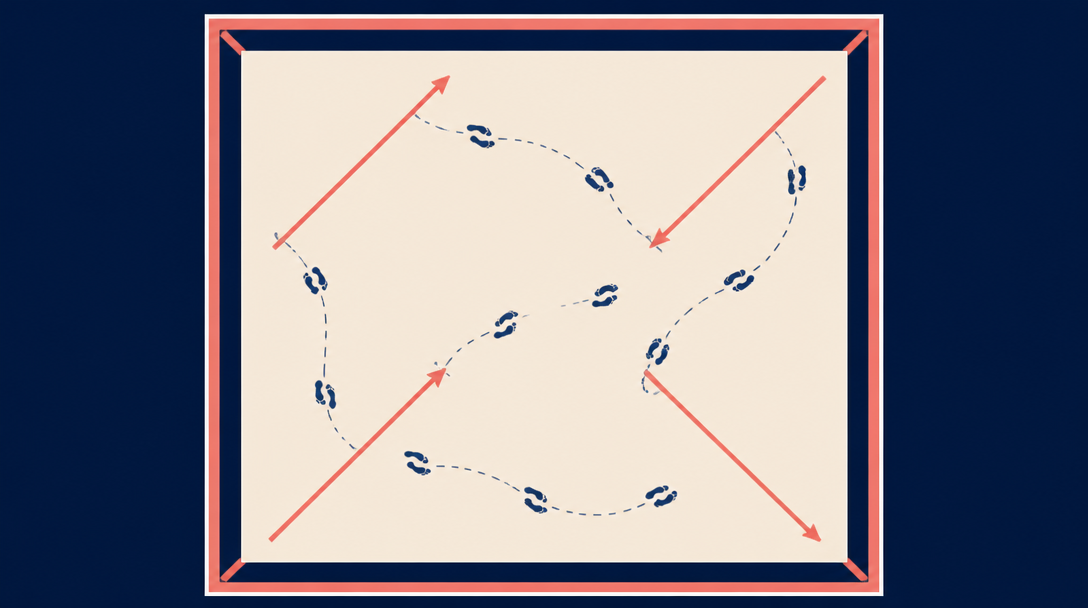
Skills on women's floor fall into two families: dance elements and acrobatic (acro) elements. Dance elements are leaps, jumps, hops and turns performed on the feet. Acro elements are saltos, handsprings and other skills where the body goes upside down. Dance elements are covered in our guide to floor leaps, jumps and turns, so this article focuses on acro elements, in other words tumbling.
According to the FIG Women's Code of Points 2025–2028, a maximum of eight elements, including the dismount, count toward the Difficulty Value on floor. At least three must be dance elements, at least three must be acro elements, and the remaining two can be either. Tumbling therefore makes up close to half of a gymnast's D-score.
What Counts as an Acro Line
A single tumbling pass across the diagonal is called an "acro line" in the Code. An acro line is a minimum of two directly connected flight elements, one of which must be a salto. A round-off, back handspring and back salto, for example, are all flight elements and finish with a salto, so they form an acro line.
- A routine may contain a maximum of four acro lines
- Difficulty in any additional acro line is not counted
- Any acro element performed after the last counting acro line is not counted
- Failing to land on the feet first from a salto still counts as an acro line
British Gymnastics summarises the same rules in its judges' guide, the BG WTC Floor Help Sheet 2025–2028.
Where Tumbling Fits in the Routine
Floor is performed on a 12 m × 12 m spring floor, and a women's routine may last no longer than 90 seconds (Wikipedia: Floor (gymnastics)). At international level, gymnasts build those 90 seconds around up to four tumbling passes, linked by dance elements, turns and choreography.
Music and choreography are what connect one pass to the next. Where a gymnast sets off on a pass and where she hits a pose is inseparable from how the music develops. If you want music built around your routine structure, you can work with a former gymnast and recording artist through our competition floor music service.
Floor Skill List (Acro): The Three Element Groups
Hand Support Elements (Group 3)
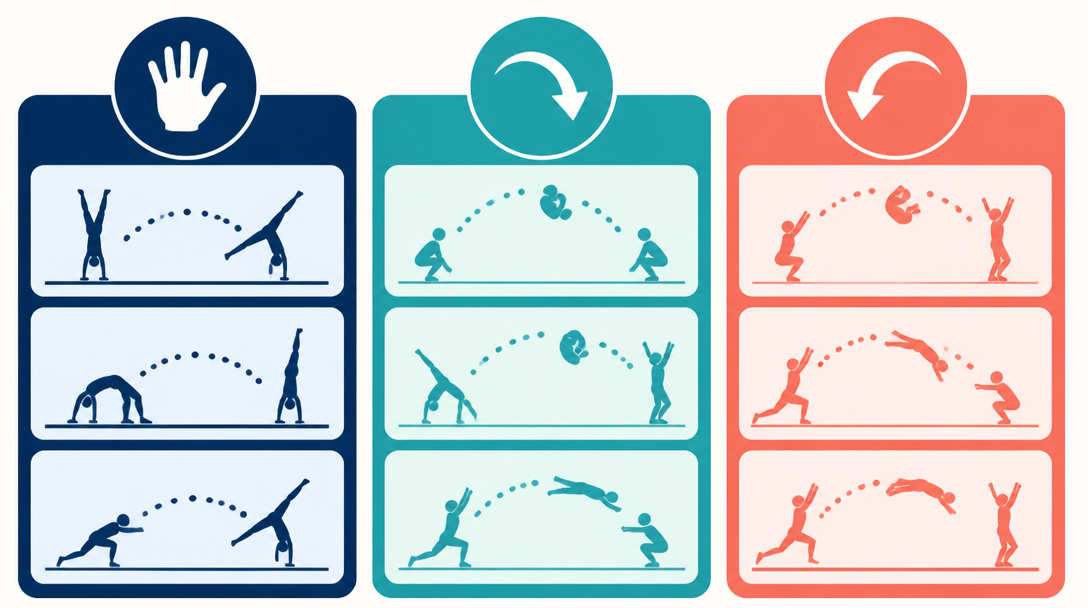
The FIG Table of Elements divides women's floor skills into five groups. Group 1 is leaps, jumps and hops, Group 2 is turns, and the acro elements sit in Groups 3 to 5. Group 3 is hand support elements: handstands, front handsprings, round-offs and flic-flacs (back handsprings).
Round-offs and flic-flacs are A-value elements, but they are mainly used as connecting skills that build momentum into a salto rather than shown on their own. A front handspring with a full twist is listed as the "Mostepanova", a C-value skill.
Saltos Forward and Sideward (Group 4)
Group 4 covers saltos that rotate forward and sideward. A front salto tucked or piked is an A, a front layout starts at B, and the value rises with each added twist. Aerial cartwheels and aerial walkovers belong here too, as does the Arabian: a backward take-off with a half twist into a forward salto.
Saltos Backward (Group 5)
Group 5 holds the backward saltos, and it is where most of the hardest skills in women's gymnastics live. The range runs from an A-value back salto (tucked, piked or stretched) all the way up to a J-value double salto with three twists. The low, fast whip salto is also a Group 5 element.
Group | What it covers | Typical skills |
|---|---|---|
3 Hand support | Skills supported on the hands | Round-off, flic-flac, front handspring, Mostepanova |
4 Saltos fwd & swd | Saltos rotating forward or sideward | Front salto, Arabian, Podkopayeva, Dos Santos |
5 Saltos bwd | Saltos rotating backward | Twisting layouts, Silivas, Moors, Biles |
Body Positions and How Twists Are Counted
Tucked, Piked and Stretched
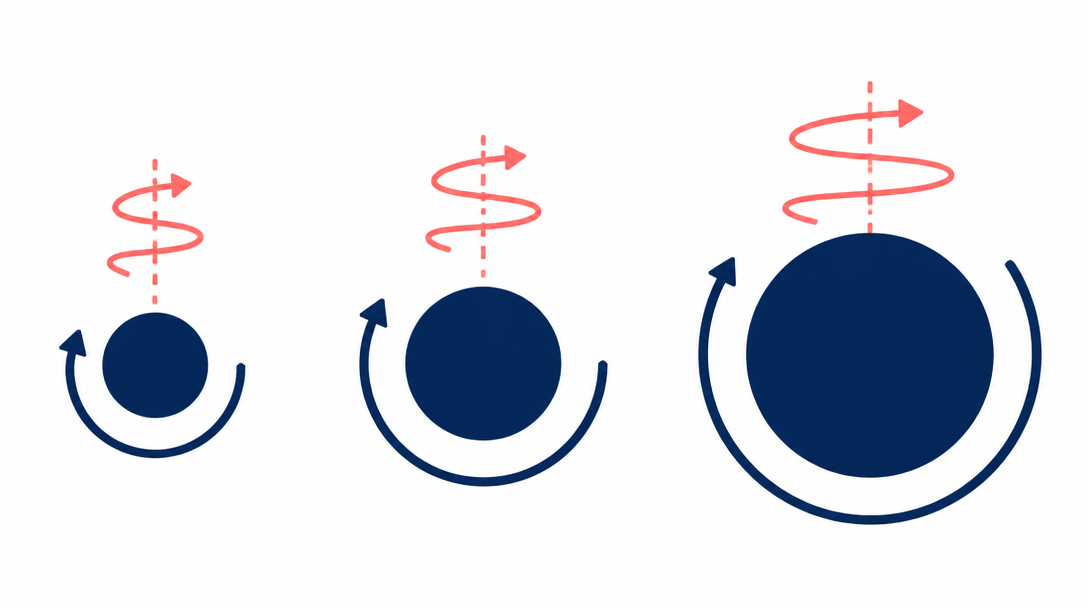
A salto's name is built from four parts: direction, body position, number of saltos and number of twists. There are three body positions:
- Tucked: knees bent and pulled to the chest. The smallest radius, so it is the easiest shape to rotate
- Piked: legs straight, body folded at the hips
- Stretched (layout): the body stays straight. The largest radius, so it is the hardest shape at any given number of rotations
Body position alone can move a skill two letters: a double back tucked is a D, while a double back stretched is an F (FIG WAG Table of Elements).
Counting Twists
A twist is a rotation around the body's long axis. A 180° turn is a half twist (1/2) and a 360° turn is a full twist (1/1). For a back layout, a half or full twist is a B, a 1½ or double twist is a C, a 2½ twist is a D, a triple twist is an E and a 3½ twist is an F. Every extra half twist moves the skill up one letter.
Reading Double Saltos with Twists
Big skills combine double saltos with twists. Because two saltos are called a "double" and two twists a "double twist", a double back tucked with two twists is known as a "double-twisting double tuck", or simply a "double double". When you hear "double double" on a broadcast, it means two twists performed inside two saltos.
Women's Floor Skill List: Tumbling by Difficulty
Backward Saltos by Difficulty
The table below lists the main backward saltos from the FIG Women's Code of Points (2025–2028) in order of difficulty. Values rise in steps of 0.10, from A = 0.10 to J = 1.00.
Value | Backward salto skills |
|---|---|
A (0.10) | Back salto tucked, piked or stretched; whip salto |
B (0.20) | Back layout with ½ twist; back salto with full twist; whip with ½ twist |
C (0.30) | Back layout with 1½ or double twist; whip with full twist |
D (0.40) | Back layout with 2½ twist; double back tucked; double back piked |
E (0.50) | Back layout with triple twist; double back tucked or piked with full twist |
F (0.60) | Back layout with 3½ twist; double back tucked with 1½ twist; double back stretched |
G–J (0.70–1.00) | Biles (G), Chusovitina (H), Silivas (H), Moors (I), Biles II (J) |
Forward and Sideward Saltos by Difficulty
Value | Forward and sideward salto skills |
|---|---|
A (0.10) | Front salto tucked or piked; side salto; aerial cartwheel or aerial walkover |
B (0.20) | Front layout; front tuck with ½ or full twist; Arabian salto |
C (0.30) | Front layout with full or 1½ twist |
D (0.40) | Front layout with double twist (Tarasevich) |
E (0.50) | Double front tucked (Podkopayeva); Arabian double tucked; front layout with 2½ twist |
F (0.60) | Double front tucked with ½ twist; Arabian double piked (Dos Santos); front layout with triple twist |
H (0.80) | Arabian double stretched (Dos Santos II) |
How to Read the Difficulty Tables
Putting the two tables side by side reveals a few patterns:
- At the same number of saltos, difficulty rises from tucked to piked to stretched
- In single saltos the number of twists drives the value; in double saltos it is the combination of twists and body position
- A double tuck is valued higher forward (E) than backward (D)
The same logic applies in men's gymnastics. For the men's six apparatus, see our gymnastics skills list for men.
Named Tumbling Skills: Silivas, Biles and More
How a Skill Gets Its Name
In gymnastics, a new skill is named after the first gymnast to perform it successfully at a major FIG competition once the FIG recognises it as new. Women's floor tumbling carries the names of great gymnasts from every era.
Named Double Back Saltos
Skill name | Description | Value | First performed |
|---|---|---|---|
Mukhina | Double back tucked with full twist | E | 1977 |
Silivas | Double back tucked with double twist | H | 1988 Seoul Olympics |
Chusovitina | Double back stretched with full twist | H | 1991 World Championships |
Biles | Double back stretched with ½ twist | G | 2013 World Championships |
Moors | Double back stretched with double twist | I | 2013 World Championships |
Biles II | Double back tucked with triple twist | J | 2019 World Championships |
Values come from the FIG Women's Code of Points (2025–2028); debut competitions come from Balance Beam Situation's named elements timeline. According to Wikipedia's list of elements named after Simone Biles, the Biles II carries a J rating, the highest-rated skill on any apparatus in women's artistic gymnastics.
Named Forward and Arabian Saltos
- Podkopayeva: double front tucked (E). Adding a half twist keeps the same name and is valued F
- Dos Santos: Arabian double piked (F). The stretched version also carries her name and is valued H
- Tarasevich: front layout with double twist (D)
- Maldonado: front layout with triple twist (F)
Forward and Arabian double saltos are valued higher than backward double saltos in the same body position (tucked: back D, front E; piked: back D, Arabian F). They let a gymnast meet the forward salto requirement while still stacking difficulty.
How Is Tumbling Scored? Composition Requirements and Connections
Composition Requirements Inside Acro Lines
The floor D-score includes four Composition Requirements (CR), each worth 0.50 for a total of 2.00. Three of the four involve tumbling:
- A dance passage of two different leaps or hops (dance)
- A salto with a longitudinal turn of at least 360°
- A double salto
- A backward salto and a forward salto in the same or different acro lines (aerials do not count as the forward salto)
Requirements 2 to 4 must be performed inside acro lines. As Gymnast Gem's guide to women's floor points out, two connected single saltos do not replace the double salto requirement. For the full scoring picture, including how CRs are credited, see our guide to women's floor scoring.
Tumbling Connections (CV)
Connecting saltos earns Connection Value (CV). For saltos without hand support connected directly, A+D and C+C earn 0.10, while A+E and B/C+D earn 0.20. Indirect connections, where round-offs or flic-flacs sit between the saltos, earn 0.10 for B+D or A+A+D and 0.20 for C+D/E or A+A+E (FIG WAG Code of Points, 13.4).
There are also mixed connections: a D salto directly into a B dance element, or an E salto into an A dance element, earn 0.10, but only in that order.
The Dismount and the DMT Bonus
The last counting acro line is the dismount, and the highest-valued element in it is credited as the dismount. If a routine has only one acro line, no dismount is credited, and a missing dismount costs 0.50 from the final score (BG WTC Floor Help Sheet). When a routine has more than two acro lines, a D-value or higher dismount performed without a fall earns a 0.20 bonus.
Common Deductions Around Tumbling
The E-panel also deducts for how tumbling is placed in the routine:
- The exercise starts immediately with an acro line (0.10)
- A pass is performed along the same diagonal as the previous one with no choreography in between (0.10 each)
- The exercise ends on an acro element with no choreography after it (0.10)
- Movement and the musical beat are not synchronised at the end of the exercise (0.10)
The choreography and music around each pass feed straight into how the whole routine is judged. Matching the musical peaks to the acro lines is central to how we build routines at our competition floor music service, with edits and original compositions shaped by the Code of Points.
How to Identify Women's Floor Skills When Watching the 2026 Worlds
Read the Take-off Direction
The first clue is the take-off. A backward take-off out of a round-off and flic-flac means a backward salto. Running forward straight into the skill means a forward salto. A backward take-off followed immediately by a half twist into forward rotation is an Arabian.
Watch the Body Shape and the Rotations
Next, check whether the knees are bent (tucked) or the body is straight (stretched). Double saltos rotate fast, while a double layout looks big and open in the air, and with practice the difference becomes easy to see. To count twists, watch the arms wrap in and how quickly the body changes direction.
What to Watch in the 2026 Worlds Floor Final
The 2026 World Championships run from 17 to 25 October in Rotterdam, Netherlands, with the women's floor final scheduled for 25 October at 14:00 local time (Wikipedia: 2026 World Artistic Gymnastics Championships). Japan's women's team includes Aiko Sugihara, the 2025 world floor champion (NBC Sports: 2025 World Championships results).
For Sugihara's title defence, see our 2026 Worlds women's floor preview, and for the rules on all four women's apparatus, see our guide to women's gymnastics events. Read alongside the difficulty tables above, they make it easier to see where the score gaps in the final come from.
Summary
- Women's floor tumbling falls into FIG Groups 3 (hand support), 4 (saltos forward and sideward) and 5 (saltos backward)
- A salto's value depends on direction, body position (tucked, piked, stretched), number of saltos and twists, ranging from A (0.10) to J (1.00)
- An acro line is at least two directly connected flight elements, one of them a salto, with a maximum of four per routine
- Three Composition Requirements (a salto with a full twist or more, a double salto, and both a forward and a backward salto) must be met inside acro lines
- The highest-valued named skills, such as the Silivas (H), Moors (I) and Biles II (J), are double back saltos
If you want a routine where every pass lands on the right beat, get in touch through our competition floor music service.