How Gymnastics Team Scores Work: Qualification vs Team Final
How are gymnastics team scores calculated? Learn the 5-4-3 qualification and 5-3-3 team final formats, FIG tie-break rules and a worked Paris 2024 example.
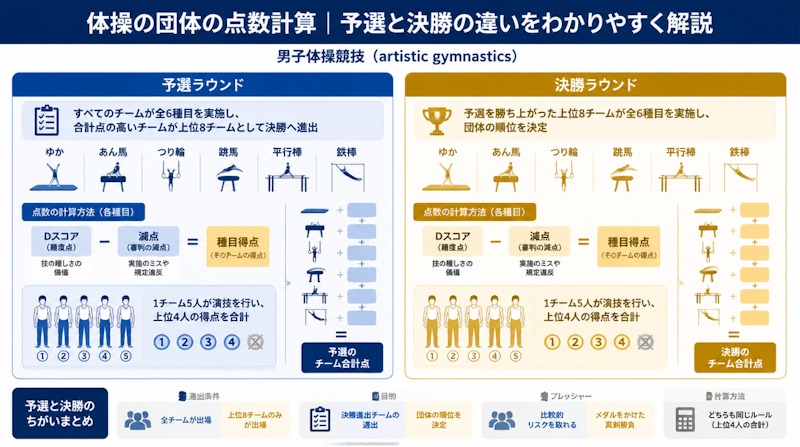
Gymnastics team scores come down to one question: on each apparatus, how many individual scores are counted toward the team total? The answer is different in qualification and in the team final. In qualification, four gymnasts may compete and the best three scores count; in the team final, three gymnasts compete and every one of those scores counts. That single difference changes how teams build line-ups, how much risk they can take, and very often who wins.
This guide walks through how team scores are calculated in artistic gymnastics under the FIG Technical Regulations 2026: the 5-4-3 qualification format, the 5-3-3 team final format, the official tie-break rules, and a worked example using the real scores from the Paris 2024 men's team final. It is also a useful primer before the team finals at the 2026 World Championships in Rotterdam this October.
How Gymnastics Team Scores Work: From One Routine to the Team Total
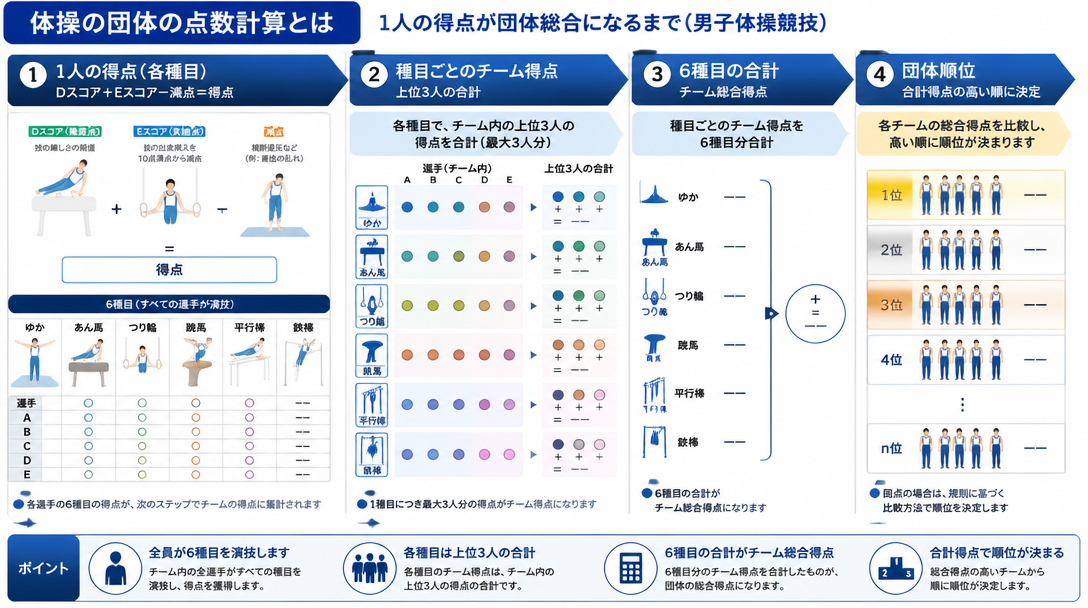
Each routine score is D-score + E-score − neutral deductions
Before looking at team totals, it helps to recall how a single routine is scored. Every exercise receives a D-score (difficulty), which reflects the value of the skills and requirements performed, and an E-score (execution), which starts from 10.0 and is reduced for errors in form, technique and landings. Neutral deductions (ND) such as stepping out of bounds or exceeding the time limit are then subtracted to produce the final score.
We break down the D-score and E-score in detail in our plain-English guide to gymnastics scoring. Team scoring is simply built on top of these individual routine scores.
If you want to see what a men's routine is actually worth in difficulty, Gymnastics AI — the D-score calculator app is a handy companion. It follows the FIG 2025–2028 Code of Points and includes a database of more than 790 skills, so you can pick skills and get the difficulty total calculated automatically — useful for comparing the routines that feed into a team's score.
The team total is the sum of the counting scores on each apparatus
Men's team competition is contested on six apparatus: floor exercise, pommel horse, still rings, vault, parallel bars and horizontal bar. Women compete on four: vault, uneven bars, balance beam and floor. Team scores are calculated in two steps:
- On each apparatus, select the individual scores that count under the rules of that phase
- Add those counting scores to get the team score for that apparatus, then add all apparatus scores together to get the team total
So the key to team scoring is just this: how many gymnasts compete on each event, and how many of their scores count? That is exactly where qualification and the team final differ.
What "5-4-3" and "5-3-3" mean
Commentators and gymnastics media often describe team formats with three numbers, such as "5-4-3" or "5-3-3." They mean:
- First number: the number of gymnasts on the team (maximum five)
- Second number: how many gymnasts may compete on each apparatus
- Third number: how many of those scores count toward the team total
At the current World Championships, qualification is effectively 5-4-3 and the team final is 5-3-3. Let's look at how scores are calculated in each phase.
Qualification Team Scoring: Four Compete, Best Three Count (5-4-3)
Team composition rules in qualification
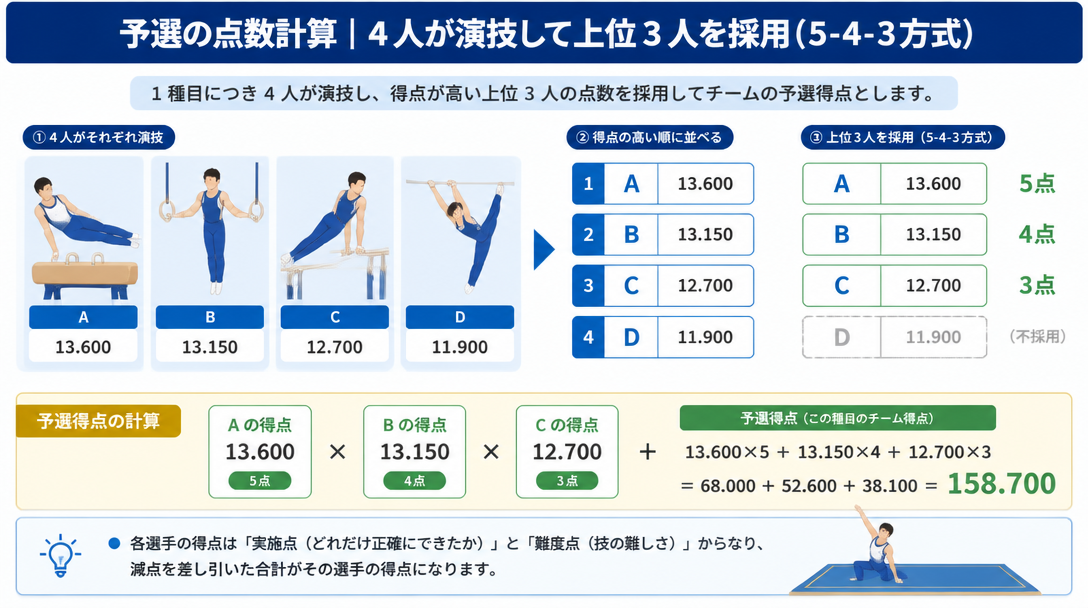
The FIG Technical Regulations 2026 state that a federation with a qualified team may enter three to five gymnasts plus one reserve. In qualification, team scores work like this:
- A maximum of four gymnasts may compete on any single apparatus
- The three highest scores on that apparatus count toward the team total
- The same calculation is made on all six apparatus, and their sum is the team's qualification total
The official Directives for the 2026 World Championships in Rotterdam repeat the same rule: up to 24 qualified teams of three to five gymnasts plus one reserve, four gymnasts per apparatus, and the three highest scores considered for the team total.
Worked example: dropping the lowest score
Here is a simple illustration. The numbers below are hypothetical, chosen only to show how the calculation works for one team on floor in qualification.
Gymnast | Floor score (hypothetical) | Counts? |
|---|---|---|
Gymnast A | 14.200 | Counts |
Gymnast B | 13.900 | Counts |
Gymnast C | 13.500 | Counts |
Gymnast D (fall on landing) | 12.800 | Dropped |
Team floor score | 14.200 + 13.900 + 13.500 = 41.600 | |
The fourth score of 12.800 is dropped, so the team's floor score is 41.600. Had someone else made the mistake instead, the remaining three good routines would still have counted. In other words, the 4-up, 3-count format gives every team a built-in safety net that can absorb one error per apparatus.
On vault, only the first vault counts for the team
Vault has a special rule. To qualify for the vault final, a gymnast must perform two different vaults, and the qualifying score is the average of the two. But the Technical Regulations specify that only the first vault counts for the all-around and team rankings.
So even when a vault specialist performs two vaults in qualification, only the first one enters the team calculation. Keep this in mind when reading team score sheets, as it explains why a specialist's vault-final average and their team contribution may not match.
Qualification decides the eight teams in the final
The eight teams with the highest qualification totals advance to the team final. Teams ranked ninth and lower receive their final placing from the qualification results.
The regulations also make clear that federations cannot ask for the results of individually qualified gymnasts — all-arounders or apparatus specialists from countries without a team — to be counted in the team ranking. Team scores are calculated only from gymnasts registered as part of the team.
Team Final Scoring: Three Compete, All Three Count (5-3-3)
The final starts from zero
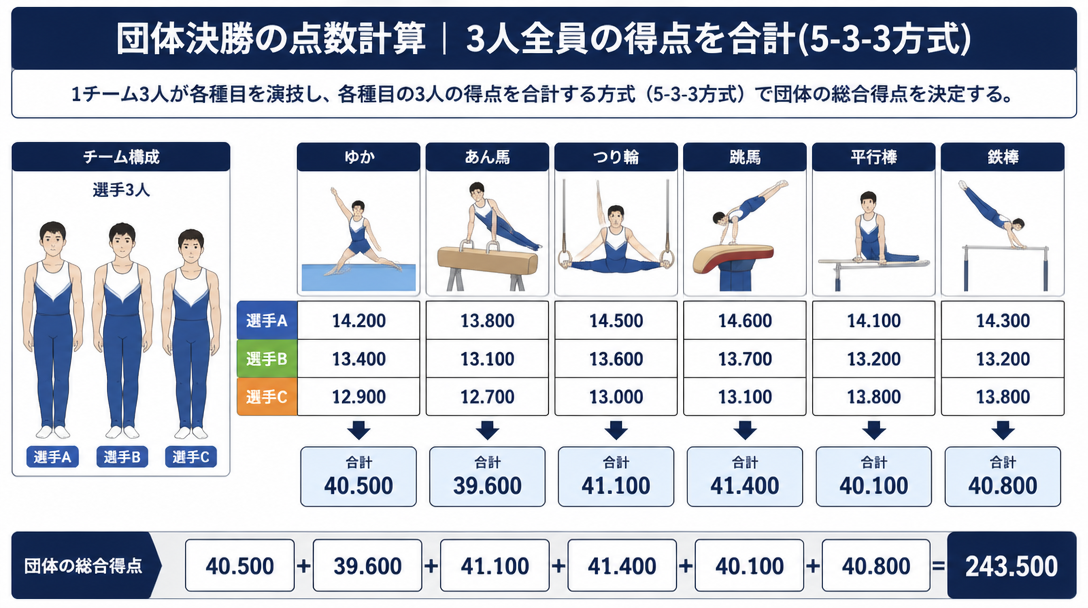
Nothing carries over from qualification. According to the Technical Regulations 2026, qualification results are not carried forward to the team final, and every team starts from zero. The top qualifier and the eighth-place qualifier begin on exactly equal terms.
The team final determines the team world champion. All eight teams compete in a single subdivision, rotating through six apparatus for men and four for women.
Every score counts — there is no drop score
In the team final, a team has a maximum of five gymnasts, three compete on each apparatus, and all three scores are added together. Unlike qualification, there is no lowest score to throw away.
Using the same hypothetical numbers, imagine Gymnasts A, B and D compete on floor in the final and Gymnast D falls again for a 12.800. Compare the two formats:
Format | Calculation | Team floor score (hypothetical) |
|---|---|---|
Qualification (4 compete, best 3 count) | 14.200 + 13.900 + 13.500 | 41.600 |
Team final (3 compete, all 3 count) | 14.200 + 13.900 + 12.800 | 40.900 |
With the same athletes, one mistake in the final stays on the board as a 0.700 loss. That is why consistency is worth far more in the team final than in qualification, and why a single fall can change the colour of a medal.
Attack with difficulty or defend with execution?
Because every score counts, coaches have to decide carefully which three gymnasts go up on which apparatus. Choosing a harder routine (a higher D-score) can raise the ceiling, while choosing a cleaner, more reliable routine (a higher expected E-score) lowers the risk. Both choices feed directly into the team score.
For example, a routine worth 0.5 more in difficulty can still finish lower than a safer one if it produces a fall, which costs 1.0 in execution. To compare how individual routines stack up, try building them in Gymnastics AI: select the skills in order and the app calculates difficulty values, element group requirements, connection bonuses and the dismount value automatically — a useful way to predict line-ups while you watch.
For a country-by-country look at the contenders' routines and difficulty, see our 2026 Worlds men's team final preview by D-score.
What Happens in a Tie? Team Tie-Break Rules
Compare the best five apparatus scores
Exact ties to three decimal places are rare in team gymnastics, but the Technical Regulations still define how to break them. If two men's teams are tied in the team final, the ranking is decided as follows:
- The team with the higher sum of its five highest apparatus team scores ranks higher
- If still tied, compare the sum of the four, then three, then two, then one highest apparatus team scores
- If the tie still remains, the teams share the same ranking
For women, who compete on four apparatus, the comparison uses the three, then two, then one highest apparatus team scores. In practice, a tie is resolved by removing each team's weakest apparatus — so a team that collapsed on one event is at a disadvantage.
Ties in qualification
The same principle applies to ties when qualifying for the team final: the sum of the five highest apparatus team scores is compared first (then four, three, two and one if needed). If the teams are still level, they share the ranking, and a draw determines their starting order in the team final.
A tie at the eighth-and-ninth-place cut line would make this rule decisive for a place in the final. When following live qualification results, it is worth watching the apparatus team scores, not just the overall totals.
Applying the tie-break to the Paris 2024 scores
Suppose Japan and China had finished level in the Paris 2024 men's team final described below. Who would have ranked higher? Removing each team's lowest apparatus score gives:
- Japan: 259.594 − pommel horse 42.332 = 217.262
- China: 259.062 − horizontal bar 39.766 = 219.296
On this calculation China would have won the tie-break, because its best five apparatus were stronger. In reality Japan won by 0.532 points, so the rule never came into play — but the exercise shows how the tie-break rewards the team that was stronger across its best events.
A Real Example: Team Scores in the Paris 2024 Men's Final
Apparatus-by-apparatus team scores
Let's check the calculation against real results. According to the Paris 2024 men's artistic team all-around record, each team selected three gymnasts per apparatus in the final, all scores were summed, and qualification scores did not carry over. The top three teams scored as follows:
Apparatus | Japan (gold) | China (silver) | USA (bronze) |
|---|---|---|---|
Floor | 43.266 | 42.532 | 42.799 |
Pommel horse | 42.332 | 43.566 | 42.466 |
Still rings | 42.633 | 45.266 | 42.732 |
Vault | 43.433 | 42.099 | 44.032 |
Parallel bars | 44.365 | 45.833 | 43.399 |
Horizontal bar | 43.565 | 39.766 | 42.365 |
Total | 259.594 | 259.062 | 257.793 |
Adding the six apparatus scores gives 259.594 for Japan and 259.062 for China, matching the official totals. Team scoring really is a straightforward sum of apparatus team scores.
How the final rotation decided a 0.532 margin
As the Olympic Council of Asia reported, China led going into the final rotation, but Su Weide fell twice on horizontal bar. Daiki Hashimoto, Japan's last competitor, then scored 14.566 on the same apparatus to lift Japan into first. The final margin was 0.532 points.
Japan's horizontal bar team score was 43.565 against China's 39.766 — a gap of 3.799 on one apparatus. Under the 5-3-3 format, two clean routines cannot hide a third that goes wrong, and a lead built over five rotations can disappear in one.
Reading strengths and weaknesses in the numbers
Comparing apparatus by apparatus, Japan outscored China on floor (+0.734), vault (+1.334) and horizontal bar (+3.799), while China was ahead on pommel horse (+1.234), still rings (+2.633) and parallel bars (+1.468).
- China posted outstanding 45-plus team scores on rings and parallel bars
- Japan scored at least 42 points on every apparatus, with no single collapse
- In the end, consistency across all six events outweighed peak scores on a few
Breaking a team score down by apparatus reveals two different strategies: winning big on specialist events, or avoiding losses everywhere.
The 2026 World Championships: Using Team Scoring as a Viewer
Schedule and team final format
The 2026 World Artistic Gymnastics Championships take place from 17 to 25 October at Rotterdam Ahoy in the Netherlands. According to the competition schedule in the Directives, men's qualification runs on 17–18 October, the men's team final is on 20 October, and the women's team final follows on 21 October.
The team final features the top eight teams from qualification in the 5-3-3 format, so every rule covered above applies directly. For the full schedule and storylines, see our 2026 Worlds Rotterdam schedule and viewing guide.
Top three teams earn places at LA 2028
The team competition in Rotterdam is also an Olympic qualifier. Under the FIG's Olympic Qualification System for Los Angeles 2028, the three highest-ranked eligible nations in the 2026 team final each earn a team quota place of five athletes. Further team places are decided by the team qualification results at the 2027 World Championships.
Japan was drawn into subdivision 4 of qualification, starting on pommel horse (Kumamoto Nichinichi Shimbun, 5 September 2026, in Japanese). The team includes Paris 2024 team gold medalists Daiki Hashimoto and Shinnosuke Oka (in Japanese). We analyse the full five-man roster in our Japan men's team for 2026 Worlds article.
What to watch during the team competition
Once you understand team scoring, these are the details worth following during the broadcast or live results:
- The fourth score in qualification: the dropped score shows how much margin a team is carrying on each apparatus
- The third gymnast in the final: the last competitor on each apparatus often has to choose between attacking and protecting the lead
- Apparatus team scores over the rotations: combining the running total with each team's remaining strong and weak events tells you whether a comeback is realistic
- Vault means the first vault: only the first vault counts in the team calculation
Summary
Gymnastics team scoring is simple addition once you know the rules. Here are the key points:
- Each routine is scored as D-score + E-score − neutral deductions, and the team total is the sum of the counting scores on each apparatus
- Qualification uses 5-4-3: four gymnasts compete per apparatus and the best three count, absorbing one mistake
- The team final uses 5-3-3: three gymnasts compete per apparatus and all three count; qualification scores do not carry over
- Men's ties are broken by the sum of the five (then four, three, two, one) highest apparatus team scores; if still level, teams share the ranking
- At the 2026 Worlds, the top three teams in the team final qualify a full team for LA 2028
If you want to calculate the difficulty behind the routines that decide team medals, give Gymnastics AI — the D-score calculator a try. Pick men's skills on all six apparatus and the D-score is calculated automatically; it is free on iOS and Android.