Uneven Bars Skills Explained: Releases, Transitions & Scoring
A guide to women's uneven bars skills: element groups, iconic releases like the Pak and Nabieva, bar-to-bar transitions, and how the Code of Points scores them.
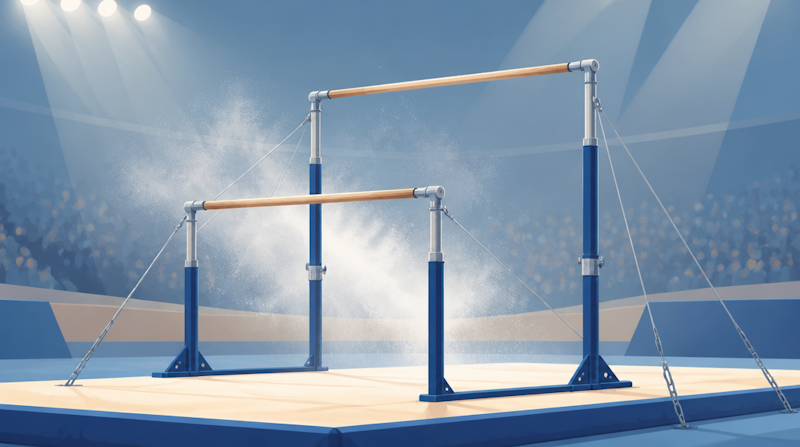
The uneven bars is the most dynamic of the four events in women's artistic gymnastics: a gymnast swings between two rails of different heights, releases her grip, and flies through the air before catching the bar again. Yet many spectators watch an entire routine without ever knowing what a skill is called or why one element scores so much higher than another. This guide sorts uneven bars skills into their main groups and walks through the signature elements, their difficulty, and the way the Code of Points turns all of it into a score.
Most gymnasts who compete on bars also perform a floor routine at the same meet. The music selection, editing, and original composition behind a competition floor track can be arranged with Daito, a former gymnast and recording artist, through competition floor music production. Understanding each apparatus is the first step toward shaping the overall world of a routine, so let us begin with the event itself.
What Kind of Event Is the Uneven Bars?
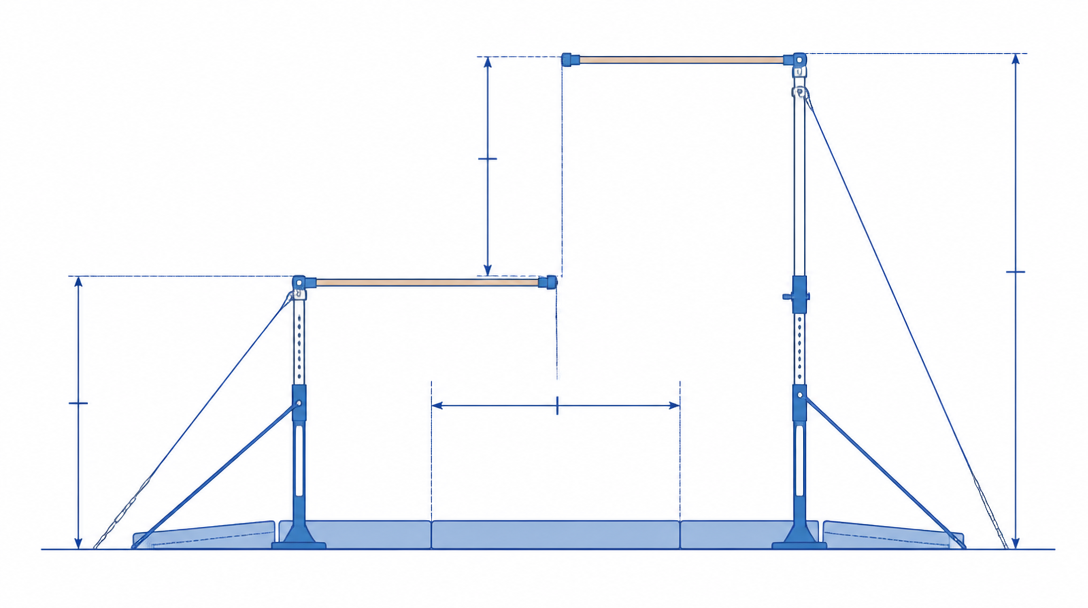
Apparatus dimensions and construction
The uneven bars are made up of two rails set at different heights, an apparatus used only in women's artistic gymnastics. According to the Japanese Wikipedia entry, the low bar sits at roughly 170 cm and the high bar at about 250 cm, while the gap between them can be adjusted within a range of about 130 to 180 cm to suit each gymnast.
Each rail is around 4 cm in diameter and about 240 cm long, and most modern bars are built with a fiberglass core wrapped in a wooden outer layer. The English Wikipedia article on the uneven bars lists the same measurements, and it is precisely this springy flex that produces the height of release moves and the power of bar-to-bar transitions.
Gymnasts wear hand guards (grips) to protect their palms and chalk the bars with magnesium carbonate to control friction. How well a gymnast harnesses the rebound of the flexing bar largely determines both the height and the stability of her skills. The shift from the old wooden rails to a fiberglass core is part of why today's gymnasts can fly higher on release moves and link elements together as fluidly as they do.
How it differs from floor and beam
Even within the same four women's events, the balance beam rewards a contrast of stillness and motion, whereas the uneven bars reward continuous rotation and flight. The thinking behind beam skills is covered in our guide to balance beam tips and skill types, and reading the two together gives a fuller picture of the women's program.
Where it sits among the four women's events
Women's gymnastics is contested across four events — vault, uneven bars, balance beam, and floor — with apparatus and scoring that differ from the six men's events. The differences in the competitive rules between the sexes are laid out in detail in our explainer on how women's and men's gymnastics differ. Note that the uneven bars are an entirely separate event from the men's parallel bars, where both rails sit at the same height.
Skill Groups on the Uneven Bars
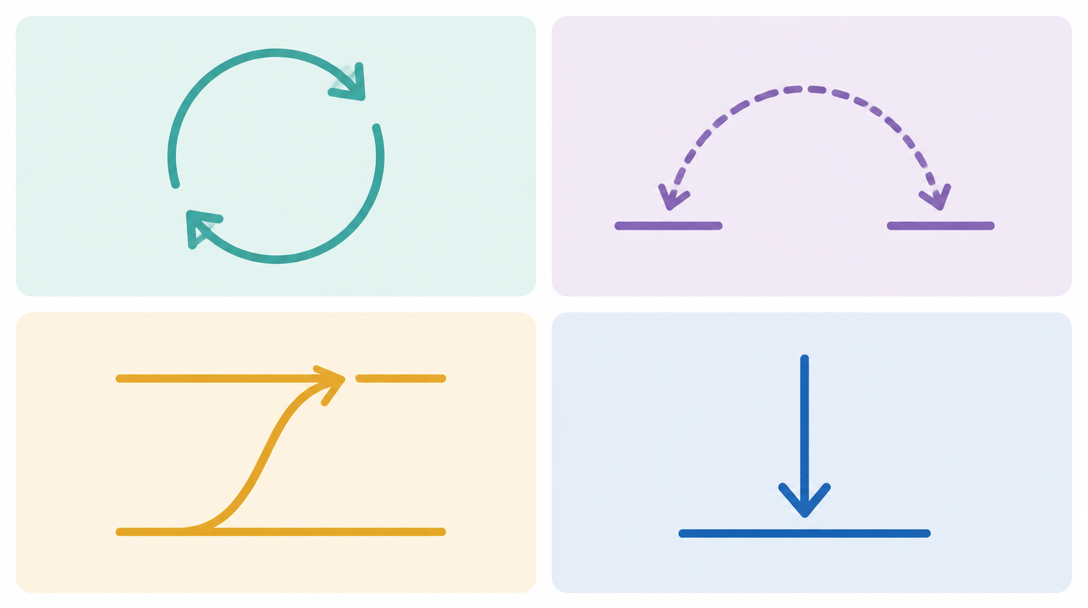
Skills fall into four broad families
Uneven bars skills are classified by the nature of the movement. The Japanese Wikipedia entry cited above organizes them into swinging and giant-swing elements that rotate around a bar, release moves where the hands let go of the bar, transition skills that travel from one bar to the other, and dismounts that bring the routine to a close.
Skill group | What it is | Representative examples |
|---|---|---|
Swinging / giant-swing elements | Rotations and swings around the bar; foundational skills such as the Stalder | Giant, Stalder |
Release moves | Letting go of the bar to rotate or twist in the air before regrasping | Tkatchev, Jaeger, Gienger |
Transition skills | Flying between the low and high bars, unique to the uneven bars | Pak salto, Shaposhnikova, Maloney |
Dismounts | Landing skills that close the routine | Double layout, Ray |
The FIG element groups (EG)
In the International Gymnastics Federation (FIG) Code of Points, these are formally defined as four element groups (EGs) and built into the composition requirements of a routine. According to the explanation of the Code of Points, satisfying each group's requirement adds to the composition score, and the higher groups must be met with elements of D difficulty or above. A routine is expected to include a flight element from bar to bar, a flight element on the same bar, an element with a change of grip, and a dismount — simply lining up hard skills will not produce a high score.
If you are watching for the first time, following each skill through these three questions makes the categories easier to spot:
- Is she rotating while still gripping the bar (giants and swinging elements)?
- Has she let go to twist or somersault in the air (release moves)?
- Is she flying between the low and high bars (transition skills)?
How the 2025–2028 rules approach it
The new 2025–2028 Code of Points introduced adjustments such as counting the eight hardest skills across an event and reworking how dismounts are handled. For the big picture of the rule changes, the Inside Gymnastics breakdown of the new code is a useful reference (that article focuses on the men, but the logic of how many skills are counted applies to the women as well).
Signature Release Moves
The Tkatchev and Jaeger families
Release moves are the showpiece of the uneven bars. The Tkatchev, in which a gymnast lets go of the bar and clears it backward in a straddle, and variations that change the grip or body position, such as the Ricna (a Tkatchev out of a Stalder), are the archetypes. The Jaeger, which rotates forward before regrasping, adds variety with a release that travels in the opposite direction. For a feel of how these skills differ in flight, the technical breakdown from The Red & Black is easy to picture.
The Gienger
A backward somersault with a half twist that regrasps the same bar is the Gienger. According to the entry on the Gienger, it was devised by the West German standout Eberhard Gienger and is a D-difficulty skill used on both the women's uneven bars and the men's horizontal bar. The added twist makes managing body position in the air harder and affects the execution (E) score.
The Nabieva, one of the hardest of all
Among all release moves, the Nabieva is one of the most difficult. The SPAIA explainer on the uneven bars describes it as a skill in which the gymnast clears the bar high in a stretched position out of a backward pike giant and regrasps, placing it in the top G-difficulty class. Russia's Tatiana Nabieva first completed it in 2010, and it has since become a hallmark of the elite. Release moves change in difficulty depending on the direction they clear the bar (facing forward or backward), whether a twist is added, and the type of regrasp, so skills that look similar can be worth very different values. When you watch, noticing which side of the bar a gymnast is flying to makes the families easier to tell apart.
Bar-to-Bar Transition Skills
The Pak salto
A charm unique to the uneven bars is the transition skill that flies from the high bar to the low bar. The classic example, the Pak salto, hangs from the high bar, swings toward the low bar, and catches it with a backward stretched somersault. According to the entry on the Pak salto, it is named after North Korea's Pak Gyong-sil, and developed versions such as the Bhardwaj, which adds a full twist, also exist.
The Shaposhnikova family
The signature skill that travels from the low bar up to the high bar is the Shaposhnikova. It swings from a giant on the low bar and flies backward to catch the high bar, a move whose original form was devised by the former Soviet gymnast Natalia Shaposhnikova. The Red & Black breakdown cited above explains that many modern bar-to-bar transitions are classified within this Shapo family.
The Maloney, Komova, and Comaneci
According to the SPAIA explainer, there are many transition skills named after the gymnasts who devised them: the Maloney, a low-to-high transition (created by Kristen Maloney, D difficulty), the Komova, which combines several movements (E difficulty), and the Comaneci, which clears the bar with a forward somersault (devised by Nadia Comaneci, E difficulty). Transition skills have a dynamic airborne phase and are the biggest highlight for spectators. Because the body is carried a long way — from the low bar to the high bar, or from the high bar to the low — they demand a precise sense of distance and a tight body line. Combining a transition with a release move makes it eligible for connection bonus, sharply raising the scoring efficiency of a routine. The best gymnasts link their transitions without a hitch, appearing almost to dance between the two bars.
How Skills Are Connected and Scored
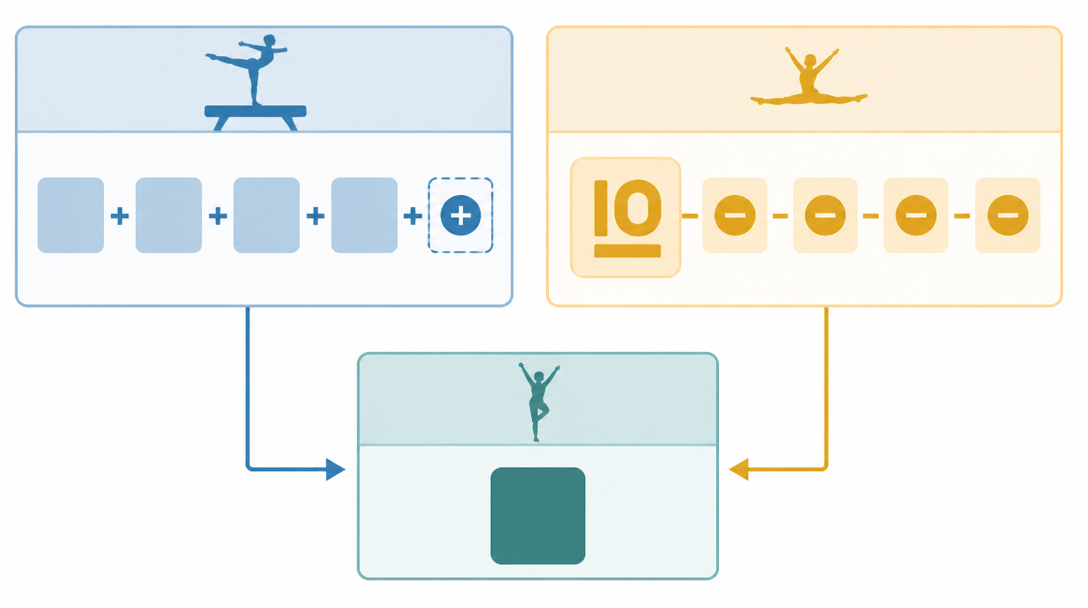
The D-score (difficulty) and connection bonus
A bars score is the sum of the difficulty value (D-score) and the execution score (E-score). According to the Code of Points explanation cited above, the D-score totals the difficulty values of the hardest counted skills, and performing hard skills in direct succession adds a connection-value bonus. A routine that links release moves one after another is a source of high scores, but it also carries a high risk of failure. The more you connect difficult skills directly — a transition into a release, a release into another release — the larger the added value. On the other hand, if an extra swing slips into the connection the bonus is not credited, so gymnasts pursue a seamless chain of motion with no wasted movement. The D-score has no theoretical ceiling, and the world's best compete by building routines with D-scores in the six-point range.
The E-score (execution) and deductions
The E-score starts from a perfect 10.0 and is reduced according to flaws in body position and landings. The Code of Points explanation cited above organizes these as small errors of 0.1, medium errors of 0.3, and large errors of 0.5, with a fall counted as a 1.0 deduction. Brushing a foot or the body against the bar is also subject to deduction. Because raising the difficulty tends to make execution messier, balancing the D-score and the E-score is the heart of building a routine.
The "composition" mindset that carries over to floor music
Which order to place skills in, and where to build the highlight — this compositional thinking is shared with the choreography and music selection of a floor routine. Unlike bars, floor is performed to music, and the way the 90 seconds are paced and the musical mood is designed feeds directly into the evaluation. For details, see our template for pacing the 90 seconds of a floor routine. Music selection and editing that respect the Code of Points, as well as original composition, can be arranged through competition floor music production, with a consistent approach all the way to score-conscious sound design.
What to Watch For on the Uneven Bars
The flow and rhythm of connected skills
A top gymnast's routine links giants into release moves into transitions without a break. If you watch the split-second pause as the hands let go and regrasp, and the way the gymnast uses the spring of the flexing bar to push herself out, the skill of the connections comes into view. Picturing the bonus stacking up every time a connection lands makes watching far more engaging. The moments when one release flows uninterrupted into the next concentrate the gymnast's timing and spatial awareness. She lets go at the point where the bar's flex is greatest and finishes the skill at its highest apex — tuning in to this rhythm reveals the overall polish of the routine.
The airborne phase and the landing
The height and twisting beauty of release and transition skills, and the landing of the final dismount, are the biggest showpieces. A backward double-stretched-somersault dismount such as the Ray introduced in the SPAIA explainer becomes a major source of bonus if it is stuck cold on the landing. It is not unusual for a single step on the landing to decide the standings.
Skills that changed history
The uneven bars have evolved over time. According to the English Wikipedia article cited above, skills performed by Olga Korbut in 1972 and Nadia Comaneci's release in 1976 transformed what had been a giant-swing-centered event into the dynamic event it is today (some of Korbut's skills are now banned for safety reasons). Knowing the background of a skill's name changes how you see the routine. The fact that so many skills carry the name of the gymnast who first completed them is official proof of their difficulty and originality. Each new skill is registered into the Code of Points when it appears, steadily pushing up the overall difficulty level of the event, and this accumulation of history is what shapes the dynamic routines we see on the uneven bars today.
Summary
The uneven bars is a spectacular event in which rotation and flight flow one into the next, even among the women's events. Grasp the classification of skills and the skeleton of the scoring, and the resolution at which you watch jumps up at once.
- The apparatus is two rails — a low bar at about 170 cm and a high bar at about 250 cm — whose springy flex produces the release moves.
- Skills can be sorted into four families: swinging/giants, release moves, transitions, and dismounts.
- Release moves include the Tkatchev, Jaeger, and Gienger, with the Nabieva in the very top difficulty class.
- Transition skills are typified by the Pak salto, Shaposhnikova, Maloney, and Komova.
- The score is the sum of the D-score (difficulty plus connection bonus) and the E-score (deductions from 10.0).
Gymnasts who take on bars almost always perform a floor routine at the same meet. If you would like to talk through floor music selection, editing, or original composition, consider competition floor music production by Daito, a former gymnast and recording artist. The support runs all the way to designing a 90-second track in light of the Code of Points.