Gymnastics Floor Music Timeline: Structuring a 90-Second Routine
Split a women's floor routine's 90 seconds into seven phases, from opening pose to final crescendo, covering tumbling passes, music accents, and editing.
A women's floor routine lasts just 90 seconds. Into that short window a gymnast must pack tumbling passes, leaps, turns, and a performance that feels fused with the music. Deciding your floor music timeline by instinct alone often b
uries the highlight in the middle or leaves you gasping by the finale. This guide breaks the 90 seconds into a seven-phase template so you know exactly what belongs where.
Why the 90-Second Timeline Shapes Your Score
Your floor music timeline is not just time management—it feeds directly into the score. Composition, music choice, and musicality all come down to what you place, and when.
The 90-Second Limit and Overtime Deduction
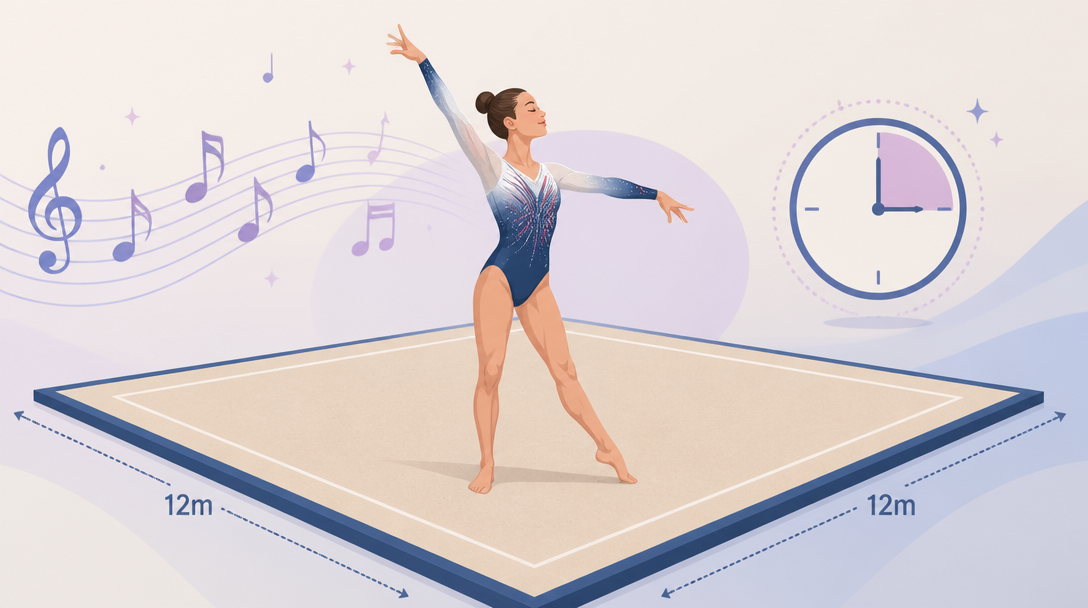
According to this breakdown of the FIG 2025–2028 women's floor rules, a routine may not exceed 90 seconds. Any movement after 1:30 draws a –0.10 neutral deduction, and skills performed after the buzzer receive no difficulty credit—a double loss. Note that the clock starts on your first intentional movement, not when the music begins, so the pause before you move is part of your 90-second budget.
Musicality Decides the Artistry Score
What separates women's floor from men's is performing to music. Judges expect you to perform the music—showing phrasing, style, and emotional range—rather than simply move to it. How you stage that connection across the 90 seconds is the heart of the timeline.
Treating the Timeline as Design
Music selection,
editing, and choreography should be built together, with the Code of Points in mind. If you want a routine track shaped around the rules by someone who understands both the sport and music production, working with a specialist such as a competition floor-music production service can help align music and composition from the start.
The 90-Second Floor Timeline: A Seven-Phase Template
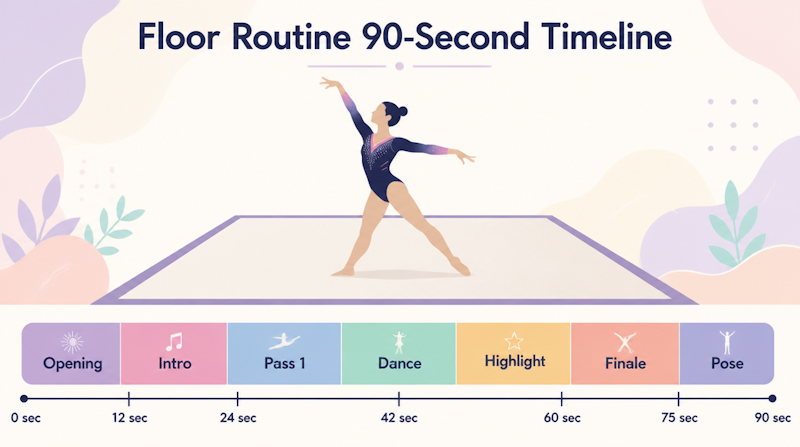
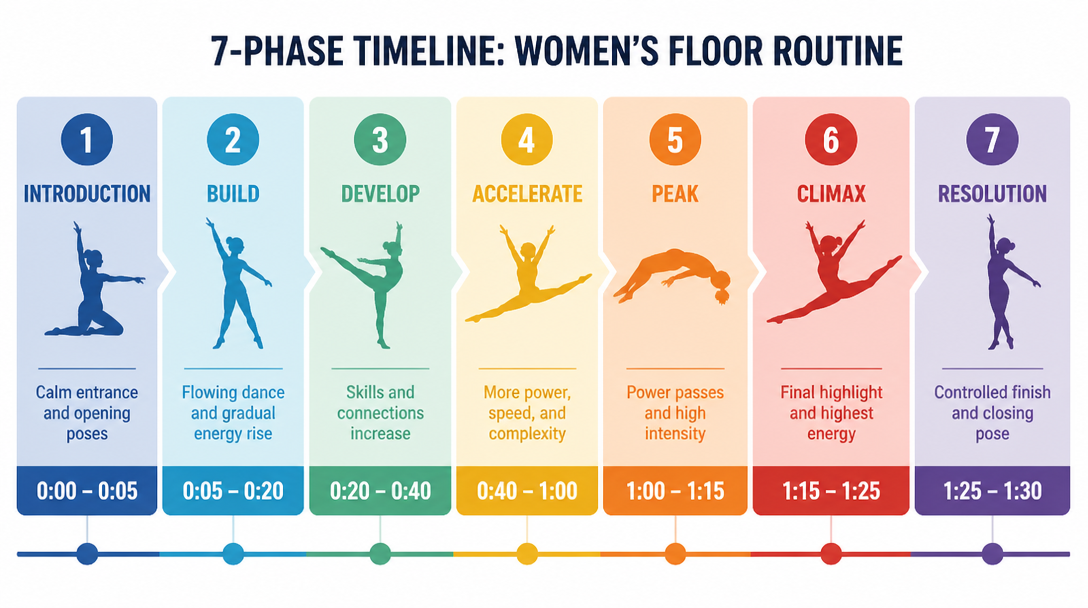
Splitting the routine into seven phases makes it clear what goes where. The structure below follows the Gymnast Gem floor music timeline.
Phase-by-Phase Timing Table
Phase | Approx. time | Focus |
|---|---|---|
1. Opening Mark | 0:00–0:05 | Strong pose on the first beat; set the tone |
2. Intro Flourish | 0:05–0:12 | Short choreography that establishes your style |
3. Pass #1 Build-Up | 0:12–0:25 | Transition into the first tumbling pass |
4. Artistic Passage | 0:25–0:35 | Leaps, turns, and controlled recovery |
5. Centerpiece + Pass #2 | 0:35–1:05 | Peak dance elements and second pass |
6. Final Crescendo | 1:05–1:25 | Last tumbling pass / dismount |
7. Resolution Pose | 1:25–1:30 | Freeze on the final beat, hold ~1 second |
These times are guidelines, adjusted by level and athlete type. But the three-act skeleton—establish the mood, place the peak in the middle, close decisively—holds at every level.
Opening a nd Intro (0:00–0:12)
The first five seconds are your first impression. A pose locked to the opening sound tells the judges instantly whether this is a power routine or an expressive one. The intro flourish is a "musical handshake" that invites the judges in.
- Match your pose to the first beat—don't move before the sound
- Use a phrase that communicates the theme of the piece
- Avoid standing right on the 12m boundary line
Placing the Highlight and Tumbling (Middle)
The 0:35–1:05 centerpiece is the peak of the routine. Layer your most difficult dance elements and the second pass over the loudest part of the track. Spend the highlight too early and the ending will feel like a letdown.
Climax and Finish (1:05–1:30)
The last 25 seconds belong to the final pass and pose. FIG composition rules require a multiple-salto dismount; a single salto costs –0.30, while a D-value or higher salto as the final element earns +0.20. Freeze on the last beat and hold for a full second to leave a sense of closure.
Tumbling Passes and How They Drive the Timeline
The biggest variable in your timeline is the number of tumbling passes, since each pass demands run-up, setup, and recovery time.
Passes by Level
Level | Tumbling passes | Effect on timeline |
|---|---|---|
Levels 6–8 | 2 | More room for dance and expression |
Levels 9–10 | 3 | Run-up/recovery grows; little slack |
Elite / FIG | 3+ | 90 seconds is almost all skills; trim every excess |
More passes mean less free space. At the elite level, even connecting steps must be timed to the music to fit inside 90 seconds.
The Breathing Room Around Each Pass
Each pass needs preparation before the run-up and a breath after landing. Cramming skills without that space makes the routine look rushed and hurts the execution score through posture and landing errors. Insert leaps or turns between passes to reset.
Stamina and Musical Rests
Ninety seconds is short, yet three full-power passes are exhausting. Design the quiet passages of the music as recovery points so you don't fade in the back half. Tie the music's dynamics to your stamina plan.
Syncing Music Accents to Choreography
Once the timeline exists, the next step is syncing accents to skills—this is where "performing the music" becomes concrete. Working with an editor who understands the Code of Points makes this far easier (competition floor-music production).
Tumbling on Strong Beats, Dance on Soft
Big movements like tumbling land best on strong accents, while leaps, turns, and expressive work sit better in softer passages, creating contrast. The Gymnast Gem timeline recommends clear beat accents for tumbling and softer moments for dance.
More Than Four 8-Counts Off = Deduction
According to Gymnast Gem's artistry deductions guide, under the 2025–2028 rules, if choreography fails to match the music for more than four consecutive 8-counts, judges must apply a deduction for lack of musical connection—up to –0.3 for that alone, with combined artistry deductions reaching –0.6. Avoid building any such disconnected stretch into your timeline.
Matching Poses to Accents
Lock the opening and closing poses to clear accents—the first and last sounds. If these are off, the whole routine reads as mistimed. In editing, adjust cut points so a strong sound lands exactly on each key pose.
Making the Timeline Work Through Selection and Editing
Turning your planned timeline into an actual track is the editing job—and forcing it here breaks the composition.
Cutting to Fit 90 Seconds
Gymnast Gem's guide to making floor music walks through using software such as Audacity or FL Studio and exporting to MP3 or WAV at 44.1 kHz / 16-bit.
- Fix the seven-phase structure and the seconds per phase first
- Choose the section of music for each phase
- Smooth the joins with crossfades
- Check the total stays under 90 seconds on the timeline
- Fine-tune so strong sounds land on key poses
What Not to Do When Splicing Tracks
When combining songs, avoid stitching unrelated fragments with no throughline. Mismatched themes read as "incoherent" and lower the artistry score. As Gymnastics Tracks emphasizes, build the music around one theme or story; match key, tempo, and mood before joining tracks.
Lyrics and Copyright (FIG vs. NCAA)
Confirm whether lyrics are allowed before choosing music. Per Gymnast Gem, most FIG and USA Gymnastics competitions require instrumental music; recognizable lyrics or spoken words trigger a –1.0 deduction, as does having no music. US collegiate NCAA competition, by contrast, permits lyrics—a widely misunderstood distinction. Always verify your federation's current rules.
Adjusting the Timeline by Age, Level, and Type
The 90-second frame is fixed, but the ideal split shifts with age, level, and the athlete's style. Use the template as a base and tune it to the performer.
Young Gymnasts (Fewer Passes)
When a routine has only one or two passes, there is less time filled by skills, so the dance and expression sections can run longer. Rather than cramming in difficulty, prioritize whether the gymnast is dancing joyfully with the music, and keep poses and accents easy to read—this makes the routine feel cohesive.
Teens and Elites (Three-Pass Routines)
With three passes, the 90 seconds is almost entirely skills, run-ups, and recovery. Keep dance elements short but dense, and overlay stamina dips onto the quiet parts of the music. Understanding how D-score and execution work (JudgeMate) helps you meet the composition requirements—a 180-degree split leap, saltos in both directions, a double salto, and a salto with a full twist, each worth -0.5 if missing—while still fitting the clock.
Matching the Split to the Athlete's Type
Power athletes should emphasize the tumbling highlights, while expressive athletes benefit from more time in the dance sections. Design the timeline around that "type" and it will stay consistent.
Summary
- Women's floor is capped at 90 seconds; overtime costs –0.10 plus lost difficulty (the clock starts on your first intentional move)
- Use the seven-phase template to build a three-act structure
- Two vs. three passes changes how much free space you have; add breathing room around each pass
- Tumbling on strong beats, dance on soft; more than four 8-counts off the music draws a deduction
- Decide the structure before cutting to 90 seconds; don't confuse FIG (no lyrics) with NCAA (lyrics allowed)
If you'd like help building selection, editing, and a 90-second structure around the Code of Points, consider competition floor-music production, which can propose original tracks and edits tailored to your routine.