Men's vs Women's Gymnastics: Events, Rules & Scoring
A complete comparison of men's and women's artistic gymnastics: events, FIG scoring rules, D-score difficulty counts, floor music, and apparatus specifications.
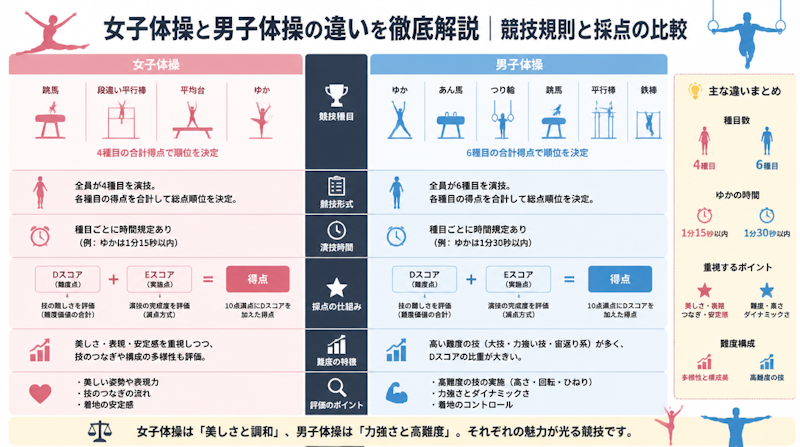
How well do you know the differences between men's and women's artistic gymnastics? Despite sharing the same sport, the two disciplines are structured quite differently: men compete across six events while women compete across four. The scoring rules also diverge in meaningful ways — from the number of skills counted toward the difficulty score to whether floor exercise is performed with music. This article draws on the FIG (Fédération Internationale de Gymnastique) Code of Points to provide a thorough comparison of men's and women's artistic gymnastics across competition structure, scoring, and apparatus specifications.
Number of Events: Men's Six vs. Women's Four
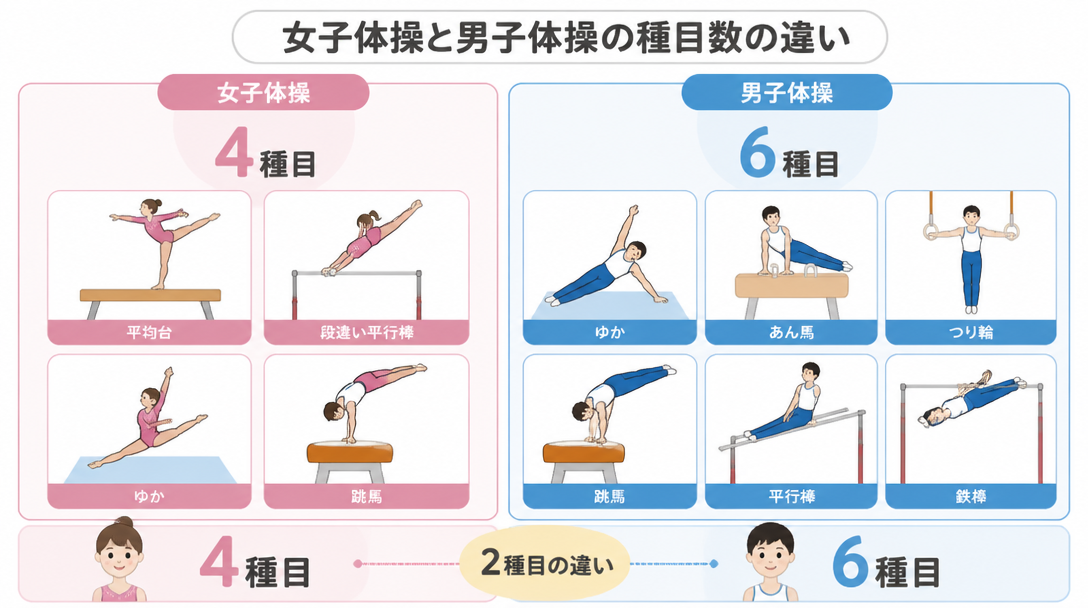
Artistic gymnastics is divided into six events for men and four for women. While the two programs share a couple of events, each gender also has disciplines entirely its own, giving the two programs distinctly different characters.
Men's Six Events
Men's artistic gymnastics comprises the following six events. According to the USA Gymnastics Men's Artistic Program, each event demands a very different physical skill set:
- Floor Exercise (FX) — Performed on a 12 m × 12 m spring floor. Gymnasts combine tumbling, acrobatic leaps, and strength elements. Maximum duration: 70 seconds.
- Pommel Horse (PH) — A 105 cm-high apparatus fitted with two pommels (handles). The gymnast supports the entire body on the arms alone and must execute continuous circular and pendulum swings without stopping.
- Still Rings (SR) — Two rings suspended 280 cm above the floor. Demands exceptional upper-body strength through a combination of strength holds and swing elements.
- Vault (VT) — A 135 cm-high table. The gymnast sprints down the runway, strikes the springboard, and launches over the table. Each vault has a pre-assigned difficulty value.
- Parallel Bars (PB) — Two rails set 200 cm high and between 42–52 cm apart. Gymnasts perform both above-bar and below-bar elements.
- Horizontal Bar (HB) — A single bar at 280 cm. Routines center on giant swings, release-and-regrasp elements, and a dismount.
Women's Four Events
Women's artistic gymnastics consists of four events. Only vault and floor exercise overlap with the men's program; the other two are unique to the women's discipline.
- Vault (VT) — The table is set at 125 cm — 10 cm lower than the men's apparatus. Technique and flight distance are the key scoring criteria.
- Uneven Bars (UB) — Two horizontal bars set at different heights (high bar ≈ 250 cm; low bar ≈ 170 cm). The height differential enables distinctive transition elements not seen in any men's event.
- Balance Beam (BB) — A beam that is 10 cm wide, 5 m long, and 125 cm high. Gymnasts perform both acrobatic and dance elements within a 90-second time limit.
- Floor Exercise (FX) — Performed to music within 90 seconds. Artistry and technical execution are evaluated together.
Shared Events: Differences in Floor Exercise and Vault
Even on the events both genders share — floor exercise and vault — the specifications and judging criteria differ significantly. Floor exercise varies in time limit and use of music, while vault differs in apparatus height. Both topics are explored in detail in the sections that follow.
Event | Men | Women |
|---|---|---|
Floor Exercise | ✓ (70 sec, no music) | ✓ (90 sec, with music) |
Pommel Horse | ✓ | ✗ |
Still Rings | ✓ | ✗ |
Vault | ✓ (135 cm) | ✓ (125 cm) |
Parallel Bars | ✓ | ✗ |
Horizontal Bar | ✓ | ✗ |
Uneven Bars | ✗ | ✓ |
Balance Beam | ✗ | ✓ |
Total | 6 events | 4 events |
How Scoring Works: D-Score and E-Score

The modern scoring system was introduced at the 2006 World Championships, replacing the traditional 10.0 perfect score with an open-ended scoring system that has no theoretical upper limit. A gymnast's total score on any event is the sum of the D-score (Difficulty Score) and the E-score (Execution Score). This basic framework applies equally to men and women, though specific details — such as the number of skills counted — differ between the two programs.
D-Score (Difficulty Score) Explained
The D-score reflects the technical content and difficulty of a routine. Under the FIG Code of Points, each skill is assigned a letter value from A to J. An A-rated skill is worth 0.1 points, B is worth 0.2 points, and each subsequent letter adds another 0.1 — meaning a J-rated skill is worth 1.0 point.
The D-score is calculated by adding three components:
- Difficulty Value (DV) — The sum of the point values of the skills counted in the routine.
- Composition Requirements (CR) — Bonus points awarded when a routine fulfills the mandatory structural requirements for that event.
- Connection Value (CV) — Additional points earned by linking two or more high-difficulty skills in direct succession (particularly relevant on women's floor exercise and uneven bars).
E-Score (Execution Score) Explained
The E-score measures the quality and artistry of a performance. It begins at a maximum of 10.0 points, from which judges deduct for every error observed. E-panel judges work independently; their scores are then aggregated and processed by the competition's scoring system.
Common deduction categories include:
- Landing errors — wobbles, steps, or hops (0.1–1.0 points each)
- Body form errors — bent knees, flexed feet, poor posture
- Incomplete skill execution
- Exceeding the time limit (event-dependent)
Difficulty Count Changes: Impact of the 2025 Code of Points
The number of skills that count toward the D-score has shifted with successive Code of Points cycles. Under the 2025–2028 Code of Points, the maximum number of skills counted for men was reduced from 10 to 8. As a result, from 2025 onward, both men and women have the same rule: the top 8 skills performed — including the dismount — count toward the D-score.
Under the previous 2022–2024 Code, there was a clear gap: men counted 10 skills while women counted 8. That gap has now been closed. However, the fundamental differences between the men's and women's programs — exercise duration, use of music, apparatus specs, and event lineup — remain unchanged.
Category | Men (2025–) | Women (2025–) |
|---|---|---|
Skills counted (D-score) | Top 8 skills (incl. dismount) | Top 8 skills (incl. dismount) |
Score components | D-score + E-score | D-score + E-score |
E-score maximum | 10.0 | 10.0 |
Scoring system | Open-ended | Open-ended |
Dismount bonus | +0.1 for C or above with stuck landing | +0.2 for C or above with stuck landing |
For a deeper dive into the fundamentals of the scoring system, see Code of Points Basics: How the D-Score and E-Score Work in Artistic Gymnastics.
Floor Exercise: Music, Artistry, and Time Limits
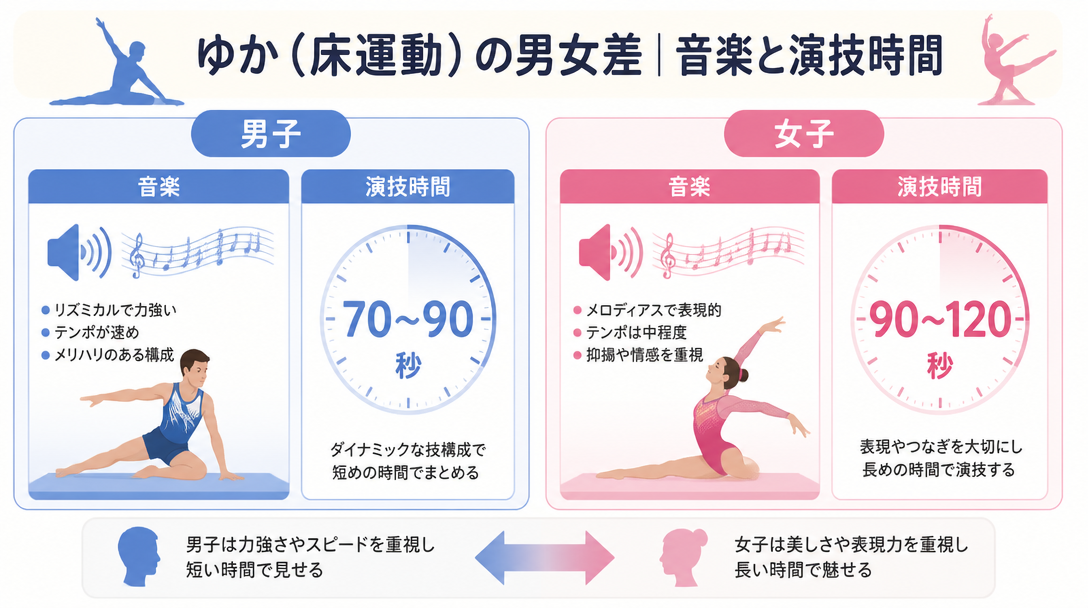
Floor exercise is one of only two events contested by both men and women, yet the two versions of the discipline are so different in character that they almost qualify as separate events. They diverge in time limit, use of music, and the judging criteria applied.
Women's Floor Exercise: Music and Artistry
Women's floor exercise is performed to music, with a maximum duration of 90 seconds. The Code of Points explicitly rewards the harmony between movement and musical accompaniment; routines where choreography is poorly matched to the music incur deductions. Under the 2025–2028 Code, a lack of connection between choreography and music can result in a deduction of up to 0.3 points — a sign that artistic evaluation has become more rigorous.
A complete women's floor routine must incorporate:
- Tumbling passes (acrobatic elements)
- Dance elements — turns, leaps, and jumps
- Artistic expression synchronized with the music
- Use of the full floor area
For more on the role of music selection and choreography in women's floor scoring, see Artistry in Floor Exercise: How Music and Choreography Affect Scoring.
Men's Floor Exercise: Power and Dynamism
Men's floor exercise is performed without music, and the time limit is a shorter 70 seconds — 20 seconds less than the women's program. The focus shifts entirely to explosive tumbling, dynamic leaps, and powerful landings. Artistic expression in the choreographic sense is not evaluated; instead, judges reward the technical precision and amplitude of acrobatic elements.
A men's floor routine typically includes:
- High-difficulty tumbling passes (e.g., triple-twisting double back)
- Turning elements such as a double-turn or triple-turn
- Powerful, controlled landings
- Use of the full floor space
Floor Exercise Specifications at a Glance
Specification | Men's Floor | Women's Floor |
|---|---|---|
Time limit | Max 70 seconds | Max 90 seconds |
Music | Not permitted | Required (harmony with music evaluated) |
Floor dimensions | 12 m × 12 m | 12 m × 12 m |
Primary emphasis | Power and dynamism | Technical skill + artistry |
Skills counted (D-score) | Top 8 skills | Top 8 skills |
Women-Only Events: Uneven Bars and Balance Beam
The two events exclusive to women's gymnastics — uneven bars and balance beam — have competitive characteristics found nowhere in the men's program. Below is an overview of the apparatus specifications and key scoring features of each.
Uneven Bars: Characteristics and Scoring
The uneven bars (UB) apparatus consists of two horizontal rails mounted in parallel at different heights: the high bar sits at approximately 250 cm and the low bar at approximately 170 cm. The 80 cm difference in height is what defines the event, enabling gymnasts to transition between the two rails in ways that have no direct parallel in any men's event.
While uneven bars shares certain movement qualities with men's horizontal bar — giant swings, release skills, and regrasp elements — the defining feature is the transition between rails, moving from the high bar to the low bar or vice versa. These bar-change skills are a required component of the routine structure. As on all events, the top 8 skills (including the dismount) are counted for the D-score, and the Composition Requirements (CR) mandate the inclusion of both release skills and bar-transition skills.
Balance Beam: Characteristics and Scoring
The balance beam (BB) is the event most closely identified with women's gymnastics worldwide — and for good reason. Gymnasts perform a full routine on a surface that is just 10 cm wide, 5 m long, and 125 cm above the floor. The time limit is 90 seconds, and exceeding it results in a deduction.
Beam elements fall into two broad categories:
- Dance elements — turns, balances, leaps, jumps, walks, runs, and wave movements
- Acrobatic elements — back handsprings, back walkovers, saltos, and other flight elements
The final score is the sum of the D-score (top 8 skills) and the E-score. Balance beam is widely regarded as the event where mental pressure peaks most visibly: a fall from the beam carries a significant deduction and can determine the outcome of a competition.
The Role of Artistry in Women's Events
Across the women's program, artistic quality is woven into the evaluation in a way that has no direct equivalent in men's gymnastics. The E-score on all four women's events penalizes poor body line, insufficient pointed toes, and lack of elegance in movement. On floor exercise and balance beam in particular, the flow and expressive quality of the performance carry significant weight. Uneven bars and vault focus more heavily on technical precision, but even there, clean lines and controlled landings are essential for a strong E-score.
Men-Only Events: Pommel Horse, Still Rings, Parallel Bars, and Horizontal Bar
Men's gymnastics includes four events with no equivalent in the women's program. Each targets a distinctly different physical capability, which is precisely what makes the six-event men's all-around such a comprehensive test of athleticism.
Pommel Horse: The Pinnacle of Circular Swing
Pommel horse (PH) is frequently described as the most technically demanding event in men's gymnastics. The gymnast grips two pommels mounted on a 105 cm-high horse and must support the entire body weight on the arms while executing an unbroken sequence of circular and pendulum swings. Any pause or interruption during the routine is a significant deduction. There are no flight elements and no momentary rest — it is relentless from start to finish.
The main skill groups on pommel horse include Russian circles, Stockli variations, and flop (loop) elements. For a detailed breakdown of pommel horse scoring, see Pommel Horse Circular Swing Technique: Roth, Stockli, and Scoring Fundamentals.
Still Rings: Absolute Upper-Body Strength
Still rings (SR) are suspended 280 cm above the floor, and the gymnast must prevent them from swinging freely throughout the routine — hence the name. No other event in gymnastics demands the same level of raw upper-body strength. Rings routines combine strength holds with swing elements and conclude with a flight dismount.
The three categories of elements are:
- Strength holds — the cross (iron cross), planche, and L-sit among others. Each hold must be maintained for at least two seconds to receive full credit.
- Swing elements — forward and backward giants and related movements.
- Dismount — typically a salto with twists.
For more on rings strength-hold scoring criteria, see Still Rings Strength Skills: Scoring Criteria for the Iron Cross and Planche.
Parallel Bars and Horizontal Bar: Swing and Release
Parallel bars (PB) uses two rails of equal height (approximately 200 cm) set parallel to each other. Routines blend above-bar swings and balances with below-bar swing elements and airborne releases, demanding both strength and fluidity.
Horizontal bar (HB) is the single-rail event at 280 cm, and it consistently draws the loudest reactions from audiences. Routines consist of giant swings punctuated by spectacular release-and-regrasp skills — Tkatchev, Kovacs, and Rybalko among the most recognizable names in the high-bar repertoire. For a full breakdown of horizontal bar release skills, see Horizontal Bar Release Skills: Tkatchev, Kovacs, and Rybalko — Difficulty and Differences Explained.
Apparatus Specifications: Men's vs. Women's
The FIG sets precise equipment standards for all apparatus used in competition. Several specifications differ between the men's and women's programs, most notably the height of the vault table.
Vault Table Heights: Men vs. Women
According to the FIG Technical Regulations, the vault table is set at 135 cm for men and 125 cm for women — a 10 cm difference. The greater height of the men's table requires more approach speed, a more powerful takeoff from the springboard, and greater aerial skill to clear the apparatus safely. For a breakdown of vault difficulty ratings by skill type, see Vault Difficulty Guide: Yurchenko and Tsukahara Family Skills Compared.
Apparatus Specifications Summary
Event | Key Specifications | Gender |
|---|---|---|
Vault | Table height: 135 cm | Men |
Vault | Table height: 125 cm | Women |
Pommel Horse | Height: 105 cm; pommel spread: 40–45 cm | Men |
Still Rings | Ring height above floor: 280 cm | Men |
Parallel Bars | Height: 200 cm; rail width: 42–52 cm | Men |
Horizontal Bar | Bar height: 280 cm | Men |
Uneven Bars | High bar ≈ 250 cm; low bar ≈ 170 cm | Women |
Balance Beam | Height: 125 cm; length: 5 m; width: 10 cm | Women |
Composition Requirements (CR): Men vs. Women
Composition Requirements (CR) define the mandatory structural elements that a routine must contain on each event. When a gymnast fulfills a CR, bonus points are added to the D-score; when a CR is not met, those bonus points simply are not awarded — there is no additional penalty, but the score loss can be substantial.
Men's Composition Requirements
Each men's event has its own set of CRs organized by skill group. On horizontal bar, for example, gymnasts must demonstrate a release skill, a giant swing series, and a salto dismount, among other requirements. Meeting all CRs while also performing high-difficulty skills is the strategic challenge at the heart of men's gymnastics routine construction. For a full event-by-event breakdown, see Composition Requirements Explained: Men's Artistic Gymnastics Skill Groups by Event.
Women's Composition Requirements
Women's events have their own CR structures tailored to each apparatus. On floor exercise, gymnasts must include tumbling passes, acrobatic leaps or jumps, turns, and wave or flexibility elements. An artistic component is also embedded within the floor CRs, reflecting the discipline's emphasis on expression.
On uneven bars, CRs include release skills and bar-change transitions. On balance beam, the requirements cover acrobatic elements, dance elements, and turns. Meeting these requirements — while constructing a routine that flows logically and showcases high-difficulty skills — is the central challenge of women's gymnastics planning.
How CRs Shape Scoring Strategy
Because CRs contribute directly to the D-score, failing to meet even one requirement can cost a gymnast a meaningful chunk of points — points that cannot be recovered no matter how difficult the remaining skills are. Effective routine construction in both men's and women's gymnastics requires balancing CR fulfillment against difficulty value to maximize the overall score. For more on how the judging system processes D-scores and E-scores, see The Gymnastics Judging System: Roles of the D-Panel and E-Panel Explained.
Summary
The key differences between men's and women's artistic gymnastics, across competition structure, scoring, and apparatus, can be summarized as follows:
- Number of events — Men compete on six events (floor exercise, pommel horse, still rings, vault, parallel bars, horizontal bar); women compete on four (vault, uneven bars, balance beam, floor exercise).
- Shared scoring framework, different details — Both programs use the D-score plus E-score open-ended system. Under the 2025–2028 Code of Points, both men and women now count the top 8 skills toward the D-score, eliminating the previous difference of 10 skills for men and 8 for women.
- Floor exercise: time and music — Men perform for up to 70 seconds without music; women perform for up to 90 seconds with music. The judging emphasis differs accordingly: technical power and dynamism for men, technical skill combined with artistic expression for women.
- Apparatus heights — The vault table is 135 cm for men and 125 cm for women. The balance beam — a women's-only event — presents one of the most demanding surfaces in all of gymnastics at just 10 cm wide.
- Conceptual differences — Men's gymnastics prioritizes strength, speed, and dynamic power. Women's gymnastics rewards the fusion of technical precision and artistic expression.
Artistic gymnastics shares a common rulebook between the two programs, yet the specific regulations for each gender are carefully crafted to match the distinct character of that program. The FIG Code of Points is updated on a four-year cycle, so always consult the official FIG website for the most current rules.