How to Commission Gymnastics Floor Music: Process, Prep & Pricing
How to commission competition floor music for women's artistic gymnastics: the process from consultation to delivery, what to prepare, pricing, and DIY vs. pro.
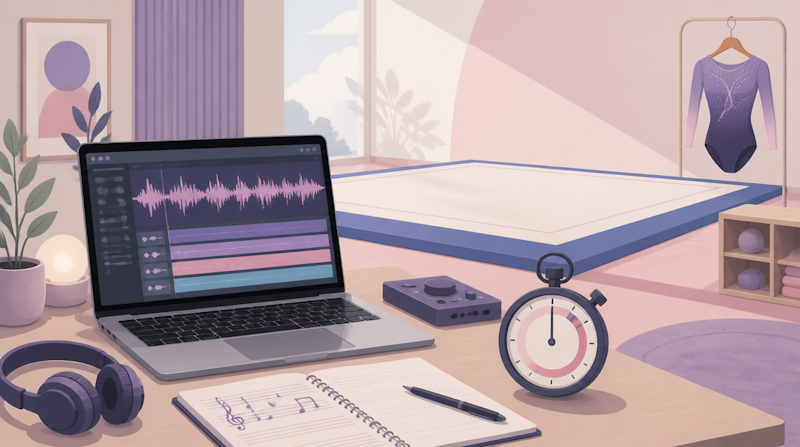
Commissioning competition floor music is an unavoidable step in polishing a women's floor (floor exercise) routine. Yet many athletes and parents freeze at the first move because they don't know what to communicate or how much it costs. This guide breaks down the full process
of commissioning gymnastics floor music, what to prepare, and how to think about pricing—so your first order goes smoothly.
What Is Competition Floor Music and Why Commission It
In women's artistic gymnastics, floor exercise is the only one of the four events performed to music. As described in general references on floor exercise, gymnasts combine tumbling, jumps, and turns to music on a 12m square. Because the music shapes both impression and score, most gymnasts don't use a raw commercial track—they use floor music edited or composed for the routine.
The role floor music plays
Floor music is more than background sound. Tumbling lands on strong beats, expression and poses fill the quieter passages. Judges evaluate musicality and artistry, so audio quality affects the artistry score directly.
Three options: ready-made, self-edit, custom commission
There are three broad ways to get floor music. Some providers, such as Green Note Music's gymnastics series, offer both download sales and made-to-order production.
- Buy a ready-made tr
ack: cheap and easy, but length and accents may not match your composition
- Self-edit: flexible and low-cost, but requires editing skill and time
- Commission a pro: optimized to your routine, but costs money and takes time
Who commissions a professional
Gymnasts, parents, and coaches who want a length and arc that fit the routine—or who lack editing time—choose to commission. Editing that aligns strong beats and highlight moments to the routine is where experienced producers shine. You can discuss selection, arrangement, and composition with an ex-competitor who is also an artist via custom competition floor music production.
Rules to Know Before You Order: 90 Seconds, Lyrics, Length
Knowing the basic rules before your consultation makes everything smoother. Break the length or lyric rules and even a great track becomes a deduction.
The 90-second limit and overtime deduction
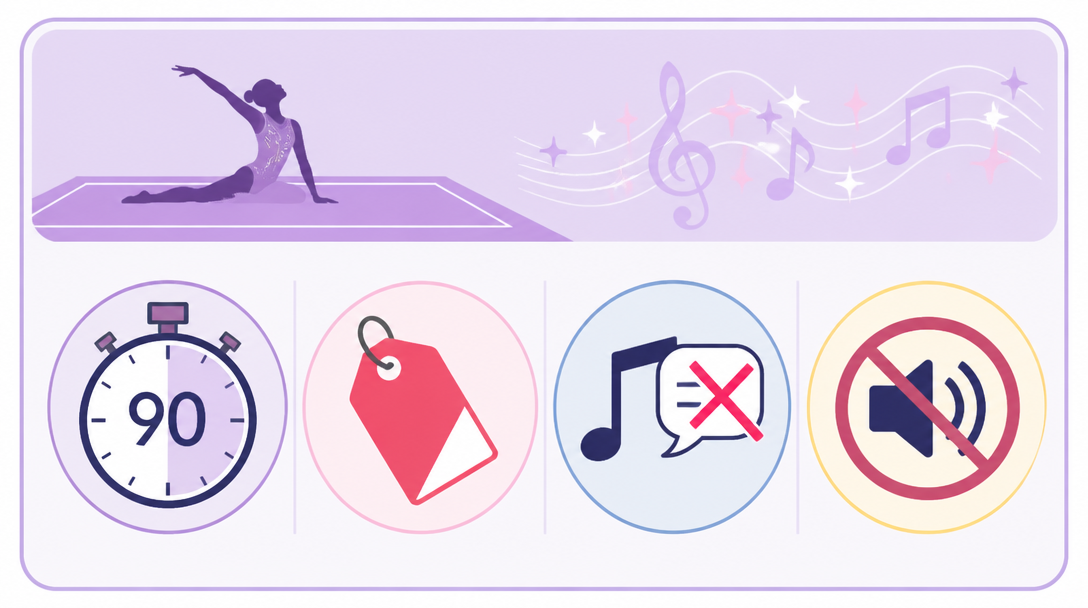
Women's floor routines last a maximum of 90 seconds. According to a 2025–2028 rules explainer, exceeding 1:30 draws a 0.10 neutral deduction. Since timing starts on the first intentional movement, editing to around 1:25 leaves a safe cushion. See our 90-second timing template for structuring the cut.
Are lyrics allowed? FIG/Japan vs. NCAA
Whether words are allowed depends on the competition. Under FIG and Japan's official events, floor music is instrumental in principle and lyrics (words) are not permitted, while U.S. NCAA gymnastics allows lyrics. Note that wordless vocals and actual lyrics are treated differently. We untangle this in can you use songs with lyrics on floor?.
No music = -1.0 (FIG 2025-2028)
A lesser-known penalty is performing with no music. Per the FIG 2025–2028 music rules, performing without music carries a hefty 1.0 deduction. Because audio failures can be catastrophic, plan your submission format and backups from the ordering stage.
Item | FIG / Japan official | U.S. NCAA |
|---|---|---|
Routine time | Max 90s (-0.10 overtime) | Max 90s (overtime deduction) |
Lyrics (words) | Not allowed (instrumental) | Allowed |
No music | -1.0 | Deduction |
Recommended edit length | ~1:25 (cushion) | ~1:25 (cushion) |
*Codes are revised over time; always confirm current rules with the Japan Gymnastics Association rules page or your federation.
The Full Commissioning Process: From Consultation to Delivery
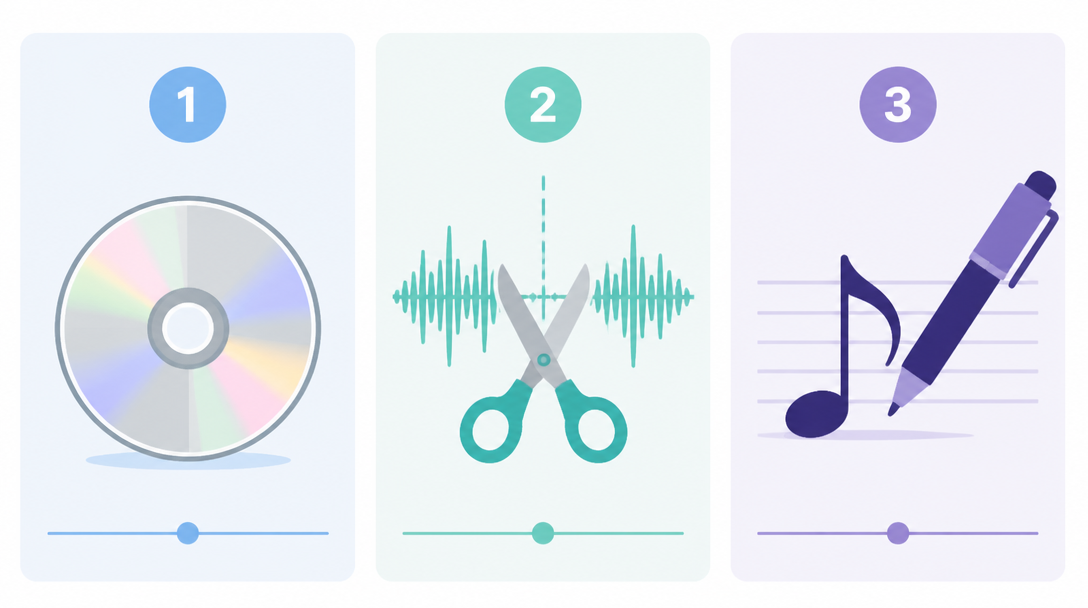
Here is the typical four-step flow. Details vary by producer, but the outline is shared.
Step 1: Consultation and quote
Start by sharing your desired songs, length, routine image, competition (applicable rules), and deadline. Most services require or recommend a pre-order consultation, and this is where you receive a quote and turnaround. Editing services such as this custom editing example also ask you to share the track and requests before ordering.
Step 2: Sharing materials and image
Once confirmed, share materials: a routine video, song audio or links, target length, and where the highlights fall. The more specific you are about where to peak and where to go quiet, the closer the result. Pro editing services also ask you to specify the big-move positions and energy peaks up front.
Step 3: Draft delivery and revisions
When the draft (usually MP3) arrives, test it against the actual movements. Refine with notes like "a bit faster here" or "smooth this transition." Revision counts vary, and a set number of free revisions is common.
Step 4: Final delivery and submission format
Once approved, receive the final track and confirm the submission format (CD, USB, or a specific digital format), volume, and length against your federation's requirements. Abrupt cuts and volume jumps lower artistry—see common floor-music editing mistakes.
- Consultation and quote (songs, length, image, competition, deadline)
- Share materials (routine video, songs, highlight positions)
- Draft delivery, then revisions (check against movement)
- Final delivery, then confirm submission format
When a producer understands your intent at the consultation stage, you make fewer revision loops. To handle selection, edits, and 90-second structure together, consider custom floor music production.
What to Prepare: Video, Songs, and Image
The key to a smooth commission is preparation. The more concrete your information, the closer the first draft and the fewer the revisions.
Routine video (composition and highlights)
The most important item is a routine video. With tumbling count and position, pose timing, and dance flow visible, the producer can align strong beats and accents. Even a run-through before the routine is finalized improves accuracy.
Song and reference list
List the songs you want to use or reference tracks with the right feel. For mash-ups, note which part of each song to use. The editing service above also treats song titles, length, and requests as basic inputs.
Length and pose timing
Communicate your target length (e.g., 1:28), intro length, and when the final pose should hit. Ending with a clear cold end rather than a fade-out helps judges register the finish.
Routine image and character
Describe the gymnast's character and world—power, expressive, or cute. See type-based floor music selection for ideas.
Item | What to convey | Priority |
|---|---|---|
Routine video | Skill count/position, highlights, run-through | High |
Songs/references | Titles, parts to use, mood | High |
Length/timing | Target length, intro, pose timing | Medium |
Routine image | Character, world, relation to leotard | Medium |
Competition/rules | FIG/Japan/NCAA, submission format | High |
How to Think About Pricing
There's no single "going rate." Because price depends heavily on scope, it's more useful to understand what changes the price than to chase a number.
Editing vs. original composition
The biggest driver is whether you order editing (cut and splice) of existing songs or full original composition. Editing is relatively affordable; one custom editing service, for example, lists a base plan from around 8,000 yen (varies by scope). Original composition adds work, so cost and turnaround rise.
Revisions, turnaround, delivery format
Free-revision counts, rush options, and physical delivery (CD/USB) all move the price. Some overseas editing services quote a 12–48 hour turnaround, though busy seasons and complex edits take longer. Ordering early, counting back from the competition date, is cheaper in the end.
What to confirm in a quote
- Scope included in the base price (editing only vs. composition)
- Number of free revisions and cost of extra revisions
- Turnaround and rush fees
- Delivery format (digital/CD/USB) and extra fees
- Rights and usage scope (competition/SNS use)
For ready-made tracks, services like gymnastics/RG accompaniment downloads let you preview and buy for less than a custom edit.
DIY vs. Hiring a Pro
Neither is universally correct—choose based on level, event importance, and available time.
When DIY fits
If you want to save money, can use editing software (including free tools like Audacity), or are testing for practice or local meets, DIY works. Floor-music guides cover basics like crossfades and tempo changes (within ±5–10 BPM). Sloppy cuts and volume jumps hurt, so work carefully.
When a pro fits
For an important meet, a perfect fit to the composition, or when time is short, a pro is safer. Because musical arc shapes impression, pros design the build-up we cover in how to build an exciting floor-music arc.
Choosing a provider
Weigh not just price but whether they understand the code and how routines read. Producers who know the sport align beats and 90-second pacing more precisely. To discuss with an ex-competitor and artist, consider custom floor music production. Pair it with matching composition and music.
Aspect | DIY | Pro |
|---|---|---|
Cost | Low (free tools) | Varies: edit to compose |
Quality | Depends on skill | Consistently high |
Time | Your own time | Delegated |
Fit to routine | Effort to adjust | Optimized via consult |
Best for | Practice/budget | Big meets/finish |
Summary
- Three ways to source floor music: ready-made, self-edit, or commission—choose by goal and budget
- Before ordering, know the 90s rule, lyric rules (no for FIG/Japan, yes for NCAA), and the -1.0 no-music penalty
- The flow is four steps: consult/quote → share materials → draft/revise → final delivery
- Prepare a routine video, songs, length, image, and applicable rules—specificity cuts revisions
- Pricing depends on editing vs. composition, revisions, turnaround, and format—check the quote breakdown
If you want music built to fit your routine with the code in mind, consider custom competition floor music production from an ex-competitor and artist.