Choosing Gymnastics Floor Music by Age: Preschool to Teen Guide
How to choose women's gymnastics floor music by age—from preschool to teens. Covers the 90-second rule, instrumental-only music, tempo (BPM) and genre tips.
Choosing floor music for women's artistic gymnastics is never one-size-fits-all. What suits a preschooler is very different from what a competitive teenager needs, because body size, expressiveness and the number of tumbling passes all change with age. This guide walks through how to choose gymnastics floor music by age—from presc
hool to elementary to the teen years—while respecting the 90-second limit and the instrumental-only rule.
Music selection is inseparable from choreography. When a track's tempo, structure and mood match the gymnast's character and skill level, the overall impression and the artistry score improve dramatically. Thinking in age brackets helps parents and coaches pick the one track that fits this gymnast, right now.
Why Floor Music Choices Change With Age (and the Basic Rules)
Before we get to age brackets, let's lock down the rules and scoring context that apply to every women's floor routine. Ignore these and even a perfect song can cost deductions.
Floor Music Is Instrumental and Capped at 90 Seconds
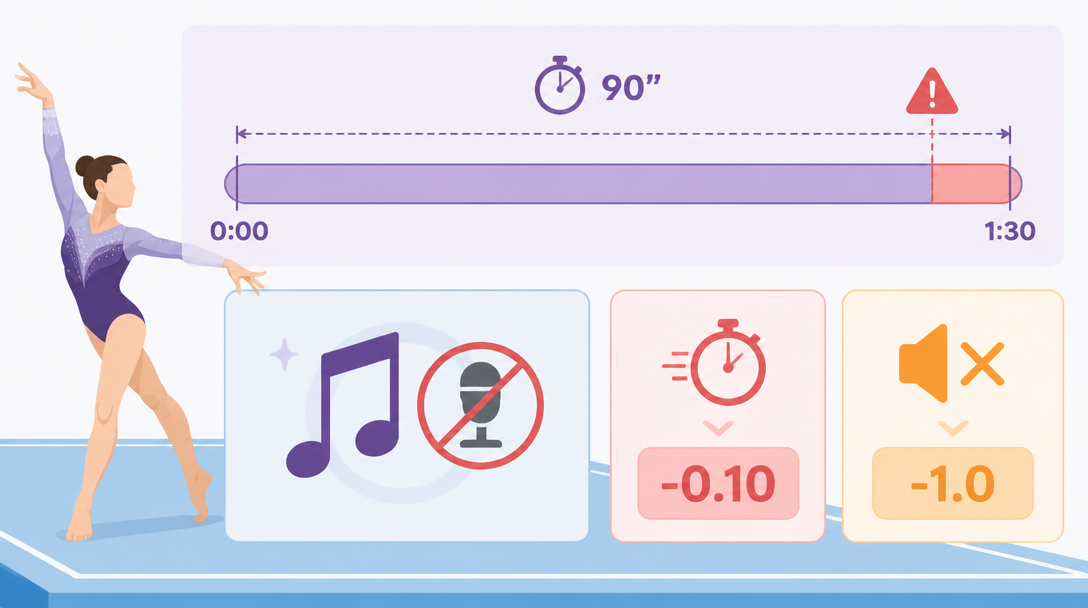
Under the FIG Code of Points, a women's floor routine lasts a maximum of 90 seconds; going over incurs a 0.10 neutral deduction. Music must be instrumental—vocals without lyrics are treated like an instrument, but songs with words are not allowed. Performing with no music at all carries a large 1.0 deduction (GymnastGem's WAG floor 2025–2028 overview).
Japanese domestic competition follows the same logic: only the women's routine is set to music, and voi
ces without lyrics may be used like any instrument (floor-exercise rules explainer, SPOJOBA). No matter the age, the 90-second, no-lyrics foundation stays the same. For the lyrics question in detail, see our article on whether songs with lyrics are allowed.
Musicality Feeds Directly Into the Score
The 2025–2028 code judges expression, choreography, posture and musicality more rigorously. Deductions in the 0.10–0.20 range are applied consistently for weak posture, flat expression or filler choreography, and gymnasts are expected to perform the music rather than simply move to it. Whether a gymnast can match movement to the music's phrasing and accents shows up directly in the artistry score.
Why the Right Song Changes With Age
As gymnasts grow, the number and difficulty of tumbling passes, the range of body expression and the focus needed to sell a routine all change. Preschoolers need fun and simplicity, elementar
y athletes need clear rhythm and budding expression, and teens need individuality and storytelling. The same 90 seconds plays a different role at each age.
If you want help with music, selection and 90-second structure, Daito Iwasaki—a former gymnast and recording artist—offers competition floor-music production that chooses tracks to fit the athlete's character within the Code of Points, including editing and original composition tailored to age and routine.
Preschool (Ages 3–6): Prioritize Fun and Simplicity
The preschool years are not about impressing judges with a difficult track; they are about building the joy of moving to music. Choices here form the foundation for expression at later ages.
Songs That Match Developmental Stage
Even in early-childhood settings, exercise songs are chosen by three factors: the goal, the type/purpose, and age suitability. Toddlers suit simple repeated movements to happy sounds; ages 2–3 respond to movements themed around food or animals; ages 4–5 can handle slightly harder choreography (how to choose exercise songs, Mynavi Hoikushi).
The same logic applies to competitive floor: preschoolers do best with bright, familiar melodies and clear beats that mark movement changes. Internationally, playful music is recommended for gymnasts under seven, with more sophisticated choices needed as they age (choosing floor music from Level 1 to 10, GymnastGem).
Tempo and Rhythm Guidance
Preschoolers do better with a moderate, easy-to-follow tempo than with fast tracks. Sports-day music for this age emphasizes clapping rhythms and simple choreography with upbeat, cheerful tones (dance songs by age group, Utaten). Music too fast for the child to follow causes beats and tumbling to fall out of sync, inviting deductions.
What to Avoid at This Age
- Complex structures where the highlight is unclear
- Tempos too fast to match movement to the beat
- Dark, heavy moods that make it hard to show a bright smile
- Commercial songs with lyrics (unusable as-is in official competition)
Elementary School: Split Lower and Upper Grades
Elementary gymnasts vary hugely in development, and what lower and upper grades can do differs a lot. Don't treat them as one group—choose music by stage.
Lower Grades (Ages 6–9): Familiarity and Clear Rhythm
Lower grades suit easy-to-learn rhythms and catchy melodies. Sports-day picks for this age favor memorable rhythms and pop melodies that aren't too fast, prized for being easy to practice at home (lower-grade song trends, Utaten). A clear beat makes switching between tumbling and dance easier.
Upper Grades (Ages 9–12): Linking Expression and Tumbling
Upper-grade gymnasts can handle more complex choreography and tracks with changes in tempo or mood—provided the routine is choreographed to match. Placing tumbling highlights on strong beats and dance or expression on quieter passages gives the 90 seconds real contrast. Our 90-second time-allocation template helps align routine and music.
Thinking in Levels
The U.S. level system is a useful reference. Levels 4–5 use the same compulsory music to teach musicality and expression. From Level 6, gymnasts move to optional routines: Level 6 wants strong beats and clear phrasing, Levels 7–8 highlight personality, and Levels 9–10 demand professional-quality edits and storytelling (choosing music for optional Levels 6–10, GymnastGem). Matching musical complexity to skill level applies to Japanese age categories too.
When you move to the practical stage, beat-matched editing and highlight design matter. Competition floor-music production that edits and composes within the Code of Points can deliver anything from a simple lower-grade track to a dynamic upper-grade routine. Common editing mistakes are covered in our cut-editing NG guide.
Teens and Elite Athletes: Win With Individuality and Story
By the teen years, gymnasts craft a track that only they could perform, powered by higher-difficulty tumbling and expression. Here, music becomes the routine's brand.
Match the Athlete's Character
Start with a character audit. Match the music to the gymnast's vibe—powerful, expressive, cute—and the routine gains conviction. Experts recommend identifying whether the athlete is elegant, powerful, playful or quirky, then choosing a matching style (six tips for choosing floor music, Sposci). See our type-based selection guide for details.
Designing Tumbling and Tempo
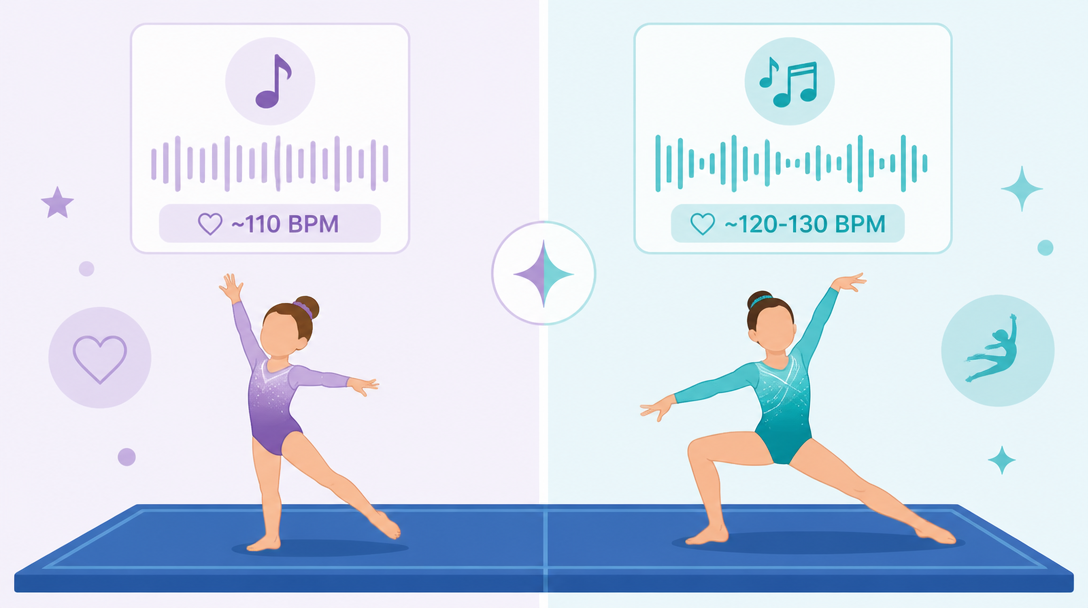
In optional routines, tempo and structure are key. Floor music is often adjusted to around 120–130 BPM: 120–125 BPM suits graceful, expression-led routines, while 130–140 BPM fits powerful tumblers (tempo and BPM guidance, GymnastGem). Tracks with clear highs and lows let you pair big tumbling with peaks and dance with lighter passages.
Lyrics: A Common Misunderstanding
Teens and parents often get stuck on lyrics. FIG and Japanese official competition prohibit lyrics; instrumental is the rule. U.S. college gymnastics (NCAA) has historically been lenient with lyrics but has grown stricter on human voices and on music-choreography consistency (overview of NCAA 2025 rule updates, College Gym News). Athletes competing in Japan should treat no-lyrics, 90-seconds as a hard premise.
Quick Reference: Floor Music by Age
Here is the guidance organized by age. Treat it as a starting point—judge real suitability by each athlete's skill level and personality.
Age-by-Age Selection Points
Age | Priority | Suited mood / tempo | Watch out for |
|---|---|---|---|
Preschool (3–6) | Fun, simplicity | Bright pop, moderate clear beat | Avoid too fast / too complex |
Lower elementary | Familiarity, clear rhythm | Catchy melody, easy structure | Don't overload the structure |
Upper elementary | Emerging expression, contrast | Varied tracks, ~120–130 BPM | Prioritize music-choreo match |
Teen / elite | Individuality, story | Dramatic tracks, 120–140 BPM | Link skills and highlights |
Tempo and Genre Pairings
- Graceful / expressive: piano and strings, relaxed structure around 120–125 BPM
- Powerful: drums and brass at 130–140 BPM, strong beats to emphasize tumbling
- Cute / playful: bright pop with rhythms that invite audience clapping
How genres read on the floor is closely tied to the athlete's type. Instrumental tracks are the premise for official competition, so commercial songs require a no-lyrics instrumental version (floor-music tips and where to buy, GymnasticsHQ).
A Selection Workflow for Every Age
Whatever the age, the selection process shares a common shape. Follow it and you won't go far wrong from preschool to the teen years.
Five Steps to Select Music
- Character audit: decide whether the athlete is powerful, expressive or playful
- Set a theme: choose the story or mood the routine should convey
- Move to candidates: actually move to the track to test beat-to-movement fit
- Adjust to 90 seconds, no lyrics: edit for length and rules
- Full run-through check: confirm highlights and tumbling align with musical peaks
Experts recommend visualizing while actually moving to test compatibility (testing music-choreography fit, Sposci). Whether the gymnast loves the music enough to move naturally translates directly to competition performance.
Self-Edit vs. Professional Help
For a simple preschool or lower-grade track, an off-the-shelf instrumental may work as-is. For a dynamic routine from upper grades on, beat-matched editing or original composition demands precision. Our guide to commissioning music covers the workflow and what to prepare.
To discuss options by age and routine, competition floor-music production that edits and composes within the Code of Points is a reliable route. Share a video, target songs and the routine's image, and the right track for the athlete's current age can take shape.
Summary
Age-based floor-music selection keeps a shared foundation while shifting the song's role by age. The key points:
- Women's floor is instrumental and capped at 90 seconds (0.10 over-time, 1.0 no-music deductions)
- Preschool: prioritize fun, simplicity and clear beats
- Elementary: split lower (familiarity) and upper (expression and contrast)
- Teens/elite: win with individuality, story and 120–140 BPM design
- At every age, music-choreography match feeds the artistry score
If you'd like help with selection, editing or original composition by age and routine, consider competition floor-music production by a former gymnast and recording artist—shaping the track that fits the athlete's current age within the Code of Points.