Gymnastics Floor Music Rules: Can You Use Lyrics? (FIG vs NCAA)
Can women's floor routines use lyrics? FIG and Japan require instrumental music; NCAA allows them. A guide to the rules, the 90-second limit and the 2026 vocal changes.
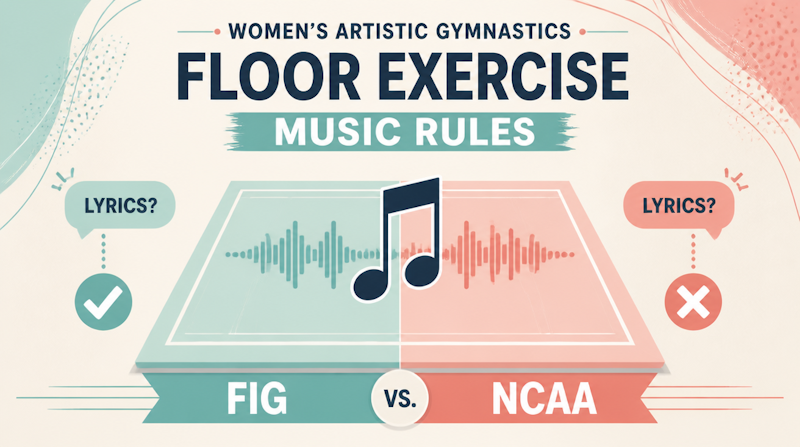
Can you use music with lyrics in women's gymnastics floor exercise? It is one of the first questions gymnasts and coaches face when choosing floor music. The short answer: under the International Gymnastics Federation (FIG) and Japanese domestic rules, songs with words are not permitted and the music must be instrumental. U.S. college gymnastics (NCAA), on the other hand, does allow lyrics. This guide breaks down the floor music rules by organization — FIG, Japan and the United States — and covers the 90-second rule and the 2026 debate over vocals.
The Basic Rules of Women's Floor Music
Only women perform to music, within 90 seconds
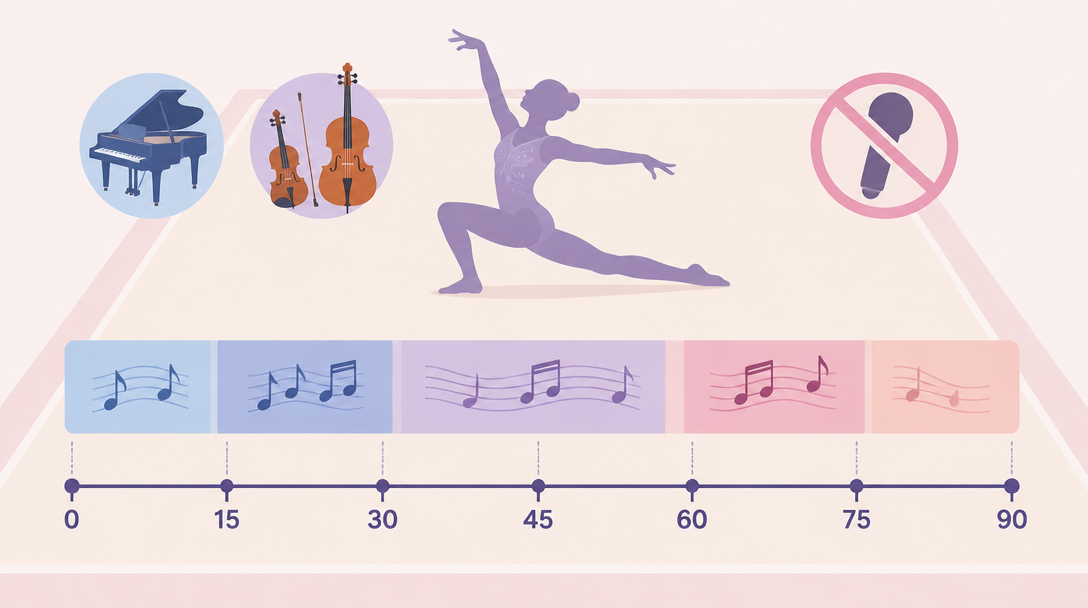
Floor exercise differs sharply between men and women. According to the Japanese Olympic Committee overview, women perform on a 12-meter square floor, combining acrobatic elements with jumps and turns set to musical accompaniment, all within 90 seconds. Men's floor has no music and runs roughly 70 seconds. Because women's floor is set to music, song choice heavily shapes the impression of a routine.
For the broader differences between men's and women's rules and scoring, see our comparison of women's and men's gymnastics. Start from the premise that women's floor is a 90-second routine performed to music.
Song selection and the 90-second structure can also be handled through a competition floor music production service that combines the perspective of a former gymnast and an artist — a useful starting point if you want to begin from "what music actually fits the routine" rather than the rules alone.
Music must be instrumental in principle
Under the FIG Code of Points, women's floor music must be instrumental. As this floor music guide explains, songs containing words are prohibited, while wordless vocalizations such as humming or scatting are allowed. The dividing line is not whether a human voice is present, but whether it forms actual words (lyrics).
Performing with no music at all is also penalized. A breakdown of the 2025–2028 rules notes that competing without music carries a 1.0-point deduction. For women's floor, music is not optional — it is a required part of the routine.
Lyrics vs. wordless vocalization
The trickiest part of song selection is how "voice" is treated. The key points:
- Songs with lyrics (words): generally prohibited under FIG and Japanese competition
- Humming, scatting, chants and other wordless vocalizations: generally allowed
- Instrumental, orchestral or cover versions of commercial songs: usable as long as they contain no words
- Sound effects and ambient sound: acceptable when they fit naturally as part of the music
If you want a popular song for a floor routine, the standard approach is to prepare an instrumental version with the lyrics removed rather than the original vocal track. Even top gymnasts use instrumental arrangements of famous songs for this reason — "keep the song, drop the words" is the basic mindset.
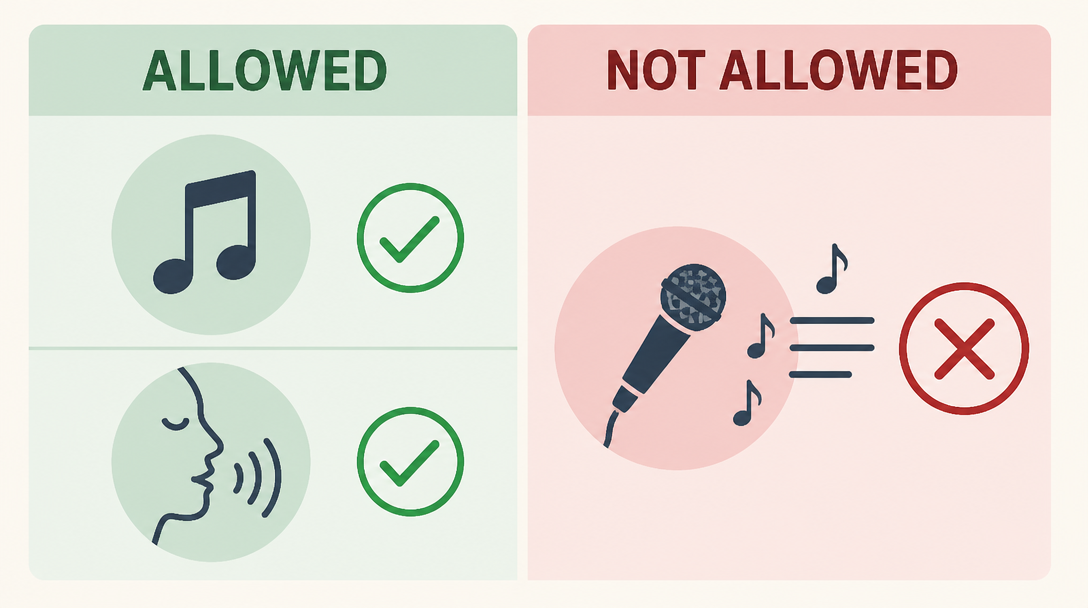
FIG and Japan: Songs With Lyrics Are Not Allowed
Under the FIG Code of Points
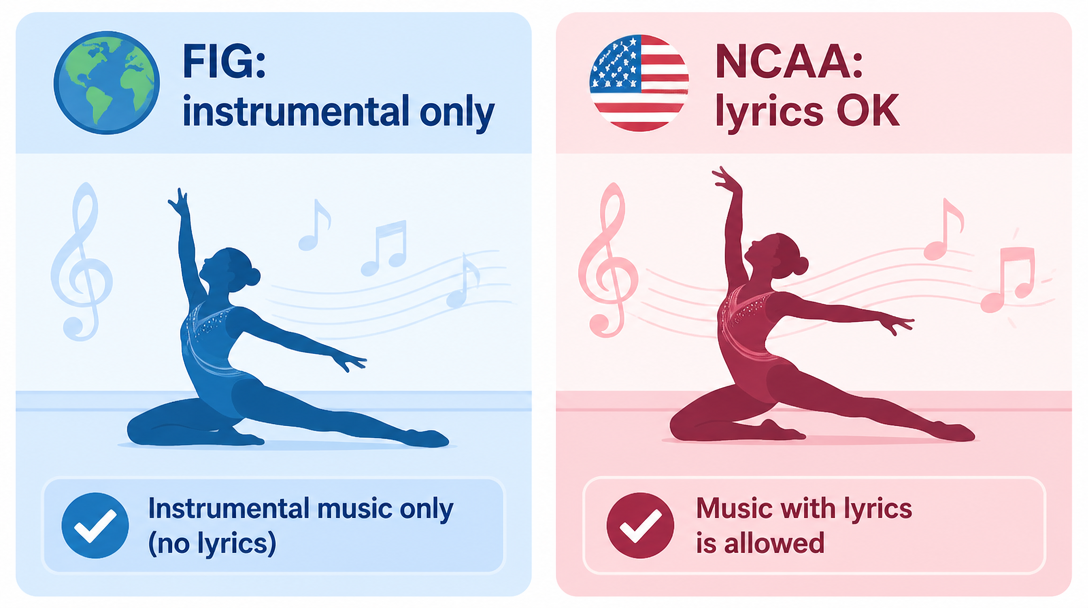
In competitions governed by FIG — the Olympics and World Championships — women's floor music may not contain lyrics. The rules explainer states plainly that the music "must be instrumental" and that "songs with words remain prohibited," while wordless vocalizations are allowed. At the elite level, simply choosing a song with lyrics is a rules violation.
Japan's domestic competitions follow FIG
Official gymnastics competitions in Japan are run on the FIG Code of Points. So at the All-Japan Championships and junior national events sanctioned by the Japan Gymnastics Association, you should assume that "songs with lyrics are generally not allowed." To use a commercial song, prepare an instrumental version without words, or use audio edited specifically for competition. Note that using commercial tracks at events or on social media also raises copyright questions worth checking before you compete.
What happens if you break the rule
Under FIG-based rules, using a song with lyrics is treated as a music-regulation violation and can lead to deductions. However brilliant the routine, breaking the rule at the song-selection stage lowers the score. Choose music by asking first "is this allowed?" and only then "do I like it?" Floor is also judged on artistry, and the unity of music and movement feeds directly into the execution score.
U.S. NCAA and USAG: Lyrics Are Allowed
NCAA allows lyrics — but choreography must match
In U.S. college gymnastics, the NCAA permits lyrics in women's floor music. This is the biggest difference from FIG. A 2026 floor music rules explainer notes that while the NCAA allows songs with lyrics, judges increasingly look for "thematic consistency" — if you use a song with words, the choreography needs to reflect the meaning of those words or you risk artistry deductions. The lyrics can't just play in the background; the words and the movement need to connect.
This "lyrics allowed" rule is a big reason NCAA floor routines go viral. It makes crowd-connecting, entertaining performances easier to build, and that showmanship is one of the sport's biggest draws in the U.S.
USAG time limits and vocals
USA Gymnastics (USAG), which governs U.S. club gymnastics, sets music time limits by level in its development program. According to a guide to optional-level floor music, Level 6 is capped at 1:15 and Levels 7–10 at 1:30, with a 0.10-point deduction per second over the limit. Vocals have historically been handled more loosely than under FIG.
The 2026 debate over vocals
Recently the biggest story in U.S. floor music rules has been the treatment of the human and synthetic "voice." According to a regulation update, an initial proposal would have banned any music containing words, sounds or chants from a human or synthetic voice starting August 1, 2026, with a 1.00-point deduction from the chief judge. USAG later walked that blanket ban back: wordless vocalizations such as whistling, animal sounds and humming remain allowed, while music containing words is reported to be subject to a 0.5-point deduction instead. U.S. rules are still evolving and differ by season and organization, so check the latest floor-music updates and confirm which body's rules govern your meet. Don't assume that because you saw lyrics in an overseas video, they're allowed where you compete.
The 90-Second Rule and Timing/Audio Notes
Time limits and deductions
For women's floor, the length of the routine itself affects the score. The 2025–2028 rules explainer puts the maximum at 90 seconds, with a 0.10 neutral deduction for going over. Because aiming for exactly 90 seconds risks an overtime penalty, a practical target of around 1:25 is recommended to leave a safety margin. A few seconds over can cost points, so the audio length must be managed precisely.
Time limits by organization
Time limits vary by governing body and level. The main categories (always confirm current rules in each body's official materials):
Category | Time limit (guide) | Lyrics (words) |
|---|---|---|
FIG (international elite) | 1:20–1:30 | Not allowed (instrumental) |
Japan domestic | Within 90s (FIG-based) | Generally not allowed |
NCAA (U.S. college) | Up to 1:30 | Allowed (must match choreography) |
USAG Level 6 | Up to 1:15 | Depends on rule (under review) |
USAG Levels 7–10 | Up to 1:30 | Depends on rule (under review) |
For FIG elite, the 1:20–1:30 window applies, with a 0.10 deduction for each second over or under. Even for the "same" women's floor, the music you're allowed to use changes with the rules your meet follows.
Format and audio quality
Beyond length, audio quality and export format matter. Clipping, noisy audio, or unnatural starts and endings hurt the artistic impression. Tempo (BPM) design matters too: the selection guide notes that many successful routines sit around 120–140 BPM — roughly 120–125 BPM for graceful movement and 130–140 BPM for tumbling-heavy routines — and that a clear 4/4 time signature makes it easier to sync movement to the music.
Choosing and Editing Music When Lyrics Are Off-Limits
Use instrumental versions and covers
Even if your favorite song has lyrics, you don't have to give up on it. An instrumental arrangement, orchestral cover or piano version keeps the song's appeal while staying within the rules. Film and video-game scores are often instrumental to begin with and build dramatic arcs easily, which makes them a natural fit for floor.
Sync BPM and structure with the routine
The key to song selection is matching the music's peaks to the routine's highlights. Build the music up before a tumbling pass and add contrast on turns and poses, shaping a clear arc across the 90 seconds. Artistry — posture, expression, and how you ride the music — is judged closely. Recent trends reward gymnasts who "perform the music" rather than just moving to it, and flat expression or sloppy transitions draw consistent deductions.
How to Prepare Competition Floor Music
Editing commercial tracks
When you use a commercial song for floor, you rarely play the original as-is; you cut it down to fit 90 seconds. But splicing unrelated fragments together produces an incoherent result that hurts artistry. Keep to a single theme and edit so the sections flow naturally. And don't forget copyright clearance when using commercial tracks at meets or on social media.
A competition floor music production service that handles rule-aware cutting and even original composition tuned to 90 seconds makes it easier to satisfy requests like "drop the lyrics but keep the song's world" or "line the buildup up with my biggest skill" — all within the rules.
DIY editing vs. hiring a professional
- DIY editing: cheaper, but length trimming, audio quality and smooth transitions take skill
- Professional editing: a finish that reflects the rules and the routine's structure, and saves time
- Original composition: a world built from scratch, with no risk of sharing a song with another gymnast
If your meet is close or you want music and choreography tightly linked, hiring a professional is the safer route.
Original composition as an option
Beyond editing commercial tracks, you can commission an original piece built around the gymnast's image. An original clears the lyrics question from the start and lets you design the peaks to match the routine's highlights, so the 90-second structure and the music align completely. Not sharing a song with anyone else is a real advantage when you want a memorable routine.
Summary
- Whether lyrics are allowed depends on the governing body: under FIG and Japan, words are generally prohibited; under U.S. NCAA, they are allowed
- FIG requires instrumental music; wordless vocalizations like humming are fine, and performing with no music carries a 1.0 deduction
- Women's floor runs within 90 seconds, with roughly a 0.10 deduction per second over or under; time limits vary by body and level
- U.S. vocal rules were debated in 2026 and the blanket ban was walked back — always confirm your meet's rules
- Even when lyrics are off-limits, instrumental versions, covers and original compositions work; selection and editing hinge on syncing with the routine's highlights
If you would like to talk through song selection, 90-second structure, or editing and producing your audio, see our competition floor music production. We support rule-compliant music that fits your routine.