USA Names 2026 Men's Worlds Team: A D-Score Breakdown
Fred Richard won the 2026 U.S. Championships as the U.S. named its Rotterdam Worlds men's team. A former athlete breaks down the five-man roster by D-score.

Note: This article reflects information as of August 9, 2026.
The 2026 U.S. Gymnastics Championships concluded on August 6–9 in Phoenix, Arizona, and USA Gymnastics named the five men who will travel to the Rotterdam World Championships. Fred Richard won his first
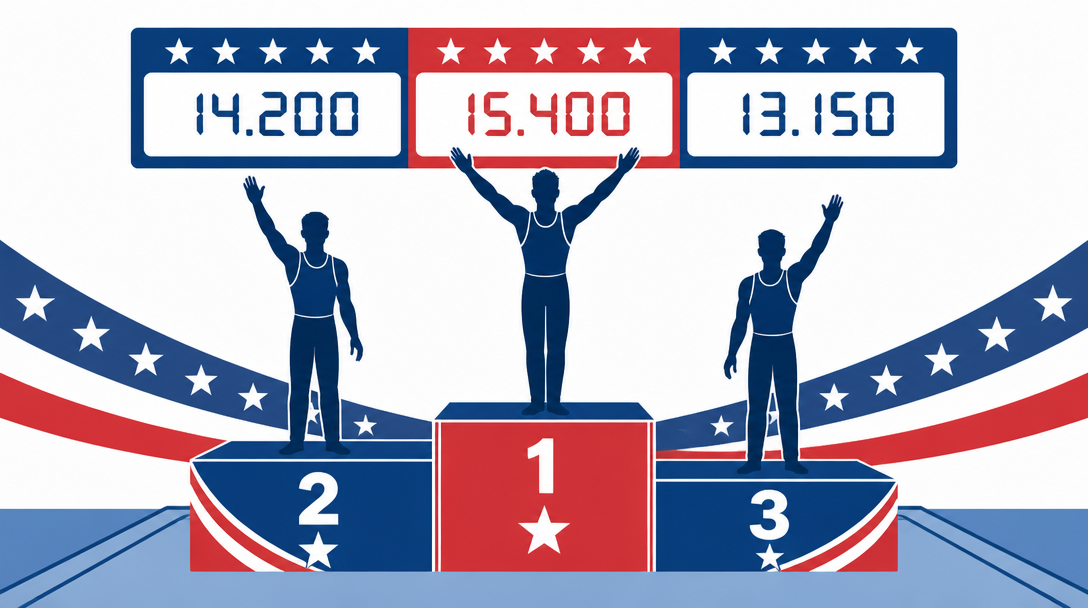
national all-around title, and the roster mixes all-arounders with event specialists. In this article, a former gymnast and D-score app developer breaks down the roster through the lens of the five-man team format and D-score (difficulty) strategy, comparing it with Japan's approach.
2026 U.S. Championships: how the men's team was decided
Let's first review what happened in Phoenix. Beyond crowning national champions, this meet was the key selection event for the men's team heading to the October World Championships.
What was at stake
Held as the Xfinity U.S. Gymnastics Championships at the Mortgage Matchup Center, the senior men competed across two days for a combined total, per USA Gymnastics. Those results fed the world team selection. The World Championships run October 17–25 at Rotterdam Ahoy.
If you want to check any of these gymnasts' routines and difficulty values yourself, the Gymnastics AI D-score calculator is handy. Built on the FIG 2025–2028 Code of Points with a database of 790+ skills, it lets you visualize the compositions discussed below.
Fred Richard wins first national all-around title
Richard took the all-around with 170.015
over two days. According to Gymnastics Now's final results, Shane Wiskus placed second (167.964) and 19-year-old Danila Leykin third (167.001). Richard, a 2023 Worlds team and all-around bronze medalist and Paris Olympic team bronze medalist, led throughout the second day after a tight opening night.
Two absences opened the door
Reigning 2025 national champion Asher Hong and former world champion Brody Malone were both absent. Per NBC Sports, Hong sat out following an ankle injury from last October's Worlds, while Malone is taking the season off with an eye on returning in 2027. Their absence made this a generational-shift meet.
The five-man U.S. team for Rotterdam
Just hours after competition ended, USA Gymnastics announced the five-man world team.
The selected five
Per Gymnastics Now, the team is:
- Fred Richard (all-around champion, team leader)
- Shane Wiskus (all-around runner-up)
- Danila Leykin (19, senior Worlds debut)
- Kameron Nelson (vault champion)
- Patrick Hoopes (pommel horse champion)
Leykin won high bar silver plus team and parallel bars bronze at the 2025 Junior Worlds. Nelson and Hoopes both competed at the 2025 Jakarta Worlds, where Hoopes earned pommel horse bronze.
Alternates and selection method
The alternates are parallel bars champion Yul Moldauer (traveling) and Cooper Kim (non-traveling). With no automatic qualification scenario triggered, the selection committee named all five at its full discretion—exactly the discretionary path outlined in our analysis of the 2026 U.S. selection rules.
Event champions
Two-day event champions, per USA Gymnastics and Gymnastics Now:
Apparatus | Champion | Two-day total |
|---|---|---|
Floor | Fred Richard | 28.916 |
Pommel Horse | Patrick Hoopes | 30.816 |
Rings | Asher Cohen | 29.950 |
Vault | Kameron Nelson | 28.745 |
Parallel Bars | Yul Moldauer | 29.986 |
High Bar | Cooper Kim | 30.936 |
Note that pommel champion Hoopes and vault champion Nelson both made the team—the key to understanding this roster.
A D-score reading of the five-man roster
Here is an independent analysis of why this particular five, through the lens of D-score and the team format.
Why the five-man three-up, three-count format is hard
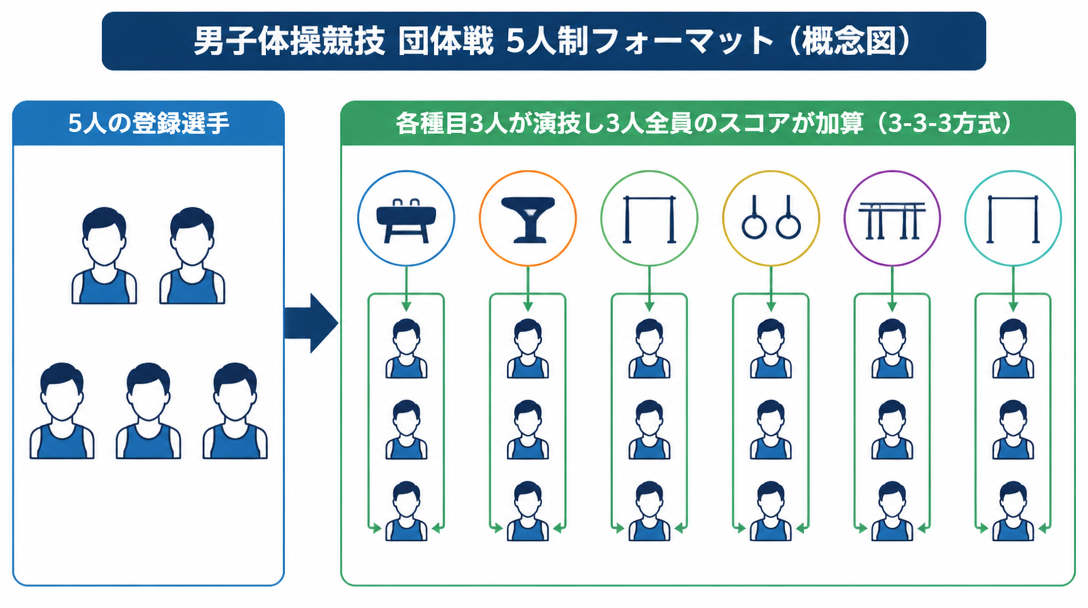
Starting at these Worlds, teams field only five gymnasts. In the team final, three compete on each apparatus and all three scores count—no drop score. This "three-up, three-count" format means a single weak apparatus can sink the whole total.
So the puzzle is fielding three reliable performers on all six apparatus with only five athletes. To compare compositions by the numbers, try the Gymnastics AI app, which auto-calculates difficulty, group requirements, and connection bonuses as you build a routine.
Two specialists (vault and pommel)
The standout choice is including two event specialists: Nelson (vault) and Hoopes (pommel). Pommel horse is where many nations struggle due to difficulty and fall risk. Hoopes is the national pommel champion (30.816) and a 2025 Worlds pommel bronze medalist—locking down a notoriously fragile apparatus. Nelson secures vault, another event where reliable high-difficulty athletes are scarce.
Three all-arounders to raise the floor
Richard, Wiskus, and Leykin fill the remaining spots as all-arounders who can flexibly plug the "third performer" slot on any apparatus. Richard in particular builds strong D-scores on high bar, floor, and parallel bars and can contend for an all-around medal. Three all-arounders plus two specialists is a pragmatic answer to fielding three per apparatus with only five athletes.
Contrast with Japan: all-around depth vs. specialist blend
The U.S. build stands out against Japan's philosophy.
Japan leans all-around; the U.S. mixes in specialists
Japan traditionally stacks all-arounders around Daiki Hashimoto and Shinnosuke Oka. As detailed in our preview of Japan's 2026 men's team, Japan maximizes total strength by having everyone score highly across all six events. The U.S., by contrast, patches weak apparatus with specialists—a clear philosophical divide.
The U.S. weakness and its D-score risk
The U.S. challenge is stabilizing both D- and E-scores on error-prone events like pommel. Even with Hoopes, the team final needs three per apparatus, so the second and third pommel workers matter. As covered in our guide to pommel flops and Scissors, composition swings D-score dramatically on this event.
The medal picture
After the announcement, Richard told Gymnastics Now that China and Japan loom large and Russia is resurgent, casting the U.S. as an underdog chasing the podium.
Looking ahead to Rotterdam
Finally, what to watch in October.
From qualification to the team final
To reach the three-up, three-count final, the U.S. must finish among the top eight in qualification. Per the Rotterdam schedule, the men's team final is set for October 20. How the U.S. deploys and reshuffles its three per apparatus is the heart of its D-score strategy.
Richard's role
As the new leader amid a generational shift, Richard eyes both an all-around and a team medal. The Inside Gymnastics preview already tipped him as the driving force. Primary results are always available via the FIG official site.
Summary
- Fred Richard won his first national all-around title (170.015); Hong and Malone were absent
- The Rotterdam men's team: Richard, Wiskus, Leykin, Nelson, and Hoopes
- Alternates are Moldauer (traveling) and Cooper Kim (non-traveling); selection was fully discretionary
- With the five-man three-up, three-count format, the U.S. blended two specialists (vault, pommel) with three all-arounders
- Against Japan's all-around depth, the U.S. patches weaknesses and enters as a podium-chasing underdog
In an era of fielding three per apparatus from only five gymnasts, roster building is increasingly a D-score calculation. To simulate how each athlete's routine stacks up, try Gymnastics AI—free on iOS and Android.