2026 Worlds Men's Team Final: How Japan Won on Execution
Japan won the 2026 Worlds men's team final with 251.928 despite less difficulty than Russia (WG2). D/E breakdowns, apparatus ranks and the finals schedule.

Information as of October 21, 2026. This is an analysis from the perspective of a former Japanese gymnast and the developer of a D-score calculator, based on the official D/E score breakdowns.
The men's team final at the 2026 World Artistic Gymnastics Championships in Rotterdam took place on October 20 (local time), and Japan won with 251.928, defending the title it won in 2023. Russia, competing as World Gymnastics 2 (WG2), took silver with 250.329 and China won bronze with 249.193. All three medal teams earned team spots for the Los Angeles 2028 Olympics. This article breaks down the published D-scores (difficulty) and E-scores (execution), along with the team totals on each apparatus, to explain how Japan closed out the win.
2026 Worlds Men's Team Final Results: Japan Repeats with 251.928

Team final standings (eight teams)
In the team final, the top eight teams from qualification put up three gymnasts per apparatus and all three scores count (official championship directives). Qualification scores do not carry over. The results were as follows (full team final scores with D, E, bonus and neutral deductions).
Rank | Team | Total | Gap to Japan |
|---|---|---|---|
1 | Japan | 251.928 | – |
2 | World Gymnastics 2 (Russia) | 250.329 | -1.599 |
3 | China | 249.193 | -2.735 |
4 | Great Britain | 247.395 | -4.533 |
5 | Switzerland | 246.497 | -5.431 |
6 | United States | 245.161 | -6.767 |
7 | Netherlands | 241.294 | -10.634 |
8 | Colombia | 240.093 | -11.835 |
Japan's team was Daiki Hashimoto, Shinnosuke Oka, Shohei Kawakami, Ryosuke Doi and Fusuke Maeda. Hashimoto competed on all six apparatus.
A second straight title, an eighth overall, and LA28 team spots
According to Jiji Press (via nippon.com), this is Japan's second consecutive world men's team title and its eighth overall. It follows the win at the 2023 World Championships in Antwerp, the last Worlds with a team event.
- The top three teams in the team final earn a five-member team quota for LA 2028 (LA 2028 artistic gymnastics qualification system)
- International Gymnast reports that Japan, WG2 and China became the first men's teams to secure LA28 berths
- The same report notes that this was Russia's first team medal since its 2019 world title
If you want to check what D-score a particular routine construction is worth, Gymnastics AI — the D-score calculator can help. It follows the FIG 2025–2028 Code of Points and includes a database of more than 790 skills across all six men's apparatus.
Why Japan Won the 2026 Worlds Men's Team Final: D-Score vs E-Score
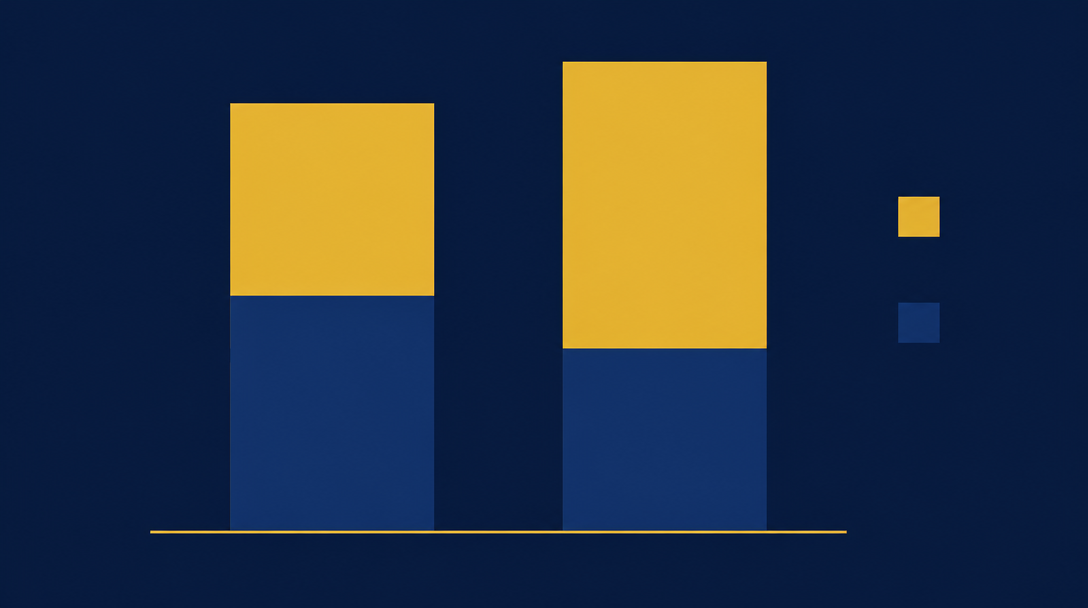
D, E, bonus and ND for the top four teams
A gymnastics score is the D-score (difficulty) plus the E-score (execution) plus any bonus, minus neutral deductions (ND, such as stepping out of bounds). The basics are covered in our guide to the Code of Points, D-score and E-score. Summing the 18 counting routines gives the following.
Team | D total | E total | Bonus | ND | Total |
|---|---|---|---|---|---|
Japan | 97.000 | 154.928 | +0.7 | -0.7 | 251.928 |
WG2 (Russia) | 97.800 | 152.429 | +0.3 | -0.2 | 250.329 |
China | 96.800 | 152.393 | +0.4 | -0.4 | 249.193 |
Great Britain | 96.600 | 150.495 | +0.4 | -0.1 | 247.395 |
Source: team final scores (official FIG/Longines data).
WG2 had 0.8 more difficulty; Japan won execution by 2.499
The highest team D total belonged to WG2 at 97.800, 0.8 more than Japan's 97.000. In other words, Japan did not win on difficulty. The gap came from execution: Japan's E total of 154.928 was 2.499 higher than WG2's and 2.535 higher than China's. Spread over 18 routines, that is roughly 0.14 per routine in Japan's favor.
On the other hand, Japan's neutral deductions of -0.7 were the largest of the top four teams. Part of what Japan earned on execution went straight back out through line deductions and similar penalties.
Switzerland had the best execution: you need both D and E
The best E total among all eight teams was actually Switzerland's 155.797. But the Swiss D total of 90.100 was 6.9 lower than Japan's, and they finished fifth. The D ranking ran WG2, then Japan and the United States tied at 97.000, then China. The U.S. matched Japan's difficulty but scored only 147.861 in execution and finished sixth.
- High difficulty does not win if execution slips (United States)
- High execution does not win without enough difficulty (Switzerland)
- Japan was the only team in the top two for both D (tied second with the U.S.) and E (second)
Team Scores by Apparatus: Only Japan Was Top Four on All Six
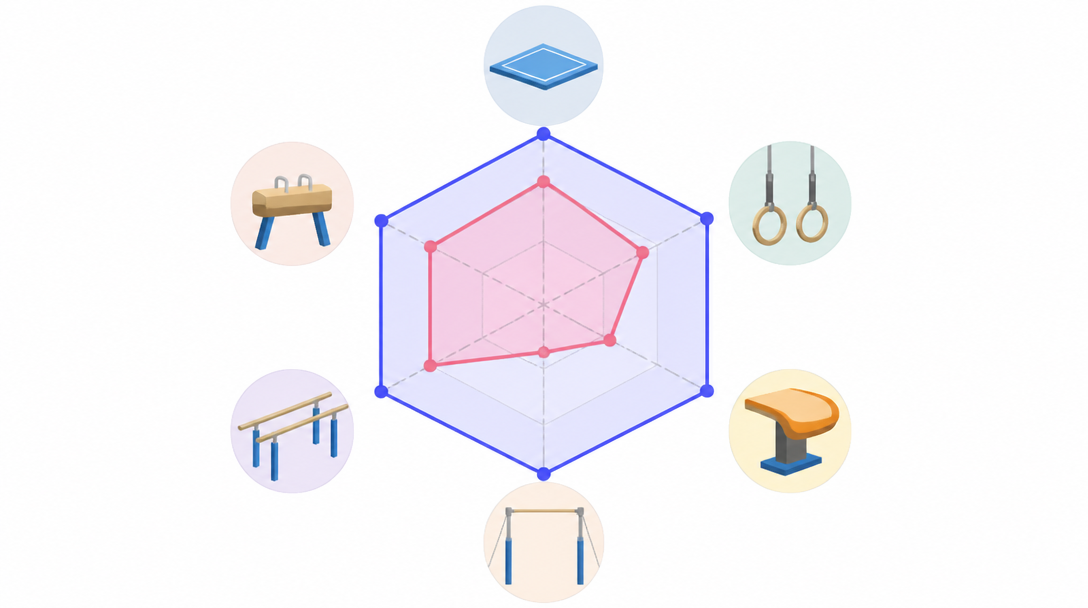
Team totals and ranks on each apparatus
Comparing the three-person totals on each apparatus makes Japan's approach even clearer. The number in parentheses is the rank among the eight teams.
Apparatus | Japan | WG2 | China | Great Britain |
|---|---|---|---|---|
Floor | 41.299 (4) | 41.333 (2) | 39.699 (8) | 41.300 (3) |
Pommel horse | 42.332 (1) | 41.166 (6) | 41.132 (7) | 41.965 (2) |
Rings | 40.933 (3) | 39.666 (4) | 42.766 (1) | 41.899 (2) |
Vault | 42.966 (2) | 42.666 (3) | 40.998 (8) | 43.499 (1) |
Parallel bars | 42.099 (4) | 42.933 (2) | 43.366 (1) | 39.999 (7) |
High bar | 42.299 (2) | 42.565 (1) | 41.232 (4) | 38.733 (8) |
Japan topped only one apparatus, pommel horse. Yet Japan was the only team to finish in the top four on all six apparatus. WG2 was sixth on pommel horse, China was eighth on floor and vault, and Great Britain was eighth on high bar. Every other team had at least one big hole. In a final where all three scores count, having no weak event was the difference.
Against WG2, the gap came from pommel horse and rings
Here is the apparatus-by-apparatus gap between Japan and second-place WG2 (from Japan's side).
- Pommel horse +1.166 / Rings +1.267 / Vault +0.300
- Floor -0.034 / Parallel bars -0.834 / High bar -0.266
WG2 was better on parallel bars and high bar, but Japan banked 2.433 on pommel horse and rings combined, which more than covered the final margin of 1.599. WG2 climbed the standings late; International Gymnast highlights high bar work such as Sergei Naidin's 14.566.
Where China and Great Britain lost ground
According to The Japan Times (AFP-Jiji), Japan and China were separated by just one-tenth of a point going into the final rotation. China won both rings and parallel bars, with Zou Jingyuan posting 15.366 on parallel bars, the highest single score of the team final. But Yang Haonan stepped out of bounds and landed on his hands on floor, and China finished eighth on both floor and vault.
Great Britain led after three rotations, according to International Gymnast. GymCastic points to Joe Fraser's fall in the opening routine and a balked release on high bar, as well as Courtney Tulloch's rings dismount. The numbers show the same story: 39.999 on parallel bars (seventh) and 38.733 on high bar (eighth) in the last two rotations.
Checking the Qualification Preview: Parallel Bars -2.367, a Fall on High Bar
Japan's qualification and final, apparatus by apparatus
In our men's qualification results analysis, we listed three things Japan needed to protect in the final: repeating its parallel bars execution, getting three clean high bar routines, and its margins on pommel horse and rings. Qualification (four up, three count) and the final (three up, three count) use different formats, but the team totals compare like this.
Apparatus | Qualification | Final | Change |
|---|---|---|---|
Floor | 41.433 | 41.299 | -0.134 |
Pommel horse | 41.966 | 42.332 | +0.366 |
Rings | 41.265 | 40.933 | -0.332 |
Vault | 42.599 | 42.966 | +0.367 |
Parallel bars | 44.466 | 42.099 | -2.367 |
High bar | 42.800 | 42.299 | -0.501 |
Total | 254.529 | 251.928 | -2.601 |
Why the two rounds count scores differently is explained in how team scores are calculated in qualification and the final.
Parallel bars: Japan's standout event fell to fourth
Parallel bars, where Japan scored a dominant 44.466 in qualification, dropped to 42.099 (fourth) in the final. Oka went from 14.866 to 13.600, and Hashimoto from 14.800 to 13.933. GymCastic mentions Japan's misses on parallel bars, and Jiji Press says the score on the fifth apparatus was lower than expected. Of the three points in our preview, the parallel bars repeat did not happen.
High bar: Hashimoto's 14.866 made up for Kawakami's fall
On high bar, the last rotation, Kawakami, who had topped high bar in qualification with 14.600, fell and scored 13.100 (Nippon TV, International Gymnast). Maeda followed with 14.333 (D 5.8, E 8.533), and Hashimoto closed with 14.866. According to Nippon TV, Hashimoto stuck his landing, and that was the moment the Japanese team knew it had won.
GymCastic also notes that Japan won without even using Oka, the Olympic high bar champion, on the event. The final high bar lineup was Hashimoto, Kawakami and Maeda, which says a lot about the team's depth.
Meanwhile, pommel horse (+0.366 on qualification) and rings, which our preview flagged as places to build a margin, turned out to be exactly where Japan beat WG2. If you want to see how the balance of difficulty and execution plays out in a routine, try Gymnastics AI. Pick and arrange skills, and it calculates difficulty values, element group requirements and dismount value automatically.
2026 Worlds Men's Team Final by Gymnast: Hashimoto's 84.865 on Six Events
D and E totals for Japan's five gymnasts
Gymnast | Apparatus | D total | E total | Bonus | ND | Total |
|---|---|---|---|---|---|---|
Daiki Hashimoto | All six | 32.700 | 52.365 | +0.2 | -0.4 | 84.865 |
Shohei Kawakami | PH, SR, VT, PB, HB | 26.900 | 42.031 | +0.2 | 0.0 | 69.131 |
Ryosuke Doi | FX, PH, VT | 15.900 | 26.433 | 0.0 | -0.3 | 42.033 |
Shinnosuke Oka | FX, SR, PB | 15.700 | 25.566 | +0.3 | 0.0 | 41.566 |
Fusuke Maeda | HB | 5.800 | 8.533 | 0.0 | 0.0 | 14.333 |
Source: team final scores. The published data gives each gymnast's totals only, so the D-score for each individual routine is not available except for Maeda, who competed on high bar alone.
Hashimoto: the best E total of anyone who did all six
Five gymnasts competed on all six apparatus in the team final: Hashimoto, Arsenii Dukhno (WG2), Angel Barajas and Camilo Vera (Colombia), and Yang Haonan (China). Among them, Hashimoto's E total of 52.365 was the highest, and so was his 84.865 overall. Barajas had the highest D total at 33.800; Hashimoto's 32.700 was second.
In qualification Hashimoto scored 84.632 (D 33.200, E 51.332). In the final his D dropped by 0.5, but his E rose by 1.033, so his total was 0.233 higher. By apparatus, high bar, where he fell in qualification, went from 13.700 to 14.866, while parallel bars went from 14.800 to 13.933.
Japan's -0.7 ND came from Hashimoto and Doi
Japan's -0.7 in neutral deductions was Hashimoto's -0.4 plus Doi's -0.3. According to Nippon TV, Hashimoto went out of bounds on floor, his first event. GymCastic also noted that the judging assistance cameras caught every out-of-bounds. For a team that won execution by 2.499, a 0.5 gap in ND against WG2 (-0.2) is not a small number.
2026 Worlds Men's All-Around and Apparatus Finals: Outlook and Schedule
All-around final: Oka and Hashimoto
Oka (85.098) and Hashimoto (84.632) qualified first and second for the all-around final. Third in qualification was WG2's Dukhno (83.866), who was steady again in the team final with 83.932 on six events. The Japan Times suggests that with China's Zhang Boheng out injured, the Russians could be the main challengers to the two Japanese gymnasts.
Japanese gymnasts in the apparatus finals
- Floor: Ryosuke Doi
- Pommel horse: Daiki Hashimoto
- Rings: Shinnosuke Oka
- Vault: Shohei Kawakami
- Parallel bars: Shinnosuke Oka, Daiki Hashimoto
- High bar: Shohei Kawakami, Shinnosuke Oka
D-scores for the leading contenders are in our 2026 Worlds men's event finals preview.
Finals schedule (local time and Japan time)
Local times are from the championship results and schedule pages. Europe leaves summer time on October 25, so the gap to Japan becomes eight hours that day.
Event | Rotterdam time | Japan time |
|---|---|---|
Men's all-around final | Thu Oct 22, 19:30 | Fri Oct 23, 2:30 |
Floor final | Sat Oct 24, 14:00 | Sat Oct 24, 21:00 |
Pommel horse final | Sat Oct 24, 15:49 | Sat Oct 24, 22:49 |
Rings final | Sat Oct 24, 17:12 | Sun Oct 25, 0:12 |
Vault final | Sun Oct 25, 14:00 | Sun Oct 25, 22:00 |
Parallel bars final | Sun Oct 25, 15:50 | Sun Oct 25, 23:50 |
High bar final | Sun Oct 25, 17:19 | Mon Oct 26, 1:19 |
For the full schedule and venue, see our 2026 Worlds Rotterdam schedule and viewing guide. Updates on the Japanese team are also posted by the Japan Gymnastics Association.
Summary
- Japan won the 2026 Worlds men's team final with 251.928, its second straight title after 2023 and eighth overall (Jiji Press)
- Japan, WG2 (Russia) and China earned team spots for LA 2028
- WG2 had 0.8 more difficulty; Japan won execution by 2.499 and built a 2.433 margin on pommel horse and rings
- Japan was the only team in the top four on all six apparatus. Parallel bars dropped 2.367 from qualification, and Kawakami fell on high bar, but Hashimoto's 14.866 closed it out
- Hashimoto's 84.865 on six events was the best total, and the best E total, of anyone who did all six in the team final
If you want to check the D-score of each gymnast's routine while you watch the all-around and apparatus finals, give Gymnastics AI a try. It covers all six men's apparatus and is free on iOS and Android.