Women's Gymnastics Difficulty Values Explained: A to J Skills
How women's gymnastics difficulty values work under the FIG 2025-2028 Code: A-to-J values, element numbers, the hardest skills by apparatus and D-scores.
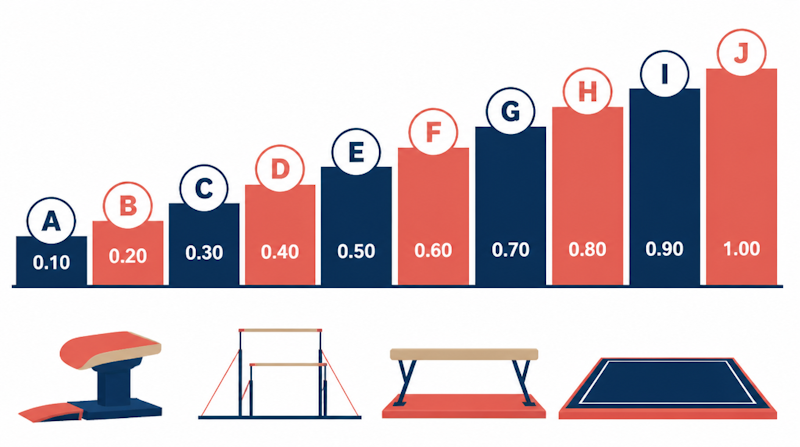
Women's gymnastics difficulty values run from A (0.10) to J (1.00). This guide walks through the FIG Women's Artistic Gymnastics Code of Points for 2025-2028: how to read the difficulty tables, which skills carry the highest values on each apparatus, and how a D-score is built. It also looks at two members of Japan's women's team at the 2026 World Championships who already have skills named after them in the Code.
Women's Gymnastics Difficulty Values: The A-to-J Basics
Ten levels, each worth 0.10 more than the last
Every skill in women's artistic gymnastics has a Difficulty Value (DV). Section 7 of the FIG WAG Code of Points 2025-2028 sets the values as follows.
Difficulty | Value | Difficulty | Value |
|---|---|---|---|
A | 0.10 | F | 0.60 |
B | 0.20 | G | 0.70 |
C | 0.30 | H | 0.80 |
D | 0.40 | I | 0.90 |
E | 0.50 | J | 1.00 |
The Code describes the Table of Elements as "open ended": when a gymnast successfully performs a new skill at a qualifying international competition, it is added to the table. People often call the letters a "difficulty ranking," but the official term is Difficulty Value.
Only the eight highest skills count on bars, beam and floor
On uneven bars, balance beam and floor exercise, the D-panel counts a maximum of eight elements with the highest values, including the dismount. A ninth or tenth skill adds nothing to the difficulty total. Going the other way, routines with too few elements are hit hard by the "short exercise" rule in Section 6.3, which deducts from the final score:
- 7 or more elements: no deduction
- 5-6 elements: 4.00 points
- 3-4 elements: 6.00 points
- 1-2 elements: 8.00 points
The same element only earns its value once per routine. On bars there is an extra limit: only three elements from the same root skill are counted, in the order they are performed (kips, giants and casts to handstand are exceptions).
Vault works differently: the vault's value is the D-score
Vault is the exception. Each vault has a fixed value in the Table of Vaults (for example 5.40), and that number is the D-score. There is no A-to-J letter for vaults. For a full list of women's vaults and their values, see our guide to women's vaults, from the Yurchenko to the Cheng.
On floor, difficulty is only part of the picture. Music and choreography feed into the artistry portion of the E-score, so where a gymnast places her biggest passes depends on how the music builds. Gymnasts and coaches who want help with that can work with a former gymnast turned composer on custom floor music for competition.
How to Read the Women's Gymnastics Difficulty Table
The first digit after the decimal point is the difficulty
Every skill in the Table of Elements has a number such as "5.802". You can read it like this:
- Before the decimal point (5): the element group (on floor, group 5 is backward saltos)
- The first digit(s) after the decimal point (8): the difficulty value (1 = A, 2 = B ... 8 = H, 9 = I, 10 = J)
- The last two digits (02): the row in the table, which groups related skills together
So floor element 5.802 is an H-value backward salto, and 5.1002 is a J. Once you know this, you can read the value straight from the number whenever a results sheet or judging report lists element numbers.
Columns show difficulty, rows show skill families
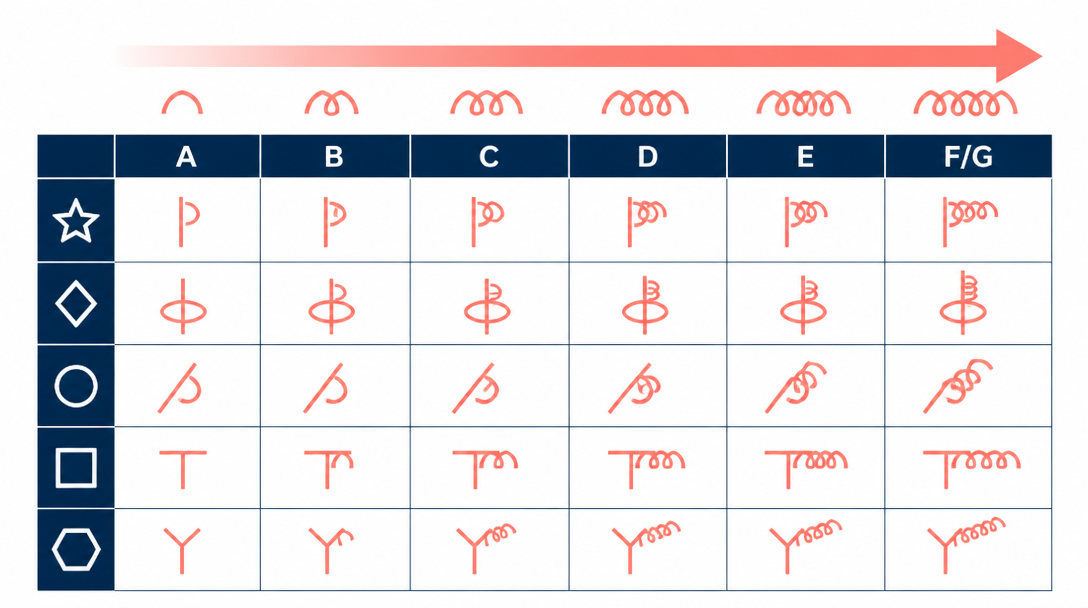
The table is laid out with difficulty running left to right (A, B, C ...) and related skills running down the page. Moving right along a row usually means more twists or more saltos. Here is one row of backward saltos on floor:
Element number | Value | Skill |
|---|---|---|
5.101 | A | Salto backward tucked, piked or stretched |
5.301 | C | Salto backward stretched with 1½ or 2/1 twist |
5.401 | D | Salto backward stretched with 2½ twist |
5.501 | E | Salto backward stretched with 3/1 twist |
5.601 | F | Salto backward stretched with 3½ twist |
For an overview of every kind of tumbling element on floor, read our guide to women's floor tumbling skills and their values.
Named skills honor the first gymnast to perform them internationally
Names like "Silivas" or "Biles" come from the gymnast who first performed the skill successfully at a major international competition. The appendices of the Code list each named skill along with the gymnast and the event where it was first performed. New skills are announced in newsletters from the FIG Women's Technical Committee and then added to the Code.
The FIG WAG Newsletter No. 1 (February 2026) announced six new women's elements from 2025. Two belong to Japanese gymnasts:
Gymnast | Apparatus | Skill | Value (number) | Competition |
|---|---|---|---|---|
Yume Minamino (JPN) | Uneven bars | Jaeger salto piked with 1/1 turn to hang on HB | F (3.608) | 2025 Junior World Championships |
Mana Okamura (JPN) | Uneven bars | From L grip, swing backward with ½ turn to double salto backward piked (dismount) | D (6.408) | 2025 Antalya World Cup |
The Hardest Skills in Women's Gymnastics by Apparatus
Floor: the J-rated Biles sits at the top
The highest-valued skill in women's gymnastics is on floor. These are the saltos rated H or above in the 2025-2028 floor table:
Value | Number | Skill | Name |
|---|---|---|---|
J (1.00) | 5.1002 | Double salto backward tucked with 3/1 twist | Biles |
I (0.90) | 5.903 | Double salto backward stretched with 2/1 twist | Moors |
H (0.80) | 5.802 | Double salto backward tucked with 2/1 twist | Silivas |
H (0.80) | 5.803 | Double salto backward stretched with 1/1 twist | Chusovitina/Touzhikova |
H (0.80) | 4.805 | Arabian double salto stretched (counted as a forward element) | Dos Santos |
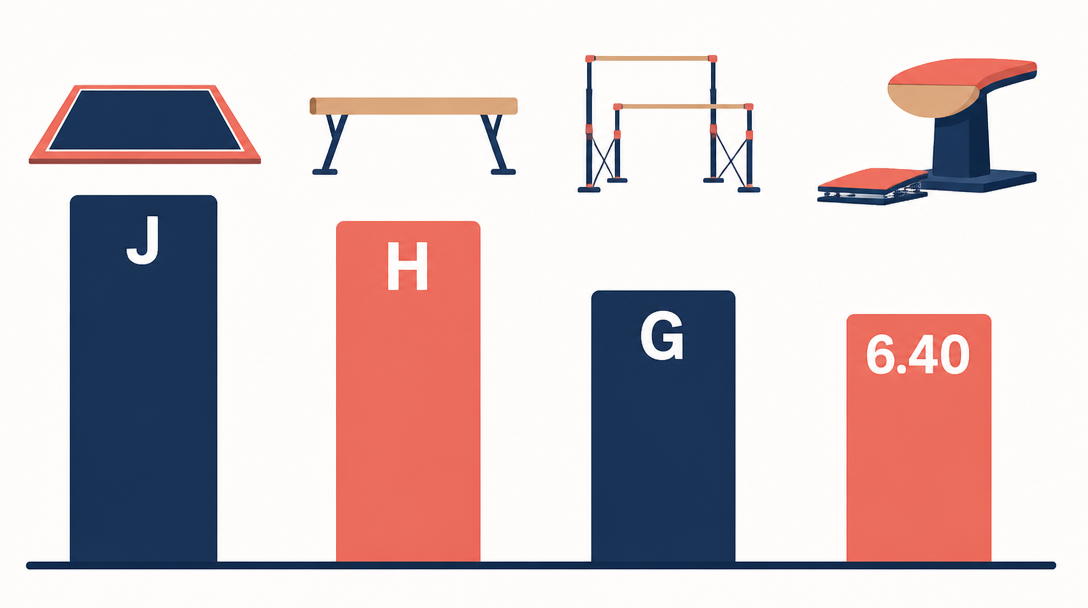
The more twist added to a double salto, the higher the value, and for the same amount of twist a stretched (layout) position is rated higher than tucked. That is why the Silivas is an H and the Moors an I.
Beam: G on the beam, H for the dismount
On balance beam, the highest value for a skill performed on the beam itself is G. That includes the stretched salto backward with full twist (Shishova) and some round-off mounts. The dismount table goes one step further: a double salto backward tucked with double twist (Biles, 6.805) is rated H. For more on beam skills and how they are judged, see our balance beam guide.
Uneven bars: the table stops at G
On uneven bars, the right-most column of the table is F/G, and there are no H-value skills. G-rated elements include:
- Clear pike circle backward with counter stretched reverse hecht over the high bar to hang (Nemour)
- Swing forward to double salto backward stretched with 2/1 turn, dismount (Ray)
- Swing forward to triple salto backward tucked, dismount (Magaña)
On bars, connecting skills matters as much as raw difficulty. Our uneven bars guide covers release moves and connections in more detail.
Vault: the Yurchenko double pike is worth 6.40
The highest value in the Table of Vaults is 6.40, for a round-off entry (Yurchenko) followed by a piked double salto backward, named after Simone Biles.
Vault | Name | D-score |
|---|---|---|
Yurchenko entry, double salto backward piked | Biles | 6.40 |
Handspring forward, double salto forward tucked | Produnova | 6.00 |
Round-off ½ on, salto forward stretched with 2/1 twist | Biles | 6.00 |
Round-off ½ on, salto forward stretched with 1½ twist | Cheng | 5.60 |
Yurchenko entry, salto backward stretched with 2½ twist | Amanar | 5.40 |
All values are taken from the vault table in the FIG WAG Code of Points 2025-2028.
How the Women's Gymnastics D-Score Is Calculated
Four parts add up to the D-score
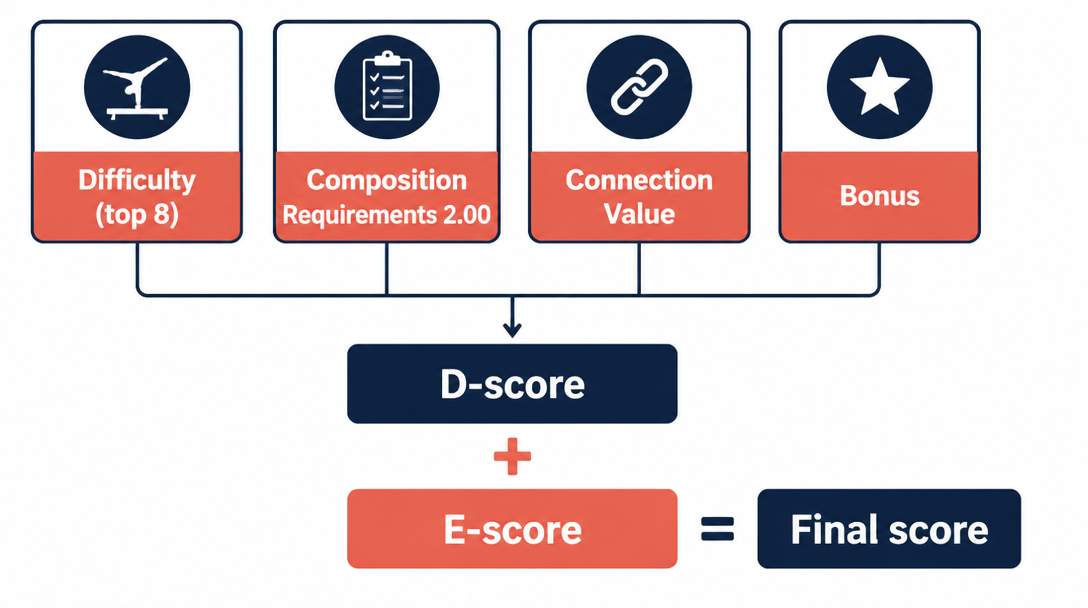
On bars, beam and floor, the D-score is the sum of four parts:
- Difficulty Value (DV): the values of the eight highest elements
- Composition Requirements (CR): four requirements worth 0.50 each, for a maximum of 2.00
- Connection Value (CV): 0.10 or 0.20 for specified skill combinations performed in direct connection
- Bonus: 0.20 for a dismount of D value or higher landed without a fall (on floor this requires more than two acro lines). Beam also has a 0.10 series bonus for three or more connected elements
On beam and floor, the eight counting elements must include at least three dance elements and at least three acro elements. Floor routines can have at most four acro lines (an acro line is at least two directly connected flight elements, one of which is a salto).
Composition Requirements by apparatus
Apparatus | Composition Requirements (0.50 each) |
|---|---|
Uneven bars | 1) Flight element from high bar to low bar 2) Flight element on the same bar 3) Different grips 4) Non-flight element with at least a 360° turn |
Balance beam | 1) Connection of two different dance elements, one with a 180° split or straddle 2) Turn (or roll/flair) 3) Acro series of at least two flight elements, one a salto 4) Acro elements in different directions (forward/sideward and backward) |
Floor exercise | 1) Dance passage of two different leaps or hops, one with a 180° split 2) Salto with at least 360° twist 3) Double salto 4) Salto backward and salto forward |
For a deeper look at floor scoring, including acro line rules, read our explainer on women's floor scoring and composition requirements.
Worked example from the Code of Points
D-score example
Section 6 of the Code includes this worked example:
- Difficulty: 3 C + 3 D + 2 E = 0.90 + 1.20 + 1.00 = 3.100
- Composition Requirements: 2.000
- Connection Value: 0.600
- D-score: 5.700
Final score example
The E-score (execution and artistry) starts from 10.000, with deductions taken by each judge. The middle scores are averaged and truncated, not rounded, to three decimal places. In the Code's example the E-score is 8.666, so the final score is 5.700 + 8.666 = 14.366.
On floor, the order in which those eight elements appear against the music shapes how the routine reads to the judges. If you want the biggest pass to land on the musical climax, or need to fit every composition requirement comfortably into 90 seconds, custom floor music edited or composed with the Code of Points in mind is one way to get there.
Women's Gymnastics D-Scores at the Top Level: 2025 Worlds Data
Highest D-scores by apparatus (2025 Worlds qualification)
The FIG WAG Newsletter No. 1 (February 2026) includes the judging report from the 2025 World Championships in Jakarta, Indonesia. These were the top marks in qualification:
Apparatus | Highest D-score | Highest E-score | Highest final score |
|---|---|---|---|
Vault | 5.400 (Kalmykova) | 9.300 (Aiko Sugihara) | 14.233 (Melnikova) |
Uneven bars | 7.10 (Nemour) | 8.433 (Nemour) | 15.533 (Nemour) |
Balance beam | 6.500 (Zhang Qingying) | 8.333 (Saraiva) | 14.366 (Zhang Qingying) |
Floor exercise | 6.100 (Roberson) | 7.900 (Petisco) | 13.666 (Maneca-Voinea) |
Source: FIG WAG Newsletter No. 1 (February 2026).
What the numbers tell us
- The top bars D-score was 7.10. The judging report singles out Kaylia Nemour for connecting eight elements directly and receiving connection value eight times
- The top vault D-score of 5.400 equals the value of an Amanar. None of the vaults valued 6.00 to 6.40 was credited in qualification in Jakarta
- The highest E-score of the competition was Aiko Sugihara's 9.300 on vault, a reminder that execution matters as much as difficulty
2025 Worlds apparatus medals
According to the same report, Aiko Sugihara won gold on floor and bronze on beam in Jakarta. Kaylia Nemour (Algeria) won bars, Zhang Qingying (China) won beam, and Angelina Melnikova won both vault and the all-around.
Skills Named After Japanese Gymnasts to Watch at 2026 Worlds
Mana Okamura: a D-value bars dismount
Japan's women's team at the 2026 World Championships in Rotterdam is Aiko Sugihara, Rina Kishi, Misa Nishiyama, Haruka Nakamura and Mana Okamura (championship overview). Okamura's uneven bars dismount, from L grip with a backward swing and ½ turn into a piked double salto backward, was added to the Code as a D-value element (6.408) after she performed it at the 2025 Antalya World Cup (Mana Okamura profile).
On the first day of qualification in Rotterdam, Okamura scored 14.266 on beam, the best beam score after day one (International Gymnast, October 18; Gymnastics Now live updates). Women's qualification continues through October 19 local time, so final qualifiers will not be known until every subdivision has competed.
Haruka Nakamura: the piked Deltchev (D value)
Haruka Nakamura performed a piked Deltchev on uneven bars, a forward swing with ½ turn into a piked salto forward to regrasp the high bar, at the 2023 Junior World Championships. The Code lists the skill as the "Moreno/Nakamura," shared with Mexico's Alexa Moreno, at D value (Haruka Nakamura profile).
Women's finals schedule
Final | Local time (CEST) | Japan time |
|---|---|---|
Women's team final | Wed, Oct 21, 19:00 | Thu, Oct 22, 2:00 |
Women's all-around final | Fri, Oct 23, 19:30 | Sat, Oct 24, 2:30 |
Apparatus finals | Sat, Oct 24 and Sun, Oct 25 | Evening of each day |
Times are from the championship overview and NBC Sports' viewing schedule. Schedules can change, so check the Japan Gymnastics Association and official event channels for updates.
Summary
- Women's gymnastics difficulty values run from A (0.10) to J (1.00). On bars, beam and floor, the eight highest elements count toward the D-score
- The first digit(s) after the decimal point in an element number give its value (5.802 = H, 5.1002 = J)
- The hardest skill is the J-rated Biles on floor. Beam peaks at H with the Biles dismount, bars at G, and vault at 6.40
- The D-score is DV + Composition Requirements (up to 2.00) + Connection Value + bonuses. The highest D-score at 2025 Worlds was 7.10 on bars
- Two members of Japan's 2026 Worlds team, Mana Okamura and Haruka Nakamura, already have named skills in the Code
If you are a gymnast, coach or parent looking to pair big skills with music that shows them off, take a look at custom floor music for competition. Services range from editing an existing track to fit the Code of Points to composing an original piece.