2026 Worlds Men's Podium Training: Japan's Form and a 6.9 D-Score
What men's podium training at the 2026 Worlds showed about Japan, the USA and Britain, Fusuke Maeda's 6.9 high bar D-score explained, and LA28 team berths.
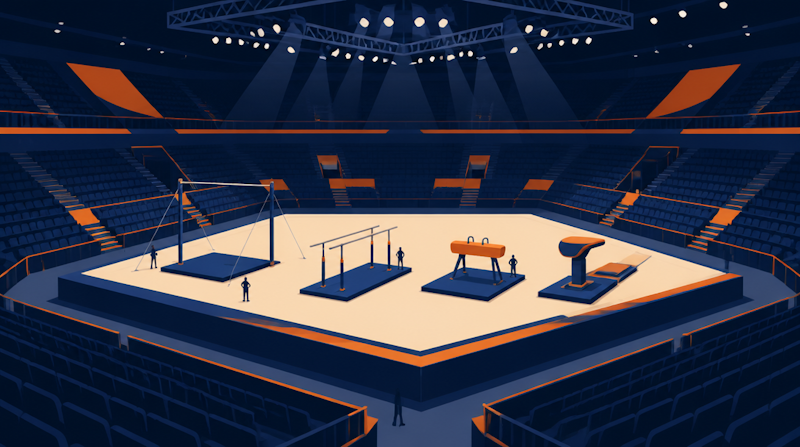
Men's podium training for the 2026 World Gymnastics Championships took place on October 14 and 15 at the competition venue in Rotterdam, the Netherlands. Japan, led by Daiki Hashimoto and Shinnosuke Oka, drew some of the strongest reviews of the first day. This analysis comes from the developer of a D-score app built on the FIG Code of Points, written for a Japanese and international audience. It covers what podium training revealed about Japan and its main rivals, breaks down Fusuke Maeda's 6.9 D-score high bar routine using the scoring rules, and explains how the team final decides the first Olympic team berths for LA 2028. It also lists the qualification and final times in both local time and Japan time.
Note: This article reflects information available as of October 15, 2026. Podium training details come from on-site reports by international media, and routines may change before qualifications.
2026 Worlds Men's Podium Training: What Happened
What podium training is
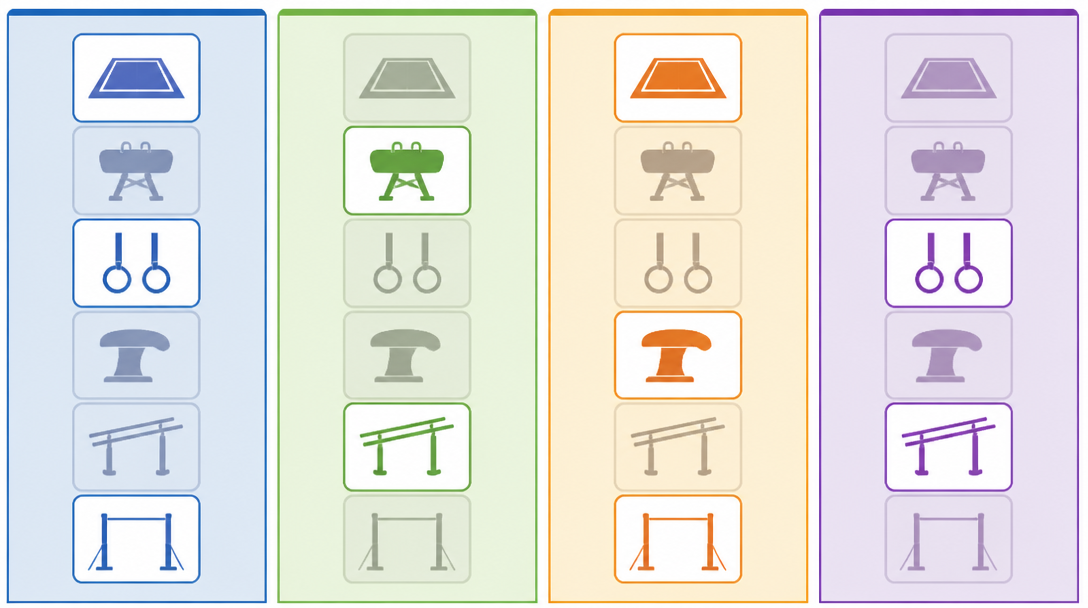
Podium training is the last practice before competition, held in the arena on the same equipment the gymnasts will use in qualifications. The apparatus sits on a raised platform, or podium, which is where the name comes from. The bounce of the floor, the flex of the high bar and the feel of the vault springboard change from venue to venue, so teams use these sessions to adjust their timing for takeoffs and landings.
Nothing in podium training is scored. Some gymnasts test harder routines than they plan to compete. Others run only half routines to save energy. A good or bad session does not decide the result. What makes podium training useful for previews is that it shows which skills each gymnast intends to use in qualifications.
What happened on October 14 and 15
The championships run from October 17 to 25 in Rotterdam (Japan Gymnastics Association event page). Four of the six men's subdivisions trained on October 14, and the remaining two trained on October 15. International Gymnast's notes from day one of men's podium training describe the sessions country by country, including Japan, the United States, Great Britain, Canada, Chinese Taipei and Ukraine.
A coaching site, Gymnastics Coaching, came away from day one with a blunt conclusion: "Japan will win team." The same report named five main contenders for the team title: Japan, Great Britain, China, the United States and the Russian neutral athletes.
Hashimoto: "I have no intention of giving up first place"
According to a Kyodo News report (published by Daily Sports, in Japanese), Hashimoto stuck his landings on parallel bars and other events during the October 14 session. He said his condition was good and that he had no intention of giving up first place in either the team or the individual competition. On the withdrawal of China's Zhang Boheng, he said he was a little surprised but would focus on showing his own world-class gymnastics.
If you want to see how a routine's skills add up to a D-score, you can build it in Gymnastics AI, a D-score calculator app. It follows the FIG 2025–2028 Code of Points and includes more than 790 skills across all six men's apparatus.
Japan's Form: What Podium Training Showed About the Five
The team and their roles
Japan's men's team for the 2026 Worlds is Shinnosuke Oka, Daiki Hashimoto, Shohei Kawakami, Ryosuke Doi and Fusuke Maeda (Japan Gymnastics Association). Oka, the Paris 2024 Olympic all-around champion, and Hashimoto, the Tokyo 2020 Olympic all-around champion, cover all six events. First-time world team member Kawakami, floor specialist Doi and high bar specialist Maeda add scores on specific apparatus. We analyze how the five fit together in our article on Japan's 2026 Worlds men's team.
Gymnast | Main role | Reported in podium training (International Gymnast and others) |
|---|---|---|
Daiki Hashimoto | All-arounder | Beautiful pommel horse. Missed his second release on high bar, then hit it on the repeat. Stuck landings on parallel bars and other events (Kyodo) |
Shinnosuke Oka | All-arounder | Excellent pommel horse. On vault, balked one Kasamatsu double twist and put his hands down on another attempt |
Fusuke Maeda | High bar specialist | Hit a 6.9 D-score high bar routine, reportedly planned for qualifications |
Shohei Kawakami, Ryosuke Doi | Event specialists | No individual notes. The team hit four floor routines |
Strengths on parallel bars and high bar
International Gymnast wrote that Japan delivered some of the most impressive gymnastics of the day, singling out the execution on parallel bars and high bar. Japan also hit four floor routines. Japan has long built its scores on precise execution (the E-score), and sticking landings at this stage is reassuring for qualifications, where four gymnasts compete on each apparatus and the top three scores count.
The concern: vault landings
The main concern in the reports was Oka's vault. He is training a Kasamatsu (a Tsukahara-family vault) with a double twist. On one attempt he balked at the takeoff, and on another he put his hands down on the landing. Mistakes in training are common, but on vault a single fall costs a full point or more. Whether Oka keeps this vault for qualifications or chooses a safer, lower-value vault is one of the decisions worth watching.
Fusuke Maeda's 6.9 High Bar D-Score Explained
The three parts of a D-score
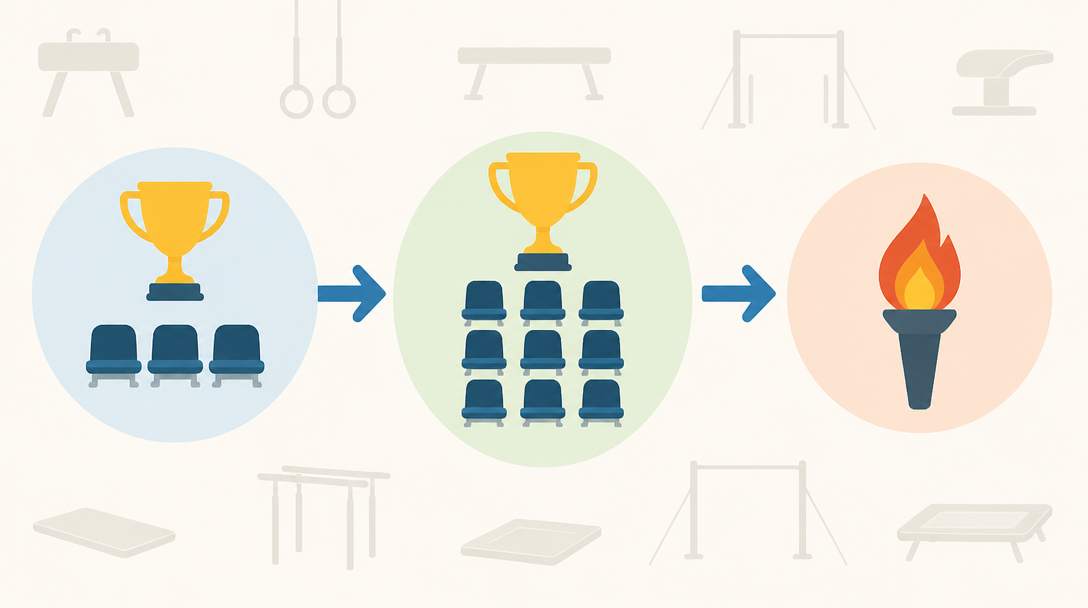
Under the FIG 2025–2028 Code of Points, a men's D-score (difficulty score) is the sum of three parts:
- Difficulty value (DV): the values of the eight highest-valued skills performed, from A (0.1) to J (1.0). The 2022–2024 code counted the top ten
- Element group requirements (EG): credit for covering the four element groups on each apparatus, worth up to 2.0 points
- Connection value (CV): bonus for connecting high-difficulty skills, used on high bar and floor
Our guide to calculating the floor exercise D-score walks through the eight-skill rule with a worked example. The same logic applies on high bar.
Working backward from 6.9
International Gymnast reports that Maeda performed a 6.9 D-score high bar routine in podium training and plans to use it in qualifications. His full skill list was not published, so here we only estimate the structure from the scoring rules.
Component | Calculation | What it tells us |
|---|---|---|
Total D-score | 6.9 | Value reported by International Gymnast |
Element group requirements | Assume the maximum 2.0 | Top gymnasts normally fulfill all four groups |
Difficulty value + connection value | 6.9 − 2.0 = 4.9 | Eight skills plus connection bonus make 4.9 points |
Average per counted skill | 4.9 ÷ 8 ≈ 0.61 | Even before removing connection bonus, the average is around an F-value skill (0.6) |
Because that figure includes connection value, the true average of the eight counted skills is a little lower. Even so, a 6.9 D-score is only possible if almost every counted skill is valued E to G or higher. The likely shape is a routine that chains release moves (skills where the gymnast lets go of the bar and regrasps it) to collect connection bonus.
You can test this kind of breakdown yourself in Gymnastics AI. Pick skills and line them up, and the app splits the total into difficulty value, element group credit and connection bonus. You can also swap one release move and see how much the D-score changes.
Training difficulty is not always competition difficulty
The difficulty shown in podium training does not always make it into qualifications. According to International Gymnast, Chinese Taipei's Tang Chia-Hung showed a 6.6 D-score high bar routine in training but plans to compete a 6.0 or 6.3 version in qualifications. Qualifications decide who reaches the finals, so many gymnasts give up 0.3 to 0.6 of difficulty to avoid a fall that would end their chances.
Against that background, the report that Maeda will go with 6.9 from qualifications signals two goals at once: lifting Japan's team total on high bar and chasing a medal in the high bar final. A fall on high bar costs 1.0 point in execution, so his routine in qualifications also matters directly for the team ranking.
Rivals in Podium Training: USA, Great Britain and China
United States: still building
The U.S. team is Frederick Richard, Shane Wiskus, Danila Leykin, Kameron Nelson and Patrick Hoopes (Gymnastics Now's list of competitors). International Gymnast reported that Nelson landed low on his new Dragulescu vault and needed three attempts to land his triple tuck on floor. Richard missed a giant Diamidov on parallel bars and struggled with rings strength elements and his dismount.
On the positive side, Hoopes looked sharp on pommel horse, and Leykin connected a Pegan to a Kolman on high bar. Most U.S. gymnasts did half routines, and the team mostly trained 4.8 vaults. Difficulty may go up once the competition starts.
Great Britain: big floor difficulty, weaker high bar
Great Britain brings Jake Jarman, Harry Hepworth, Reuben Ward, Joe Fraser and Courtney Tulloch. International Gymnast praised Jarman's Kasamatsu 2½ and the pommel horse work of Fraser and Ward. The Gymnastics Coaching report described Britain's floor difficulty as "insane."
International Gymnast also identified high bar as the team's weaker event. Fraser missed a release-to-Kolman connection, and Tulloch trained a routine of moderate difficulty. Britain scoring big on floor and vault but giving points back on high bar is exactly where the gap with a strong Japanese high bar team could show.
China and the day-two subdivisions
China's team is Lan Xingyu, Zou Jingyuan, Yang Haonan, Tian Hao and Li Hongyan (Gymnastics Now). Without Zhang Boheng, China is missing its all-around leader, but it still has world champions Zou Jingyuan on parallel bars and Lan Xingyu on rings. China is in qualification subdivision 5 and trained on day two, October 15, so it was not part of the day-one reports. We look at how China's lineup change affects the team race in our analysis of Zhang Boheng's withdrawal.
Other gymnasts to watch
- Oleg Verniaiev (Ukraine): plans to compete only pommel horse, parallel bars and high bar, with rings still possible (International Gymnast)
- Ilia Kovtun (Croatia): trained comfortably, including a Kasamatsu double twist and solid pommel horse
- Eleftherios Petrounias (Greece): strong rings workout, though his dismount still needed work
- Russian neutral athletes: only three men obtained visas, according to Gymnastics Coaching. International Gymnast reported that other athletes were due to arrive late
How the Team Final Decides the First LA 2028 Olympic Berths
Three team spots are decided in 2026
The 2026 Worlds are the first qualification event for the Los Angeles 2028 Olympics. Under the FIG qualification system for LA28 artistic gymnastics, men's team spots are allocated as follows.
Event | Team spots | How they are decided |
|---|---|---|
2026 World Championships (Rotterdam) | 3 nations | Top three in the team final |
2027 World Championships | 9 nations | Top nine in team qualifications, excluding nations already qualified in 2026 |
Olympic teams have five athletes and no reserves, and the men's quota totals 96 athletes (same document). Gymnastics Canada's team announcement also notes that the top three teams in both the men's and women's team finals earn direct qualification. The FIG document also lists a mixed team event on the LA28 program.
Scoring formats in qualifications and the team final
Teams bring five gymnasts, but not everyone competes on every event.
- Qualifications: four of five gymnasts compete on each apparatus and the top three scores count (4-up, 3-count). One mistake can be dropped
- Team final: three gymnasts compete on each apparatus and all three scores count (3-up, 3-count). A single fall goes straight into the team total
In other words, qualifications forgive one mistake, while the team final requires everyone to hit. That is why many gymnasts lower their difficulty in qualifications, while in the final every risk feeds directly into the team ranking.
What it means for Japan
Japan are the reigning Olympic and world team champions (International Gymnast's men's preview) and are favored for the team title. Even so, the team final's 3-up, 3-count format means that a run of falls on one event could push any team out of the top three. A top-three finish would secure Japan's LA28 team spot without waiting for 2027, freeing the following year for event finals and for giving newer gymnasts experience. Our preview of the 2026 Worlds men's team contenders compares the leading nations.
2026 Worlds Men's Qualification Schedule and What to Watch
Qualification and final times
The times below are based on International Gymnast's complete competition schedule. Rotterdam is on summer time (CEST) until the early hours of October 25, seven hours behind Japan. From October 25 it switches to CET, eight hours behind Japan.
Session | Rotterdam time | Japan time | Main nations |
|---|---|---|---|
Men's qualification, subdivision 4 | Oct 17, 18:10–20:00 | Oct 18, 1:10–3:00 | Great Britain, Japan, USA, Australia |
Men's qualification, subdivision 5 | Oct 18, 10:00–11:50 | Oct 18, 17:00–18:50 | Belgium, Italy, China, Spain |
Men's team final | Oct 20, 19:30–22:30 | Oct 21, 2:30–5:30 | Top eight teams from qualifications |
Men's all-around final | Oct 22, 19:30–22:00 | Oct 23, 2:30–5:00 | Top 24 from qualifications (max two per nation) |
Apparatus finals, day 1 | Oct 24, 14:00–18:00 | Oct 24, 21:00 – Oct 25, 1:00 | Top eight on each apparatus |
Apparatus finals, day 2 | Oct 25, 14:00–18:00 | Oct 25, 22:00 – Oct 26, 2:00 | Top eight on each apparatus |
Japan is in subdivision 4 with Great Britain and the United States, so the three main rivals compete in the same session. Our 2026 Worlds Rotterdam schedule guide covers the full program and the highlights on each apparatus.
Three things to watch in qualifications
- Does Maeda go with 6.9 on high bar from the start? If he hits it, he becomes a leading contender for the high bar final
- Oka's vault: does he keep the Kasamatsu double twist that broke down in training, or choose a lower-value vault?
- Event-by-event gaps with Britain and the U.S.: Britain on floor, the U.S. with Hoopes on pommel horse, Japan on parallel bars and high bar. Because they share a subdivision, the strengths and weaknesses are easy to compare directly
Reading the live scores
Qualification scoreboards show the D-score and E-score separately. If a D-score comes in lower than the value reported in training, the gymnast downgraded the routine. If the E-score is low, there were execution errors. The final score is the D-score plus the E-score, minus any neutral deductions such as stepping out of bounds.
Summary
- In men's podium training at the 2026 Worlds (October 14–15), Japan's parallel bars and high bar execution drew high praise, and one on-site report predicted that Japan will win the team title
- Fusuke Maeda hit a 6.9 D-score high bar routine and reportedly plans to use it in qualifications. Taking out 2.0 for element groups, eight skills plus connection bonus account for 4.9 points
- The main concern reported for Japan was Oka's Kasamatsu double twist on vault. His choice in qualifications is worth watching
- The U.S. trained mostly half routines. Britain showed huge floor difficulty but was described as weaker on high bar
- The top three teams in the team final earn LA28 Olympic team berths. Japan's qualification starts at 1:10 on October 18, Japan time
Once qualification scores are out, try rebuilding the routines in Gymnastics AI. Pick the skills and the app calculates the D-score automatically. It is free on iOS and Android.