2026 Worlds Women's Qualifying: Japan 5th, Sugihara Out on Floor
2026 Worlds women's qualification analysed through D, E and neutral deductions: Japan 5th, Kishi and Sugihara in the AA final, Okamura 4th on beam.

*This article reflects information as of October 20, 2026. Rankings are based on the published qualification scores and may change until the results are made official.
Women's qualification at the 2026 World Artistic Gymnastics Championships in Rotterdam finished on October 19 (local time). Japan qualified fifth to the team final with 161.630. Rina Kishi and Aiko Sugihara advanced to the all-around final, and Mana Okamura qualified fourth on balance beam. The biggest surprise for Japanese fans: Sugihara, the reigning world floor champion, placed 17th on floor after out-of-bounds deductions and will not defend her title. This analysis, written from the perspective of a former Japanese gymnast and the developer of a D-score app, breaks down the 2026 Worlds women's qualification results through the published D-scores, E-scores and neutral deductions.
Floor is the only women's event performed to music, and the way a routine uses the 12 x 12 m area is part of the composition. Gymnasts and coaches who want help with music selection and editing can work with a former gymnast who is also a recording artist through custom floor music for competition.
2026 Worlds Women's Qualification Results: China Tops the Team Standings, Japan Fifth
Team qualification standings (the eight team finalists)
In team qualification, each team of up to five gymnasts puts four athletes on each apparatus and counts the top three scores (2026 Worlds Directives). After all ten subdivisions, the top eight teams that move on to the team final were as follows (full women's team qualification scores with D, E and ND).
Rank | Team | Total | D total | E total | Neutral deductions |
|---|---|---|---|---|---|
1 | China | 164.996 | 67.500 | 97.596 | -0.1 |
2 | United States | 164.529 | 68.600 | 96.429 | -0.5 |
3 | World Gymnastics 2 (Russia's neutral team) | 163.662 | 67.100 | 96.562 | 0.0 |
4 | Italy | 162.430 | 64.600 | 97.930 | -0.1 |
5 | Japan | 161.630 | 65.900 | 96.430 | -0.7 |
6 | France | 161.430 | 65.100 | 96.730 | -0.4 |
7 | Canada | 160.130 | 63.700 | 96.430 | 0.0 |
8 | Brazil | 159.131 | 62.700 | 96.531 | -0.1 |
Great Britain finished ninth with 158.963, just 0.168 behind Brazil. Japan competed in the second subdivision on day one and sat third after three subdivisions, then slipped to fifth as China, World Gymnastics 2 and France competed later (The Gymternet's day one live blog).
Three storylines from women's qualification
- China moved to the top late: competing in the final subdivision, China scored 43.966 on beam and finished 0.467 ahead of the United States. Zhang Qingying (15.100) and Qiu Qiyuan (14.966) went one-two on beam
- Kaylia Nemour led the all-around: the Algerian scored 55.999 and also topped uneven bars with 14.933 from a 7.100 D-score
- No Chinese gymnast in the bars final: Gymnastics Now noted it is the first time since 2006 (Gymnastics Now women's qualification live coverage)
How Japan used its five gymnasts
Japan's team was Aiko Sugihara, Rina Kishi, Misa Nishiyama, Haruka Nakamura and Mana Okamura. Our pre-competition look at the roster is in 2026 Worlds women's team: Japan's five and the medal race. In qualification, the roles looked like this:
- Rina Kishi: all four events, 53.499 in the all-around (13th). All four of her scores counted for the team
- Aiko Sugihara: all four events, 52.266 (21st). Her 14.200 vault was the second-highest vault score among all-around competitors
- Misa Nishiyama: all four events. Her 13.933 was Japan's best bars score, but she had trouble on vault and beam
- Mana Okamura: vault, bars and beam. Fourth on beam with 14.266
- Haruka Nakamura: floor only (12.466), which did not count
Reading Japan's Fifth Place in 2026 Worlds Women's Qualification by the Numbers

Same execution as the U.S.; the gap was difficulty and neutral deductions
Japan's E-score total was 96.430, essentially identical to the United States' 96.429. In other words, Japan matched the second-placed Americans on execution. The difference came from difficulty: the U.S. D total was 68.600, Japan's 65.900, a gap of 2.700. Against fourth-placed Italy the picture flips: Japan was 1.300 higher on D but 1.500 lower on E.
The other gap was Japan's -0.7 in neutral deductions (ND), the largest of any team in the top eight. All of it came from two counting floor routines (Sugihara -0.4, Nishiyama -0.3). Neutral deductions are taken from the final score separately from D and E; on floor they include stepping outside the boundary of the floor area (FIG WAG Code of Points 2025-2028).
By apparatus: ahead of the third-placed team on beam, behind on bars and floor
Apparatus | Japan | 3rd: World Gymnastics 2 | Difference | 1st: China |
|---|---|---|---|---|
Vault | 41.466 | 41.533 | -0.067 | 42.032 |
Uneven bars | 41.133 | 42.499 | -1.366 | 41.232 |
Balance beam | 40.899 | 40.632 | +0.267 | 43.966 |
Floor | 38.132 | 38.998 | -0.866 | 37.766 |
Total | 161.630 | 163.662 | -2.032 | 164.996 |
Of the 2.032 gap to third place, Japan lost 1.366 on bars and 0.866 on floor. Vault was even and beam was in Japan's favor. The floor gap of 0.866 is almost the same size as Japan's 0.7 in neutral deductions. How team totals are built is explained in how gymnastics team scores are calculated in qualification and finals.
Three mistakes erased by the "four up, three count" format
Because qualification lets each team drop its lowest score on every apparatus, Japan kept three rough routines out of its total (International Gymnast's day one report; Gymnastics Now live coverage):
- Sugihara, uneven bars, 11.966: missed the catch on her Pak salto and fell
- Nishiyama, vault, 12.233: appeared to put her hands or knees down on the landing, with a -0.3 neutral deduction
- Nishiyama, balance beam, 12.666: fell on her wolf turn
The team final is three up, three count: three gymnasts compete on each event and every score counts. The mistakes Japan could drop in qualification would go straight into the total in the final.
2026 Worlds Women's Qualification: Kishi (13th) and Sugihara (21st) Make the All-Around Final
The top of the all-around and their D-scores
The top 24 from qualification, with a maximum of two per country, advance to the all-around final (FIG Technical Regulations 2026). The leaders and Japan's gymnasts looked like this (full women's all-around qualification scores):
Rank | Gymnast (country) | Total | D total | E total |
|---|---|---|---|---|
1 | Kaylia Nemour (Algeria) | 55.999 | 23.600 | 32.699 |
2 | Skye Blakely (USA) | 55.465 | 22.500 | 32.965 |
3 | Liudmila Roshchina (World Gymnastics 2) | 55.098 | 23.100 | 31.998 |
4 | Elena Colas (France) | 55.032 | 21.600 | 33.432 |
5 | Ke Qinqin (China) | 54.699 | 22.200 | 32.499 |
13 | Rina Kishi (Japan) | 53.499 | 21.500 | 31.999 |
21 | Aiko Sugihara (Japan) | 52.266 | 21.600 | 31.066 |
Nishiyama finished 33rd with 51.398. Since both Kishi and Sugihara were inside the top 24, Japan fills its two all-around final spots with them.
Rina Kishi: four events without a major break
Kishi scored 14.000 on vault (D 5.000), 13.400 on bars, 13.633 on beam and 12.466 on floor. She avoided big errors on all four events and posted Japan's best all-around total. Her D total of 21.500 is 1.0 to 2.1 points below the top three, but fourth-placed Colas shows another route: she sits fourth with a 21.600 D total thanks to a 33.432 E total. For Kishi, the path upward in the final runs through execution.
Aiko Sugihara: a 14.200 vault, then three costly events
Sugihara opened with a strong double-twisting Yurchenko for 14.200 (D 5.000, E 9.200). She then fell on bars (11.966), had a big wobble on her switch leap mount on beam (13.000), and took out-of-bounds deductions on floor (13.100). International Gymnast wrote that she "had an off day" on the remaining events after vault. Her D total of 21.600 is exactly the same as Colas, the fourth-place qualifier, so the difference in E (31.066 against 33.432) is what separated them.
Apparatus Finals: Mana Okamura Qualifies Fourth on Beam
The top eight on balance beam
The top eight on each apparatus, with a maximum of two per country, advance to the apparatus finals. On beam, Okamura placed fourth with 14.266 (D 6.000, E 8.266) (full women's beam qualification scores):
Rank | Gymnast (country) | D | E | Score |
|---|---|---|---|---|
1 | Zhang Qingying (China) | 6.800 | 8.300 | 15.100 |
2 | Qiu Qiyuan (China) | 6.500 | 8.466 | 14.966 |
3 | Flavia Saraiva (Brazil) | 6.100 | 8.300 | 14.400 |
4 | Mana Okamura (Japan) | 6.000 | 8.266 | 14.266 |
5 | Manila Esposito (Italy) | 5.800 | 8.400 | 14.200 |
6 | Skye Blakely (USA) | 6.200 | 7.966 | 14.166 |
7 | Elena Colas (France) | 5.800 | 8.333 | 14.133 |
8 | Kaylia Nemour (Algeria) | 6.200 | 7.933 | 14.133 |
China's third beam worker, Ke Qinqin, scored 13.900 for 11th but is blocked by the two-per-country rule.
Okamura's beam: balance between D and E earned fourth place
Okamura's D-score of 6.000 and E-score of 8.266 both rank sixth among the eight finalists. Neither number stands out on its own, but in a field where many gymnasts were strong on one side and weaker on the other, she kept both intact, and that was enough for fourth. The Gymternet called her side aerial to layout step-out and her front aerial "lovely," and noted that she also hit her aerial-to-jump series and the split ring to Korbut connection. She finished with a 2.5 twist dismount and a small hop forward. The two Chinese leaders are 0.5 to 0.8 ahead on D, so to fight for a medal in the final Okamura will need either another step up in execution or a way to close the difficulty gap. Beam skills and judging are covered in balance beam tips: skills, highlights and judging criteria.
No Japanese gymnasts on vault, bars or floor
- Vault: the vault final requires two vaults. Rebeca Andrade (Brazil) led with a 14.533 average. No Japanese gymnast performed a second vault
- Uneven bars: Nishiyama was 14th (13.933) and Okamura 17th (13.800). Eighth place, Blakely, scored 14.333, 0.400 out of reach
- Floor: Sugihara was 17th (13.100). More on that below
Aiko Sugihara Misses the Floor Final: The Weight of a -0.4 Line Deduction
The top eight on floor and where Sugihara landed
Sugihara won the world floor title at the 2025 championships in Jakarta (NBC Sports' 2025 Worlds results). She came to Rotterdam to defend it, but scored 13.100 for 17th in qualification. Applying the two-per-country rule to the qualification scores gives this top eight (full women's floor qualification scores):
Final spot | Gymnast (country) | D | E | ND | Score |
|---|---|---|---|---|---|
1 | Reese Esponda (USA) | 6.000 | 7.733 | -0.1 | 13.633 |
2 | Lia Grace Redick (Canada) | 5.400 | 8.033 | - | 13.433 |
3 | Abigail Martin (Great Britain) | 5.800 | 7.733 | -0.1 | 13.433 |
4 | Lia-Monica Fontaine (Canada) | 5.700 | 7.666 | - | 13.366 |
5 | Claire Pease (USA) | 6.000 | 7.633 | -0.3 | 13.333 |
6 | Maiana Prat (France) | 5.600 | 7.700 | - | 13.300 |
7 | Alice Kinsella (Great Britain) | 5.400 | 7.866 | - | 13.266 |
8 | Liudmila Roshchina (World Gymnastics 2) | 5.800 | 7.466 | - | 13.266 |
(17th) | Aiko Sugihara (Japan) | 5.700 | 7.800 | -0.4 | 13.100 |
Canada's Gabrielle Black (13.300) had the sixth-best score but is shut out because two Canadians are ahead of her. The table applies the two-per-country rule to the qualification scores; check the official announcement for the confirmed finalists.
Without the neutral deduction, it was the second-best score
Sugihara's floor routine scored D 5.700 and E 7.800. That E-score would rank third among the eight finalists, so the execution itself was not the problem. According to Gymnastics Now, she went out of bounds on her opening double layout and again on her 1.5 twist through to double back. Without the -0.4 neutral deduction she would have scored 13.500, second only to Esponda's 13.633. She missed eighth place by 0.166, so the line deduction alone decided whether she made the final.
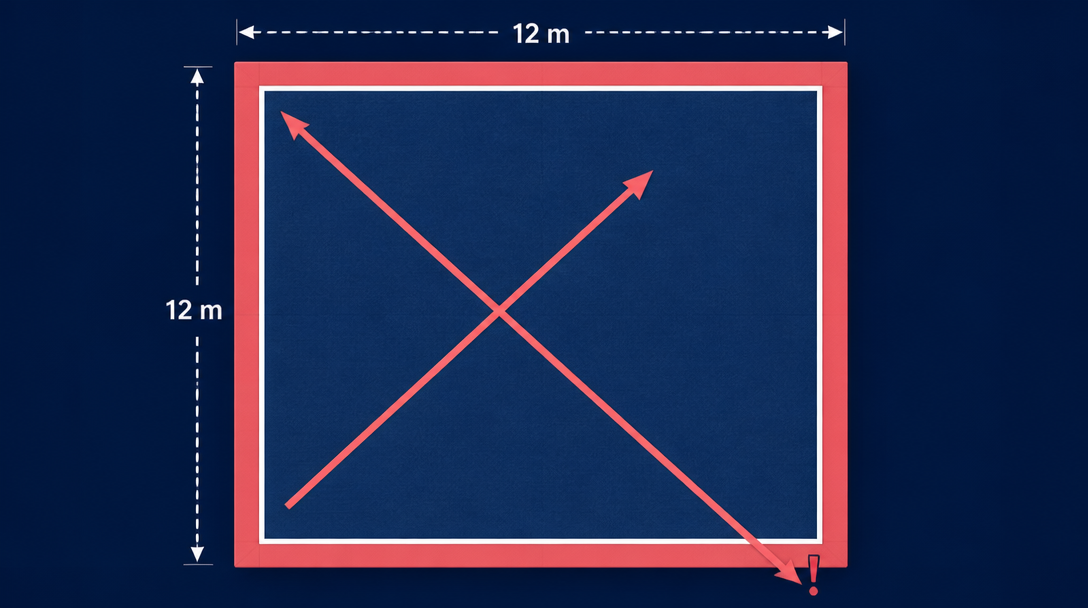
The floor area is 12 m x 12 m, and touching the floor outside the border marking is penalized (FIG WAG Code of Points). Tumbling passes run along the diagonals, so a landing that travels can easily carry a gymnast over the line.
What floor scoring showed: the execution ceiling
Even the top floor score in qualification, 13.633, was 0.9 to 1.5 points below the leaders on the other three events (vault 14.533, bars 14.933, beam 15.100). Among the eight finalists, E-scores ranged from 7.466 to 8.033 and D-scores from 5.400 to 6.000, and three of the eight took neutral deductions. This is an event where 0.1 to 0.3 reshuffles the order. On floor, the E panel looks at everything across the 90 seconds: tumbling landings, dance, and how well the movement fits the music. The link between composition and music is explained in how to match a women's floor routine to its music.
Lining up tumbling passes with the high points of the music is easier when it is planned at the editing stage. Music editing and original composition that take the Code of Points into account are available through custom floor music edited or composed with the Code of Points in mind.
2026 Worlds Women's Team Final Outlook and LA28 Team Spots
The team final is three up, three count
In the team final, three gymnasts compete on each apparatus and all three scores count. Japan's top three scores per event in qualification added up to 161.630. Matching that total in the final assumes no repeat of the three routines Japan was able to drop. Japan's top three per event in qualification were:
- Vault: Sugihara 14.200, Kishi 14.000, Okamura 13.266
- Uneven bars: Nishiyama 13.933, Okamura 13.800, Kishi 13.400
- Balance beam: Okamura 14.266, Kishi 13.633, Sugihara 13.000
- Floor: Sugihara 13.100, Nishiyama 12.566, Kishi 12.466
The top three teams earn LA28 spots
Under FIG's qualification system for the Los Angeles 2028 Olympics, the three highest-ranked eligible teams in the 2026 Worlds team final each earn a team quota of five athletes (FIG LA28 Artistic Gymnastics Qualification System). In qualification, Japan was 2.032 behind third place and 0.800 behind fourth-placed Italy. Scores do not carry over into the final, so the order can change completely in one night.
Women's finals schedule (Rotterdam and Japan time)
Local start times come from the results site's schedule (2026 Worlds competition schedule). European summer time ends on October 25, so the time difference to Japan becomes eight hours on the final day.
Final | Rotterdam time | Japan time | Japanese gymnasts |
|---|---|---|---|
Women's team final | Oct 21, 19:30 | Oct 22 (Thu), 2:30 | Japan (5th in qualification) |
Women's all-around final | Oct 23, 19:30 | Oct 24 (Sat), 2:30 | Rina Kishi, Aiko Sugihara |
Vault and uneven bars | Oct 24, from 14:37 | Oct 24 (Sat), from 21:37 | None |
Balance beam | Oct 25, 14:42 | Oct 25 (Sun), 22:42 | Mana Okamura |
Floor | Oct 25, 16:30 | Oct 26 (Mon), 0:30 | None |
The full schedule and the men's storylines are in our 2026 Worlds Rotterdam schedule and viewing guide. For broadcast details in Japan, see the Japan Gymnastics Association. An overview of the event is also on the 2026 World Artistic Gymnastics Championships page.
Summary
- China led 2026 Worlds women's qualification with 164.996. Japan qualified fifth to the team final with 161.630
- Japan's E total matched the United States. The gap was difficulty and a -0.7 neutral deduction total, the largest in the top eight
- Rina Kishi (13th) and Aiko Sugihara (21st) made the all-around final, and Mana Okamura (4th) made the beam final
- Reigning floor champion Sugihara placed 17th after a -0.4 line deduction. Without it, her 13.500 would have been the second-best score
- The team final (Oct 22, 2:30 Japan time) is three up, three count, and the top three eligible teams earn LA28 team spots
If you are a gymnast, coach or parent who wants to build a floor routine where the composition and the music work together, take a look at custom floor music for competition. Services range from editing an existing track to composing an original piece.