Balance Beam Tips: Skills, Scoring and What to Watch in WAG
A clear guide to the balance beam in women's gymnastics: how to stay balanced, key skill types, and how the 2025-2028 Code of Points scores a routine.
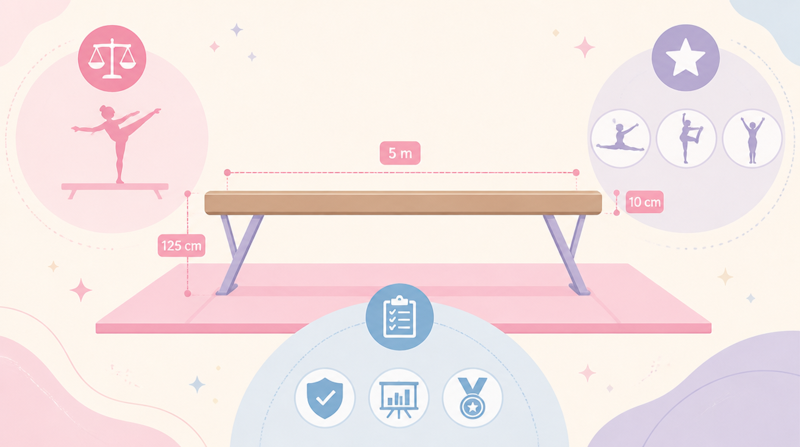
Balance beam tips unlock the most nerve-wracking event in women's artistic gymnastics (WAG). Standing 125cm tall and just 10cm wide, the beam demands leaps, turns and saltos performed on a strip narrower than your foot. This guide covers how to stay balanced, the main skill types, routine composition and how the 2025-2028 Code of Points scores a routine, so you get more out of both watching and training.
What is the balance beam in women's gymnastics?
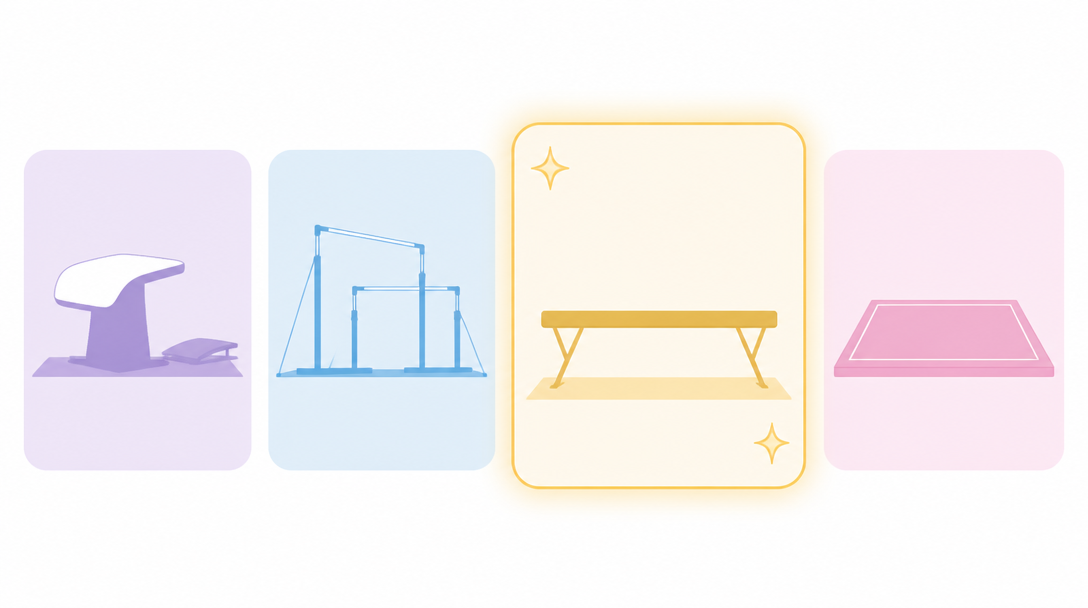
The balance beam is one of the four events in women's artistic gymnastics, standing alongside the vault, uneven bars and floor exercise. Because the gymnast links skill after skill on such a narrow surface, the event rewards not just athleticism but an extraordinary sense of balance and concentration. Let us start with the basic specifications of the apparatus and the rules of the event.
The apparatus and its dimensions
The beam's measurements are fixed by the International Gymnastics Federation (FIG). According to the English Wikipedia entry on the balance beam, it is 5m (500cm) long, 10cm wide and 125cm high. A mat around 20cm thick is laid beneath it, yet that single figure — 10cm wide — tells you almost everything about why this event is so difficult.
Item | Specification | Why it matters |
|---|---|---|
Length | 5m (500cm) | Routines must travel from one end to the other |
Width | 10cm | Narrower than the sole of a foot; landing accuracy decides everything |
Height | 125cm | Brings a real risk of falling and the fear that comes with it |
Routine time | 90 seconds max | Going over incurs a deduction (see below) |
The 90-second time limit
A beam routine may last up to 90 seconds (1 minute 30 seconds). According to SPAIA's primer on the balance beam, most routines actually finish in around 80 seconds. Exceeding 90 seconds does not mean disqualification, but the overrun is penalised as a neutral deduction. Within that short window, the gymnast must string everything from the mount to the dismount into one flowing routine.
A women-only event
The balance beam is performed only by women and is not among the six events of men's gymnastics. It is often described as having the highest fall rate of the women's events other than the vault. For how the events and scoring differ between men and women, see our detailed guide on the differences between women's and men's gymnastics. Beam gymnasts also tend to compete on floor exercise, and the competition floor music production they use there can be discussed from the perspective of a former gymnast and an artist.
Balance beam tips: five fundamentals for staying balanced

The heart of good balance beam tips is keeping your centre of gravity stable on that narrow surface. Before chasing high-difficulty skills, learning to use your body so you do not lose balance is the fastest route to progress. Here are the fundamentals shared by beginners and elite competitors alike.
Control your gaze and centre of gravity
Most wobbles start when the eyes have nowhere to settle. Fix your gaze on a single point slightly ahead on the beam and avoid moving your head too much, and the body's axis becomes stable. Keep your centre of gravity stacked directly under your pelvis and over the middle of your foot. During turns and pivots, how you leave and return your gaze — spotting — is directly tied to preventing a loss of balance.
Grip the beam with your feet
On a 10cm surface, the sensation of "gripping" the edge with the whole sole of the foot matters enormously. Feel the beam through three points — the ball of the big toe, the ball of the little toe and the heel — and make fine adjustments with your toes. Training barefoot or in beam shoes sharpens that feedback and leads to steadier landings.
Keep your rhythm and breathing even
Excellent routines carry a steady rhythm in the pauses between skills. Without holding your breath, link steps, poses and skills into a single flow so that excess tension drains away and your balance settles. Just as on floor, the way you think about distributing your 90 seconds applies directly to building a beam routine.
Managing fear and the mental side
Performing a salto 125cm up brings genuine fear. Repeating the movement on a low beam or on the floor and stacking up successful attempts gradually shrinks that anxiety. Fixing a pre-competition routine to raise your focus is just as important. For how athletes settle their minds, our article on mental health is a useful reference.
Types of beam skills: from mounts to dance, acro and dismounts
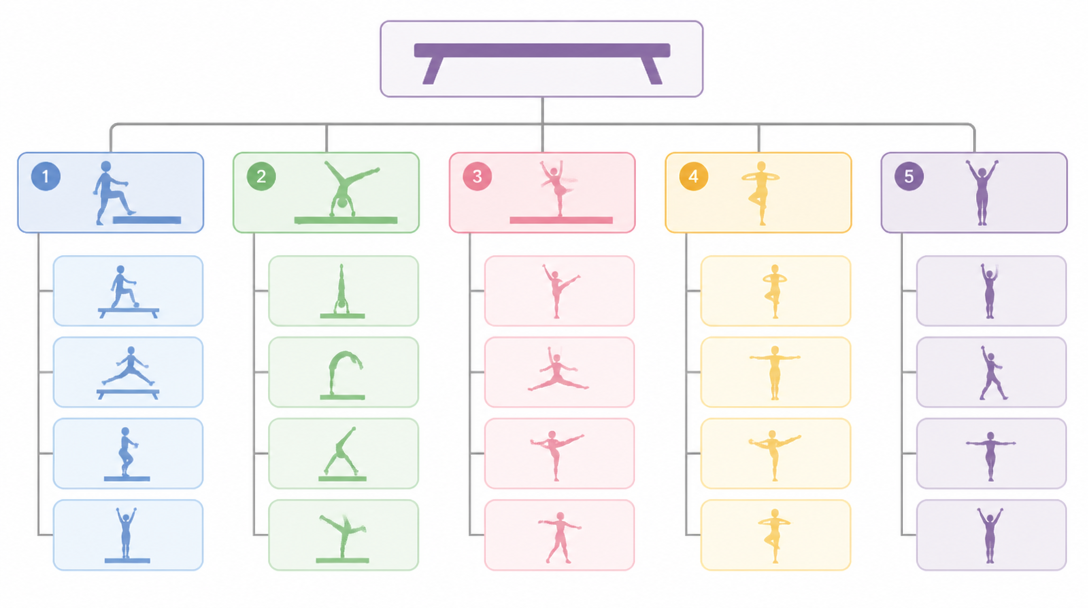
Beam skills fall broadly into mounts, acrobatic elements, dance elements, turns and dismounts. A routine is built by combining these in a balanced way. Drawing on SPAIA's guide to the skill types, let us look at some representative examples.
Mounts
The mount that opens a routine is a key element that shapes first impressions. One high-difficulty example is the "Erceg" (G difficulty), in which the gymnast rounds off, jumps backwards and performs a salto to land on the beam. Choices range from a simple jump-up to salto-based entries, depending on the gymnast's level.
Acrobatic skills
Acrobatic elements involving saltos and twists are the dynamic highlight of the beam. Well-known examples include the "Grigoras" (F difficulty), a front tucked salto with a half twist to land facing backwards, and the "Shishova" (F to G difficulty), a back tucked salto with a full twist. Composition rules call for skills in different directions (forward and backward).
Dance elements and turns
Dance elements centre on leaps, jumps and turns. A jump that opens the legs more than 180 degrees front-to-back, such as the "Yang Bo", is judged on the accuracy of the split angle and on artistry. A full turn on one foot is one of the composition requirements and tests the stability of the axis. Alongside flashy acrobatics, these more feminine forms of expression are scored with equal weight.
Dismounts
The dismount that closes a routine translates directly into the final impression and score through the quality of the landing. A high-difficulty example is the "Patterson" (G difficulty), a round-off with a twist into a double front tucked salto. Dismounts of D difficulty and above can earn a connection bonus. The technique of sticking the landing shares the principles explained in our article on landing technique and avoiding deductions.
Skill | Category | Difficulty | Summary |
|---|---|---|---|
Erceg | Mount | G | Round-off, back jump with a half twist into a front tucked salto mount |
Grigoras | Acrobatic | F | Front tucked salto with a half twist to land facing backward |
Shishova | Acrobatic | F to G | Back tucked salto with a full twist |
Yang Bo | Dance | — | Jump with a 180-degree front-to-back split |
Patterson | Dismount | G | Round-off with a twist into a double front tucked salto dismount |
Beam and floor: women's expression and competition music
The beam and floor exercise are the two events in women's gymnastics where expression counts most. Many gymnasts compete on both, and the stable axis and dance expression honed on beam carry straight over to the floor routine. Here we look at the link between the two events from the angle of expression.
Expression shared by both events
The dance elements on beam and the choreography of a floor routine are both judged on musicality, sense of rhythm and the beauty of posture. The way you take a "pause" on the beam also feeds into building a 90-second floor routine. For how to choose floor music and build a routine, see our detailed guide on composing a women's floor routine and matching the music.
Competition floor music as an option
Because a floor routine is judged together with its music, the quality of the song choice, editing and 90-second structure shapes the result. From cutting and editing commercial tracks to original composition, competition floor music production offers editing grounded in the Code of Points, with the combined perspective of a former gymnast and an artist. For misunderstandings about floor-music rules, such as whether songs with lyrics are allowed, our article on whether songs with lyrics can be used sets the record straight. Note that the beam itself is an event performed without music.
Scoring the beam: the D-score and composition requirements (2025-2028 Code)
A beam score is the sum of the "D-score" (difficulty value), which rewards the difficulty of the skills, and the "E-score" (execution), which rewards clean performance. Drawing on USA Gymnastics' explanation of women's scoring and the Japan Gymnastics Association rules page, here is how it works.
How the D-score and E-score work
The D-score adds together skill difficulty (ranks from A to H and beyond), composition requirements and connection value, and has no upper limit. The E-score starts from a perfect 10 and is reduced by deductions — the more mistakes, the lower it falls. The final score is calculated as "D-score + E-score − neutral deductions".
Counting the top eight skills
Under the 2025-2028 Code of Points, the number of difficulty skills counted toward the D-score on beam, bars and floor changed from the previous ten to the top eight (including the dismount). As noted in the Japan Gymnastics Association's Code of Points information, this change aims to reduce the physical load on gymnasts and prevent injury. Maximising value with fewer skills — the quality of the composition — now matters more than ever.
Composition requirements (CR) and connection bonuses
The beam has composition requirements (CR) that a routine must include. According to the English Wikipedia entry, the main requirements are as follows.
- A connection of two dance elements (one of them a leap with a 180-degree split)
- A full turn on one foot
- A connection of two acrobatic elements (one of them a salto)
- Acrobatic elements in different directions (forward and backward)
- A dismount
In addition, a dismount of D difficulty or above earns a 0.20 connection bonus, part of a system that rewards high-difficulty combinations.
Beam deductions: falls, wobbles and going over time
The beam's E-score is reduced for every kind of execution mistake. Deductions range from 0.1 for a small error to a full 1.0 for a fall, and these accumulate to move the final score a great deal. Let us organise the main deductions.
Falls and losses of balance
A fall from the beam is a 1.0 deduction and the mistake gymnasts most want to avoid. Even short of a fall, a wobble (balance check) or a large sway of the upper body is deducted around 0.1 to 0.3. As USA Gymnastics also explains, loss of control and loss of balance are clear grounds for deduction.
Execution (E) deductions
Broken posture, bent knees or toes, an insufficient split angle and steps on landing are each tallied as execution deductions. On beam and floor, artistry is part of the score too, so poor expression and — on floor — a mismatch with the music also lead to deductions.
Neutral deductions, time and stepping off
Separate from how well the skills are performed, neutral deductions include the following.
- Going over the 90-second routine time
- Clothing or decoration that breaks the rules
- Exceeding the allowed time off the beam (failing to restart within the set time after a fall)
Because these are subtracted from the final score independently of the execution points, thorough time management from the composition stage is essential.
What to watch on beam: points that make viewing more fun
Knowing what to watch on beam makes viewing on television or at the arena far more enjoyable. Look out for the coexistence of power and delicacy that unfolds on that narrow surface.
The beauty of using the full 5m
An excellent routine uses the 5m beam from end to end, linking walks, steps, leaps, poses and saltos without waste. There is compositional intent in where on the beam each skill is performed, and the beauty of the overall flow lifts the score.
The battle of connections and difficulty
Linking a salto to a step, or one salto straight to another without stopping — the "connection" — is the beam's greatest showpiece. Landing a high-difficulty connection adds a connection bonus, so gymnasts weigh risk against reward when building their routines. Once you understand this gamble, you cannot take your eyes off how one skill joins the next.
Artistry and expression
Beyond the impact of acrobatics, the extension of turns and jumps and expression right to the fingertips are also scored. At the same difficulty, the beauty of posture and a musical sense of rhythm change the impression greatly. For floor-music selection by type of gymnast, see our article on choosing women's floor music by type as well.
Summary
We have organised the key balance beam tips and the standards for scoring. Combining stability and expression on that narrow surface, this event concentrates the essence of women's gymnastics. Let us review the main points.
- The beam is 5m long, 10cm wide and 125cm high, with a routine time of up to 90 seconds
- The core of the tips is five things: gaze, centre of gravity, the sole of the foot, rhythm and the mind
- Routines are built from mounts, acro, dance, turns and dismounts
- Under the 2025-2028 Code, the difficulty skills counted toward the D-score changed to the top eight
- A fall is a 1.0 deduction; wobbles, going over time and stepping off are also deducted
Beam gymnasts often compete on floor too, and a floor routine is judged together with its music. If you would like to consult on competition floor music production, with its strength in song choice, editing and 90-second structure, you can get support from the combined perspective of a former gymnast and an artist.