Gymnastics Landing Technique: Scoring Rules & Deductions
Learn how gymnastics landing technique affects E-scores, the 2025-2028 stuck landing bonus, deduction tiers from -0.1 to -1.0, and training methods to improve precision.
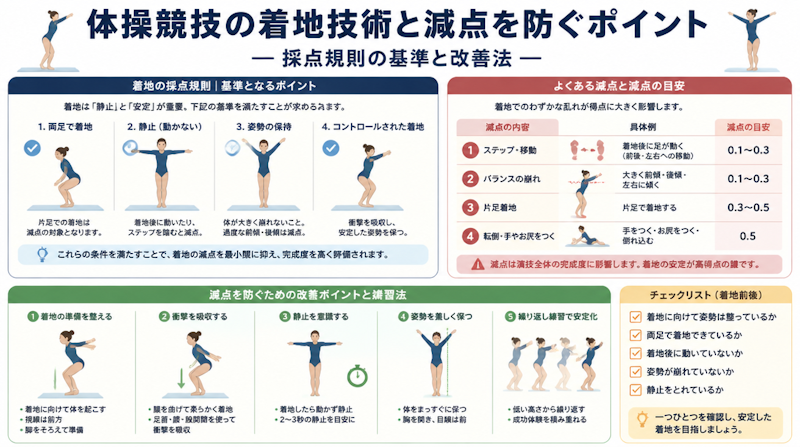
In artistic gymnastics, landing technique is one of the most consequential elements of a gymnast's performance. No matter how difficult the skills attempted, any error on landing results in an immediate deduction from the Execution Score (E-score). Understanding the basic structure of the Code of Points — and specifically how landings are judged — is essential for any athlete or coach looking to improve competitive results. The 2025–2028 Code of Points elevated the strategic importance of landings even further by introducing a stuck landing bonus. This article breaks down the landing deduction standards under the current Code of Points and provides practical guidance for improving landing accuracy across all apparatus.
Why Landings Matter in Artistic Gymnastics
The Final Frontier of Execution Scoring
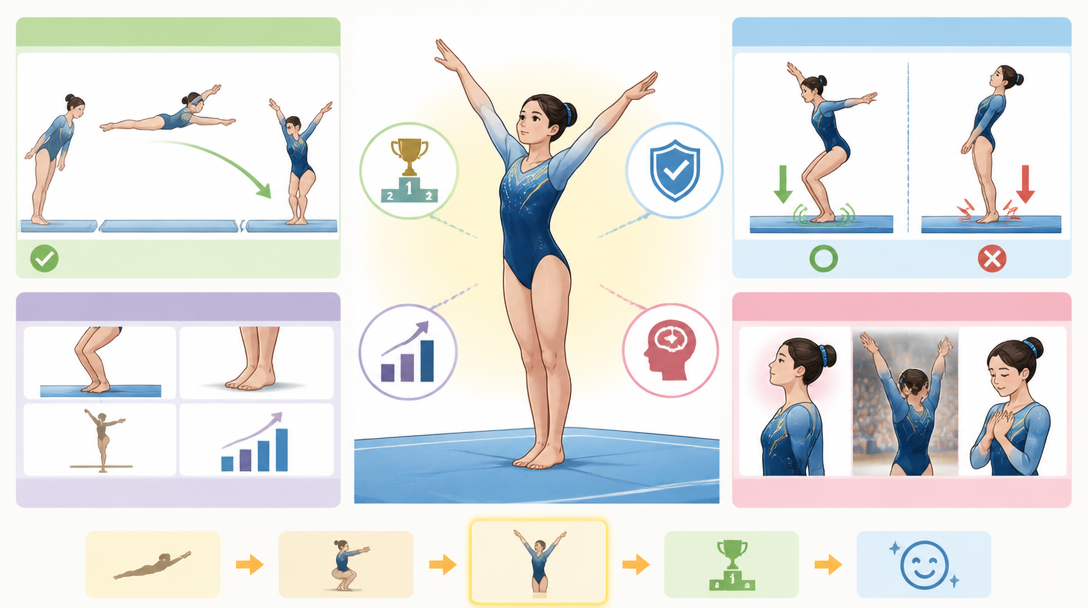
In the gymnastics scoring system, a gymnast's final score is determined by combining the Difficulty Score (D-score), which reflects the value of skills performed, and the Execution Score (E-score), which evaluates the quality of performance. Landings fall primarily under E-score evaluation, and their impact on the final total should never be underestimated.
Consider a floor exercise dismount where a gymnast receives a medium fault (-0.3) on the landing: that single deduction can shift an athlete several places in the rankings. At the World Championships or the Olympic Games — in both team and all-around competitions — score differences of 0.1 points per event directly affect final standings. Landing precision is, without question, a determining factor in competitive outcomes.
According to the JudgeMate scoring guide, Execution judges continuously assess technical errors throughout the entire routine, meaning that landing stability has a significant cumulative impact on the final E-score. Under the current system (introduced in the 2022 Code), seven E-judges score the routine; the highest and lowest scores are discarded, and the remaining five are averaged to produce the final E-score.
How Landing Technique Affects Athletic Longevity
Beyond its scoring implications, landing technique is critically important for injury prevention. Poor landing mechanics dramatically increase the forces transmitted to the ankles, knees, and lower back, raising the risk of chronic overuse injuries and acute trauma. Correct technique is not merely a competitive advantage — it is a prerequisite for a long and healthy athletic career.
The relationship between core stability and landing quality is explored in detail in the article on core training for artistic gymnastics. The ability to stabilize the trunk at the moment of landing is a quality developed progressively through deliberate daily training. Athletes who invest in this foundation consistently demonstrate cleaner landings under competitive pressure.
Understanding Landing Deduction Standards
How the E-Score Works: Four Levels of Fault
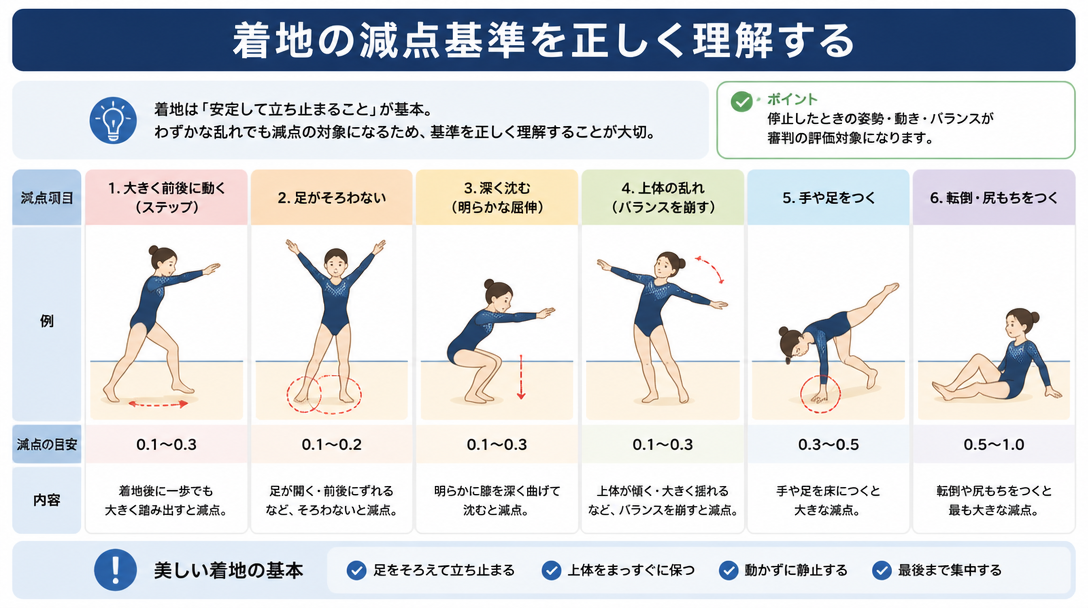
The E-score begins at 10.0 points, and deductions are subtracted for every execution error observed during the routine. There are two broad categories of deduction — execution faults and technical faults — both of which apply to landings. Faults are classified into four levels of severity:
Fault Level | Deduction | Landing Examples |
|---|---|---|
Small fault | -0.1 | Slight wobble, small foot displacement, arm swing for balance |
Medium fault | -0.3 | One large step, feet wider than shoulder-width apart |
Large fault | -0.5 | Deep squat / low landing (knees below hip level) |
Fall | -1.0 | Tumbling to the ground, collapsing on landing |
The final score formula is: D-score + (10.0 − total deductions) = final score. For example, a D-score of 6.0 combined with 1.0 point in total deductions yields a final score of 6.0 + 9.0 = 15.0. Because landing deductions feed directly into this formula, even a seemingly small difference of 0.1 points can compound into a significant gap across multiple events.
A Complete List of Landing Deduction Categories
The following are the primary fault categories applied to landings under the current Code of Points. It is important to note that multiple faults can be applied simultaneously to a single landing attempt:
- Lack of preparation: Insufficient setup or approach before the dismount. Assessed as a technical fault.
- Low landing: The knees descend below hip height, resulting in a deep squat position. This constitutes a large fault (-0.5).
- Feet apart: Within shoulder width = small fault (-0.1); exceeding shoulder width = medium fault (-0.3).
- Uncontrolled momentary landing: Loss of balance or postural collapse at the moment of contact, even if the gymnast recovers.
- Incomplete twist: Landing before completing the specified number of twists in a skill.
- Steps or hops: A small step = small fault (-0.1); a large step = medium fault (-0.3).
- Fall: A complete collapse to the floor. Maximum deduction of -1.0.
As explained in Flipped Decisions' 2025 Code of Points analysis, multiple deductions can stack within a single landing. For example, if a gymnast lands with feet beyond shoulder width (medium fault, -0.3) and also takes a step (small fault, -0.1), the combined deduction is -0.4 for that one landing.
The 2025–2028 Landing Deduction Cap
One of the most noteworthy changes in the 2025–2028 Code of Points is the introduction of a deduction cap on landings. This cap was designed to prevent excessively punitive scoring on landings and to encourage athletes to pursue higher-difficulty skills without fear of catastrophic score loss from compounding faults.
- Without a fall: The total deductions from a single landing are capped at 0.80 points.
- With a fall: The combined deductions for steps, low landing, and the fall itself are capped at 1.0 point. Other concurrent faults (such as lack of preparation or feet apart) may still be added separately.
This revision meaningfully reduces the risk that athletes performing high-difficulty dismounts face a cascade of compounding landing penalties. It represents a deliberate effort to balance the reward for difficulty with a more proportionate approach to execution errors, ultimately raising the overall quality of competitive gymnastics.
The Stuck Landing Bonus: New in the 2025–2028 Code
What Is the Stuck Landing Bonus?
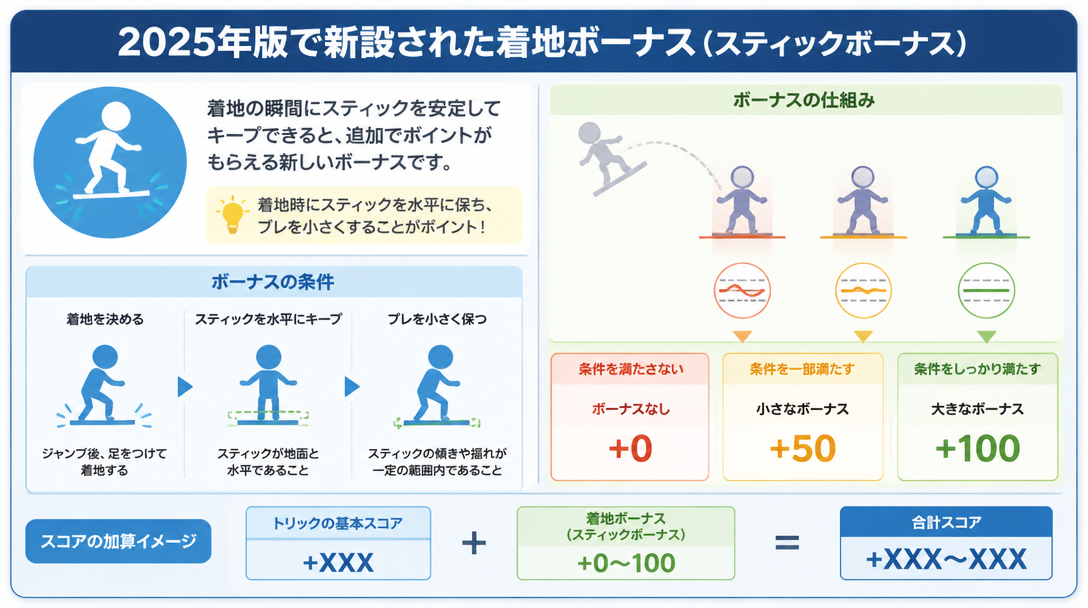
The stuck landing bonus, introduced in the 2025–2028 Code of Points, awards additional points to the D-score when a gymnast achieves a visibly complete and controlled landing stop. This represents a fundamental shift in how landings are framed within the scoring system — transforming them from a source of potential deductions into an active opportunity for score gain.
The qualifying condition is described as a "visibly controlled landing and stop." Balancing on the toes or heels to maintain stability does not qualify for the bonus. However, the bonus can still be awarded even if minor concurrent faults occur, such as feet apart, a slightly low landing, or arm swings — provided the landing is otherwise controlled and stopped.
According to Flipped Decisions' analysis of the 2025 rule changes, the stuck landing bonus is evaluated by the D-panel (Difficulty judges), and the bonus value is added directly to the D-score.
Stuck Landing Bonus Conditions by Apparatus
The conditions for earning the stuck landing bonus differ depending on the apparatus. Based on the FIG's official 2025–2028 MAG Code of Points, the following criteria apply:
Apparatus (MAG) | Applicable Element | Minimum Difficulty | Bonus |
|---|---|---|---|
Still Rings | Dismount landing | C difficulty or above | +0.1 |
Parallel Bars | Dismount landing | C difficulty or above | +0.1 |
Horizontal Bar | Dismount landing | C difficulty or above | +0.1 |
Floor Exercise | Final pass dismount landing | C difficulty or above | +0.1 |
Vault | Landing of vaults with salto | Vaults including a salto | +0.1 |
Pommel Horse | Not applicable | — | None |
Strategic Implications of the Stuck Landing Bonus
The introduction of the stuck landing bonus has meaningfully changed competitive strategy. Previously, the dominant approach was to maximize the D-score by loading the routine with the highest possible difficulty regardless of landing outcomes. Under the 2025–2028 Code, the optimal strategy now requires balancing high difficulty with landing stability.
To illustrate: a gymnast who performs a C-difficulty or higher dismount, earns the stuck landing bonus (+0.1), and avoids all landing deductions gains a net advantage of +0.1 on the D-score with zero E-score penalties. Compare that to the same gymnast taking a medium landing fault (-0.3) on the same skill — the total swing in score is 0.4 points. In the all-around or event finals, a gap of that size is frequently the difference between medal positions.
As discussed in the article on parallel bars routine construction strategy, designing the dismount skill and the landing plan together — rather than treating them as separate decisions — is the most effective path to maximizing both D-score and E-score simultaneously.
The Physical Mechanics of Sticking a Landing
Toe-First Landing and the Shock Absorption Chain
The foundation of effective landing technique in artistic gymnastics is the sequential absorption of impact forces through the body, beginning with the toes. A toe-first landing activates a four-stage shock absorption chain that dramatically improves stability:
- Metatarsophalangeal joints (MTP joints): The ball of the foot receives the initial impact.
- Ankle joint: The calf muscles engage eccentrically to buffer the force.
- Knee joint: The quadriceps and hamstrings work in coordination to absorb and control the load.
- Hip joint: The gluteal muscles and core provide the final stabilization.
By contrast, a heel-first landing bypasses the first two stages of this chain, leaving only the knee and hip joints to manage all incoming force. This forces the gymnast into a deep squat — precisely the mechanics that result in a "low landing" large fault (-0.5). Consistently landing toe-first is therefore essential both for avoiding deductions and for protecting long-term joint health.
Core Stability and Center of Mass Control
Sticking a landing requires keeping the center of mass (CoM) positioned directly over the base of support — the area formed by both feet — from the moment of aerial flight through the instant of contact. When the CoM drifts forward, backward, or laterally at landing, the gymnast must take corrective steps to recover balance, generating deductions in the process.
Core strengthening forms the foundation of CoM control. Plank variations that specifically activate the transversus abdominis and multifidus muscles, combined with squats and lunges performed on unstable surfaces such as a BOSU balance trainer, progressively build the body's capacity to respond to landing forces. Consistent engagement with gymnastics-specific core training leads to measurable improvements in postural control at landing, reducing wobbles and unnecessary movement.
A particularly important skill is what coaches refer to as "bracing" — the act of maximally contracting the core musculature in the final moment before landing. Pre-activating the abdominal wall in this way primes the entire kinetic chain to distribute impact forces efficiently across the body, rather than allowing them to concentrate in a single joint.
Air Awareness and Visual Focus
Two additional factors that directly influence landing precision are air awareness (proprioceptive sense during flight) and the strategic use of visual focus. In salto skills, the ability to sense the body's orientation and rotational speed during flight — proprioception — determines how accurately the gymnast can predict the landing point. Underdeveloped air sense causes athletes to spot their landing too late, resulting in steps or CoM displacement.
Developing a consistent habit of visually locating the landing target in the final phase of each skill is a highly practical strategy for improving landing stability. In floor exercise, for example, drills that train the gymnast to shift eye focus rapidly to the landing spot at the end of a twisting element are particularly valuable for corner tumbling passes. Trampoline training is widely used to develop air awareness through high-volume repetition in a safe environment, and many athletes incorporate this into their off-season training programs.
Apparatus-Specific Landing Tendencies and Corrective Strategies
Floor Exercise: Final Pass Landings
The most common landing errors in floor exercise are steps and low landings. Back saltos and twisting elements are particularly prone to forward-backward CoM drift at landing, caused by inconsistencies in body axis alignment or rotational speed. Skills with multiple rotations carry the additional risk of residual angular momentum causing the body to rebound at ground contact — a major contributor to large steps or falls.
One of the most effective corrective cues is the concept of "pinning" — actively engaging the entire body into a rigid, aligned position in the final moments of the aerial phase. This prepares the kinetic chain to receive the impact cleanly rather than collapsing under it. Training gymnasts to hold a deliberate landing pose for two to three seconds after contact reinforces the habit of stopping rather than continuing to move.
For a comprehensive overview of how floor exercise routine requirements interact with landing strategy, the article on compositional requirements (CR) in gymnastics provides useful context. Balancing the difficulty of the final pass with the compositional requirements needed for bonus points is key to optimizing the total score.
Horizontal Bar, Parallel Bars, and Still Rings: Dismount Landings
On apparatus events, the two most common dismount landing failures are the low landing (deep squat) and the step. Low landings typically occur when the dismount skill lacks sufficient height, or when the gymnast is late in transitioning body position for landing. Both errors are correctable with focused technical work.
On horizontal bar, the ideal dismount landing sees the gymnast contact the mat with both feet simultaneously while maintaining the hips at approximately waist height — avoiding the collapse into a deep squat. This is especially relevant after high-difficulty release moves on horizontal bar, where sufficient height and rotational completion before landing are prerequisites. A productive practice progression begins with low-bar landing drills to establish shock absorption patterns, then transitions to full-height execution once the mechanics are ingrained.
The detailed review of the 2025–2028 Code of Points notes that handstand angle standards on horizontal bar have also been tightened in the new Code, meaning that precision throughout the routine — not just at the dismount — now more directly influences landing quality.
Vault: Managing Speed and Rotation Through to Landing
Vault landings present a unique challenge because the athlete must execute a complete sequence — run, hurdle, springboard contact, block, aerial skill, and landing — within a matter of seconds. For vaults with twisting elements, the timing and direction of the twist unwinding determines the landing orientation, making technical consistency through repeated practice absolutely essential.
Since the stuck landing bonus on vault applies specifically to vaults that include a salto, high-difficulty Yurchenko-series and Tsukahara-series vaults offer meaningful bonus-earning potential as part of an athlete's scoring strategy. Cultivating the habit of a deliberate landing pose — arms held slightly diagonally downward and fixed after landing — not only stabilizes the body mechanically but also communicates control clearly to the judging panel.
Training Methods to Improve Landing Accuracy
Proprioceptive and Balance Training
Improving landing stability requires training the proprioceptive system — the body's capacity to sense its own position and movement in space. The following progressive approach is recommended for athletes at all levels:
- Single-leg balance: Standing on one leg with eyes closed to strengthen ankle and knee proprioception. Aim for 30 seconds × 3 sets per side.
- Unstable surface training: Squats and lunges performed on a balance disc or BOSU trainer to build adaptive responses to landing forces.
- Targeted jump-landing drills: Jumping to a marked spot and landing with precision to develop spatial awareness and CoM control simultaneously.
- Held landing practice: Setting a rule that every landing in training must be held for a full three seconds of stillness before moving. This forces conscious engagement with the "stop."
- Consecutive landing sets: Repeating the same skill multiple times in succession to build landing consistency and improve motor pattern reproducibility.
These drills yield the greatest benefit when combined with flexibility training, particularly for the hips and ankles. Greater joint mobility expands the margin for postural adjustment at landing — an athlete with more flexible hips can make finer corrections at the moment of contact without losing balance.
Systematic Repetition and Video Analysis
Improving landing technique is not a matter of simply repeating a skill as many times as possible. Effective improvement requires a systematic approach: deliberate, focused repetition of specific landing patterns, combined with objective feedback mechanisms that reveal the gap between how a landing feels and how it actually looks.
Video analysis is among the most powerful tools available for this purpose. Slow-motion review of leg angles, foot orientation, and CoM position at the moment of landing allows athletes and coaches to identify technical errors that are imperceptible in real time. Collaborative review sessions between athlete and coach accelerate the correction cycle by converting abstract coaching cues into concrete visual evidence.
Building a daily habit of self-assessment against the scoring standards is equally important. Keeping the FIG's official 2025–2028 MAG Code of Points accessible and referencing the deduction criteria regularly helps athletes internalize the standards they are being judged against, raising the overall level of execution across every training session.
Summary
Landing technique and deduction standards in artistic gymnastics can be distilled into the following key points:
- Four levels of landing deduction: Small fault (-0.1), medium fault (-0.3), large fault (-0.5), and fall (-1.0). Multiple faults can be applied simultaneously to a single landing.
- Deduction caps introduced in 2025: Without a fall, total landing deductions are capped at -0.80. With a fall, the combined deductions for steps, low landing, and fall are capped at -1.0 (other concurrent faults may still be added).
- Stuck landing bonus now available: A visibly controlled and stopped landing on a C-difficulty or higher dismount earns +0.1 on the D-score on all apparatus except pommel horse (vaults must include a salto).
- Toe-first landing is fundamental: The four-stage shock absorption chain enabled by a toe-first landing is the mechanical basis of landing stability. Heel-first landings significantly increase the risk of a low landing (-0.5 fault).
- Core strength and proprioception training are essential: The capacity to control the center of mass through landing and maintain postural stability under impact is built through consistent, targeted training.
A landing is not simply the end of a skill — it is the final scored element of a routine and deserves to be treated with the same intentionality as any other part of the performance. Athletes and coaches who take the time to understand the Code of Points standards for landings, and who build landing precision into daily training as a deliberate priority, will find consistent rewards both in scores and in reduced injury risk. Integrating stuck landing bonus eligibility into routine construction — so that the dismount skill choice and landing plan are designed together — is one of the most effective strategies available for maximizing the interaction between D-score and E-score.