Women's Floor Scoring Explained: D-Score & Requirements (FIG)
How women's floor is scored under the FIG 2025-2028 Code of Points: the D-score, the four composition requirements, difficulty (A-J), and key deductions.
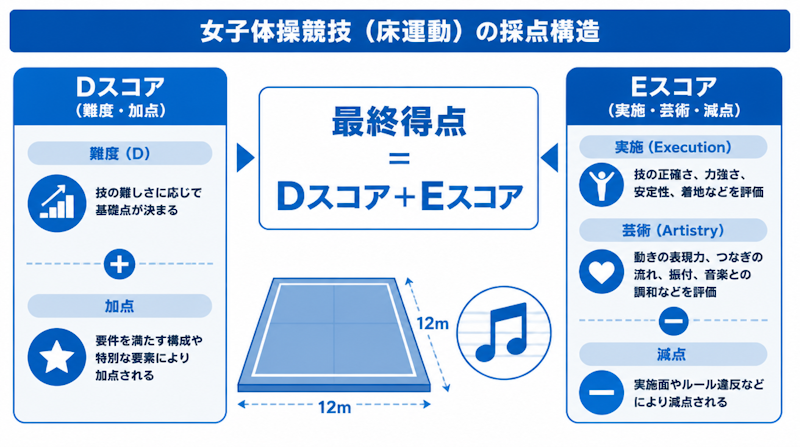
Women's floor scoring is built from two separate scores: the open-ended D-score that adds up the difficulty you perform, and the E-score that starts at 10.0 and deducts for every flaw. Two gymnasts can throw the
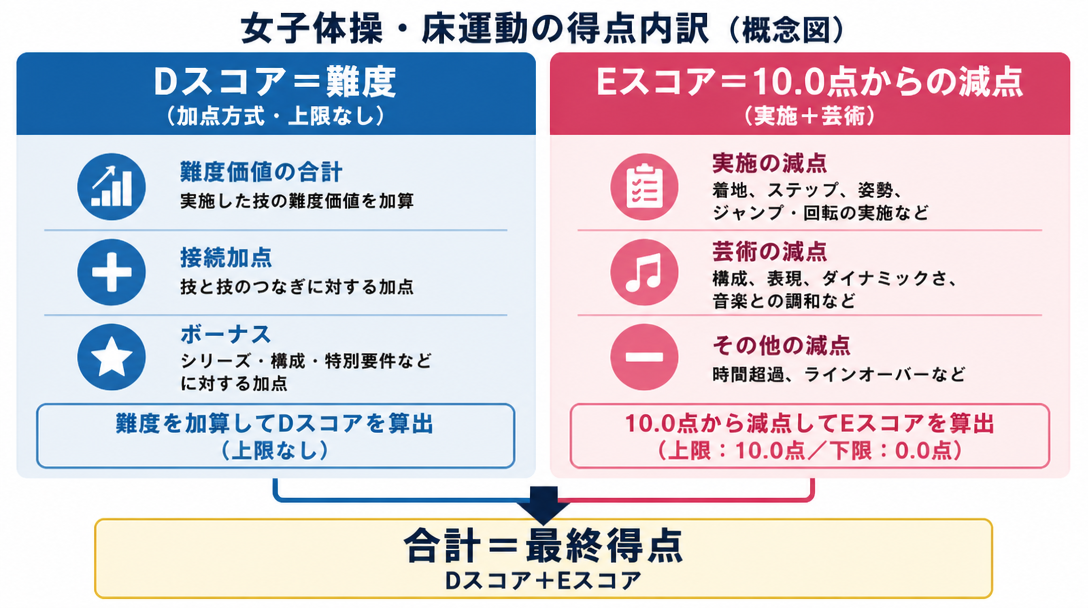
same skills and still earn very different marks depending on their composition requirements, connections, and how the routine sits inside 90 seconds of music. This guide breaks down how women's artistic gymnastics (WAG) floor is scored under the FIG 2025-2028 Code of Points — D-score, composition requirements, difficulty, and deductions.
How Women's Floor Is Scored: D-Score and E-Score
The final mark is D-score plus E-score
A WAG floor routine is performed on a 12m × 12m spring floor to music, with a maximum duration of 90 seconds (Wikipedia: Floor (gymnastics)). The final score adds the D-score (Difficulty) to the E-score (Execution) (Code of Points).
In other words, stacking hard skills is not enough on its own. You raise the D-score by building difficulty, while protecting the E-score from form breaks and artistry losses. Both sides decide the result.
What the D-score is
The D-score is open-ended: it sums
the difficulty values, composition requirements, and connection bonuses in your routine. Unlike men's floor, women's floor has no strength holds or circle elements — it is built from acrobatic (tumbling) and dance elements only.
What the E-score is
The E-score starts from a base of 10.0 and is reduced by deductions. Judges take off for landing errors, bent legs, loose form, and — importantly on floor — for a lack of artistry and musicality (JudgeMate: How gymnastics is scored).
Because floor is a performance set to music, the quality of the music and choreography feeds directly into the artistry impression. If you want competition floor music built around the Code of Points, the custom competition music production (/music) by Daito Iwasaki — a former gymnast and artist — can help. For now, remember that music is the foundation of your artistry score.
Building the D-Score: Top 8 Elements, CR, and Connections
Counting the top 8 elements (A to J)
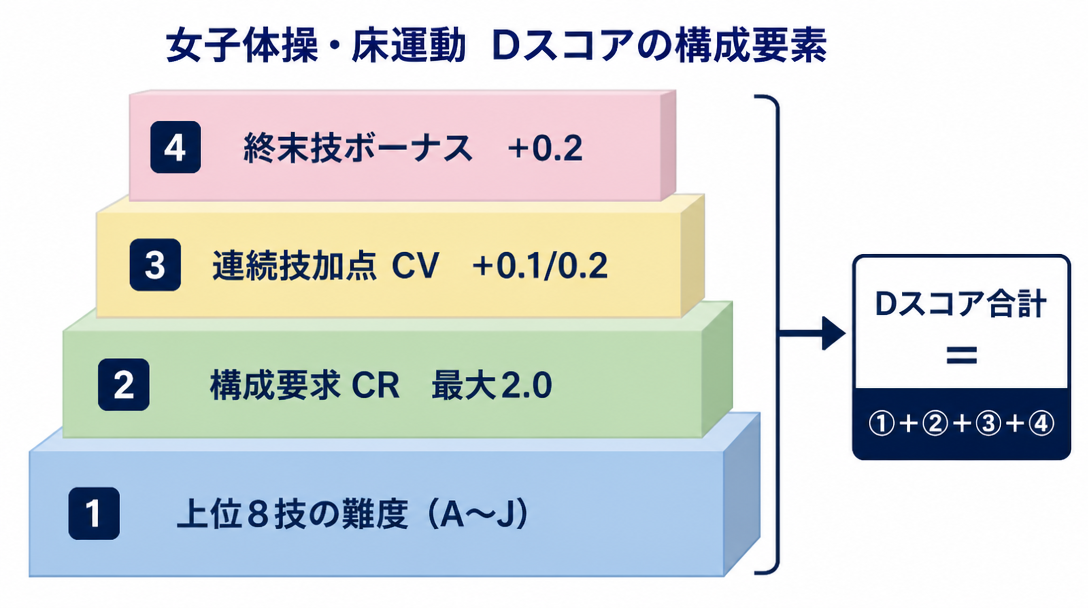
The core of the D-score is the sum of the difficulty values of the eight highest-valued elements in the routine (the dismount counts as one of the eight). Element difficulty runs from A (0.1) up to J (1.0) (Gymnast Gem: Women's Floor 2025-2028).
How you fill those eight elements — more tumbling versus more dance — changes the physical and artistic balance of the
routine, but you still need dance elements to satisfy the requirements below.
Composition Requirements add up to 2.0
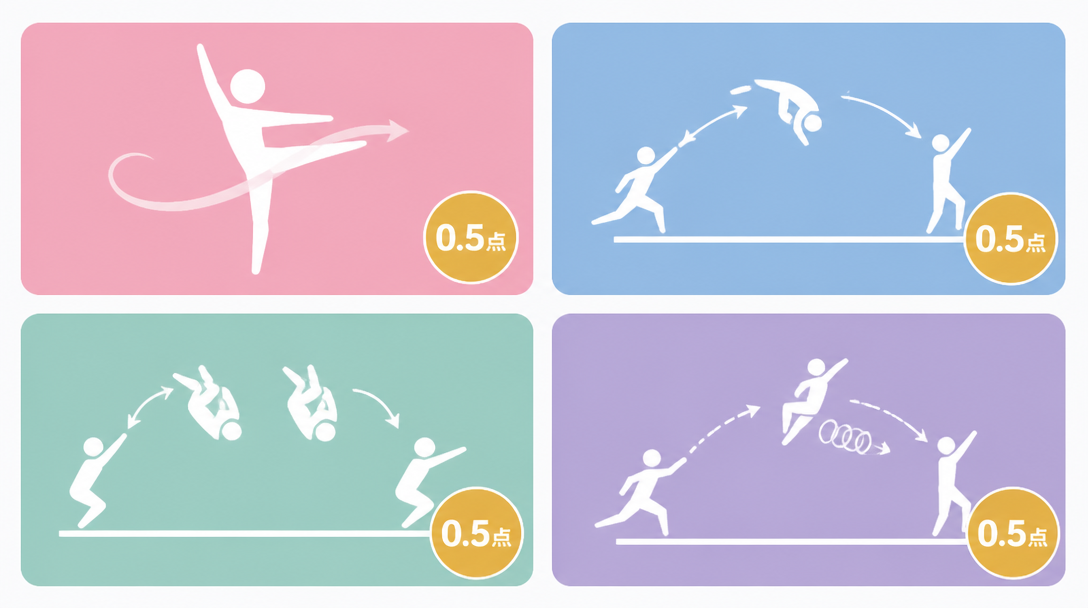
The D-score includes Composition Requirements (CR) — bonuses awarded for including specific element types. Women's floor has four CRs, each worth 0.5, for a maximum of 2.0. Missing one simply means you do not receive that 0.5, so elite gymnasts reliably hit all four (Gymnast Gem).
Connection Value (CV) and the dismount bonus
Linking skills directly earns a Connection Value (CV) of +0.10 or +0.20 depending on the connection (JudgeMate). In addition, if the final salto (dismount) is D-value or higher, a +0.20 dismount bonus applies (Gymnast Gem).
To put it together, a women's floor D-score is the sum of four parts:
- Top 8 difficulty values: the eight highest-valued elements (including the dismount).
- Composition Requirements (CR): four items × 0.5 for up to 2.0.
- Connection Value (CV): +0.10 / +0.20 for direct connections.
- Dismount bonus: +0.20 for a D-value-or-higher salto finish.
Building a high D-score is not just about difficulty — it means hitting every CR and collecting the connection and dismount bonuses as well.
The Four Composition Requirements Explained
1. A dance passage (one 180° split)
A connection of two different dance elements (leaps/hops), with one reaching a 180° split. The two can be linked directly or indirectly with running steps, small leaps, hops, a chassé, or chainé turns (USA Gymnastics Elite 101).
2. Saltos in both directions
The routine must include both a forward/sideward salto and a backward salto (Arabians count as forward). Showing saltos in different directions demonstrates technical range.
3. A double salto (or two saltos in one line)
At least one double salto, or two saltos connected in a single acro line, is required. For top gymnasts, this double is both a scoring anchor and a highlight of the routine (GymnasticsHQ: Understanding Floor).
4. A salto with a full twist
At least one salto with a minimum full (360°) twist. Adding twists also raises the element's own difficulty, so it is an efficient way to satisfy a CR while gaining difficulty value.
Composition Requirement | What it needs | Value |
|---|---|---|
1. Dance passage | Two different dance elements, one at 180° split | 0.5 |
2. Both directions | Forward/sideward + backward salto | 0.5 |
3. Double salto | Double salto, or two saltos in one line | 0.5 |
4. Twisting salto | Salto with a full (360°) twist | 0.5 |
Maximum total | 2.0 | |
What Raises Difficulty: Acro, Dance, Leaps, and Turns
Acrobatic elements (tumbling)
Tumbling — such as a double-twisting back layout or double saltos — is the main driver of a women's floor D-score. Tumbling is often called the heart of the event, and gymnasts stack difficulty through their tumbling passes (GymnasticsHQ).
If you want to map out where your big passes land inside the routine, the custom competition floor music production (/music) service designs the edit around the Code of Points — including where the biggest skills sit within the 90 seconds. Matching your tumbling peaks to the musical climax also helps the artistry score.
Dance elements (leaps, turns, jumps)
Dance elements include split leaps, ring positions, and turns on one leg. Turns increase in difficulty with rotation — a full turn (360°) versus a double (720°). For example, a split-leg 720° turn (the Memmel turn) is rated D (0.4) (Gymnast Gem). Dance elements are also the key to satisfying CR #1 and keeping the routine from becoming pure tumbling.
Reading the difficulty table (A to J)
Difficulty rises in 0.1 steps: A = 0.1, B = 0.2, and so on up to J = 1.0. When composing, gymnasts work backward: which difficulties fill the top eight, where to place CR-satisfying elements, and whether the dismount earns the +0.2 bonus.
E-Score and Deductions: Execution, Artistry, and Neutral
Execution deductions
The E-score begins at 10.0 and loses value for each execution error: landing steps or falls, bent legs and loose toes, insufficient height or amplitude on saltos. Several judges score independently, and the highest and lowest marks are dropped before averaging (JudgeMate).
Artistry deductions
Women's floor explicitly evaluates artistry. A lack of unity between music and movement, weak expression, and monotonous choreography all draw artistry deductions. Under the 2025-2028 code, artistry deductions in the 0.10-0.20 range are applied more consistently (Gymnast Gem). Song choice and choreography quality shape the E-score directly.
Neutral deductions (out-of-bounds, time, no music)
Neutral deductions (ND) sit outside D and E. Stepping out of bounds costs -0.10 for one hand/foot and -0.30 for both feet or another body part; exceeding 90 seconds is -0.10; and performing without music is -1.0 (Gymnast Gem, Wikipedia). A music failure or an over-length cut is an instant, avoidable loss.
Deduction type | Situation | Amount |
|---|---|---|
Out of bounds | One hand/foot out | -0.10 |
Out of bounds | Both feet / other body part out | -0.30 |
Overtime | Exceeding 90 seconds | -0.10 |
No music | Performing without music | -1.0 |
Key Changes in the 2025-2028 Code
Dismount and difficulty revisions
In the 2025-2028 code, forward stalders gained +0.1 in difficulty, and the full-twisting double layout dismount was upgraded from E to F (+0.1). Ending with a single salto now carries a -0.30 deduction, effectively requiring a multi-salto (or comparable) finish (Gymnast Gem).
Stricter artistry and balance requirements
A scale (balance pose) is required, and missing it also incurs -0.30. Combined with more consistent artistry deductions, the direction is clear: from pure difficulty toward all-round performance, presentation included. The full rules are outlined in the Code of Points and the official FIG document.
Music and Composition: Maximizing the Score
Placing skills across 90 seconds
Within 90 seconds, gymnasts alternate tumbling (big skills) with dance (connections and expression). A common shape places major passes at the start, middle, and end, with CR-satisfying dance elements between them. For timing, see the 90-second time allocation template.
How music affects the artistry score
Aligning the musical climax with your biggest skills tightens the overall impression and helps the artistry score; when skills and music drift apart, the routine looks driven by the music rather than the gymnast. See how to match choreography and music. Whether lyrics are allowed depends on the ruleset, so check the FIG vs NCAA lyrics rules as well.
If you want music designed so that each skill lands on the right musical moment, the custom competition floor music production (/music) can help — from song selection and cut editing to original composition that avoids scoring pitfalls.
Summary
- Women's floor scoring is D-score (difficulty) + E-score (execution and artistry).
- The D-score = top 8 difficulty values + composition requirements (up to 2.0) + connection value + dismount bonus.
- There are four CRs (0.5 each): dance passage (180° split), saltos both directions, a double salto, and a twisting salto.
- The E-score starts at 10.0; watch execution, artistry, and neutral deductions (out-of-bounds, overtime, no music).
- The 2025-2028 code tightens dismounts and artistry; how skills and music sit in 90 seconds affects both scores.
If you want a floor routine that scores well and matches skills to music, talk to the former-gymnast-and-artist behind the custom competition floor music production (/music). Code-aware song selection and editing can lift how your routine reads to the judges.