Women's Gymnastics Deductions Explained: Falls, Landings, Bounds
How deductions work in women's gymnastics under the FIG 2025–2028 Code: the 0.1–1.0 scale, falls, landings, bars, beam, vault and floor faults, and penalties.
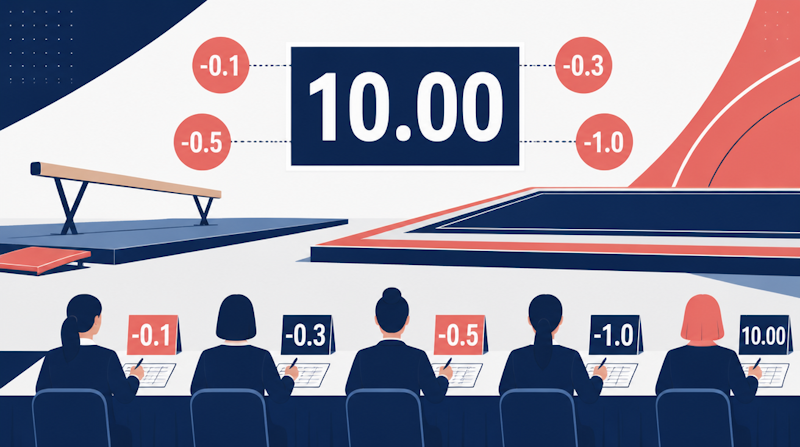
How much is a fall worth in women's gymnastics? Is a small hop on landing really just a tenth? Once you know how deductions work in women's artistic gymnastics, every routine you watch, whether at the Worlds or at your daughter's club meet, starts to make a lot more sense. The score is built from two parts: a D-score that adds up difficulty, and an E-score that starts at 10.00 and loses points for every error. The size of each deduction is set out in detail by the International Gymnastics Federation (FIG).
This guide walks through the official FIG Women's Artistic Gymnastics Code of Points 2025–2028 and organizes the deductions into tables: the general execution faults that apply on all four apparatus, falls and landings, apparatus-specific faults on vault, uneven bars, balance beam and floor, and the neutral penalties for time, boundaries, attire and conduct. All values were checked against the version of the Code posted on the FIG website in October 2026.
How Deductions Work in Women's Gymnastics Scoring
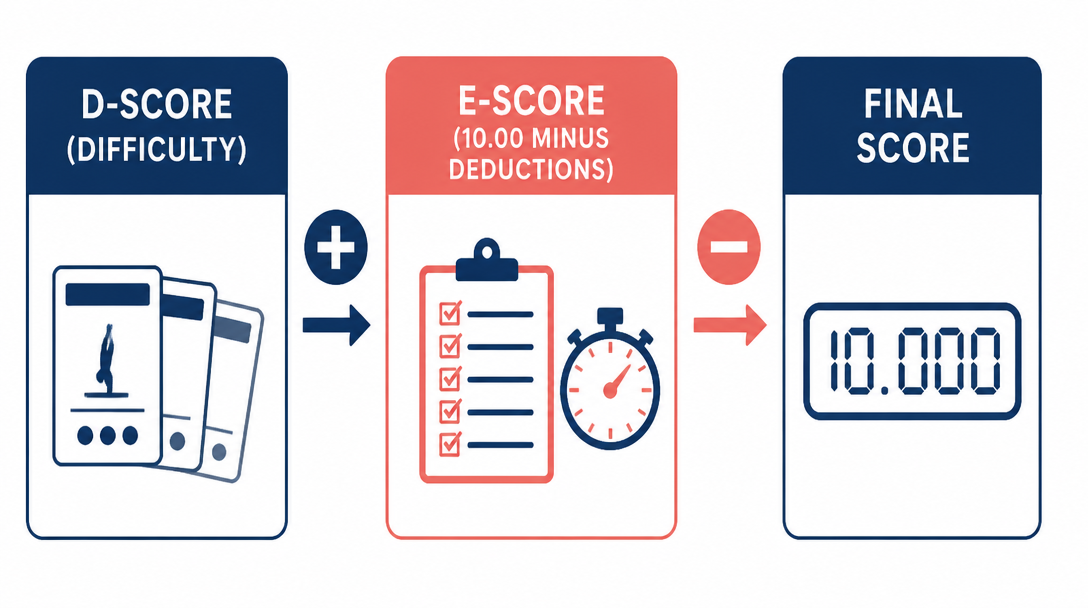
Final Score = D-Score + E-Score − Penalties
In women's gymnastics, the final score is the D-score (content: difficulty value, composition requirements and connection value) plus the E-score (execution and artistry), minus any penalties (WAG Code of Points, Section 6.2). That means "deductions" actually come from three different places:
- E-score deductions: taken by the E-jury from 10.00 for form, landings, falls and artistry
- Penalties from the final score: taken by the D-jury (D1 and D2) for overtime, stepping out of bounds on floor, a missing dismount, attire violations and so on
- Value that is simply not awarded: connection value lost to a fall, or the difficulty value of a skill that was not landed feet first. Nothing is subtracted, but nothing is added either
If you want a refresher on what the D-score and E-score are and how they fit together, our guide to gymnastics scoring and the Code of Points covers the basics.
The E-Score Is Counted Down From 10.00
The E-score is calculated by adding up the execution deductions and the artistry deductions and subtracting the total from 10.00. The worked example in the Code shows a judge taking 0.700 for execution and 0.300 for artistry: 1.000 in total, for an individual E-score of 9.000. The perfect 10 stopped being the ceiling for the final score when the scoring system was overhauled in 2006 (history of the Code of Points), but the E-score is still a countdown from 10.
How the Judges' Scores Are Combined
E-judges do not confer. Each one records deductions independently, and their scores are then averaged as follows (Section 6.2):
- 7 or 5 E-judges: average of the middle 3 scores
- 4 E-judges: average of the middle 2 scores
- 3 or 2 E-judges: average of all scores
If the average runs beyond three decimal places, it is truncated, not rounded. Dropping the highest and lowest scores keeps a single unusually strict or lenient judge from deciding the result (Inside Gymnastics scoring overview).
On balance beam and floor exercise, artistry is also part of the E-score. Floor goes further and evaluates the connection between movement and music, so the choice and editing of the music has a direct effect on the score. If you are working on a floor routine, you can talk to former gymnast and recording artist Daito Iwasaki about custom floor music for competition built around the Code.
The Four Sizes of Women's Gymnastics Deductions: 0.1, 0.3, 0.5, 1.0
Small, Medium, Large and Very Large
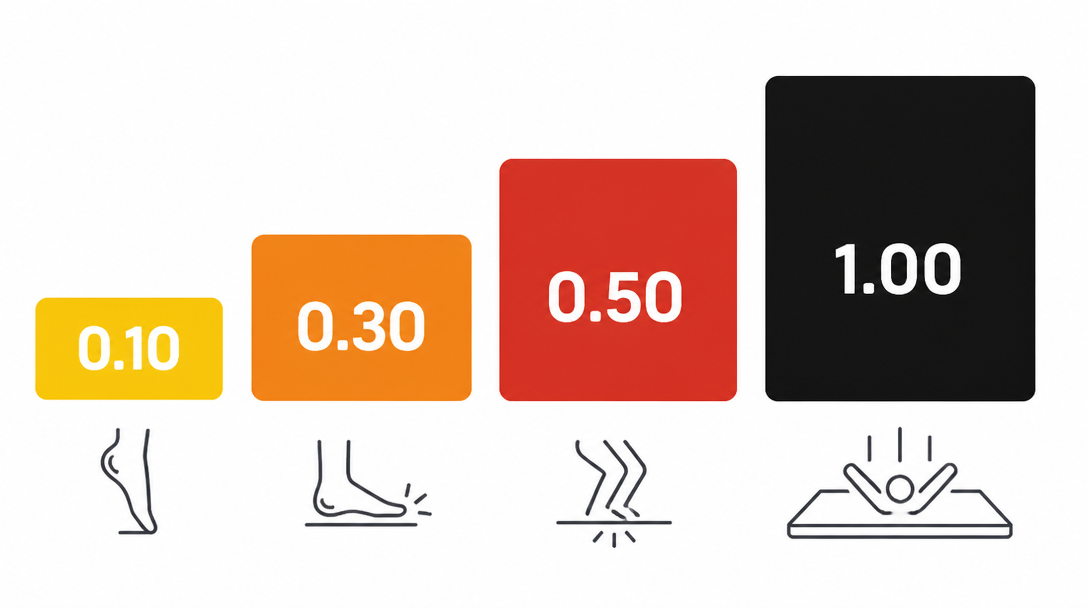
Deductions in women's gymnastics come in four sizes depending on how serious the error is (Section 9.3):
Category | Deduction | Typical errors |
|---|---|---|
Small | 0.10 | Feet not pointed, a small step on landing, slight leg separation |
Medium | 0.30 | Legs apart shoulder width or more, a very large step, brushing the apparatus or mat with the hands |
Large | 0.50 | A deep squat on landing, heavily bent arms or knees |
Very large | 1.00 or more | A fall, support on the mat with the hands, falling to the knees or hips |
Many items in the table are marked "each time", so the same fault can be deducted again and again within one routine. It is not unusual for a string of small 0.10 deductions to add up to almost as much as a fall.
Execution Faults: Form, Height and Body Shape
The main execution faults that apply on all four apparatus are listed below (Section 9.3):
Execution fault | Deduction |
|---|---|
Bent arms or bent knees | 0.10 / 0.30 / 0.50 |
Leg or knee separations (0.30 if shoulder width or more) | 0.10 / 0.30 |
Legs crossed during twisting elements | 0.10 |
Insufficient height of elements | 0.10 / 0.30 |
Inexact tuck or pike in a single salto (0.10 at a 90° hip/knee angle, 0.30 beyond 90°) | 0.10 / 0.30 |
Piking too early in a stretched position | 0.10 / 0.30 |
Hesitation during an element | 0.10 |
Run without performing an element (empty run) | 0.30 |
Feet not pointed or relaxed | 0.10 |
Body shape faults in dance elements (split angle and so on) | 0.10 / 0.30 / 0.50 |
The Short Exercise Penalty
On uneven bars, balance beam and floor, there is also a heavy penalty when a routine ends early (after a fall or an injury, for example) and does not contain enough elements. The D-jury takes it from the final score (Section 6.3):
- 7 or more elements: no deduction
- 5–6 elements: 4.00
- 3–4 elements: 6.00
- 1–2 elements: 8.00
- No elements: 10.00
The Code's own example is a floor routine in which the gymnast falls and is injured after only four elements. Her final score of 8.100 drops to 2.100 once the 6.00 short exercise penalty is applied.
Fall and Landing Deductions: How Much Is a Fall in Gymnastics?
Landing Deductions (Capped at 0.80 Without a Fall)
Landing faults apply to every element, not just the dismount. The Code caps them: if there is no fall, the maximum landing deduction is 0.80 (Section 9.3).
Landing fault | Deduction |
|---|---|
Feet apart on landing | 0.10 |
Extra arm swings | 0.10 |
Lack of balance | 0.10 / 0.30 |
Extra steps or a slight hop | 0.10 each time |
Very large step or jump (guideline: more than shoulder width) | 0.30 |
Body posture fault | 0.10 / 0.30 |
Deep squat | 0.50 |
Brushing or touching the apparatus or mat with the hands, without falling | 0.30 |
This table is where the familiar "a step is a tenth" comes from. Each extra step costs another 0.10, so two steps cost 0.20.
Falls, Hand Support and Falling to the Knees: All 1.00
The fall is the biggest single deduction in women's gymnastics. In the 2025–2028 table, the following four faults all carry 1.00:
- Support on the mat or apparatus with one or two hands
- Falling on the mat to the knees or hips
- Falling on or against the apparatus
- Failure to land feet first from an element
Many fans assume that putting a hand down is "less than a fall", but under the current women's Code, hand support costs exactly the same 1.00. As English-language explainers put it, on vault, floor and dismounts, a landing with hand support counts the same as a fall (Inside Gymnastics).
A Fall Costs More Than 1.00
What makes a fall so costly is that the 1.00 off the E-score is only part of the damage. The D-jury also withholds value (Section 9.3, D-jury table):
- Connection performed with a fall: no connection value (CV), and on beam no series bonus (SB)
- Dismount performed with a fall: no dismount bonus
- Failure to land feet first or in the prescribed position: no difficulty value (DV), CV, composition requirement (CR), SB or dismount bonus
So a beam worker who comes off on the second skill of a connection loses 1.00 from the E-score and the connection value on top of it. That is why a single fall can reshuffle the standings among top gymnasts.
Apparatus-Specific Deductions: Vault and Uneven Bars
Vault Deductions
On vault, phase-by-phase deductions are added on top of the general faults in Section 9 (Section 10.6):
- First flight phase: missing degrees of turn (for example 0.10 for up to 45° or 0.30 for up to 90°, depending on the vault group), body alignment, bent knees
- Support phase: staggered hand placement, bent arms or shoulder angle, failure to pass through vertical
- Second flight phase: height (0.10 / 0.30 / 0.50), body position in the salto, under-rotation (0.10 without a fall, 0.30 with a fall), insufficient distance (0.10 / 0.30), deviation from a straight direction (0.10)
Landings are judged with the general table in Section 9. For the vaults themselves and their values, see our guide to women's vaults, from the Yurchenko to the Cheng.
Uneven Bars Deductions
Bars rewards continuous swing, so extra swings are expensive. Without a fall, the execution deduction for a single element may not exceed 0.80 (Sections 11.5 and 11.6).
Uneven bars fault | Deduction |
|---|---|
Body alignment in handstands and casts to handstand | 0.10 / 0.30 |
Adjusted grip | 0.10 |
Brushing the mat | 0.30 |
Feet hitting the apparatus | 0.50 |
Feet hitting the mat (counted as a fall) | 1.00 |
Intermediate swing | 0.50 |
Empty swing | 0.50 |
Angle of completion of elements | 0.10 / 0.30 / 0.50 |
Jump from the low bar to the high bar (composition) | 0.50 |
An intermediate or empty swing between two elements also wipes out the connection value for that pair (Section 11.4). We break down bar skills and how connections are built in our uneven bars skills guide.
Balance Beam and Floor Deductions: Artistry, Time and Out of Bounds
Balance Beam Deductions: Wobbles, Falls and Artistry
On beam, even when the gymnast stays on, every extra movement to keep her balance is deducted (Sections 12.5 and 12.6):
Balance beam fault | Deduction |
|---|---|
Additional movements to maintain balance (wobbles) | 0.10 / 0.30 / 0.50 |
Additional support of the leg against the side of the beam | 0.30 |
Grasping the beam to avoid a fall | 0.50 |
Poor rhythm in a connection | 0.10 |
Pauses of 2 seconds or more, adjustments without choreography | 0.10 each time |
Insufficient variation in rhythm and tempo (artistry) | 0.10 / 0.20 |
Poor body posture: head, shoulders, trunk (artistry) | 0.10 / 0.20 |
More than one ½ turn on two feet (composition) | 0.10 |
A fall from the beam is 1.00, and the gymnast has 10 seconds to remount without penalty. A routine with no dismount loses 0.50, taken by the D-jury. For the skills and what to watch for, see our balance beam tips and judging guide.
Floor: Out of Bounds, Time and the Dismount
The floor area is 12 m × 12 m, and touching the floor outside the border with any part of the body is deducted. Line and time judges report violations in writing to the D-jury, which takes them from the final score (Section 13.1):
- One step or landing outside the boundary with one foot or hand: 0.10
- Stepping outside with both feet, both hands or another body part, or landing with both feet outside: 0.30
- Routine lasting 1:31 (91 seconds) or longer: 0.10
- No dismount (no final counting acro line): 0.50
If the take-off is entirely outside the border, that element also receives no difficulty value, connection value or composition credit.
Floor Artistry and Music Deductions
Floor artistry looks closely at how the gymnast connects to her music, and some deductions are about the music itself. Choosing and editing the track can therefore cost or save real points (Sections 13.1 and 13.5).
Floor artistry or music fault | Deduction |
|---|---|
No music, or music with words | 1.00 (by the D-jury, from the final score) |
Poor editing of the music (abrupt cuts and so on) | 0.10 |
Poor expressive engagement with the style of the music | 0.10 / 0.20 / 0.30 |
Lack of connection between the music and the routine, in part or throughout | 0.10 / 0.20 / 0.30 |
Final movement not synchronized with the musical beat | 0.10 |
Poor choreography in the corners, no movement touching the floor | 0.10 each |
The Code says the music must be flawless, without abrupt cuts, with a clear start and a clear finish, and should highlight the gymnast's own character. The human voice may be used as an instrument (humming, vocalizing without words), but music with lyrics costs 1.00. How lyrics are treated differently at FIG and NCAA meets is covered in our article on floor music with lyrics.
Poor edits and a final pose that misses the beat are deductions you can prevent at the music stage. If you want cuts and transitions designed around your choreography and highlights, competition floor music production by a former gymnast offers rule-aware editing as well as original compositions.
Time, Attire and Conduct Penalties
Time Penalties
Time violations are recorded by the time judges and taken from the final score by the D-jury. The Code states that they apply as soon as the limit is exceeded by one second (Section 9.3).
Time violation | Deduction |
|---|---|
Overtime on beam or floor (more than 90 seconds) | 0.10 |
Failure to start within 30 seconds of the green light | 0.30 |
Failure to start within 60 seconds | Right to perform is terminated |
Exceeding the allowed time after a fall (30 s on bars, 10 s on beam) | 0.30 |
Not resuming within 60 seconds after a fall | Exercise ended |
Starting without the signal or while the red light is on | Score of 0 |
On beam, a gong sounds 10 seconds before the 90-second limit and again at 1:30. If the dismount lands on the second signal, there is no deduction.
Attire, Conduct and Coach Penalties
Some penalties have nothing to do with the quality of the routine (Section 9.3):
- Failure to acknowledge the D-jury before and/or after the routine: 0.30
- Incorrect attire (leotard, jewelry, bandage color), missing start number or national identification: 0.30
- Spotting assistance by the coach during the routine: 1.00 (and, depending on the help, no DV for the element)
- Non-permitted presence of a spotter: 0.50
- Unsportsmanlike conduct by a coach: 0.50 or 1.00 plus a yellow or red card
How FIG Rules Differ From Domestic and NCAA Scoring
Everything above applies to FIG international competition such as the Olympic Games and World Championships. National federations generally follow the FIG Code, but they may issue their own adaptations for age-group and junior events (in Japan, through the Japan Gymnastics Association), so always check the rules for the specific meet.
US college gymnastics (NCAA) uses a separate set of rules and still scores from a 10.0 start value. In the NCAA, a fall costs 0.50, half the FIG deduction (NCAA.com scoring explainer). Rules for US development levels are set separately by USA Gymnastics. Knowing which rulebook a meet uses will save you a lot of confusion when you compare scores.
Summary
- Women's gymnastics deductions come in four sizes: 0.10 (small), 0.30 (medium), 0.50 (large) and 1.00 (very large). The E-score counts down from 10.00
- A fall, hand support on the mat, falling to the knees or hips, and failing to land feet first all cost 1.00. Without a fall, landing deductions are capped at 0.80
- A fall also wipes out connection value and the dismount bonus. Failing to land feet first removes the difficulty value as well
- Intermediate and empty swings on bars cost 0.50, grasping the beam costs 0.50, stepping out on floor costs 0.10 or 0.30, and overtime costs 0.10
- Floor music is judged too: no music or music with lyrics costs 1.00, poor editing 0.10, and a weak connection between music and movement up to 0.30
Once you understand deductions, you can see exactly where a routine lost its tenths. If you want floor music built around the Code, or help with edits and transitions, get in touch through our competition floor music page.