2026 Worlds Men's All-Around: How Hashimoto Won a Fourth Title
Daiki Hashimoto won his fourth straight world all-around title with 85.998. A D/E breakdown of his 1.799 margin, the final high bar, and why Oka fell to 8th.

*Information as of October 23, 2026.
Daiki Hashimoto won the men's all-around final at the 2026 Artistic Gymnastics World Championships in Rotterdam on October 22, scoring 85.998 across six apparatus. It is his fourth straight world all-around title, something only Kohei Uchimura (six in a row through 2015) had done before him. Top qualifier Shinnosuke Oka, the Paris 2024 Olympic champion, finished eighth after major errors on vault and high bar.
This analysis is written from the perspective of a former Japanese gymnast and the developer of a D-score calculator. Using the official FIG/Longines numbers, it splits Hashimoto's 1.799-point winning margin into D-score (difficulty) and E-score (execution), explains why the order changed so much from qualification, and lists the Japanese gymnasts in the apparatus finals on October 24 and 25.
2026 Worlds Men's All-Around Final Results: Hashimoto Makes It Four

The top eight
Here are the top eight in the final (scores from the full men's all-around final results on Gym Art, based on FIG/Longines data).
Rank | Gymnast (Nation) | Total | D total | E total |
|---|---|---|---|---|
1 | Daiki Hashimoto (JPN) | 85.998 | 33.000 | 52.698 |
2 | Yang Haonan (CHN) | 84.199 | 31.300 | 52.499 |
3 | Joe Fraser (GBR) | 83.531 | 32.000 | 51.431 |
4 | Daniel Marinov (WG2) | 83.297 | 32.300 | 50.997 |
5 | Angel Barajas (COL) | 83.232 | 33.300 | 49.832 |
6 | Jake Jarman (GBR) | 82.865 | 30.900 | 51.965 |
7 | Arsenii Dukhno (WG2) | 82.697 | 32.200 | 50.297 |
8 | Shinnosuke Oka (JPN) | 82.165 | 32.000 | 50.765 |
The total also includes bonus points (B) and neutral deductions (ND) on top of D and E. WG2 denotes Russian gymnasts competing as neutral athletes. Frederick Richard of the United States also scored 82.165.
Only the second man to win four in a row
According to Jiji Press (in Japanese), Hashimoto is only the second gymnast to win four consecutive world all-around titles, after Uchimura, who won six straight up to the 2015 Worlds. The Yomiuri Shimbun (in Japanese) noted that Hashimoto, second after qualification, got through all six events without a major mistake.
NBC Sports reported that the 1.799-point margin is the largest in a men's all-around at an Olympics or Worlds since Uchimura won by 1.958 in 2013. Four world all-around titles also put Hashimoto two short of the record of six shared by Uchimura and Simone Biles.
How the final works: 24 gymnasts, two per country, no carry-over
Entry to the all-around final is defined in Art. 5.1.4 of the FIG Technical Regulations 2026:
- The 24 highest all-around totals among gymnasts who competed on every apparatus in qualification
- A maximum of two gymnasts per national federation
- Qualification scores are not carried forward; the final starts from zero
That is why Shohei Kawakami, fourth in qualification with 83.699, did not compete in the final: he was Japan's third-best all-arounder. You can see the full standings in the men's all-around qualification results, and our breakdown of that day is in 2026 Worlds Men's Qualification: Why Japan Led on E-Scores.
If you want to see how a routine's D-score is built from its elements, Gymnastics AI, our D-score calculator app, lets you do exactly that. It follows the FIG 2025–2028 Code of Points and has a database of more than 790 skills: pick the elements and it calculates the difficulty for you.
Breaking Down the 1.799 Margin: Difficulty Beat Yang Haonan
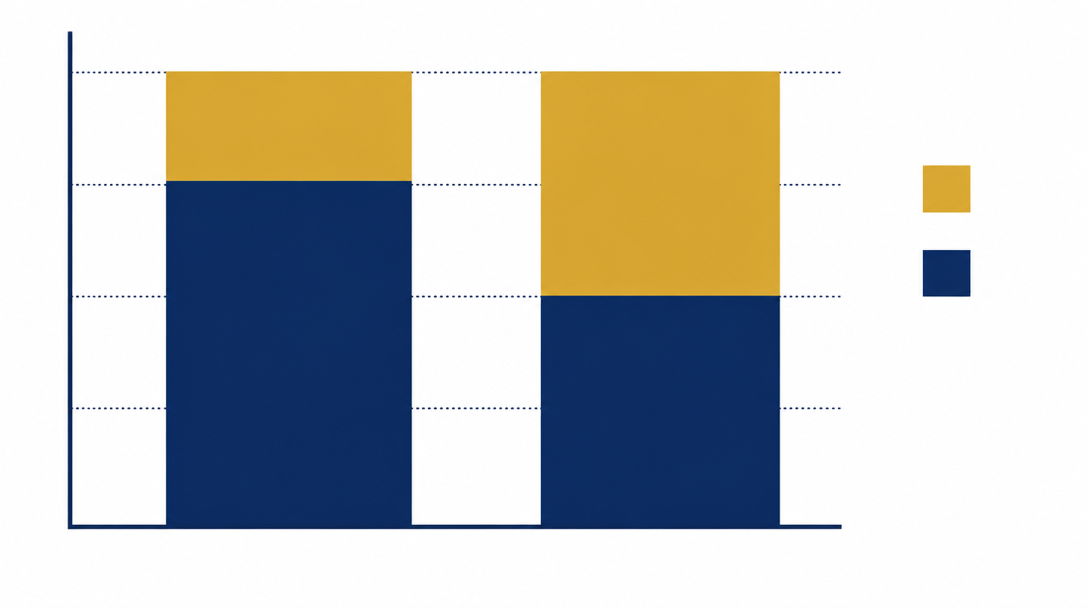
Splitting the margin into D, E and bonus
Here is the gap between Hashimoto and runner-up Yang Haonan, component by component.
Component | Hashimoto | Yang | Difference |
|---|---|---|---|
D total (difficulty) | 33.000 | 31.300 | +1.700 |
E total (execution) | 52.698 | 52.499 | +0.199 |
Bonus | 0.3 | 0.4 | -0.1 |
Total | 85.998 | 84.199 | +1.799 |
Of the 1.799 points, 1.700 came from difficulty. Yang, competing at his first World Championships, came within 0.199 of Hashimoto on execution. What separated them was how hard Hashimoto's routines are. For a refresher on how the two scores work, see Artistic Gymnastics Code of Points: FIG D-Score & E-Score.
By apparatus: +1.833 on pommel horse and high bar alone
The per-apparatus difference (Hashimoto minus Yang) looks like this:
- Floor: -0.034 (13.666 vs 13.700)
- Pommel horse: +0.600 (14.500 vs 13.900; D 5.7 vs D 5.0)
- Rings: -0.200 (13.900 vs 14.100)
- Vault: +0.066 (14.466 vs 14.400)
- Parallel bars: +0.134 (14.700 vs 14.566)
- High bar: +1.233 (14.766 vs 13.533; D 6.0 vs D 4.9)
Yang had the best rings score of the night (14.100), but pommel horse and high bar alone produced a 1.833 gap. On both apparatus, the difficulty gap (0.7 on pommel horse and 1.1 on high bar) turned almost directly into the score gap.
The highest E total in the field, too
This was not a win on difficulty alone. Hashimoto's E total of 52.698 was the highest of all 24 finalists. His D total ranked third, behind Illia Kovtun of Croatia (33.600) and Angel Barajas (33.300). But Kovtun's E total was 46.864 (he finished 11th) and Barajas's was 49.832 (fifth overall), so neither could turn their difficulty into a winning score.
That is the real story of the margin: among the gymnasts with the most difficulty, Hashimoto also had the cleanest execution. His harder routines did not cost him anything in form.
You can test how a difficult composition translates into a D-score in Gymnastics AI. Choose and order the skills, and it automatically calculates difficulty values, element group requirements and connection bonuses.
What Improved Since Qualification: +1.266 in E on High Bar
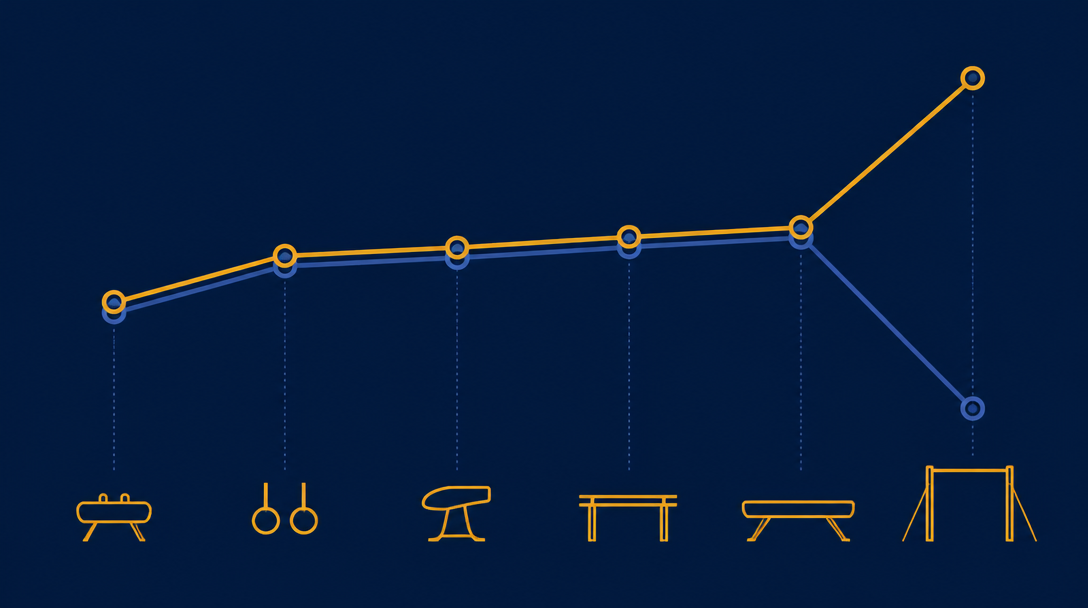
Apparatus by apparatus, qualification to final
Hashimoto went from 84.632 in qualification to 85.998 in the final, a gain of 1.366 points. Here is where it came from.
Apparatus | Qualification | Final | Change | Rank in final |
|---|---|---|---|---|
Floor | 13.600 | 13.666 | +0.066 | 9th |
Pommel horse | 14.533 | 14.500 | -0.033 | 1st |
Rings | 13.733 | 13.900 | +0.167 | 3rd |
Vault | 14.266 | 14.466 | +0.200 | 3rd |
Parallel bars | 14.800 | 14.700 | -0.100 | 1st |
High bar | 13.700 | 14.766 | +1.066 | 1st |
Nearly all of the gain came from high bar (+1.066). He posted the top score of the final on three apparatus: pommel horse, parallel bars and high bar.
High bar: 0.2 less difficulty, 1.266 more execution
On high bar, qualification was D 6.2 / E 7.400, while the final was D 6.0 / E 8.666. Difficulty dropped by 0.2, but execution rose by 1.266, so the score went up by more than a point.
The official data does not tell us why the D-score was lower, whether he changed the routine or a skill was not credited. What the numbers do show is that the final high bar routine gave up a little difficulty and was performed cleanly. Getting through the last apparatus without a big error decided the competition, as the next section shows.
Zero neutral deductions
In qualification, Hashimoto lost a combined 0.2 in neutral deductions on floor and vault. Neutral deductions are penalties outside the routine itself, such as stepping out of bounds. In the final he had none. Across six apparatus, his D total fell from 33.2 to 33.0, his E total rose from 51.332 to 52.698, and having no neutral deductions made up for the lost difficulty. The extra execution flowed straight into the total.
- D total: 33.200 to 33.000 (-0.200)
- E total: 51.332 to 52.698 (+1.366)
- Neutral deductions: -0.2 to 0 (+0.200)
Decided on the Last Apparatus: 0.101 After Five Events
Totals without high bar
Hashimoto and Dukhno both finished on high bar (France 24 (AFP) reported that Dukhno was second, just 0.1 behind, going into the final rotation). Here are the totals for the medal contenders on the other five apparatus, calculated from the official scores.
Gymnast | Five-apparatus total | High bar | Final total |
|---|---|---|---|
Hashimoto | 71.232 | 14.766 | 85.998 |
Dukhno | 71.131 | 11.566 | 82.697 |
Yang | 70.666 | 13.533 | 84.199 |
Fraser | 69.631 | 13.900 | 83.531 |
*Five-apparatus totals are calculated from the official apparatus scores.
With five apparatus done, only 0.101 separated Hashimoto and Dukhno. Until then, Dukhno had been one of the stories of the final: the top floor score (14.666), second on vault (14.766) and third on parallel bars (14.666).
Dukhno's 11.566 vs. Hashimoto's 14.766
On high bar, Dukhno scored just 11.566 with an E-score of 6.166 and dropped to seventh. GymCastic wrote that he was headed for silver until his Cassina, a high bar release skill.
Hashimoto, meanwhile, scored the best high bar of the night at 14.766. A 0.101 lead became a 1.799 win in a single rotation. The all-around can turn on the final apparatus, and the ability to hit all six routines showed up directly in the result.
Why Did Oka Finish Eighth? 2.933 Points Down from Qualification
Same 32.0 difficulty; the gap was execution and neutral deductions
Oka dropped from 85.098 (first) in qualification to 82.165 in the final, a loss of 2.933 points. His D total was exactly 32.000 both times. The drop came from execution (-2.233), bonus (-0.2) and neutral deductions (-0.1 to -0.6, a further -0.5). His routines were just as hard; mistakes in execution cost him the podium.
Vault and high bar cost 2.433
According to Jiji Press, Oka fell on his vault landing and came off the high bar. NBC Sports also described falls on both apparatus. In numbers:
- Vault: 13.966 to 12.700 (-1.266). E 8.866 to 7.800, neutral deduction -0.3
- High bar: 14.500 to 13.333 (-1.167). E 8.700 to 7.833, neutral deduction -0.3
- Parallel bars: 14.866 to 14.300 (-0.566)
Vault and high bar alone cost him 2.433. Had he repeated his qualification scores on those two apparatus, with everything else as it was in the final, his total would have been 84.598. On paper, that is higher than Yang's silver-medal 84.199.
High execution everywhere else
Elsewhere, Oka was second on floor with 13.966 (up 0.166 from qualification) and second on rings with 14.000. The level that won him three golds in Paris was there on four apparatus; the damage was confined to two. Based on qualification, Oka is also in the rings, parallel bars and high bar finals.
2026 Worlds Apparatus Finals: Japan's Finalists and Schedule
Japanese gymnasts in the apparatus finals
Each apparatus final features the top eight from qualification, with a maximum of two per country, and again qualification scores are not carried forward (FIG Technical Regulations, Art. 5.1.5). Japan has a finalist on all six apparatus.
Apparatus | Japanese gymnasts (qualification rank, score) |
|---|---|
Floor | Ryosuke Doi (8th, 14.033) |
Pommel horse | Daiki Hashimoto (8th, 14.533) |
Rings | Shinnosuke Oka (7th, 14.066) |
Vault | Shohei Kawakami (5th, 14.283) |
Parallel bars | Shinnosuke Oka (3rd, 14.866), Daiki Hashimoto (4th, 14.800) |
High bar | Shohei Kawakami (1st, 14.600), Shinnosuke Oka (3rd, 14.500) |
For a look at the key contenders and their D-scores on each apparatus, see 2026 World Gymnastics: Men's Apparatus Finals D-Score Preview.
Schedule (Rotterdam time)
- Saturday, October 24, from 14:00: floor, pommel horse, rings
- Sunday, October 25, from 14:00: vault, parallel bars, high bar (Europe returns to standard time that morning)
Kawakami, who missed the all-around final under the two-per-country rule, goes for gold on high bar, where he qualified first. Hashimoto also contests pommel horse and parallel bars, two of the apparatus he won in the all-around final. For Japan's second straight team title, see 2026 Worlds Men's Team Final: How Japan Won on Execution.
Summary
Key takeaways from the 2026 Worlds men's all-around final
- Daiki Hashimoto won with 85.998 for a fourth straight world all-around title, the first man to do so since Kohei Uchimura
- Of his 1.799 margin over Yang Haonan, 1.700 came from difficulty; pommel horse and high bar alone were worth 1.833
- Hashimoto also had the highest E total of all 24 finalists: the hardest routines among the leaders, performed the cleanest
- After five apparatus he led Dukhno by just 0.101; the last high bar (14.766) settled it
- Top qualifier Shinnosuke Oka kept the same 32.0 difficulty but lost 2.433 on vault and high bar and finished eighth
Before the apparatus finals
The apparatus finals are one-shot competitions with no carry-over from qualification. Looking at D (what a gymnast performs) and E (how cleanly) separately makes the scores much easier to read. If you want to build a contender's routine yourself and see its D-score, try Gymnastics AI. It is free on iOS and Android.