D-Difficulty Skills in Men's Gymnastics: A Learning Map
A by-apparatus guide to D-difficulty skills in men's gymnastics: key elements on all six events, how they build the D-score, and a map for learning them.
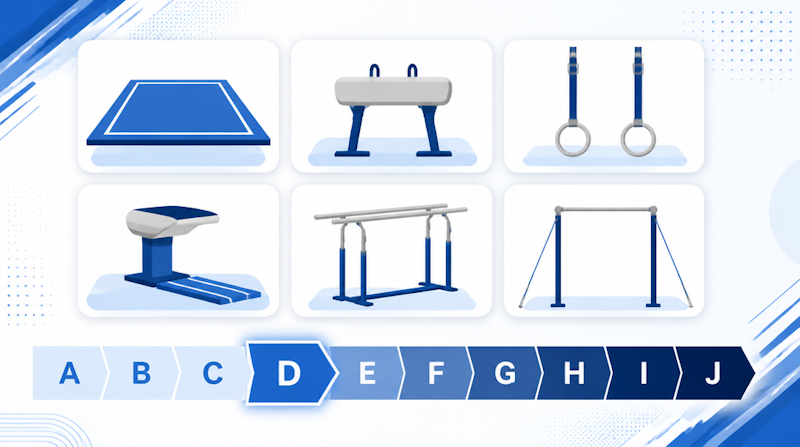
In men's artistic gymnastics, D-difficulty skills are the reliable mid-to-upper-tier elements that build the foundation of the difficulty score (D-score). Skills are graded from A (easiest) to J (hardest), and a D-rated element is worth 0.4 points. This guide maps out D-difficulty skills across all six men's apparatus, listing representative elements and their acquisition difficulty while explaining where D-difficulty sits in the overall value system and how it is treated under the 2025-2028 Code of Points.
If you want to line up D-difficulty skills across the six men's events and check the resulting D-score at a glance, try Gymnastics AI — the D-score calculator app. It follows the FIG 2025–2028 Code of Points and includes a database of more than 790 skills.
What Are D-Difficulty Skills? Their Place in the Value System
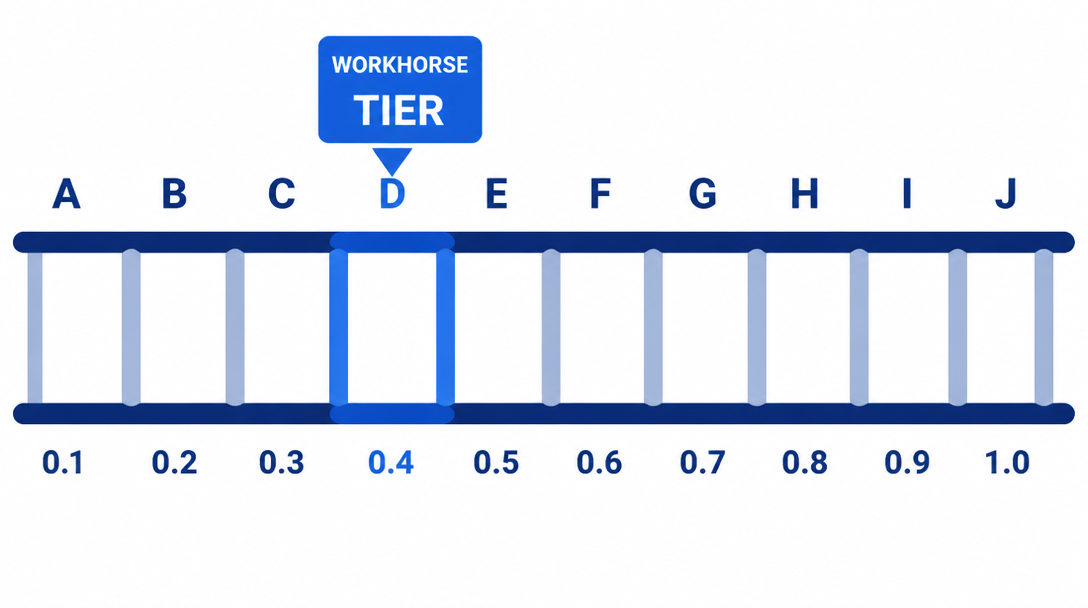
Difficulty Letters (A–J) and Their Point Values
In gymnastics, every single skill is assigned a difficulty, expressed with a letter of the alphabet. A beginner-friendly explainer from Seiko notes that difficulty begins at A and climbs through the alphabet as skills become more advanced, with men and women using the same lettering system. The FIG Code of Points likewise states that elements are valued from A (0.10) up to J (1.0) according to their difficulty.
The table below shows how the letters map to point values. D-difficulty sits squarely in the middle of the scale, making it the realistic entry point into the higher-value skills that most gymnasts rely on as the backbone of their routines.
Difficulty | A | B | C | D | E | F | G | H | I | J |
|---|---|---|---|---|---|---|---|---|---|---|
Value | 0.1 | 0.2 | 0.3 | 0.4 | 0.5 | 0.6 | 0.7 | 0.8 | 0.9 | 1.0 |
Why D-Difficulty Is Called the "Workhorse" of Competition
A and B skills are basics and C skills are intermediate, so in a top gymnast's routine they tend not to count toward the difficulty total. E-level skills and above, on the other hand, carry high acquisition risk and often become the cause of deductions that lower the overall polish of a routine (the E-score). That is why how many dependable D-difficulty skills a gymnast can assemble becomes so important for building the base of the D-score.
In practice, routines on each apparatus are frequently built by lining up several D-difficulty skills, so D functions as the zone where gymnasts bank value reliably. As an explanation of the relationship between the D-score and E-score points out, the D-score is the sum of the difficulty values of the skills built into the routine, so the question becomes how consistently a gymnast can line up high-value skills.
How D-Difficulty Skills Contribute to the D-Score
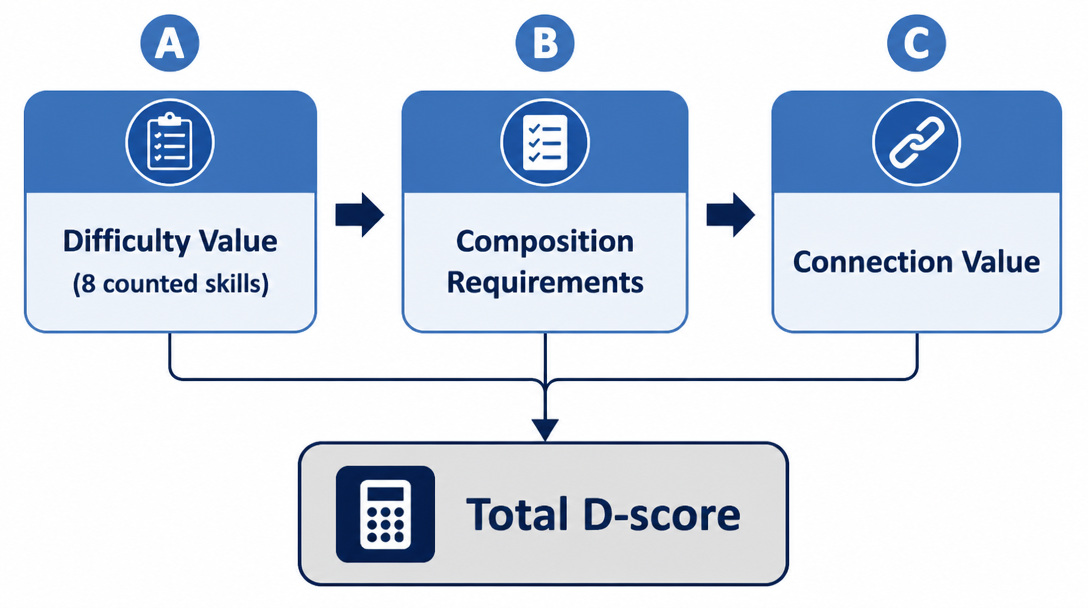
The D-score is made up of three parts: difficulty value, element group (composition) requirements, and connection value. According to an explanation of how the D-score is calculated, the difficulty value is the sum of the point values of the counted top skills plus the dismount. The more D-difficulty skills a routine includes, the more this difficulty-value total is lifted. For the overall scoring framework, our article explaining the gymnastics judging system is a useful companion read.
How the D-Score Works and Why D-Difficulty Matters
Under the 2025-2028 Rules, Counted Skills Drop to Eight
One of the biggest changes in the 2025-2028 Code of Points is the reduction in the number of counted skills. According to a summary of the main changes in the 2025 Code of Points, the maximum number of counted skills drops from the previous ten to eight, and the difficulty value is calculated from the seven highest-difficulty skills plus the dismount, for a total of eight. With the number of skills narrowed, the weight of each one increases, and the importance of reliably landing skills of D-difficulty and above has risen.
This revision nudges the sport away from simply cramming in as many skills as possible and toward carefully selecting high-quality skills and performing them consistently. It is also communicated in the official announcement of the 2025-2028 Code of Points by the Japan Gymnastics Association.
Element Group Requirements and D-Difficulty Skills
With the exception of floor, each apparatus has three skill groups — I, II, and III — plus group IV, the dismount group. According to an explanation of the element group requirements, the bonus for satisfying each group varies with the difficulty of the skill used: fulfilling a group with a skill of D-difficulty or above awards 0.5 points, while an A–C skill awards 0.3 points (group I awards 0.5 points regardless of difficulty). In other words, D-difficulty skills work in your favor not only through their own value but also on the element-group side.
The way skill groups work on each apparatus is organized in detail in our article explaining the composition requirements (CR).
Connection Value (Combination Bonus)
On floor and high bar, connecting high-difficulty skills in sequence earns a connection bonus. According to an explanation of the high-bar connection bonus, for release moves on high bar a "C-difficulty + D-difficulty or above" or "D-difficulty + D-difficulty" connection earns 0.1 points, while a "D-difficulty or above + E-difficulty or above" connection earns 0.2 points. D-difficulty skills thus also function as the "connecting core" that makes these combination bonuses possible.
- Difficulty value: the sum of the values of the eight counted skills (seven skills + the dismount)
- Element group requirements: up to 2.0 points for satisfying each group
- Connection value: awarded for linked skills on floor and high bar
D-Difficulty Skills on Floor and Pommel Horse
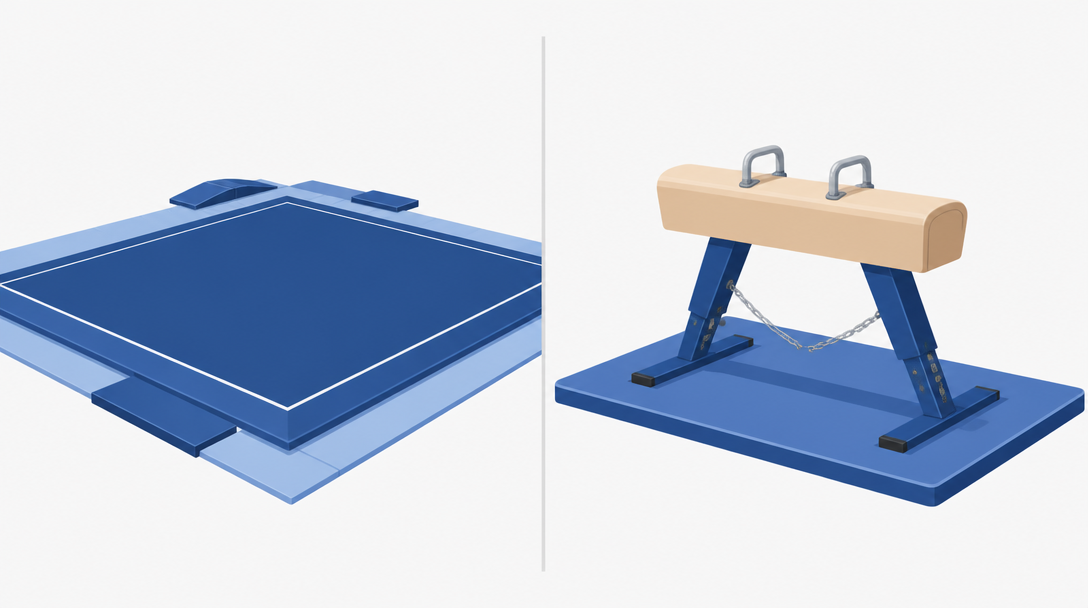
Floor D-Difficulty Skills
Floor is built from forward, backward, and twisting somersaults. Organizing the list of gymnastics skill names, representative floor elements placed at D-difficulty include a double-tucked backward somersault with a full twist (the Tsukahara group) and a double somersault combination in the Dejfel group. The point at which a twist is added to a double somersault is a rough marker for reaching D-difficulty.
On floor, a gymnast must fit multiple somersaults within a limited floor area, so landing accuracy and rotational power have to be achieved together.
Pommel Horse D-Difficulty Skills
On pommel horse, circles form the base, and difficulty is raised with traveling, turning, and twisting skills. Representative D-difficulty examples include the Kurbanov group, which travels lengthwise across both pommels, the Sivado group, which travels from one end of the horse to the other, and the Tong Fei group of downward-facing turning travels. The thinking behind high-difficulty pommel skills is also covered in our article explaining flops and scissors on pommel horse.
Pommel horse is among the most error-prone of the six events, and acquiring D-difficulty skills that weave in travels and turns without breaking the rhythm of the circles is said to require a long period of repetition.
Learning Points for Floor and Pommel Horse
On floor, the height and rotational speed of the somersaults, and on pommel horse, the axis of the circles and the timing of the hand changes, are the keys to making D-difficulty skills work. In both cases, the basic flow is to stabilize the C-difficulty skills first, then add elements such as twists or travels in stages.
On floor in particular, a D-difficulty skill is placed within a single acrobatic series (a run connecting multiple somersaults), and maintaining speed all the way to the landing is required. On pommel horse, even though the basic circle itself is A–B difficulty, the moment a travel or turn is combined in, the difficulty jumps up to C or D, so the quality of the basic circle greatly influences how quickly a skill can be learned.
D-Difficulty Skills on Rings and Vault
For those who want to try lining up D-difficulty skills in an actual routine and see how the D-score changes, Gymnastics AI is a great tool. Just select and arrange skills, and it automatically calculates the difficulty value, group bonuses, and connection bonuses.
Rings D-Difficulty Skills
Rings is an apparatus that tests upper-body strength, built from both strength (hold) elements and swing elements. Representative D-difficulty examples include the Kato group, which enters an L-sit cross support (inverted cross variant) from a back uprise, the Nakayama group, which transitions from a back lever to a cross support, and the Tsukahara group of direct L-sit cross supports. The scoring criteria for ring strength elements are explained in detail in our article comparing swing elements and backward-somersault skills on rings.
Because ring strength elements require a two-second hold, even at D-difficulty the polish of "stopping in the correct position" feeds directly into the E-score.
Vault D-Difficulty Skills
On vault, a point value is assigned to each single jump, and rather than being evaluated with difficulty letters like the other events, each vault is scored with an individual point value. According to the list of skill names, a handspring with a quarter turn into a forward tucked somersault with a half turn (the Kasamatsu group) is one example of a vault carrying value equivalent to D-difficulty. The way vaults are grouped into families is organized in our article explaining high-difficulty vaults by family.
Acquisition Difficulty of Strength Elements and Takeoffs
Ring D-difficulty strength elements presuppose muscular strength and a stable core, requiring grip strength and endurance around the shoulders to be built up over a long period. Vault D-difficulty is only established when run-up speed, takeoff accuracy, and the height of the block come together. In both cases, building the physical foundation greatly influences the acquisition period.
D-Difficulty Skills on Parallel Bars and High Bar
Parallel Bars D-Difficulty Skills
Parallel bars connects hang, support, and somersault elements, and it is an event where the beauty of the flow is tested. Representative D-difficulty examples include the Belle group — a double-tucked backward somersault to upper-arm support from a forward swing in hang — and the Morisue group, a double-tucked backward somersault to upper-arm support from above the bars. The changes in the 2025 Code of Points (parallel bars) also explain the review of skill groups and values.
For parallel bars D-difficulty skills, the spatial awareness to catch a double somersault accurately in "upper-arm support" is important, and if the point of contact is off, it leads to large deductions.
High Bar D-Difficulty Skills
High bar is built from release moves and giant-swing skills, and its appeal lies in its dynamism. Representative D-difficulty examples include the Kovacs group — a double-tucked backward somersault over the bar to re-grasp — and the Gaylord group, a forward tucked somersault over the bar to re-grasp. Variations of the giant-swing family are organized in our article explaining the differences between the Endo, Adler, and Markelov on high bar.
Linking Release Moves and the Bonus
As noted earlier, on high bar, connecting release moves of D-difficulty or above in sequence earns a connection bonus. As the explanation of the high-bar connection bonus shows, a D-difficulty release move can serve as both the starting point and the relay of a connection, playing the role of efficiently raising the D-score.
A Learning-Difficulty Map for D-Difficulty Skills
Four Factors That Determine Learning Difficulty
Even at the same D-difficulty, how easy a skill is to learn differs greatly depending on the apparatus and the nature of the skill. The main factors that determine learning difficulty are the following four.
- Physical prerequisites: which of strength, flexibility, and sense of rotation is most strongly demanded
- Managing fear: how much one must overcome releasing the bar or losing sight during the airborne phase
- Presence of a base skill: whether the foundational C-or-lower skills are stable
- Risk of failure: how large the impact of a fall or missed landing is on the body and the score
A By-Apparatus Learning-Difficulty Map
The following is a rough guide organizing the abilities that D-difficulty skills on each apparatus particularly demand, along with the main hurdles to acquisition. Because difficulty varies with a gymnast's aptitude, please take it only as a general tendency.
Apparatus | Main nature of D-difficulty skills | Abilities especially required | Main hurdle to acquisition |
|---|---|---|---|
Floor | Double somersault + twist | Jumping power, rotation, landing precision | Landing control on a limited floor area |
Pommel horse | Travels, turns, twists | Axis of the circle, sense of rhythm | Hand changes that do not break the circle |
Rings | Strength elements (two-second hold) | Upper-body strength, core stability | Holding still in the correct position |
Vault | Twisting somersault vaults | Run-up, takeoff, block | Takeoff accuracy and securing sight in the air |
Parallel bars | Double somersault to upper-arm support | Spatial awareness, timing | Accurate contact in upper-arm support |
High bar | Release moves, giant-swing family | Precision of release and catch | Loss of sight during release and re-grasping |
The B → C → D Progression
D-difficulty skills are not learned in isolation; they are developed on the foundation of the A and B basics and the C-difficulty intermediate skills. For a high-bar release move, for example, you first stabilize a C-difficulty Tkatchev or Ginger, then add posture and rotation to progress to D-difficulty. Skipping stages sharply raises fear and failure risk, so steady step-by-step progression ends up being the shortest route to acquisition.
Training and Safety for Acquiring D-Difficulty Skills
Repeating Basics and Building the Body
Acquiring D-difficulty skills presupposes being able to reproduce the base skills at a near-unconscious level. Thoroughly polishing elements such as somersault height, the axis of the circle, and the holding of strength elements with C-or-lower skills is, in the end, the shortcut to D-difficulty. Building the foundation of flexibility and core strength is also indispensable.
For concrete ways of thinking about physical development, please also refer to past articles on the core and range of motion.
Using Spotting and Safety Equipment
Skills with high failure risk, such as release moves and double somersaults, are generally acquired in stages using a pit (foam pool), a spotting belt, and coach assistance. By stacking up successful experiences while securing safety, fear becomes easier to manage. Competition bodies including the Japan Gymnastics Association are also advancing the development of safe coaching systems.
A Plan for Raising Difficulty in Stages
D-difficulty skills should be acquired on a reasonable schedule worked backward from the season's goals and competition calendar. By making sure you can reliably land one D-difficulty skill before moving on to the next, you can achieve both the stability of the whole routine and the D-score. The differences in the abilities required by each apparatus are also covered in our article explaining the characteristics of the six men's events.
Also, once you have acquired one D-difficulty skill, it is important to adopt the perspective of designing where to place it in the routine to maximize element-group points and connection bonuses. Even the same D-difficulty skill changes in its contribution to the D-score depending on whether you simply insert it, place it in a position that fills a still-unsatisfied skill group, or use it as the starting point of a connection. It is efficient to always consider skill acquisition and routine composition as a set.
Summary
D-difficulty skills in gymnastics are the "workhorses of competition" that build the base of the D-score, and the abilities they demand and their learning difficulty differ greatly by apparatus. The key points of this article are as follows.
- D-difficulty is worth 0.4 points and is a practical high-difficulty tier positioned in the middle of the value system (A–J).
- Under the 2025-2028 rules, the number of counted skills drops to eight, making the reliability of D-difficulty skills even more important.
- D-difficulty skills contribute to the D-score in three directions: difficulty value, element group requirements, and connection value.
- Representative skills differ by apparatus, and the abilities required (strength, rotation, spatial awareness, and so on) are varied.
- Acquisition is fastest via staged B → C → D development and the use of spotting and safety equipment.
If you would like to easily simulate the D-score of a routine composition, please try Gymnastics AI. Just select and arrange skills from a database of more than 790 elements, and it automatically calculates the D-score including D-difficulty skills. It is available free for iOS and Android.