Artistic Gymnastics Judging System Explained: D & E Panels
A complete guide to artistic gymnastics judging: D Panel, E Panel, R Judges, the inquiry system, Paris 2024 cases, and Fujitsu's AI scoring support system (JSS) explained.
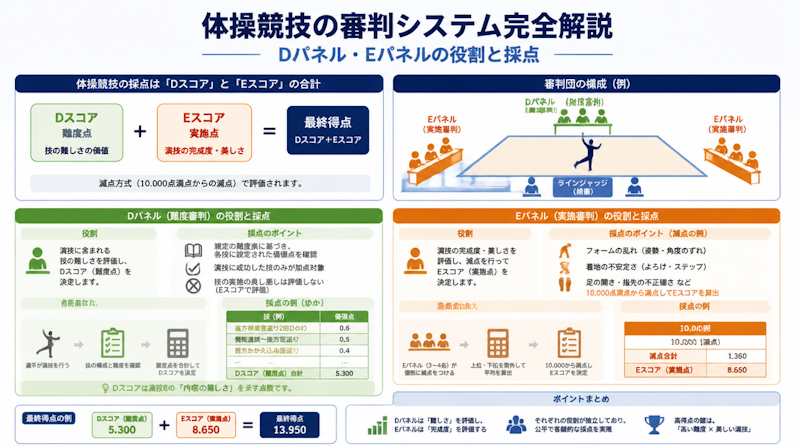
Artistic gymnastics judging is one of the most intricate scoring systems in all of sport. To the casual spectator, a routine ends and a number appears — but behind that number lies a carefully coordinated process involving the D Panel (Difficulty judges), the E Panel (Execution judges), and the R Judges (Reference judges). This guide breaks down every layer of the system as defined by the Fédération Internationale de Gymnastique (FIG), from how scores are calculated to how disputes are resolved and how artificial intelligence is now assisting human judges.
Artistic Gymnastics Scoring: The 2006 Revolution That Changed Everything
The Limits of the Perfect 10 Era
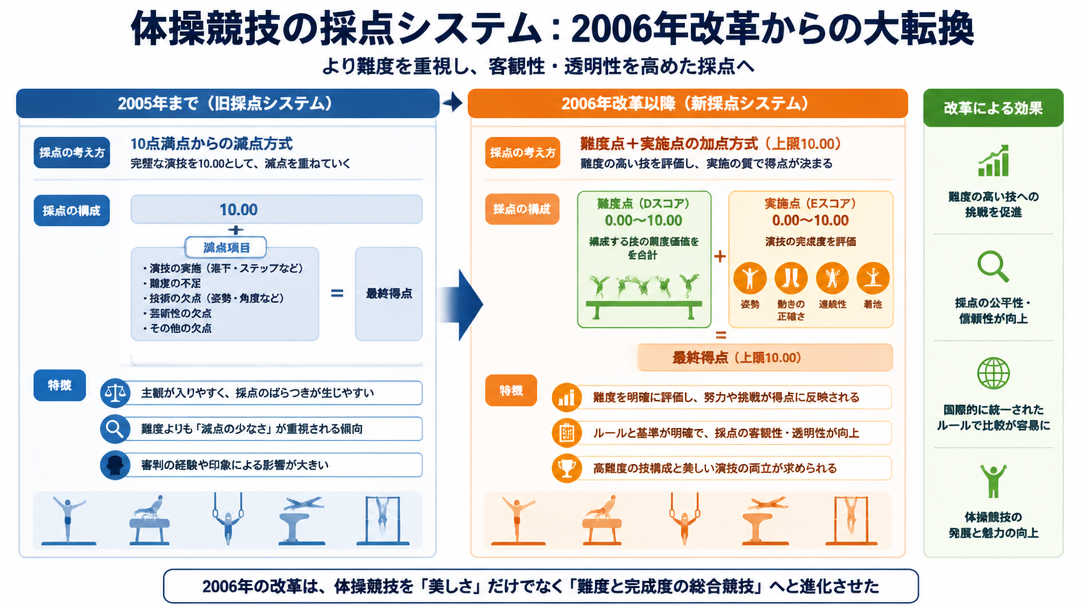
For most of the twentieth century, gymnastics operated under the "Perfect 10" framework. A score of 10.000 represented flawless execution, and when Romanian gymnast Nadia Comaneci achieved the first-ever perfect 10 at the 1976 Montreal Olympics, it became the sport's ultimate benchmark. Yet as decades passed and training methods advanced, the system began to buckle under its own logic.
The fundamental flaw was straightforward: a gymnast performing a relatively simple routine with perfect technique could earn the same 10.0 as one performing a far more demanding program. That equivalence created a perverse incentive. Rather than push boundaries with high-risk, high-difficulty skills, athletes were strategically rewarded for performing easier, cleaner routines. Innovation was, in effect, penalized. By the early 2000s, judging controversies — most notably the pairs figure skating scandal at the 2002 Salt Lake City Winter Olympics, which jolted the entire judged-sport world — made reform unavoidable. In gymnastics, the breaking point came at the 2004 Athens Olympics, where disputed scores in the men's all-around final made headlines globally.
The Open-Ended System: D Score + E Score
The FIG introduced a completely redesigned scoring framework beginning in 2006. Known as the open-ended or "Code of Points" system, it separates the evaluation of a routine into two independent components that are then added together:
- D Score (Difficulty Score): Measures the technical content of a routine — which skills were performed, whether they were connected, and whether the gymnast met required compositional elements.
- E Score (Execution Score): Measures how well the routine was performed, starting from a maximum of 10.000 and deducting for errors in form, technique, and landings.
Critically, the D Score has no upper ceiling. A gymnast who adds more difficult skills earns a higher D Score without limit. This single design choice transformed the sport: the incentive now clearly favored difficulty and innovation. World-class D Scores in events like the men's floor exercise have climbed well into the 7.0 and even 8.0 range in recent Olympic cycles. The final score is calculated as follows:
Component | Description | Cap |
|---|---|---|
D Score (Difficulty) | Skill values + connection bonuses + composition requirements | None (unlimited) |
E Score (Execution) | 10.000 minus execution deductions | 10.000 |
Neutral Deductions | Line violations, time overruns, etc. | — |
Final Score | D + E − Neutral Deductions | Theoretically unlimited |
The D Panel: How Difficulty Is Judged
Two D Judges, One Agreed Score
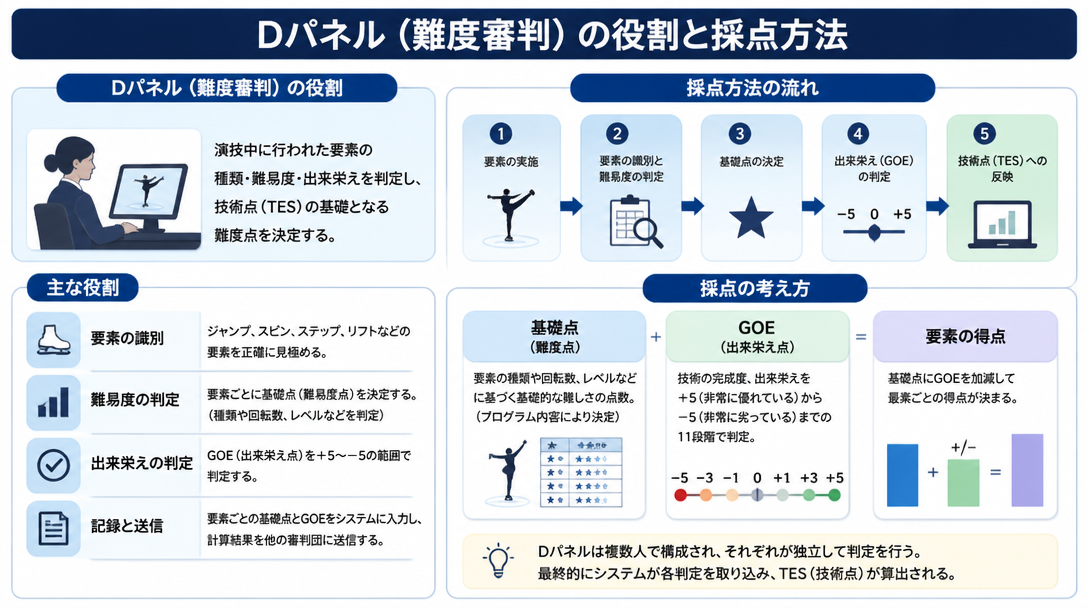
According to JudgeMate's scoring guide, the D Panel consists of exactly two D judges. Unlike the E Panel, where scores are averaged, the two D judges work independently through a routine and then confer to produce a single, agreed-upon D Score. Their evaluation covers three distinct elements:
- Difficulty Value (DV): Each skill in the Code of Points is assigned a letter grade from A (0.1 points) through the highest classifications exceeding 1.0 point. In most events, only the top eight highest-valued skills count toward the D Score. Performing nine or ten difficult skills does not help if the eighth-highest is already capped in value.
- Connection Value (CV): When certain high-difficulty skills are performed in direct sequence, bonus points (typically 0.1 or 0.2 points) are awarded. This incentivizes gymnasts to chain dangerous elements together rather than perform them in isolation.
- Composition Requirements (CR): Each apparatus event specifies a set of skill-group requirements that a routine must satisfy. Meeting each requirement earns additional points. For a detailed breakdown of CR by event, see the Composition Requirements explainer.
How the D Score Is Calculated: Men's Floor Exercise as an Example
To see how this works in practice, consider the men's floor exercise. A gymnast performs a series of tumbling passes, dance elements, and strength skills. After the routine concludes, the D judges work through the following process:
- Every skill attempted is identified and matched to its Code of Points entry. Skills that were not properly completed may not be credited.
- The eight highest-valued skills are selected and their difficulty values are summed. If a gymnast performs more than eight creditable skills, the lower-valued ones are simply dropped.
- Connection bonuses are applied wherever qualifying skill combinations were executed in direct sequence — for example, a double-twisting double back immediately followed by a front double-twisting layout.
- Composition requirements are checked. Men's floor exercise requires elements from specific skill groups (forward acrobatic, backward acrobatic, skills with turns, etc.). Each satisfied requirement adds to the D Score.
The full mechanics of D Score calculation for floor exercise are covered in detail in the floor exercise D Score calculation guide.
Why Having No D Score Ceiling Matters
As explained in this scoring system breakdown, the uncapped D Score is arguably the most consequential design decision of the modern era. It creates a direct, transparent relationship between technical ambition and competitive reward. Coaches and gymnasts now have an unambiguous incentive to develop new skills, push existing ones to harder variations, and construct routines that maximize the connection bonus. The result has been an explosion in technical difficulty across all apparatus events since 2006. Men's pommel horse and men's high bar routines, in particular, have reached levels of complexity that would have seemed implausible under the old Perfect 10 system.
The E Panel: How Execution Is Judged

Panel Size and the Averaging Method
The E Panel is composed of five E judges in most international competitions. At the 2024 Paris Olympics, the FIG expanded the panel to seven E judges to increase scoring accuracy at the sport's highest-profile event. Regardless of panel size, each E judge works entirely independently: there is no conferring, no shared information, and no awareness of what scores colleagues are assigning during the routine.
Each E judge begins from a baseline of 10.000 points and subtracts deductions for every error observed. The process for arriving at the final E Score is:
- All five (or seven) E judges submit their individual scores.
- The highest score and the lowest score are discarded. In a seven-judge panel, the top two and bottom two scores are discarded.
- The remaining scores (three in a five-judge panel, three in a seven-judge panel) are averaged to produce the official E Score.
This discard-and-average method is the system's primary protection against outlier judgments — whether caused by distraction, bias, or simple error.
Execution Deduction Categories: Small, Medium, Large, and Fall
E judges assess errors across a wide range of technical and aesthetic criteria, and each error is assigned a deduction based on its severity. The four tiers are:
Deduction Category | Points Deducted | Typical Examples |
|---|---|---|
Small fault | −0.1 | Slight bend in knees or ankles, minor body-line deviation |
Medium fault | −0.3 | Clear form break, noticeable landing instability |
Large fault | −0.5 | Major loss of form or balance, large landing step |
Fall | −1.0 | Falling to the apparatus, floor, or mat |
Common deduction sources include bent knees during flight phases, insufficiently extended ankles, body angles that fall short of the required position, lack of amplitude on release elements, and poor landing control. Because execution judging inherently involves subjective assessment — a judge must estimate, for instance, whether a knee bend reaches the threshold for a 0.1 or 0.3 deduction — the FIG's international standardization guidelines and ongoing judge training programs are essential to maintaining consistency across different panels and competitions.
E Scores Cannot Be Challenged
One of the most important rules for coaches and athletes to understand is that E Score deductions are not subject to the inquiry (challenge) process. Because execution deductions involve subjective human judgment — and because allowing coaches to dispute every 0.1 deduction would make competitions unmanageable — the FIG has explicitly placed execution scores outside the scope of formal challenges. Once the E Score is posted, it stands. For a comparative look at how execution scoring works across gymnastics disciplines, the artistic, rhythmic, and trampoline scoring comparison provides useful context.
R Judges: The Safeguard Against Collective Scoring Error
What R Judges Do and Why They Exist
The Reference Judge panel consists of two R judges. Their function is distinctly different from that of the E Panel: they do not contribute directly to the published E Score. Instead, they serve as an independent verification layer, monitoring the E Panel's collective output for signs of systematic error or bias.
Each R judge independently calculates their own E Score for every routine, using the same criteria and deduction tables as the E Panel. Their two scores are averaged to produce an R Panel reference score. This reference score is then compared against the official E Score produced by the E Panel.
How the R Judge Correction Process Works
The correction mechanism operates as follows:
- After each routine, the R Panel's averaged score is compared to the E Panel's official score.
- If the difference between the two falls within FIG-defined tolerance limits, the E Panel's score is accepted without modification.
- If the gap exceeds those tolerance limits, an adjustment process is triggered and the R Panel's score is factored into a corrected final E Score.
- In cases of extreme discrepancy, the event supervisor has authority to make a final determination.
In practice, large R judge corrections are rare at major international competitions. The real power of the R judge system is deterrent: E judges are aware that their scores are being independently verified, which reinforces careful, consistent evaluation. The system is a structural check on the possibility that a block of E judges might unconsciously drift toward inflated or deflated scores for a particular athlete, team, or country.
Other Officials: Roles Beyond the D and E Panels
The Event Supervisor
Each apparatus at a major competition is overseen by an Event Supervisor — typically one of the most experienced international judges in the field. The Event Supervisor has final authority over scoring disputes, mediates disagreements between D and E judges, and rules on formal inquiries. They are the person a coach approaches when filing a challenge, and their decision is typically final at the competition level (though decisions can be escalated to the Court of Arbitration for Sport in exceptional circumstances, as the 2024 Paris Olympics demonstrated).
Line Judges, Time Judges, and Head Judges
Beyond the D and E Panels, several additional officials monitor specific technical rules:
Official | Responsibility | Deduction Applied |
|---|---|---|
Line Judge | Monitors the 12m × 12m floor exercise boundary | −0.1 per boundary violation |
Time Judge | Times the routine (men's floor: 70-second limit) | Deduction applied for time overrun |
Head Judge | Overall competition management and coordination | Resolves procedural scoring issues |
These officials handle neutral deductions — penalties that are objective and measurable rather than subjective, and are therefore applied by rule rather than by estimation. For more on how judges assess parallel bars routines specifically, see the parallel bars routine strategy and E Score guide.
The Inquiry System: Formally Challenging a Score
What Can Be Challenged and How
The inquiry (sometimes spelled "enquiry") is the formal mechanism by which a coach can challenge a D Score. Inquiries exist because D Score errors — failing to credit a skill that was performed, or assigning the wrong difficulty value — are factual mistakes that can be verified by reviewing footage. The process is as follows:
- After the routine ends, the coach has one minute to submit a formal inquiry to the Event Supervisor.
- The Event Supervisor reviews the D judges' evaluation records.
- If warranted, video footage is consulted to determine whether the disputed skill was completed and what its correct difficulty value should be.
- If the inquiry is upheld, the D Score is corrected and the final score is updated accordingly.
The one-minute window is strict. It begins the moment the score is posted, and there are no extensions. Coaches must be watching the scoreboard and prepared to act immediately if something looks wrong.
The Jordan Chiles Case at Paris 2024: A Cautionary Tale
No recent event illustrated the importance — and the perils — of the inquiry system more vividly than the women's floor exercise final at the 2024 Paris Olympics. According to NBC New York's reporting, American gymnast Jordan Chiles initially received a score of 13.666, placing her fifth. Her coach filed an inquiry challenging the difficulty credit for a specific skill. The D Score was revised upward by 0.1 points, lifting her total to 13.766 — enough to move her from fifth to third and earn a bronze medal.
Romania, whose gymnast Ana Barbosu had finished third under the original scoring, appealed the decision to the Court of Arbitration for Sport (CAS). The CAS ruled that the inquiry had been submitted after the one-minute deadline had expired — by four seconds, according to the ruling. The inquiry was declared invalid, the D Score revision was reversed, and the medal standings returned to their original order. Chiles lost the bronze medal; Barbosu was reinstated.
The case became one of the most discussed judging controversies in recent Olympic history, and it underscored a simple but unforgiving rule: the one-minute inquiry window is absolute. Regardless of the merits of the challenge, a submission made even seconds late will not be accepted.
The Boundaries of What an Inquiry Can Change
Understanding what an inquiry can and cannot affect is essential for coaches operating at the elite level. Inquiries address factual questions about the D Score: Was a specific skill credited? Was it assigned the correct difficulty value? Was a connection bonus applied? These are all questions that can be definitively answered by reviewing the judges' records and video footage.
What an inquiry cannot address is the E Score. Execution deductions — the 0.1 for a bent knee, the 0.3 for a shaky landing — are the result of trained human judgment and are explicitly excluded from the inquiry process. This boundary exists to prevent the scoring of a completed routine from being relitigated based on subjective disagreements after the fact. The system accepts that execution judging involves some degree of human variation, and it addresses that variation through the discard-and-average method and the R judge oversight system rather than through post-hoc challenges.
Fujitsu's AI Judging Support System (JSS): Technology in the Judging Panel
How the JSS Was Developed
The growing complexity of gymnastics routines — particularly the D Score assessment, where judges must identify and correctly classify dozens of skills performed at high speed — created demand for technological assistance. In response, Fujitsu partnered with the FIG to develop the Judging Support System (JSS), an AI-powered platform designed to assist human judges rather than replace them.
According to a detailed report from Nippon.com, the project originated when FIG leadership expressed interest in using technology to improve scoring objectivity. The Fujitsu development team took an unusual approach: rather than waiting until the system was fully operational, they built an early-stage demonstration of the finished product's capabilities and presented it first — securing buy-in by showing stakeholders what the completed system would look like before the hard engineering work was done.
The JSS made its official debut at the 49th FIG Artistic Gymnastics World Championships in Stuttgart, Germany, in 2019. Initially deployed across four events — men's pommel horse, vault, and rings, and women's vault — the system expanded steadily. By the 2023 World Championships in Antwerp, Belgium, the JSS was operational across all ten apparatus events.
How the 3D Sensing Technology Works
The JSS operates through a multi-stage sensing and analysis pipeline:
- Data capture: A laser scanning system fires two million pulses per second, creating a dense three-dimensional point cloud of the gymnast in motion — without any markers or wearables attached to the athlete's body.
- Skeletal modeling: AI algorithms process the point cloud in real time and reconstruct the gymnast's skeleton at 18 key joint positions. Joint angles, body inclinations, limb positions, and spatial relationships are all calculated continuously throughout the routine.
- Skill recognition: The system maintains a database of approximately 1,400 skills from the FIG Code of Points. As the routine progresses, the AI matches observed movement patterns against this database to identify which skill is being performed and assess its execution characteristics.
- Scoring support: The system presents difficulty candidates and relevant assessment data to the D judges, who then review, confirm, or override the AI's identification before finalizing the D Score.
Current Capabilities and Remaining Challenges
One of the most concrete benefits the JSS provides is assistance with precise angle measurement. Under the Code of Points, many deductions hinge on angular thresholds: a leg deviation of 15 degrees or less might carry no penalty, while 16 degrees triggers a 0.1 deduction. These distinctions are extremely difficult to make reliably with the naked eye at competition speed. The JSS can calculate these angles with high precision from its 3D skeletal model, giving judges objective data to inform their decisions.
Critically, the JSS operates as a hybrid support tool rather than an autonomous scoring system. The AI identifies skills and presents difficulty candidates; the human D judges review those candidates and make the final call. This design preserves human accountability while reducing the cognitive load on judges who must track complex routines in real time. The system is particularly valuable for high-speed releases, multi-twist elements, and complex connecting sequences where visual tracking alone is most prone to error.
Challenges remain. Unusual or newly submitted skills may not yet be well-represented in the training data. Extreme viewing angles and overlapping body segments during complex positions can occasionally confuse the recognition algorithms. The FIG and Fujitsu continue to refine the system between each competitive cycle, expanding the skill database and improving recognition accuracy as more competition data becomes available.
Maintaining International Consistency in Judging
FIG Judge Certification and Training
For a scoring system to function fairly across competitions held on multiple continents with panels drawn from dozens of national federations, international consistency in judge training is essential. The FIG operates a tiered judge certification structure. A judge must first earn national-level certification through their country's gymnastics federation, then pass FIG-administered examinations to become internationally certified.
International judges must demonstrate not only a thorough knowledge of the Code of Points but also consistent practical evaluation skills, assessed through video judging tests and in-person seminars. Recertification is required each Olympic cycle, ensuring that all active international judges are current with the latest Code of Points revision. National federations — including Japan Gymnastics Association — maintain their own parallel training pipelines to develop judges capable of serving at international competitions.
The Four-Year Code of Points Revision Cycle
The FIG's Code of Points is not static. It is revised comprehensively on a four-year cycle aligned with the Olympic Games, with a new edition taking effect at the start of each post-Olympic competitive season. Each revision may include:
- New skills submitted by gymnasts and coaches, reviewed and assigned difficulty values by the FIG Technical Committees.
- Reclassification of existing skills whose difficulty has been reassessed based on competitive data.
- Adjustments to connection bonuses to incentivize or discourage particular skill combinations.
- New or revised composition requirements to ensure routines remain well-rounded.
- Changes to deduction criteria, clarifying the standards E judges apply.
The cyclical revision process means that the competitive landscape shifts meaningfully every four years. Gymnasts who dominated under one Code may find their routines less competitive under a revised edition, and vice versa. Coaches must actively track these changes and redesign routines accordingly. For a deeper look at the foundational structure of the Code of Points, see the Code of Points basics: D Score and E Score explained.
Summary
Artistic gymnastics judging is a multi-layered system in which specialized panels work in parallel — and check each other's work — to produce a score that reflects both the technical ambition and the execution quality of each routine. The key takeaways are:
- D Panel (2 judges): Evaluate difficulty value (DV), connection bonuses (CV), and composition requirements (CR) to produce an uncapped D Score. The two judges confer to reach a single agreed score.
- E Panel (5–7 judges): Each judge independently subtracts execution deductions from 10.000. The highest and lowest scores are discarded and the remainder is averaged to produce the E Score.
- R Judges (2 judges): Independently calculate a reference E Score and compare it to the E Panel's output. If the gap exceeds FIG tolerances, a correction is triggered — acting as a safeguard against systematic E Panel error.
- Inquiry system: Coaches may challenge D Score decisions within one minute of score posting. E Score deductions cannot be challenged. The Jordan Chiles case at Paris 2024 demonstrated that even a four-second overrun on the deadline is fatal to an inquiry.
- Fujitsu JSS: A 3D laser-based AI system that identifies skills in real time and assists D judges with difficulty recognition. Introduced in 2019 across four events, expanded to all ten events by 2023. Human judges retain final scoring authority.
Understanding how these components interact helps make sense of why scores land where they do — and why controversies, when they arise, tend to involve the precise boundaries between what can and cannot be reviewed.