Pommel Horse Flops and Scissors: How High-Difficulty Skills Work
A guide to pommel horse flops and scissors: how chained circles earn D and E value, the sequencing rules, top scissors like the Mikulak, and 2025 Code changes.
On pommel horse in men's artistic gymnastics, two families of skills do the heavy lifting for the Difficulty (D) score: the flop and the scissor. A flop chains circular elements on a single pommel, while scissors swing the legs front and back in a cross pattern. Both reward construction as much as execution, and a smart sequence can create a real gap on the scoreboard. This guide explains how each family works, how its difficulty is assigned, which composition rules you have to respect, and what changed in the 2025 Code of Points, following the FIG 2025–2028 Men's Artistic Gymnastics Code of Points.
What Is a Pommel Horse Flop? Consecutive Circles on One Pommel
The flop is one of the most eye-catching sequences in a pommel horse routine, a flowing run of connected elements that keeps the body in constant motion. Before looking at difficulty, it helps to pin down where the name comes from and how the skill is built.
Origin and Definition of the Flop
According to The Gymnastics Authority, the word "FLOP" comes from "Full Loop On Pommel." It describes circling elements (loops) performed consecutively on top of a single pommel handle. Where an ordinary circle travels across both pommels, a flop keeps one handle as the pivot while the gymnast turns and circles on that single point, which is what gives the sequence its distinctive, continuous look.
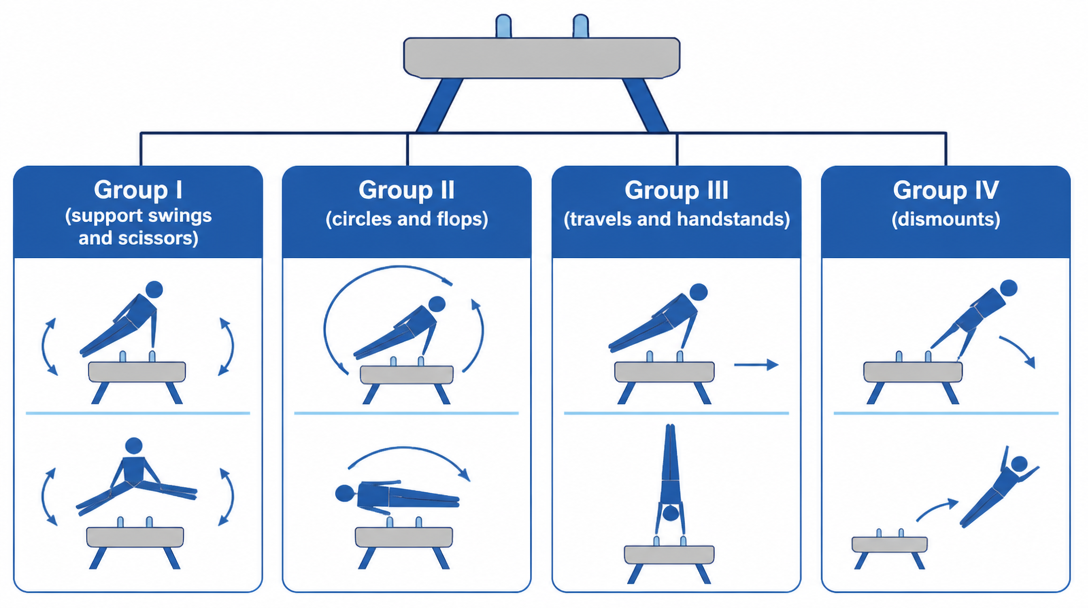
Pommel horse skills are sorted into four element groups: support swings and scissors (Group I), circles and flops (Group II), travels and handstands (Group III), and dismounts (Group IV), as laid out in this guide to men's element groups. The flop sits in Group II as an advanced extension of the circle family. For a broader look at the apparatus itself, the pommel horse overview (Wikipedia) is a useful reference.
Building Blocks of a Flop
A flop is assembled from basic circling skills. On their own these elements carry a low value, but chaining them under the rules raises the worth of the whole sequence.
- Loop (circle): the fundamental circular movement from front support through rear support and around, sometimes performed with a quarter turn.
- Stockli A and B: circles that add a half turn, in two variants (A and B).
- Kehr: a single-arm turning element used only as the entry into a chain.
- Russian wende (turning circles): consecutive turns in front support that are combined with flop sequences.
If you want a quick way to check a pommel horse composition and its difficulty value, the Gymnastics AI D-Score calculator is handy. It follows the FIG 2025–2028 Code of Points and carries a database of more than 790 skills, so you can line up flops and scissors and see on the spot how the D score shifts.
How Flop Difficulty Is Decided: D and E Value
The appeal of the flop is that its difficulty climbs step by step with the number of elements you chain together. Here is how that value is assigned.
Number of Chained Elements and Difficulty Value
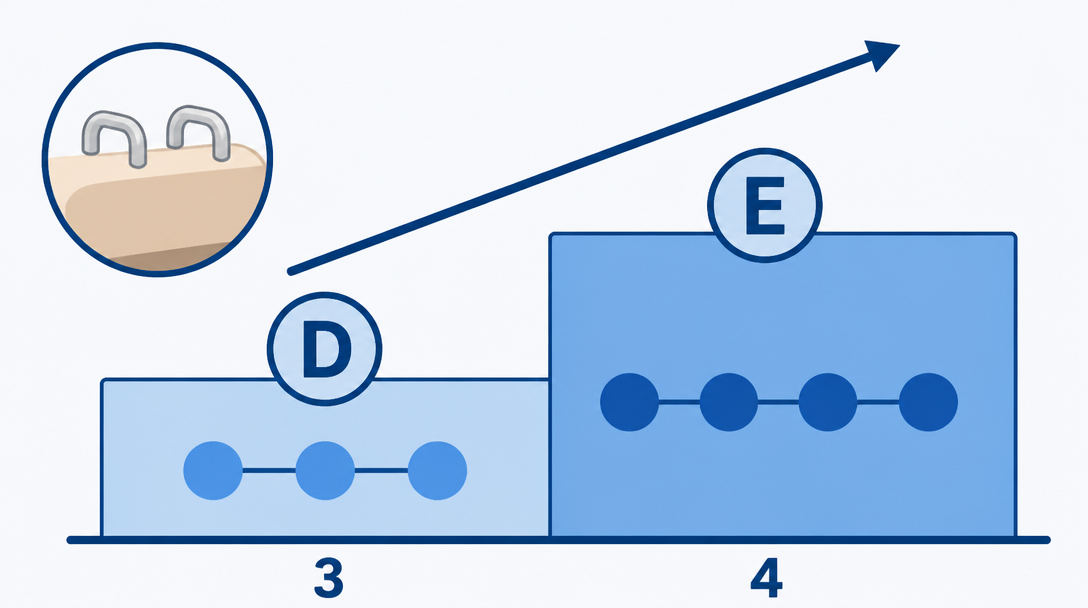
Flop difficulty is set by how many circling elements are linked in a row. According to The Gymnastics Authority, a three-element "D flop" is rated D, and a four-element "E flop" is rated E. A single circle is only an A, so stringing elements together within the rules is exactly where a flop earns its value.
Type of flop | Chained elements | Difficulty value |
|---|---|---|
D flop | 3 elements | D |
E flop | 4 elements | E |
Russian flop | Russian turns + 1–2 elements | Per the difficulty table |
The D score is then built by adding this difficulty value to group bonuses, dismount value and connection bonuses. For the full picture of how the D score is assembled, see The Basics of the Code of Points: How the D Score and E Score Work.
Pommel Horse's Top Difficulty and Where Flops Fit
The highest difficulty in gymnastics overall is H, but pommel horse has no H-value skills, so in practice G is the ceiling on this apparatus (types of pommel horse skills, SPAIA). Flops typically top out at the E flop, and gymnasts build up the routine's overall D score by pairing them with dismounts and combined elements. For the fundamentals of the circle skills that feed into flops, see also Pommel Horse Circle Technique: Russian and Stockli Basics and Scoring.
Flop Composition Rules: Chaining and Family Limits
You cannot line up flop elements in any order you like; the Code of Points sets out detailed restrictions. Understanding them is the prerequisite for avoiding invalid skills and banking difficulty reliably.
Three Restrictions on Chaining and Placement
According to The Gymnastics Authority, the main restrictions on a flop chain are as follows.
- The same loop or DSB (straddled rear-support family) element may not be chained three or more times in a row (a maximum of two in a row).
- Stockli A (DSA) family elements may be placed only at the end of a chain.
- Kehr-family elements may be placed only at the start of a chain.
These limits exist to stop gymnasts from piling up difficulty simply by repeating the same element, and to encourage variety. The way the Code frames these requirements (composition requirements and group demands) is organised in Composition Requirements (CR) and the Men's Apparatus Element Groups.
In practice, a flop usually opens with a Kehr, weaves several loops and Stocklis through the middle, and closes with a Stockli A. Getting the order wrong can make an element count as invalid, in which case the difficulty value itself is not credited, so gymnasts and coaches build the chain while cross-checking it against the rules. That makes the flop not just a showpiece but a highly strategic skill whose reward reflects how well the rules are understood.
Shaun- and Bezugo-Family Count Limits
The 2025 Code also consolidated the per-family count limits. According to a summary of the main 2025 pommel horse changes, "Shaun-family and Bezugo-family elements, including those within flops, combined elements and handstands, may be performed up to twice in a single routine." Where these had previously been counted in separate categories, they are now counted together, which affected the freedom gymnasts had in composition.
What Are Pommel Horse Scissors? Forward and Reverse Basics
Alongside the flop, the scissor is the other signature element of pommel horse. With its wide front-and-back swing of the legs, it belongs to a different technical family from the circles.
Basic Structure of the Scissor
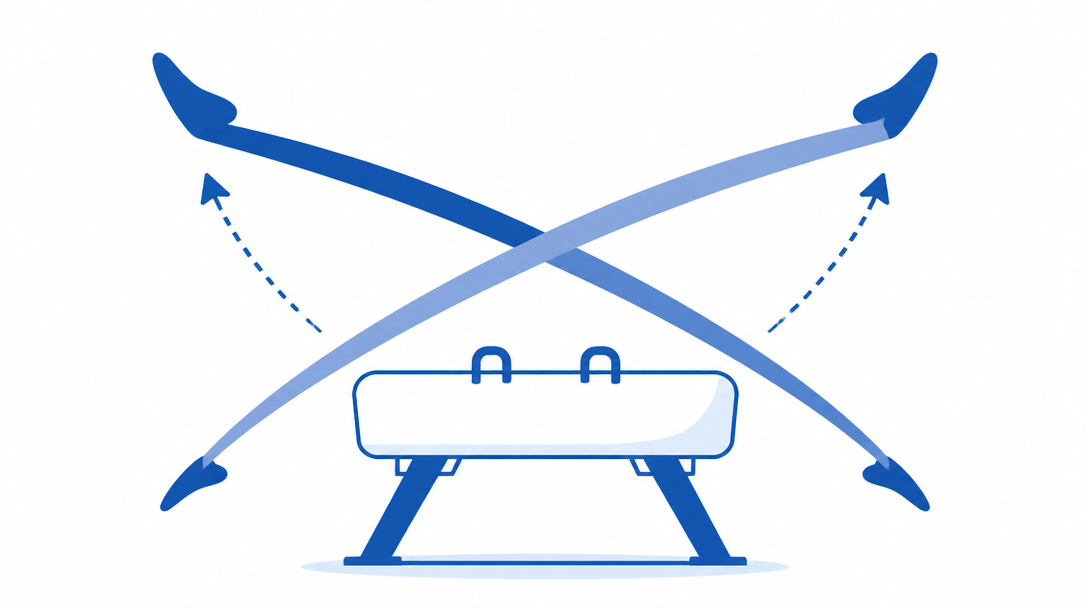
A scissor is performed by holding both pommels, splitting the legs front and back, and swapping their positions while holding the support. According to this explanation of pommel horse scissors, the regular scissor, with the legs split in the standard way, is the basic A-value skill, and the reverse scissor (back scissor), which inverts the front-and-back position of the legs, is also rated A. Within the element groups, scissors are classed in Group I together with support swings.
Progressions: Hop and Twist Variations
From the basic scissor, adding a sideways travel or a twist raises the difficulty. The main progressions, organised by value, are as follows.
Difficulty | Representative scissor |
|---|---|
A | Scissor / reverse scissor (back scissor) |
B | Scissor with hop and sideways travel / scissor with twist into reverse scissor |
C | Scissor with hop, sideways travel and twist into reverse scissor / reverse scissor to handstand |
D | Mikulak (end-to-end travel) / scissor handstand (Li Ning) |
Official notation and international names for these skills can be checked in the list of gymnastics skill names (Wikipedia). For the physical demands that pommel horse technique places on a gymnast, see also The Six Men's Apparatus and the Physical Abilities They Require.
High-Difficulty Scissors: the Mikulak and the Scissor Handstand
Compared with flops, the scissor family has a lower difficulty ceiling. Here is why, along with the top skills in the group.
Scissors Cap Out at D
According to the scissor explanation, only two scissor-family skills reach D value, the Mikulak and the scissor handstand (Li Ning), and these are the highest difficulty in the family. Scissor skills of E value or above are not expected to appear, so gymnasts who want to bank difficulty efficiently often choose a construction that limits scissors to a single element.
Features of the Mikulak and the Scissor Handstand
The Mikulak is a dynamic skill that carries a hop-and-travel scissor across the full length of the horse, end to end, with the travel distance and the in-air position being the key points for evaluation. The scissor handstand (Li Ning), by contrast, is a demanding skill that moves from the scissor flow into a handstand, requiring stable support and a held position. If you want to test how these skills change the D score in a real composition, Gymnastics AI is a good tool: just pick and arrange skills, and it automatically calculates difficulty value, group bonus and connection bonus.
2025 Code of Points Changes: Impact on Flops and Scissors
The 2025–2028 Code revised several provisions affecting pommel horse flops and scissors. Let's look at the important changes that feed directly into composition strategy.
Removal of the Flair Upgrade
Previously there was a clause that "performing a flop with flairs (straddled circles) upgrades the difficulty by one step," but according to the explanation of the 2025 changes, that provision was abolished. With the automatic upgrade for flaired execution gone, gymnasts are rethinking where flairs are worth using. On top of that, "elements performed with flairs are limited to four per routine (excluding the dismount)," which means at least half the routine must now be performed with legs-together circles.
Stricter Scissor-Handstand Requirements
The rules for the scissor handstand were also tightened. According to the rules added or changed from 2025 and the explanation cited above, it is now stated explicitly that "every scissor-handstand skill must change the support hand or pommel and also swap the legs." As a result, the number of valid variants narrowed from the former eight patterns down to just two, reducing the freedom of compositions built around the scissor handstand.
Strategy for Working Flops and Scissors into a Routine
Scoring well on pommel horse comes down to how you place flops and scissors. Here is how to think about a composition that balances difficulty with execution (the E score).
Meeting Group Requirements While Stacking Difficulty
On pommel horse you earn group bonuses by including skills from each element group (I–IV). The basic strategy is to balance scissors (Group I), flops (Group II), travels and handstands (Group III) and the dismount (Group IV). A common approach is to anchor the routine with a high-value E flop while folding in one or two of the top scissors, the Mikulak or the scissor handstand.
Balancing Execution (the E Score)
Cram in too much difficulty and you invite E-score deductions for shallow circle amplitude or messy legs. If your posture breaks down during a flop chain, the D and E difficulty you worked for can be cancelled out by execution deductions. Scoring is split between the D panel and the E panel, so the balance between the two matters (The Gymnastics Judging System: the Roles of the D and E Panels and How Scoring Works). For the circle technique that underpins pommel horse, the basic pommel horse guide (The Gymnastics Authority) is a helpful reference.
Choosing Between Flairs and Legs-Together Circles
With the 2025 Code removing the automatic upgrade for flairs and adding a four-per-routine limit, where to use flairs has become more strategic. Flairs look impressive and show well in execution, but the technique of circling cleanly with the legs together is valued just as highly. A basic principle of pommel horse construction is to group the high-difficulty flops and combined elements in the first half of the routine, then place travels, handstands and the dismount in the second half to spread out the risk of failure. Anchoring the routine on flops and scissors while using each gymnast's strongest skills to lock in group bonuses is what leads to a stable, high score.
Summary
Pommel horse flops and scissors are the headline high-difficulty skills that shape the D score. Here are the key points.
- A flop chains circling elements on a single pommel; three elements make it a D, four make it an E.
- Flops carry composition limits such as "no more than two loops in a row," "Kehr at the start," and "Stockli A at the end."
- Scissors belong to Group I, and the D-value Mikulak and scissor handstand are the family's top difficulty.
- The 2025 Code removed the flair upgrade, capped flair count, and tightened the scissor-handstand requirements.
- A composition that balances group requirements with execution (the E score) is the key to a high score.
If you want to simulate the D score of a composition easily, give Gymnastics AI a try. It follows the FIG 2025–2028 Code of Points, works on iOS and Android, and is free to use.