Gymnastics Grips Guide: Choosing the Right Grip by Apparatus
Choose the right gymnastics grip for high bar or rings. This guide covers dowel vs palm grips, sizing, Reisport and Sasaki brands, break-in, and care tips.
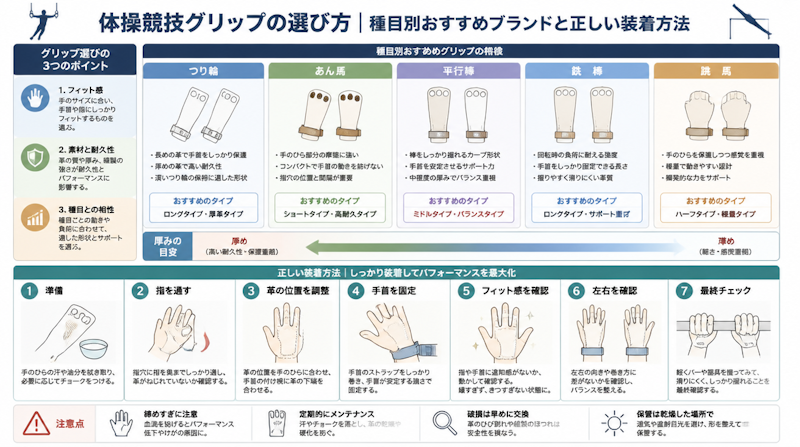
Gymnastics grips (hand protectors) are essential equipment for artistic gymnasts, protecting the hands while providing a critical mechanical advantage on the high bar and still rings. Choosing the wrong
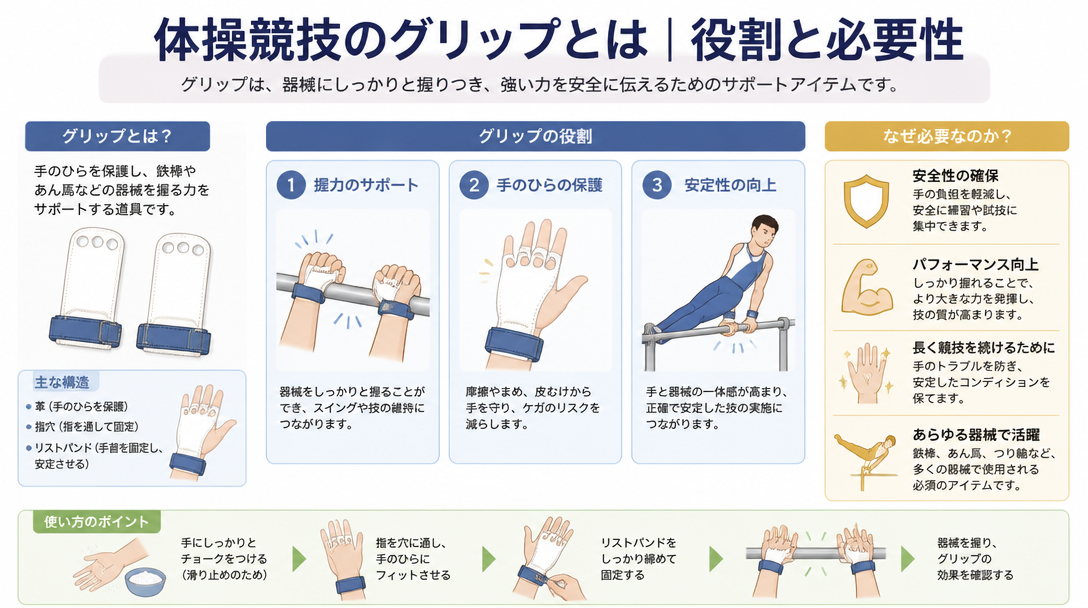
grip for your apparatus or skill level can compromise both safety and performance. This guide covers everything you need to know — from grip types and apparatus-specific selection to sizing, top brands, break-in methods, and care tips.
What Are Gymnastics Grips and Why Do You Need Them?
Two Key Functions of Gymnastics Grips
Gymnastics grips serve two core purposes:
- Hand protection: They prevent painful rips, blisters, and calluses caused by friction against metal bars and rope rings.
- Mechanical advantage: The dowel rod sewn inside competitive grips hooks onto the bar, dramatically reducing grip strength demands during swinging and release moves.
According to Wikipedia's entry on gymnastics grips, the primary purpose is to "enhance the gymnast's grip on the apparatus and reduce friction, which can cause painful blisters and rips." The dowel creates a hooking leverage that transfers force to the wrist strap rather than the fingers, enabling gymnasts to withstand the enormous centrifugal forces of giants and release moves.
Which Apparatus Require Grips?
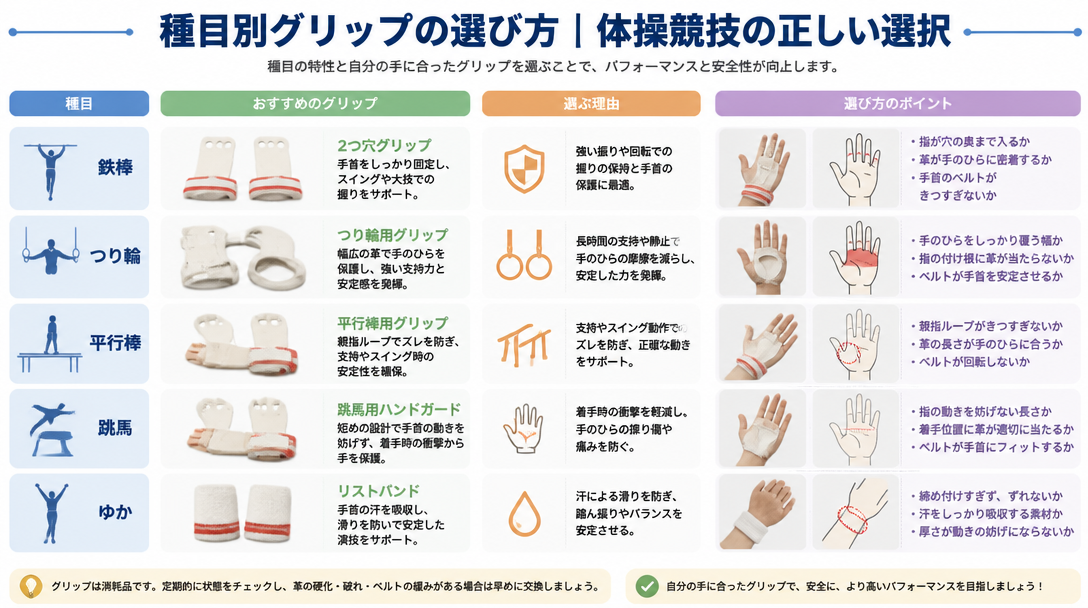
In men's artistic gymnastics, grips are used on two of the six events:
Apparatus | Grip Usage | Notes |
|---|---|---|
High Bar | Required | High centrifugal forces from 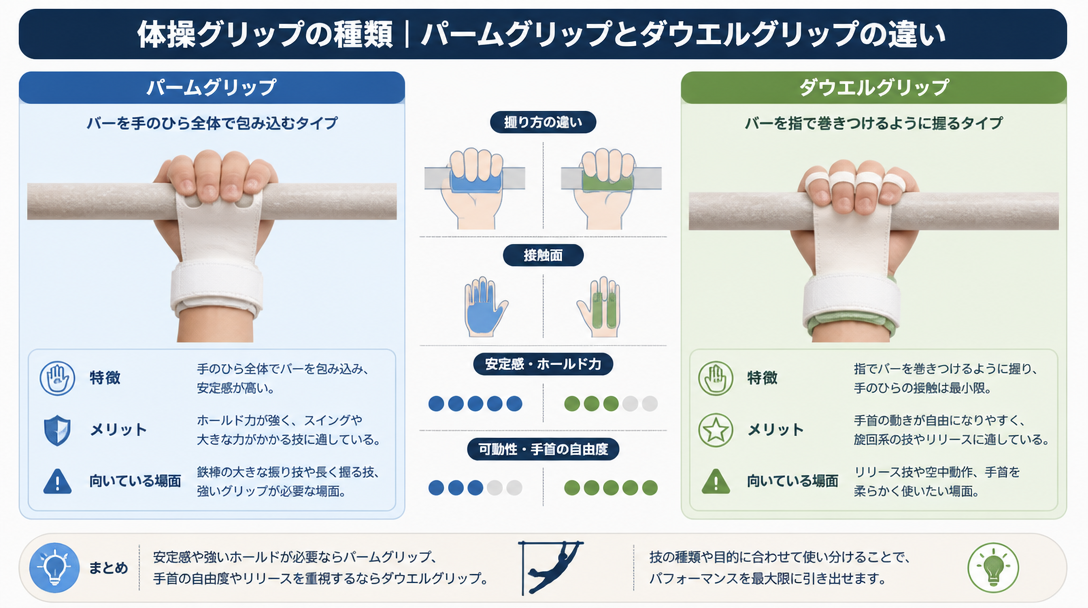 giants and releases demand grip support |
Still Rings | Recommended | Strength elements and swings create significant friction |
Floor Exercise | Not used | — |
Pommel Horse | Not used | Performed bare-handed on saddle/mushroom |
Vault | Not used | — |
Parallel Bars | Not used | Fiberglass bars provide sufficient natural friction |
Women use grips on the uneven bars. Parallel bars (men's) do not require grips because the fiberglass material provides adequate natural friction. As noted at gymnastics equipment guides, men use grips on high bar and rings, while women use them on uneven bars.
Types of Gymnastics Grips: Dowel vs. Palm Grips
Palm Grips (Basic/Beginner Grips)
Palm grips are the simplest type, covering the palm without any dowel rod. They are designed for beginners and recreational gymnasts work
ing on basic pull-ups or fundamental swings. As American Gymnast explains, palm grips "primarily provide basic protection for the palm of the hand" and are "intended for beginner (mostly non-competitive) gymnasts." They offer no mechanical advantage, so they cannot support competitive high bar or ring routines.
Dowel Grips: The Three Shapes
Competitive gymnasts use dowel grips, which feature a rigid rod sewn across the inside finger area. Dowel grips come in three shapes:
Shape | Characteristics | Best For |
|---|---|---|
Skinny | Thin dowel for direct bar feel | Sensation-focused advanced gymnasts |
Straight (Russian style) | Wider palm coverage, maximum stability | Gymnasts with larger hands, strength-focused |
Curved | Contours to hand shape, balanced feel | Most versatile — preferred by majority of gymnasts |
According to Gymnastics HQ's comprehensive grip guide, "skinny grips are good for being able to better feel the bar," while curved grips offer "a middle ground, which most gymnasts prefer."
Choosing Grips by Apparatus
High Bar Grips: Three-Finger Design
High bar grips use a three-finger hole design where the middle, ring, and small fingers are inserted. The dowel hooks onto the bar during swinging skills and release moves like Tkatchev, Kovacs, and Rybalko.
Correct fit: Finger holes should reach the second knuckle. Holes that are too short risk the grip coming off mid-swing; holes that are too deep risk grip lock — a serious injury where the grip gets stuck on the bar during rotation.
- Slim dowel profile is standard for high bar
- Double-buckle closure for maximum security in competition
- Hook-and-loop (velcro) for quick changes during training
- Never use ring grips on high bar or vice versa
Ring Grips: Two-Finger Design
Still ring grips use a two-finger hole design (middle and ring fingers) with a thicker dowel. For elements like iron cross and planche, hand stability is paramount. Correct fit: Finger holes should reach the first knuckle — shallower than high bar grips. US Glove's selection guide explicitly states: "It is not safe to wear your ring grips on the high bar or vice versa."
Parallel Bars: No Grips Needed
Men's parallel bars are performed bare-handed. The fiberglass construction provides natural friction, and the bars' flex is integral to parallel bar composition strategy.
Closure Types: Buckle vs. Hook-and-Loop
Buckle Closures
Metal buckle closures provide the most secure fit and are preferred for competition and elite training. Reisport's double-buckle model has been described as "the most popular grip in the world." The trade-off is slower on/off compared to velcro. As Gymnastics HQ notes, buckle closures are "preferred by advanced gymnasts competing high-level routines who want assurance grips won't come undone."
Hook-and-Loop (Velcro) Closures
Velcro closures allow quick on/off and easy micro-adjustment. They're popular for training-heavy schedules, especially for junior gymnasts. The downside is that velcro wears out over time and loses holding power, making it less reliable for long-term use under extreme loading.
Sizing Your Gymnastics Grips
How to Measure
Grip sizing is based on hand length — from the wrist crease to the tip of the middle finger.
- Extend your hand flat with fingers together
- Measure from the wrist crease to the tip of your middle finger in centimeters
- Match your measurement to the manufacturer's size chart
According to Reisport's official sizing guide, high bar and ring grips use the same measurement but differ in finger hole depth (second knuckle for high bar; first knuckle for rings).
Reisport Men's Size Reference Chart
Size | Hand Length (wrist to middle finger tip) |
|---|---|
XXS (000) | Up to 15.5 cm |
XS (00) | 15.5–16.5 cm |
S (0) | 16.5–17.5 cm |
M (1) | 17.5–18.5 cm |
L (2) | 18.5–19.5 cm |
XL (3) | 19.5 cm and above |
Golden rule: When between sizes, choose the smaller one. Leather stretches with use and will mold to your hand. Oversized grips increase the risk of grip lock — a dangerous injury where the dowel becomes trapped on the bar during rotation.
Top Brands for Gymnastics Grips
Reisport: The World Standard
Reisport, designed in Switzerland, is the most widely used grip brand at the elite level. Their slim rubber dowel, glued and sewn for precise placement, delivers superior bar feel without excess bulk. In Japan, Reisport Japan serves as the official distributor. Best for: Competitive gymnasts from intermediate to elite level.
Sasaki: Japan's Trusted Junior Brand
Sasaki Sports is the leading Japanese gymnastics equipment brand, widely used in clubs and schools across Japan. Their softer leather breaks in faster, and their junior-specific sizing makes them the go-to choice for young gymnasts starting out. Best for: Junior gymnasts, beginners, smaller hands.
US Glove and Others
US Glove offers a broad range from entry-level palm grips to advanced dowel grips at accessible price points. Bailie Grips are known for thick, durable leather with a longer break-in period, favored by gymnasts who want maximum longevity.
How to Properly Wear Gymnastics Grips
Step-by-Step Instructions (High Bar 3-Finger Grip)
- Widen finger holes if needed: Gradually widen using a pencil wrapped in sandpaper. Don't over-enlarge — leather stretches further with use.
- Insert fingers: Slide the middle, ring, and small fingers through the holes until they reach the second knuckle.
- Check palm coverage: The leather should lay flat across your palm, not flipped toward the back of your hand.
- Secure wrist strap: Fasten velcro or buckle to achieve a snug but not circulation-restricting fit.
- Apply chalk: Apply a thin, even layer of chalk (magnesium carbonate) to the palm side. Brush off excess.
Once your grip setup is dialed in and you're ready to design your competition routine, Gymnastics AI can help you calculate your D-score based on FIG 2025–2028 rules — select your elements and the app automatically computes difficulty, group requirements, and connection bonuses.
Key Safety Checks
- Grip is not folded toward the back of the hand
- Wrist strap ends are tucked or folded (not dangling)
- Strap is not so tight it restricts circulation
- Do a few light swings before attempting difficult skills to confirm fit
Breaking In New Grips
Progressive Break-In Schedule
Stage | Timeline | Activities |
|---|---|---|
Stage 1 | Days 1–3 | Pendulum swings, hangs, basic pull-ups only |
Stage 2 | Week 1 | Forward and backward casts, hip circles |
Stage 3 | Week 2+ | Gradually introduce giants and release moves |
Fully broken in | Individual variation | Full routine training and competition use |
Gymnastics HQ emphasizes breaking in grips "slowly" through simple skills before attempting advanced techniques. Apply chalk thinly and evenly — excess chalk builds up and actually reduces the hooking effect. Use a grip brush after each session to remove chalk buildup.
Grip Maintenance and Storage
Daily Care
- Brush off chalk after every session to prevent buildup that stiffens the leather
- Minimize water exposure: Leather loses essential oils when wet, leading to cracking
- Air dry naturally: Never use heaters or direct sunlight — rapid drying causes cracking and hardening
Storage and Replacement
Store grips in a breathable cloth bag away from extreme humidity. Always keep a backup broken-in pair for competitions. Replace your grips when the leather cracks or tears, finger holes have stretched too wide, the dowel has come loose, or the closure no longer holds securely.
Worn or oversized grips are a leading cause of grip lock injuries. According to sports safety research, grip lock occurs more frequently in male gymnasts and can result in fractures. Regular inspection is essential.
Grip Choice and D-Score Impact
How Grips Enable Higher Difficulty
Proper dowel grips unlock the ability to safely train giants and release skills on high bar — elements that build your D-score in competition. On rings, the right two-finger grip supports sustained strength positions like the iron cross and planche, each carrying significant difficulty value under the Code of Points.
Simulate Your D-Score
Try Gymnastics AI — D-Score Calculator to instantly calculate your routine's difficulty value under FIG 2025–2028 rules. The app covers all six men's events with a database of 790+ skills, automatic calculation of difficulty, group requirements, and connection bonuses. Available in Japanese and English, fully offline.
Summary
- High bar requires 3-finger dowel grips (holes to 2nd knuckle); rings require 2-finger dowel grips (holes to 1st knuckle). Never cross-use.
- Dowel shape: skinny, straight (Russian), or curved — curved is the most versatile and widely used
- Closure: buckle for maximum security in competition; velcro for training convenience
- Sizing: when between sizes, choose smaller — leather stretches, and oversized grips risk grip lock
- Reisport is the world standard for competitive gymnasts; Sasaki is ideal for Japanese juniors and beginners
- Break in grips gradually over 2–4 weeks before using them for full difficulty routines
- Care: brush chalk after sessions, avoid excess water, store in breathable bag, replace when worn
Ready to build your next competition routine? Try Gymnastics AI — the free D-score calculator built for the FIG 2025–2028 Code of Points.