Asian Gymnastics Championships 2026: Japan's Road to Rotterdam
A former gymnast and D-Score app developer breaks down the 2026 Asian Artistic Gymnastics Championships men's results in Zunyi, China: China's dominance, Japan's team silver, and the D-score story behind the Worlds qualification for Rotterdam 2026.
Note: This article reflects information as of July 5, 2026.
The 2026 Asian Artistic Gymnastics Championships took place from June 18 to 21 in Zunyi, China. China won the men's team title, Japan claimed silver, and both nations secured their team berths f

or the 2026 World Championships in Rotterdam. Written from the perspective of a former gymnast and D-Score app developer, this analysis focuses on two angles the English-language coverage often overlooks: what the results mean for the road to Rotterdam, and how the standout scores break down under the FIG Code of Points.
Overview of the 2026 Asian Championships
Event context and significance
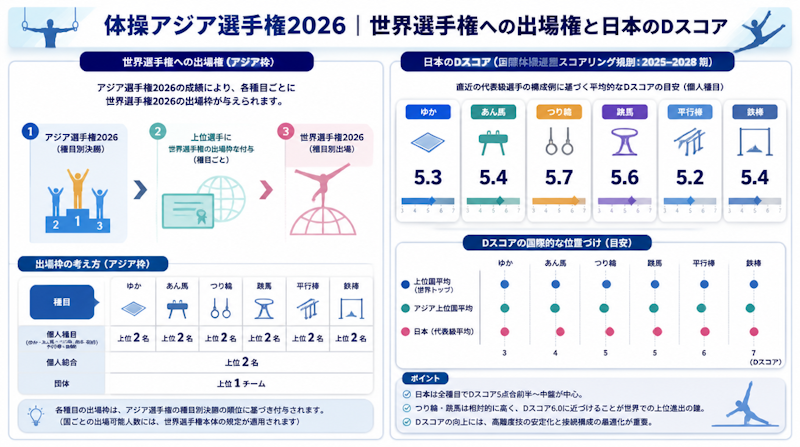
The 13th Asian Championships doubled as a continental qualifier for the 2026 World Championships in Rotterdam (October 17–25). Because Asia is one of the deepest regions in the sport, team and individual berths are always fiercely contested. The men's competition ran from June 18 to 21, as documented on the event's Wikipedia page and by the Asian Gymnastics Union.
Worlds qualification for Rotterdam
According to The Gymternet, the men's team berths for the World Championships went to China, Japan, Kaz
akhstan, and Chinese Taipei, with Uzbekistan reportedly missing out "by just a tenth." Six male athletes also qualified individually, including brothers Carlos and Eldrew Yulo of the Philippines plus gymnasts from Uzbekistan, Mongolia, and Singapore.
If you want to explore how these gymnasts' routines are constructed, the Gymnastics AI D-Score calculator is a handy companion. It follows the FIG 2025–2028 Code of Points and includes a database of more than 790 skills, so you can rebuild each routine as you read.
Men's Team Results: China's Reign and Japan's Silver
Team standings and scores
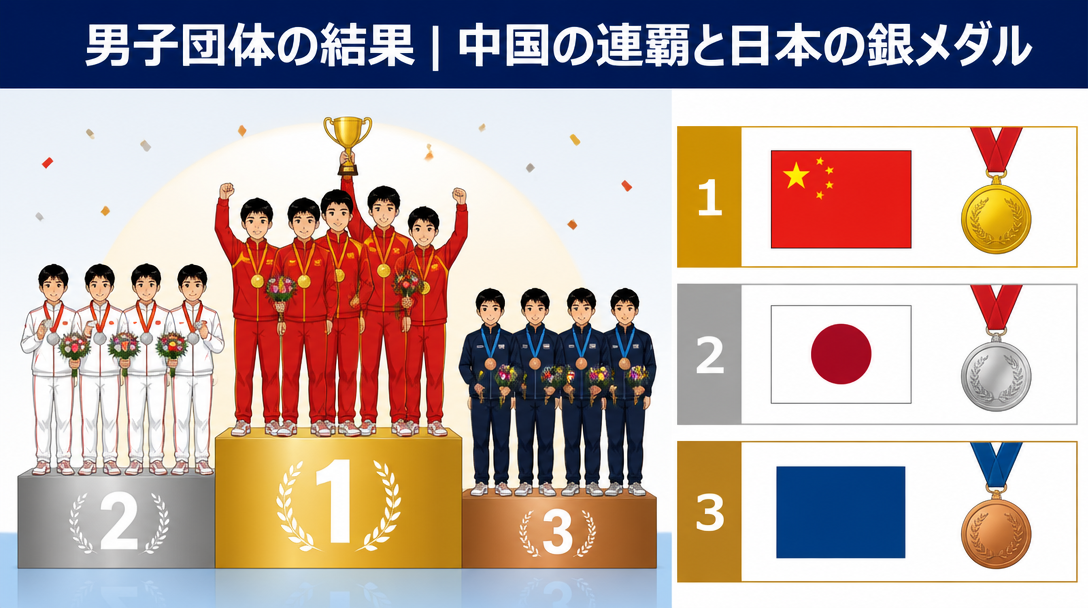
China topped the men's team competition with 254.194, while Japan took silver at 248.795. The roughly 5.4-point gap reflects China's overall depth, yet Japan comfortably cleared the rest of the field, as reported in Gymnastics Now's results roundup.
Rank | Team | Total |
|---|---|---|
1 | China | 254.194 |
2 | Japan | 248.795 |
3 | South Korea | 242.561 |
4 | Kazakhstan | 240.660 |
5 | Chinese Taipei | 238.762 |
Team totals are built from the best routines
on each apparatus, so consistency across all six events is decisive. The China–Japan gap came less from any single event and more from the accumulation of small differences in difficulty (D-score) and execution (E-score). For the scoring fundamentals, see our guide to the Code of Points and how D-scores and E-scores work.
Why Japan brought a next-generation squad
The key subplot is that Japan fielded a developmental lineup rather than its top roster. Per Gymnastics Now's Worlds roster tracker, Japan's projected men's team for Rotterdam is Daiki Hashimoto, Shinnosuke Oka, Shohei Kawakami, Ryosuke Doi, and Fusuke Maeda. In Zunyi, however, a different group led by Wataru Tanigawa carried the load.
In other words, Japan rested stars such as Hashimoto and Oka while securing the team berth with its second wave of talent. Finishing second to China without its top guns underlines the remarkable depth of Japanese men's gymnastics. For more on what each apparatus demands, see our breakdown of the six men's apparatus and the physical attributes they require.
All-Around D-Score Analysis: Zhang Boheng's Dominance
All-around top five
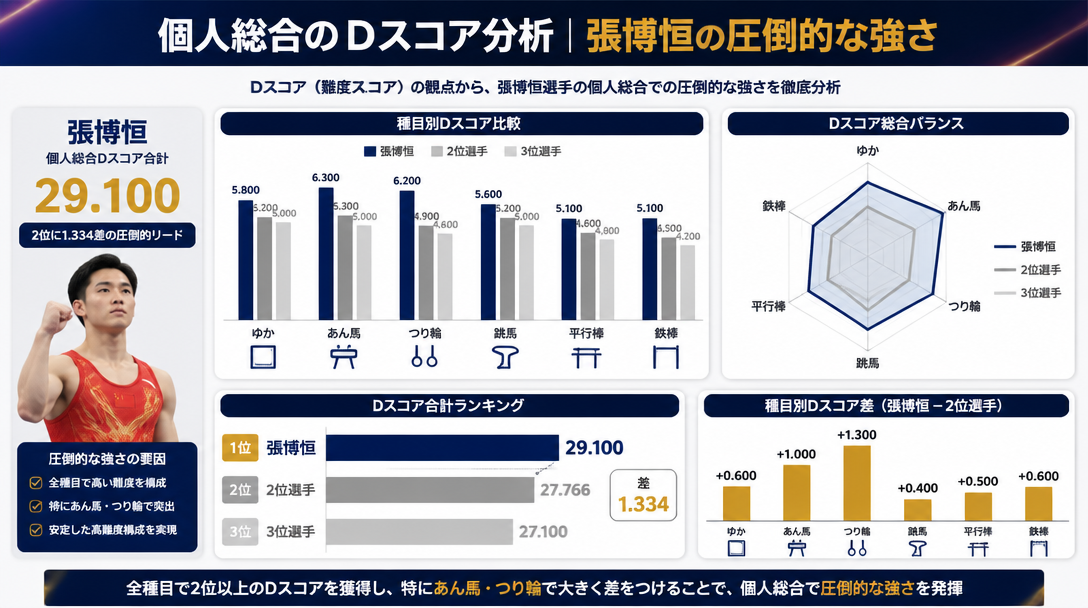
China's Zhang Boheng won the all-around with 85.298, ahead of teammate Yang Haonan (82.398) and Japan's Teppei Miwa, who took bronze at 82.265.
Rank | Gymnast | Nation | Score |
|---|---|---|---|
1 | Zhang Boheng | China | 85.298 |
2 | Yang Haonan | China | 82.398 |
3 | Teppei Miwa | Japan | 82.265 |
4 | Wataru Tanigawa | Japan | 81.265 |
5 | Ryu Sunghyun | South Korea | 80.766 |
The gap between champion Zhang and bronze medalist Miwa was about 3.0 points, or roughly half a point per apparatus. Tracing exactly where those fractions come from is what makes elite all-around battles so compelling.
Reading Miwa's bronze through the Code of Points
Miwa finishing behind only the two Chinese all-arounders is a major result for Japan's next generation. To contend in the all-around, a gymnast must bank a high D-score on their strong events while protecting the E-score elsewhere by avoiding falls and landing errors. Our article on landing technique and avoiding deductions covers that balance in detail.
To experiment with how routine construction changes a D-score, try Gymnastics AI. Selecting and ordering skills automatically calculates difficulty value, group requirements, and connection bonuses—so you can see how upgrading a single skill moves the total. Rebuilding these gymnasts' routines yourself is the fastest way to appreciate gymnastics as a judged sport.
Event Finals: Tang Chia-Hung's 15.500 on High Bar
Apparatus champions
The event finals produced several highlights, none bigger than Chinese Taipei's Tang Chia-Hung posting 15.500 on high bar.
Event | Champion | Nation | Score |
|---|---|---|---|
Floor | Carlos Yulo | Philippines | 14.700 |
Pommel Horse | Utkirbek Juraev | Uzbekistan | 14.566 |
Rings | Yang Haonan | China | 14.566 |
Vault | Wataru Tanigawa | Japan | 14.316 |
High Bar | Tang Chia-Hung | Chinese Taipei | 15.500 |
Japan also featured in the finals: Shoma Tsukiyama took second on floor (14.600) and Fusuke Maeda earned bronze on high bar (14.300).
Breaking down Tang's 15.500
Reaching 15.500 on high bar requires both an elite D-score and a clean E-score. Assuming an E-score in the high 8s, the D-score would land around 6.5–6.7—achievable only by linking multiple release moves, meeting the element-group requirements, and sticking a high-value dismount. The differences among Tkatchev, Kovac, and Rybalko release families are laid out in our guide to high-bar release skills.
Tanigawa's vault and Japan's event finals
Wataru Tanigawa won vault at 14.316. Because vault is decided in a single pass, precision through the landing is everything; see our overview of vault families and difficulty. How Japan deploys such specialists at Worlds will be worth watching.
Looking Ahead to Rotterdam
Japan's projected team and strategy
Having locked in a team berth, Japan can now unleash its top gymnasts in Rotterdam. The projected lineup is Hashimoto, Oka, Kawakami, Doi, and Maeda. Combining Zunyi-tested youngsters with rested stars could give Japan a genuine shot at team gold. The men's team final is scheduled for October 20. For Japan's Worlds history, see the evolution of Japan's national team.
Asia's rivals at Worlds
China looms as the biggest threat, powered by Zhang Boheng and rings specialist Yang Haonan. Chinese Taipei's Tang Chia-Hung is a high-bar gold contender, and the Philippines' Carlos Yulo is a podium threat on floor and vault. Official results can always be verified at the FIG website.
Summary
- Men's team: China first (254.194), Japan second (248.795)
- Worlds team berths: China, Japan, Kazakhstan, Chinese Taipei
- All-around: Zhang Boheng (85.298) gold; Teppei Miwa bronze for Japan
- Event finals: Tang Chia-Hung's 15.500 high bar stole the show
- Japan rested its stars yet secured the berth—an encouraging sign for October
To simulate the D-scores behind these routines, give Gymnastics AI a try. Free on iOS and Android.