Endo, Adler & Markelov: Men's High Bar Skills Explained
Confused by Endo, Adler and Markelov on the high bar? This guide clarifies the differences with the FIG Code of Points, covering in-bar and release elements.

The horizontal bar dazzles audiences with soaring release skills and flowing giant swings. Yet element names like "Endo," "Adler," and "Markelov" reveal little about the movements themselves, and fans often confuse them. This guide uses the giant-swing family as an anchor to clarify the differences b
etween Endo, Adler, and Markelov, all grounded in the FIG (International Gymnastics Federation) Code of Points.
The Four Element Groups That Structure High Bar
To understand any high bar skill, you first need to know which group it belongs to. The distinction between Endo, Adler, and Markelov becomes obvious once you grasp this classification.
The Four Groups of a Routine
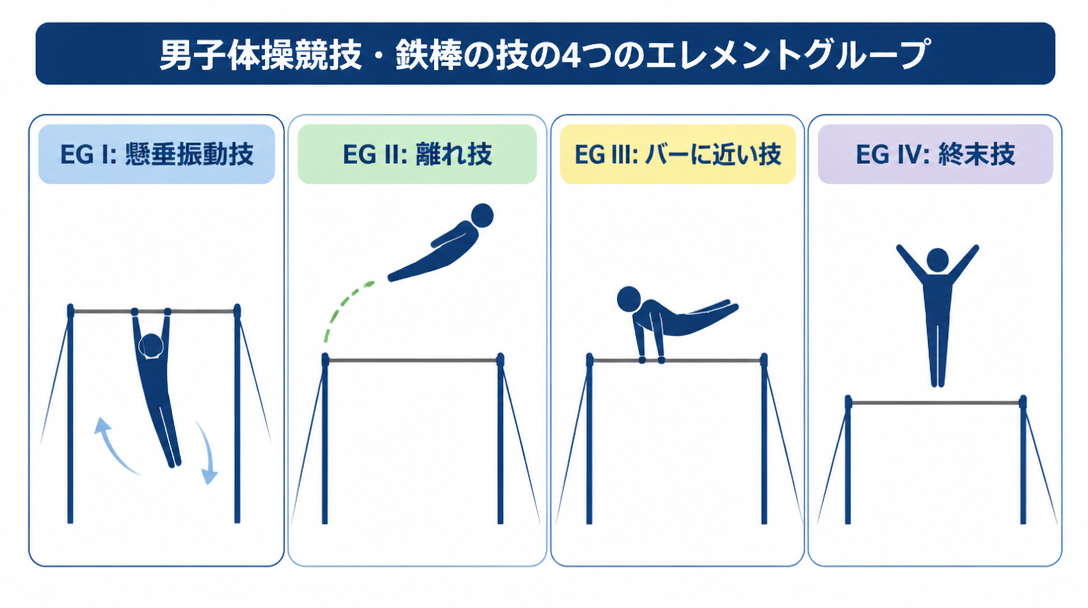
A men's high bar routine is built by selecting skills from four Element Groups (EG) defined in the Code of Points. According to the Wikipedia overview of the horizontal bar, these four groups are long hang swings (giants), flight elements, in-bar and Adler elements, and dismounts. To meet the composition requirements, a gymnast must include skills from each group.
Group | Content | Representative skills |
|---|---|---|
EG I | Long hang swings (giants) | Back giant, front giant, Quast, Rybalko |
EG II | Flight (release) elements | Tkachev, Kovacs, Jaeger, Markelov |
EG III | In-bar and Adler elements | Endo, Stalder, Adler |
EG IV | Dismounts | Double-double layout, etc. |
The key point: Endo and Adler belong to EG III (in-bar elements), while Markelov belongs to EG II (release elements). Despite the similar-sounding names, these skills come from entirely different families.
Giants Are the Foundation of Everything
Every high bar skill is built on the giant swing. According to The Gymnastics Authority, a back giant is a
full rotation from handstand, belly down toward the floor, performed in overgrip, while a front giant is done in undergrip. Adding turns produces the Quast (back giant with a full turn) and the Rybalko (back giant with 1.5 turns).
In-bar elements like the Endo and Adler compress the body close to the bar during that giant rotation, making them close relatives of the giant swing. That is why they are sometimes loosely lumped together as "giant-family" skills. The bar's dimensions (about 278 cm high, 2.8 cm in diameter) are defined in the FIG Apparatus Norms.
D-Score and E-Score Basics
A high bar score is the sum of the D-Score (difficulty) and the E-Score (execution). The eight highest-difficulty skills plus the dismount count toward the D-Score, and f
ulfilling each element group with a D-value skill awards 0.5 points. For the full scoring picture, see our guide to the basics of the Code of Points.
If you want to check the composition and difficulty values of a men's routine quickly, the Gymnastics AI D-Score calculator is a handy tool. It follows the FIG 2025–2028 Code of Points and includes a database of more than 790 skills, so you can verify the values of the Endo and Adler on the spot.
What Is the Endo? An In-Bar Element From Front Giants
Let's start with the flagship in-bar element, the Endo, which belongs to EG III.
Technique and Movement
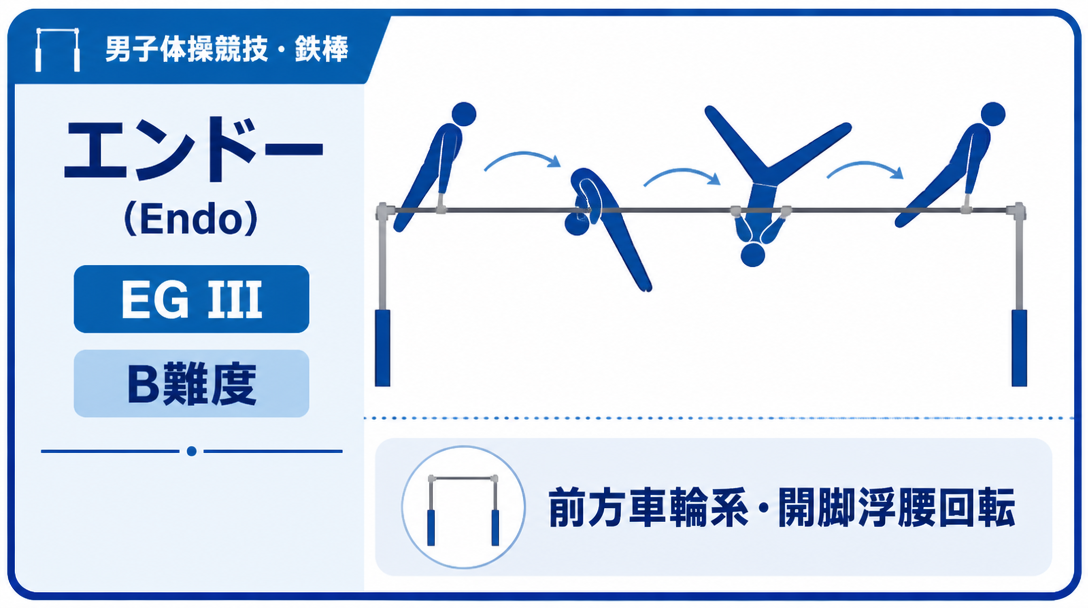
The Endo enters from a front giant, brings the hips close to the bar, and rotates in a compressed pike (straddled or closed) before returning to handstand. The guide cited above describes the Endo as a basket swing from front giants and rates it a B-value skill.
Throughout the rotation, the gymnast controls the shoulder angle and hip flexion, compressing the body as it passes beneath the bar. For recognition, the element must continue over the bar in the intended direction.
Named After Yukio Endo
The name "Endo" comes from the Japanese gymnast Yukio Endo, a star of the 1960s. When a skill is named after an athlete, it means that gymnast was the first to perform it successfully at an international competition and had it registered in the Code of Points. Japan has contributed many eponymous skills across the apparatus, reflecting its historical role in the sport.
Difficulty and Scoring
The Endo alone is a B-value skill, but adding turns or linking it into a dismount or release element raises the value of the whole routine. In-bar elements are less spectacular than releases, yet they shape a routine's flow and serve as launch points for connection bonuses. To experiment with how your composition affects the D-Score, try the Gymnastics AI, which calculates difficulty automatically as you select and arrange skills.
What Is the Adler? The German Giant
Next is the Adler, an element frequently confused with the Endo. It also sits in EG III, but its movement quality is very different.
Technique: The Hip Dislocation to Handstand
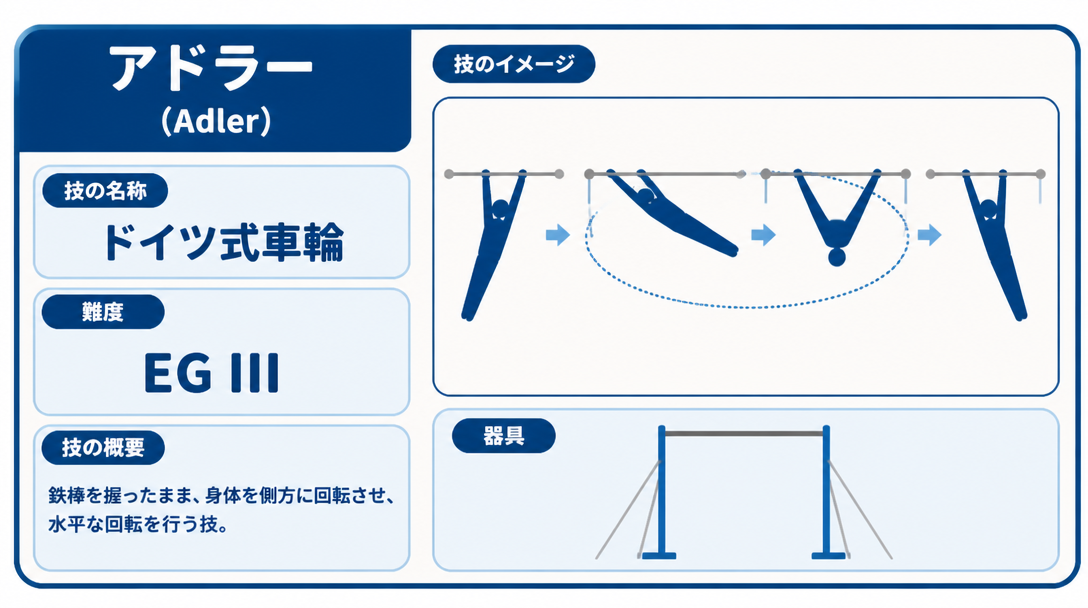
The Adler enters like a piked Endo, then drives the hips up and forward and "dislocates" the shoulders to shoot up to handstand. The Gymnastics Authority rates the Adler a C-value skill, placing it a notch above the Endo (B) and Stalder (B) within EG III. In German-speaking countries it is known as the German giant.
The technical heart of the Adler is using shoulder mobility to arch out of a back-facing position into handstand. The Gymnastics Coaching.com breakdown of German giants also notes how reaching a true handstand affects the evaluation.
Turns for Higher Value and Grip Changes
The basic Adler finishes in eagle grip (dorsal/el-grip), but adding a hop phase just before handstand, or inserting turns, upgrades the value from C to D while changing grip. Adler variants with turns bring varied grip work into a routine and expand connection options.
- Basic Adler: C-value, finishing in eagle grip
- Adler with turn to handstand: higher value via grip change
- Adler with a hop phase: upgraded from C to D
Relationship to the Koste
The Adler family includes more complex derivatives such as the Koste. According to the Gymnastics Coaching.com clarification above, the Koste is also a C-value element, and if the gymnast does not reach handstand it becomes a part of no value (though without deduction). In-bar elements share this trait: whether you reach handstand determines the value.
What Is the Markelov? A Forward Release Element
Now for a skill from a different family altogether: the Markelov, which belongs to EG II (release elements).
Movement and Classification
The Markelov releases the bar, performs a straddled forward flight (a straddled hecht), and regrasps the bar. The name comes from Soviet gymnast Vladimir Markelov, who showcased the skill in 1977. Whereas the Endo and Adler are in-bar elements performed close to the bar, the Markelov leaves the bar to create an aerial phase, making it fundamentally different in nature.
Relationship to the Jaeger
The Markelov is best understood as a relative of the Jaeger, a forward-flight release element. According to the Balance Beam Situation skill database, the straddled Jaeger is a forward salto that releases and regrasps the bar, and it is the most popular release on the uneven bars (a D-value skill). The Markelov and Jaeger share the forward-flight concept but differ in starting position and flight shape. For high bar releases in general, see our detailed guide to Tkachev, Kovacs and Rybalko release skills.
Why It Gets Confused With Giant-Family Skills
The Markelov is confused with the Endo and Adler because all three look like "rotational skills done on the bar." But the Code of Points draws a clear line: the Markelov is EG II (release), while the Endo and Adler are EG III (in-bar). Understanding this distinction is essential to reading difficulty values correctly. If you want to estimate the D-Score of a routine that includes a Markelov or an Adler, the Gymnastics AI lets you see intuitively how the group differences translate into points, calculating difficulty, group bonuses, and connection bonuses as you select skills.
Comparing the Three: Group, Difficulty, and Direction
Here is a summary of the differences between the Endo, Adler, and Markelov.
Differences in Element Group
The biggest difference is group membership. Endo and Adler are EG III (in-bar), while Markelov is EG II (release). Because a routine cannot satisfy the requirements with skills from a single group, gymnasts must draw from every group. For how the groups map to physical demands, read our overview of the six men's apparatus and the abilities they require.
Difficulty and Direction Compared
Skill | Group | Base value | Direction / feature |
|---|---|---|---|
Endo | EG III in-bar | B | Compresses from a front giant to handstand |
Stalder | EG III in-bar | B | Straddle compression from a back giant (opposite of Endo) |
Adler | EG III in-bar | C | Shoulder dislocation from back-facing to handstand |
Markelov | EG II release | Release family | Forward flight releasing the bar |
To add nuance, the Endo and Stalder form a pair defined by their entry: "from a front giant" versus "from a back giant." Closed-leg versions exist, but they differ in the lower-body action while passing beneath the bar.
Points That Are Easy to Confuse
- Endo vs. Stalder: opposite directions (front vs. back). Distinguish them by the entry rather than the name.
- Endo vs. Adler: both are in-bar, but the Adler arches out of a back-facing position via shoulder dislocation.
- Adler vs. Markelov: the Adler stays close to the bar, while the Markelov releases it, so they sit in different groups.
Changes in the 2025-2028 Code of Points
Scoring for these skills is shaped by the Code of Points, which is revised every four years. Here are the main changes in the 2025-2028 edition.
Loosened Pirouette Angle Deductions
According to the MAGnastics breakdown of the 2025-2028 changes, the deduction thresholds for turn angles at handstand were widened for mixed (L-grip) flying giants and Quast-type skills. In-bar elements such as the Adler and Stalder, however, retain the stricter standards. It helps to remember that in-bar elements are judged more strictly on whether the gymnast reaches a clean handstand.
Restructured Connection Bonuses
The same breakdown explains that flight-to-flight connection bonuses were restructured: the old "C + C or higher = 0.1" was eliminated in favor of rewarding D-value or higher elements. In addition, the value of connections linking EG I (giants) and EG III (in-bar) skills was expanded, making combinations like "Rybalko + Jaeger" more rewarding. Composition strategy is directly tied to understanding the rules; see also our guide to the judging system and the roles of the D-panel and E-panel.
Release Limits and Higher Values
Releases are capped in number: only two of Jaeger, Gienger, Markelov, or forward saltos combined; two Tkachev-type skills (including the Piatti); and two Kovacs-type skills. Non-Kovacs releases also received value increases, for example the Gaylord 1 rising from D to E. In composition, choosing which releases to use within these limits is a central strategic decision.
Summary
Using the giant-swing family as an anchor, we clarified the differences between the Endo, Adler, and Markelov. The key points:
- High bar skills fall into four Element Groups; Endo and Adler are EG III (in-bar), while Markelov is EG II (release).
- The Endo (B) enters from a front giant and the Stalder (B) from a back giant, forming a pair.
- The Adler (C) is the "German giant," arching from a back-facing position to handstand via shoulder dislocation.
- The Markelov is a forward release that lets go of the bar, best understood as a relative of the Jaeger.
- The 2025-2028 edition loosened pirouette angle deductions, restructured connections, and raised release values.
If you want to simulate the D-Score of a routine easily, give the Gymnastics AI a try. Just select and arrange skills to calculate difficulty, group bonuses, and connection bonuses automatically. It is free and available for iOS and Android.