Vault's Hardest Skills: Li Xiaopeng and Shewfelt Families
A group-by-group guide to men's vault: the forward Li Xiaopeng family, the roundoff Shewfelt family, and the hardest vaults under the 2025-2028 Code of Points.

In men's artistic gymnastics, vault is decided in a single explosive run: speed, block, and one brief flight phase set the entire difficulty (D-score). Vault's hardest skills split into families defined by how the gymnast enters the table — the forward handspring "Li Xiaopeng family," the roundoff-entry "Shewfelt family," and the Tsukahara lineage. This article organizes vault into five element groups and explains the construction, difficulty, and 2025–2028 Code of Points changes for the sport's toughest vaults.
If you want to check the D-score of any men's vault or routine quickly, Gymnastics AI — the D-score calculator follows the FIG 2025–2028 Code of Points and carries a database of 790+ skills.
The Five Element Groups Behind Vault Difficulty
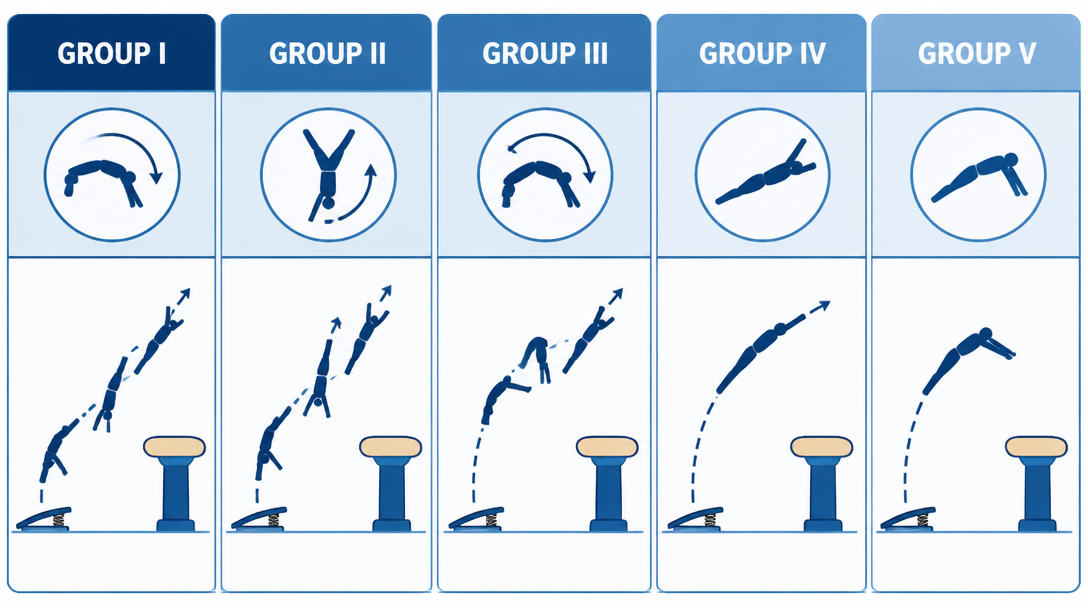
Why Vault Is Classified by Entry
Unlike the other five apparatus, vault is a single skill. Its difficulty depends on how the gymnast enters the table and how complex the salto and twists are afterward. As the overview of vault shows, the run, board, first flight phase, block, second flight phase, and landing form one chain — and the entry determines the element group.
Under the 2025–2028 rules the vaults were reorganized into five element groups. According to the 2025–2028 MAG Code of Points review, vault is grouped "into five element groups based on entry type and salto complexity."
Definitions of Groups I–V
Based on the breakdown of vault groups, Group I is single-salto-with-twist off handspring or Tsukahara entries, Group II is forward-handspring double saltos, Group III is Tsukahara double saltos, Group IV is roundoff (Yurchenko) entry single salto with twist, and Group V is roundoff-entry double saltos.
Group | Entry / salto | Representative vaults | |
|---|---|---|---|
Group I | Handspring / Tsukahara entry, single salto with twist | Lou Yun, Yeo 2, stretched Kasamatsu, Akopian | |
Group II | Forward handspring double saltos | Roche, Dragulescu, Blanik, Ri Se-gwang 2 | |
Group III | Tsukahara double saltos | Yeo, Lu Yufu, Ri Se-gwang | |
Group IV | Roundoff (Yurchenko) entry, single salto with twist | Shewfelt, Shirai / Kim Hee-hun | |
Group V | Roundoff entry double saltos | Melissanidis, Yang Wei |
Event Finals: Two Vaults From Different Groups
In vault event finals, two vaults are mandatory and, as the group rule states, each must belong to a different element group. Two vaults from the same family will not maximize the score, so preparing one forward-entry and one backward-entry vault is the standard strategy. See our guide to the six men's apparatus for how difficulty breaks down per event.
Forward-Entry Vaults: The Li Xiaopeng Family
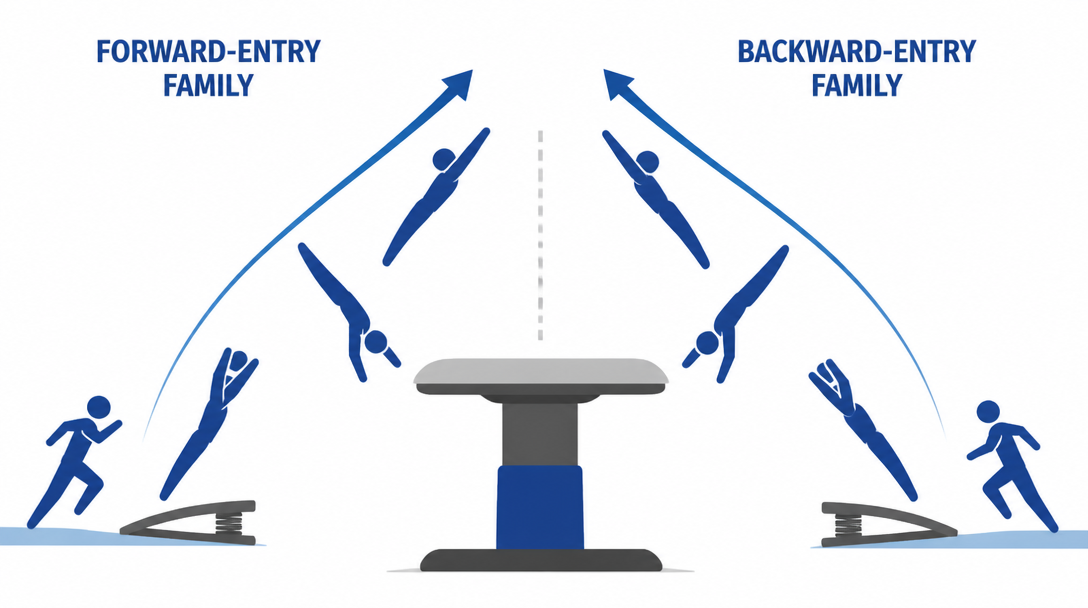
What the Handspring-Entry Family Is
Forward-entry vaults rotate the body forward after the hands leave the table. The Roche is a "handspring forward double salto tucked," named after Jorge Roche, who first completed it in 1980. Because forward doubles land facing the mat, the rotation is hard to track visually, making landing control difficult.
From the Roche, the family adds twists (Dragulescu) and stretched shapes (Ri Se-gwang 2). Limited sightlines mean these vaults demand both block height and rotational speed.
Li Xiaopeng: Construction and Difficulty
Per the list of gymnastics skills, the Li Xiaopeng is a forward stretched salto with 2.5 twists, valued at 5.4 under the previous rules. Twisting at speed while holding a stretched shape requires a rock-steady body axis. Note that the reference values here are from the pre-2024 rules; as explained below, the 2025–2028 code cut all vaults.
Relationship to Dragulescu and Yeo 2
The Dragulescu is a "Roche with ½ twist" (5.2 under the old rules) and the Yeo 2 is a handspring ½ turn to double back layout with two twists (also 5.2), per the skills list. Both are forward-entry developments in the same lineage as the Li Xiaopeng. For minimizing landing deductions, see our article on landing technique.
Backward-Entry Vaults: Shewfelt and the Roundoff Family
Characteristics of the Yurchenko (Roundoff) Entry
Backward-entry vaults enter the board from a roundoff and rotate backward. Entering back-first converts run energy into rotation efficiently, and backward saltos let the gymnast face the mat on landing — an advantage over forward entries. The basics of the Yurchenko and Tsukahara lines are covered in our vault difficulty comparison.
Shewfelt: Construction and Difficulty
According to the skills list, the Shewfelt is a "stretched Yurchenko with 2.5 twists," valued at 4.8 under the previous rules and classified in Group IV. Twisting fast in a stretched shape means the first flight phase must generate real height to succeed.
To test how a routine's D-score changes, try Gymnastics AI — line up skills and it computes vault values, difficulty, group bonuses, and connection bonuses automatically.
Group IV vs Group V
Group IV is a single salto with twist off the roundoff; Group V is a roundoff-entry double salto. Per the group breakdown, Group V includes double-salto vaults such as the Melissanidis and Yang Wei. Shewfelt earns difficulty via twists (Group IV), while Group V earns it via a second salto.
The World's Hardest Vaults: Yang Hak-seon and Ri Se-gwang
Yang Hak-seon (Peak of the Forward Family)
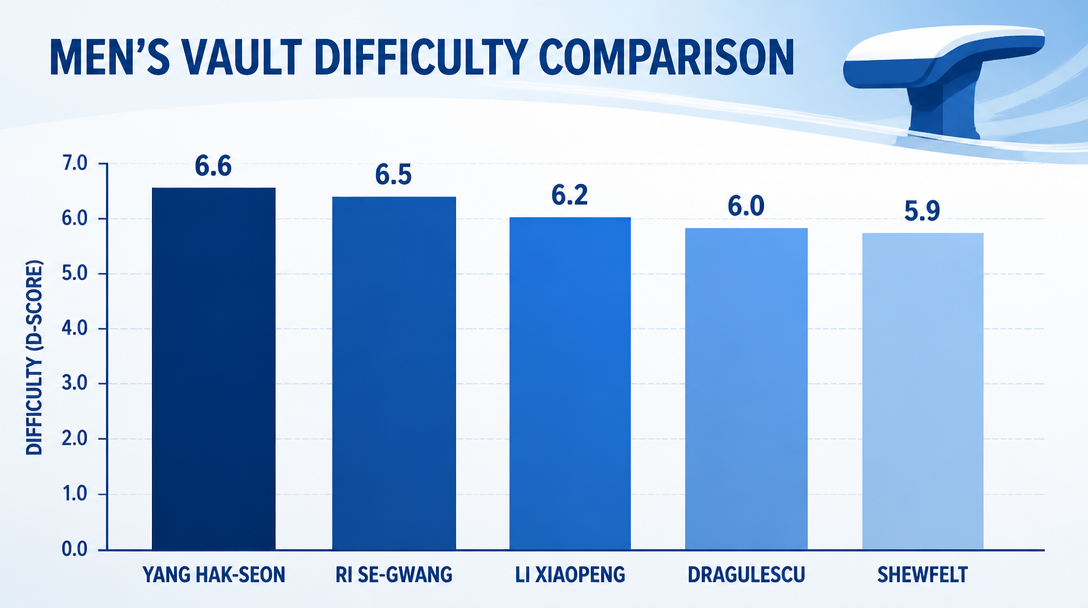
Per English Wikipedia, the Yang Hak-seon is a "front handspring layout triple twist," valued at 7.4 (2009–2012), 6.4 (2013–2016), and 6.0 (2017–2020) as difficulty was cut over time. It is arguably the summit of the forward family. Yang retired from competition in September 2025.
Ri Se-gwang II (Peak of the Tsukahara/Forward Lines)
According to English Wikipedia, Ri Se-gwang has two eponymous vaults: the "Ri Se-gwang," a full-twisting double tucked Tsukahara, and the "Ri Se-gwang II," a front handspring double piked salto with ½ twist (the "Dragulescu piked"). A roundup of the hardest men's vaults lists Ri Se-gwang, Ri Se-gwang II, Yang Hak-seon, and the Dragulescu piked among the most difficult.
Difficulty Cuts Under the 2025–2028 Rules
A major change in the 2025–2028 code is that vault values dropped by 0.4 across the board. Per the code review, this uniform cut made "the highest start value now 5.6," a new Tsukahara tucked 5/2 twist was added, and Yurchenko full-turn (Scherbo-type) vaults were removed. The summary of 2025 rule changes also codifies a large deduction for landing with the hips below the knees.
Vault | Family / description | Reference value (pre-2024) |
|---|---|---|
Yang Hak-seon | Handspring layout triple twist | 6.0 |
Ri Se-gwang | Tsukahara double back with full twist | 6.0 |
Li Xiaopeng | Forward stretched 2.5 twist | 5.4 |
Dragulescu | Roche with ½ twist | 5.2 |
Yeo 2 | Double back layout with 2 twists | 5.2 |
Shewfelt | Stretched Yurchenko 2.5 twist | 4.8 |
*Values are pre-2024 references. Under the 2025–2028 rules, vaults were cut 0.4 and the highest start value is 5.6. Check current values with the D-score calculator or the official code.
The Technique Behind the Hardest Vaults
First Flight Phase and Contact
Elite vaults are said to be decided in the first flight phase — from leaving the board to touching the table. Without height here, there is no time to complete the salto and twists after the block. Converting run speed into vertical height on the board is the foundation for both families.
Block and Second Flight Phase
The block off the table is the decisive moment that creates rotational power. Pushing hard off the table produces the height used for the salto and twists in the second flight phase. Forward vaults are hard to sight because they land facing the mat, while backward vaults land more predictably.
Preventing Landing Deductions
However hard the vault, a broken landing costs heavily on the E-score. Key points:
- Landing with hips below the knees is a large deduction (explicit in the 2025 rules)
- Each step on landing adds deductions
- Crossing the landing zone (line violations) is penalized
- For forward vaults, plan the "opening" point in advance since landing is blind
Scoring: D-Score and Risk Management
Vault D-Score Equals the Skill Value
Unlike other events, vault's D-score is simply the value of the single skill performed. So which group and which hard vault you choose determines the score. For the core idea of D-scores across events, see our floor D-score calculation article.
E-Score and Landing Deductions
The final score is D plus E (deductions from 10). With a short flight and one attempt, arches, bends, under-rotation, and off landings hit the E-score instantly. The roles of the D and E panels are covered in our judging system article.
Event-Final Strategy: Average of Two Vaults
Event finals rank by the average of two vaults from different groups. The standard is a maximum-difficulty first vault and a safer second from another family — a risk-reward design that decides medals. That is why most finalists prepare one forward and one backward vault.
Summary
Vault's hardest skills split by entry, and each family has its own technical challenge. Key points:
- Vaults are classified into five groups by entry and salto complexity
- Forward family (Li Xiaopeng, Dragulescu, Yeo 2) enters via handspring with blind landings
- Backward family (Shewfelt) enters via roundoff with easier landings
- Yang Hak-seon and Ri Se-gwang II sit at the world's highest difficulty
- The 2025–2028 rules cut vault values 0.4, capping start value at 5.6
- Event finals are decided by the average of two vaults from different groups
To simulate a routine's D-score easily, try Gymnastics AI — it covers all six men's events and is free on iOS/Android.