Rings Swing Elements vs Backward Salto Skills: Scoring Guide
A clear guide to still rings swing elements and backward salto skills: giant swings, Yamawaki, Honma, double-back dismounts and the 2025 FIG D-score rules.
On the still rings, swing elements are dynamic skills in which the gymnast swings the body across two motionless rings and links the motion into saltos or handstands. Backward salto skills in particular appear both as swing elements and as dismounts, and they weigh heavily on the D-score. This article compares rings swing elements and backward salto skills from three angles—how they are classified, how they are rated for difficulty, and how they are scored—all based on the FIG Code of Points. For the apparatus itself, see the overview of the still rings.
What Are Rings Swing Elements? Their Place in the Four Element Groups
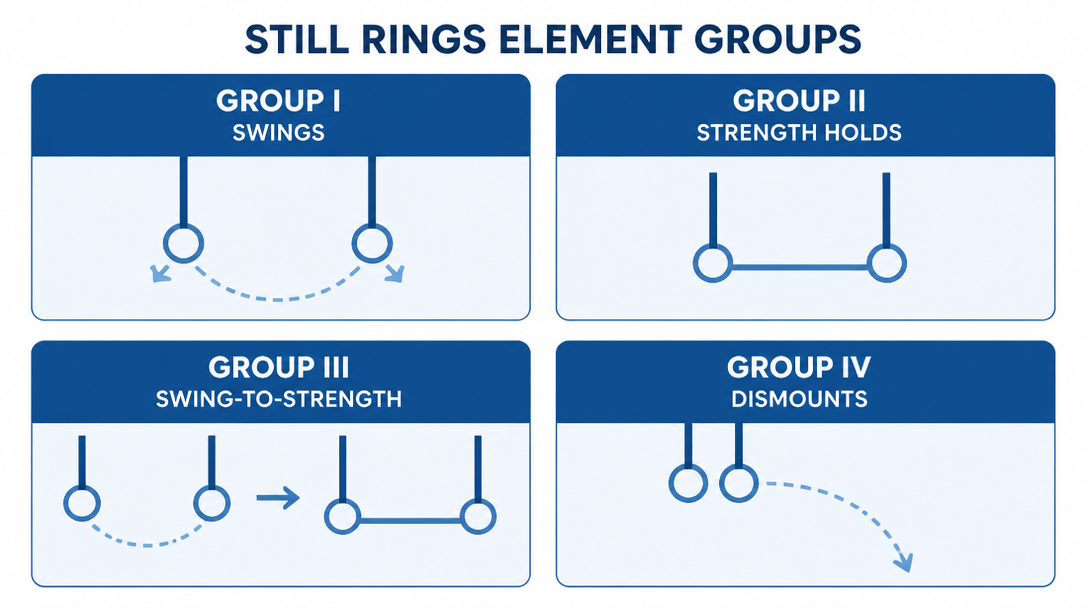
A rings routine is built from a mix of strength (hold) elements and swing elements. To understand swing elements properly, you first need to see how the apparatus as a whole is organized into element groups.
The Four Groups That Make Up Rings Skills
According to the English Wikipedia overview, rings skills are sorted into four element groups (EG), and a competitive routine is required to draw skills from each of them.
Group | Name | Contents |
|---|---|---|
Group I | Swings and swings to handstand | Giant swings, Yamawaki, Honma and other skills swung while gripping the rings |
Group II | Strength holds | Iron cross, planche and other elements held still for two seconds |
Group III | Swings to strength holds | Elements that move from a swing into a static hold position |
Group IV | Dismounts | Finishing elements that land out of a salto |
Strength elements are covered in detail in Strength Skills on Rings: Scoring Criteria for the Iron Cross and Planche. This article concentrates on the Group I swing elements and the backward salto skills that center on Group IV.
The Role of Swing Elements (Group I)
The Group I swing elements and swings to handstand form the backbone of a routine. In The Gymnastics Authority's explanation, Group I is defined as skills that swing from a hanging position, and it includes giant swings that rise to handstand as well as Yamawaki-type skills that look like double somersaults. These elements link the sections before and after the strength holds and dictate the rhythm of the entire routine.
If you simply want to check a routine's composition or its difficulty value, the Gymnastics AI D-score calculator is a handy option. It follows the FIG 2025–2028 Code of Points and is loaded with a database of more than 790 skills, so you can estimate a D-score just by picking the rings swing elements and dismount you have in mind.
Where Backward Salto Skills Fit In
Backward salto skills show up in two broad roles. One is as a swing element (Group I) that finishes back in a hang, such as the backward double salto to hang (the O'Neill); the other is as a dismount (Group IV) that ends the routine by landing. Even for the same backward salto, the meaning for scoring changes depending on which group the skill is performed as.
When the skill is performed as a swing element, the test is the control needed to regrip the rings after the salto and return to a hang or support. When it is performed as a dismount, the salto flows straight into the landing, so air shape and landing control become the focus of the evaluation. The same technical element demands different abilities depending on “where it is used,” and this is one of the factors that makes rings routine construction so difficult.
Representative Swing Elements and Their Difficulty: Giant Swing, Yamawaki, Honma
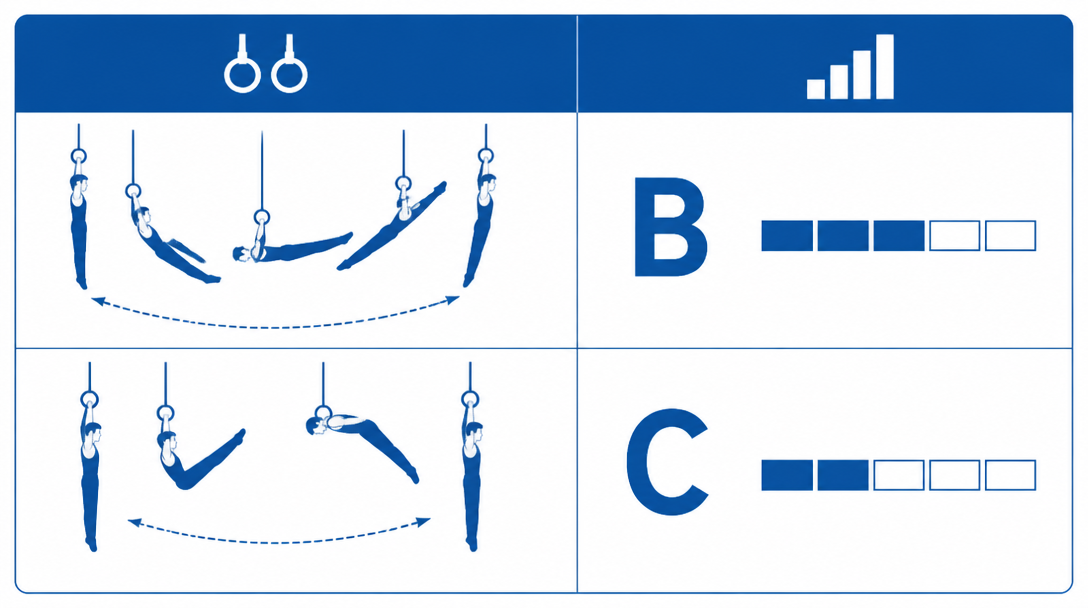
Here we take up the most representative swing elements—the giant swing, the Yamawaki and the Honma—and sort out how difficulty changes with body position.
Giant Swings (Forward and Backward) and Swings to Handstand
The giant swing is the fundamental swing element in which the body makes one large rotation while gripping the rings and arrives at a handstand. According to The Gymnastics Authority's rings guide, both the backward and the forward giant swing are rated C, while a giant swing that passes through the handstand without stopping is rated B. Handstand-oriented skills are important as the base that satisfies Group I, and they are woven in throughout a routine.
Yamawaki and Jonasson (Forward Double Salto to Hang)
The Yamawaki is a swing element that goes from a forward tucked double salto back to a hang, and it carries the name of the Japanese gymnast who originated it. According to The King of Gymnastics' summary of the 2025 changes, the Yamawaki was lowered from C to B in the 2025 edition. The Jonasson, performed in a piked or stretched position, was likewise dropped one step from D to C.
In addition, a rule was introduced so that if a Yamawaki or piked Yamawaki is linked directly into a swing-to-handstand element, those skills are upgraded by one level. Value changes not only with body position but also with “how you connect into the next skill,” and that is where the depth of rings swing elements lies.
Honma Support and Difficulty Differences by Position
Whereas the Yamawaki ends in a hang, a skill that ends in support (an arm support on top of the rings) is called the Honma. According to the guide cited above, the Honma to support is rated B in the piked position and C in the stretched position, and the pattern that difficulty rises as the body is extended holds consistently. The difficulty values of the swing elements can be summarized in the table below.
Skill | Description | Difficulty (2025 edition) |
|---|---|---|
Giant swing (through handstand) | Passes through handstand without stopping | B |
Backward / forward giant swing | Held still in handstand | C |
Yamawaki | Forward tucked double salto to hang | B (formerly C) |
Jonasson | Forward piked / stretched double salto to hang | C (formerly D) |
Honma to support (piked) | Forward double salto to support | B |
Honma to support (stretched) | Forward double salto to support | C |
For the broader picture of each skill's difficulty and the characteristics of the apparatus, reading The Six Men's Gymnastics Events and the Physical Abilities They Require alongside this article will deepen your understanding.
Backward Salto Skills: Difficulty and Types—Hang Variations and Dismounts
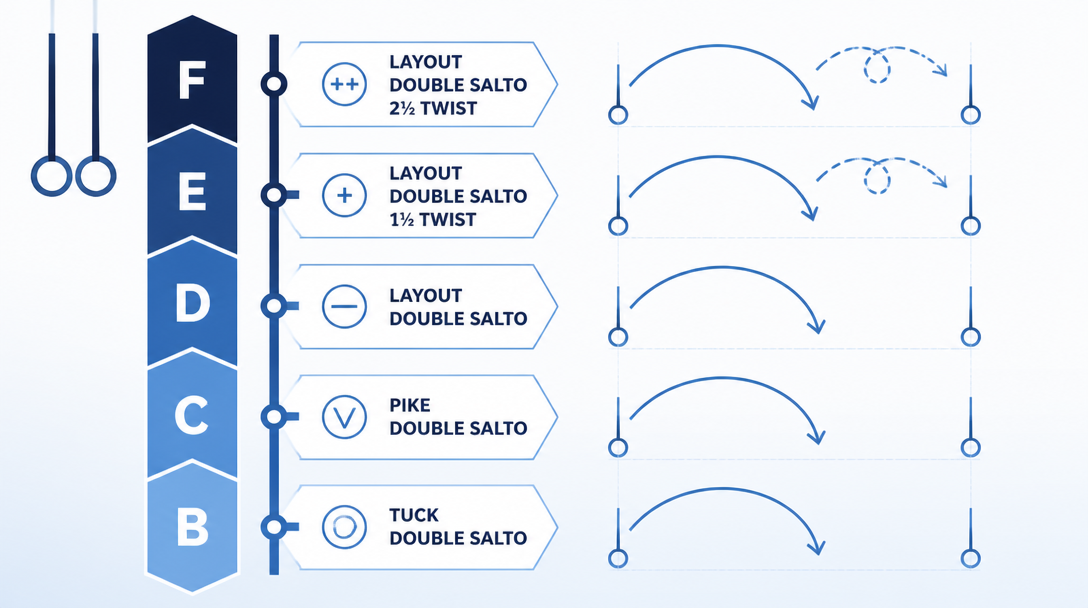
Next we sort the backward salto skills from the standpoint of difficulty. They form a group that mirrors the forward Yamawaki family, with difficulty rising step by step according to body position and the number of twists.
The O'Neill (Backward Double Salto to Hang)
A skill that returns to a hang from a backward piked or backward stretched double salto is called the O'Neill. According to the 2025 rings changes cited earlier, the O'Neill (backward piked double salto to hang / backward stretched double salto to hang) was lowered from E to D. Just like the forward-oriented Yamawaki and Jonasson, the backward hang skills have had their difficulty values reviewed across the board.
How Difficulty Rises with Position and Twists
The difficulty of backward salto skills is set by body position (tucked → piked → stretched) and the number of twists. As The Gymnastics Authority points out, salto difficulty does not rise in a straight line each time you add a rotation or twist; the harder the skill, the larger the jump in value tends to be. On rings too, difficulty climbs sharply as you adopt a stretched position or add multiple twists.
If you would like to try out how the D-score changes in an actual routine, Gymnastics AI is recommended. Simply choosing and arranging skills lets it automatically calculate difficulty value, group bonus and dismount bonus, so the difference made by swapping backward salto skills in and out is visible at a glance.
Scoring Comparison: Swing Elements vs Backward Salto Skills
Comparing the forward Yamawaki family (swing elements) with the backward salto skills, even the same “double salto” plays a different role. Forward skills end in a hang or support and tend to become connecting elements in the middle of a routine, whereas backward skills are often used as dismounts that land, so the quality of the landing feeds directly into the E-score evaluation. For the deduction criteria on landings, see Landing Technique in Gymnastics and How to Avoid Deductions.
As a scoring comparison, forward swing elements are centered on B–C difficulty and lean toward the role of “satisfying Group I while building the flow of the routine,” while backward skills can be pushed to D or above as dismounts, so they lean toward “earning difficulty value and group bonus at the same time.” Rather than leaning on one side only, the balanced design that modern rings emphasizes is to build the flow of the composition with forward skills and stack up points with backward skills.
Rings Dismounts: The Double-Back and Its Advanced Variations
Backward salto skills are at their most active as dismounts (Group IV). Here we sort out the difficulty of the basic forms and the advanced variations.
The Basic Backward Double Salto (Tucked, Piked, Stretched)
According to a guide to rings dismounts, the backward double salto is rated B in both the tucked and the piked positions, and it rises to C in the stretched position. Because control in the air becomes harder the more the body is extended, the stretched version is rated higher.
High-Difficulty Dismounts with Added Twists, Such as the Tsukahara
Adding twists raises the difficulty further. Taking the guide above together with The Gymnastics Authority's explanation, the difficulty of adding twists to a backward double salto can be organized as follows.
Dismount | Position / twists | Difficulty |
|---|---|---|
Backward tucked double salto | Tucked | B |
Backward piked double salto | Piked | B |
Backward stretched double salto | Stretched | C |
Shingetsumen | Tucked double salto with two twists | E |
Backward stretched double salto with one twist | Stretched + 1 twist | D |
Backward stretched double salto with two twists | Stretched + 2 twists | F |
The “Shingetsumen” is the common name for a tucked double salto with two twists, and it is introduced as a representative E-difficulty dismount in a guide to calculating the rings D-score as well.
How Dismounts Affect the Group Bonus
Dismounts are not simply skills for racking up difficulty value. According to the dismount guide cited above, the dismounts on pommel horse, rings, parallel bars and horizontal bar award the same number of points as their difficulty value toward the “Group IV: dismount” group bonus. In other words, the harder the backward salto dismount you perform, the more both your difficulty value and your group bonus increase—a double benefit.
How the Rings D-Score Is Calculated: Eight-Element Routines and the 2025 Changes
Let us organize the mechanism of the calculation to see how swing elements and backward salto skills are reflected in the D-score.
The Sum of Difficulty Value and Group Bonus
The rings D-score is broadly made up of “the sum of the difficulty values” and the “group bonus.” The example in a guide to calculating the D-score shows the flow in which the difficulty values and the special requirements (group bonus) are added together to determine the D-score. Incorporating swing elements, strength holds and dismounts in good balance is the prerequisite for a high score. For the fundamentals of the D-score as a whole, see The Basics of the Code of Points.
In the 2025 Edition, Eight Skills Are Counted
According to a guide to the rules changed from 2025, the number of skills counted toward the D-score was reduced from the former ten to eight. The breakdown is “the seven highest-difficulty skills plus the dismount,” for eight in total. In addition, the maximum number of counting skills from the same group was changed to four (down from five). Because the number of skills has been narrowed, the difficulty choice for each individual skill now matters more.
Difficulty Requirements for the Group Bonus (0.50 / 0.30)
The 2025 edition introduced difficulty requirements for awarding the group bonus. According to the guide cited above, when a group is satisfied with a skill of D difficulty or higher, it is worth 0.50 points, and when it is satisfied with only A–C difficulty skills, it is worth 0.30 points. As an exception, however, Group I of every apparatus (the swing elements on rings) is awarded 0.50 points no matter what difficulty satisfies it. Thanks to this exception, swing elements work in your favor on the group-bonus side.
- Group satisfied with D difficulty or higher: 0.50 points
- Group satisfied with only A–C difficulty: 0.30 points
- Exception: Group I of every apparatus earns 0.50 points regardless of difficulty
Main Changes in the 2025 Code of Points
Finally, let us summarize the main 2025 changes that bear on rings swing elements and backward salto skills.
Difficulty Downgrades for the Yamawaki and Jonasson
According to the 2025 changes cited earlier, the Yamawaki was lowered from C to B and the Jonasson from D to C. In today's routines, which have grown ever more difficult, these are now positioned as “fundamental skills,” and their value has been relatively lowered.
The O'Neill's Difficulty Change and Upgrades to Swings to Handstand
While the backward O'Neill was also lowered from E to D, a rule was added so that linking a Yamawaki or piked Yamawaki directly into a swing-to-handstand element upgrades it by one level. Even though the value of a single skill has gone down, the design lets you recover value through the way you connect skills together.
Strength Limits and Their Effect on Routine Construction
As touched on in the Wikipedia entry on rings, every rule revision has tightened the limits on hold and strength elements. Because performing strength elements in succession requires inserting a swing element of B difficulty or higher in between, the balance between swing elements and strength elements becomes the key to the composition. For the thinking behind the Composition Requirements (CR), please also see What Are the Composition Requirements (CR)?
Summary
On rings, swing elements and backward salto skills change in difficulty in fine gradations according to body position, twists and connections, and they are a central element in building a D-score. Let us pull the key points together.
- Rings skills are classified from Group I (swing elements) through Group IV (dismounts), and swing elements form the backbone of a routine.
- The Yamawaki (B), Jonasson (C) and Honma (piked B / stretched C) are representative forward swing elements.
- Backward salto skills appear frequently as the O'Neill (to hang, D) and the backward double salto (stretched C) dismount, and difficulty rises with twists.
- A dismount adds the same number of points as its difficulty value to the group bonus as well.
- In the 2025 edition the D-score counts eight skills, and difficulty requirements (0.50 / 0.30) were introduced for the group bonus.
If you want to simulate a routine's D-score easily, do try Gymnastics AI. Just by choosing swing elements and dismounts from a database of more than 790 skills, it automatically calculates difficulty value, group bonus and dismount bonus. It supports iOS and Android and is free to use.