US Men's Qualifier 2026: Nedoroscik's Pommel D-Score Strategy
A D-score breakdown of the 2026 U.S. Men's Qualifier: Nedoroscik's pommel specialism, Wiskus' all-around win, and what it signals for Rotterdam Worlds.
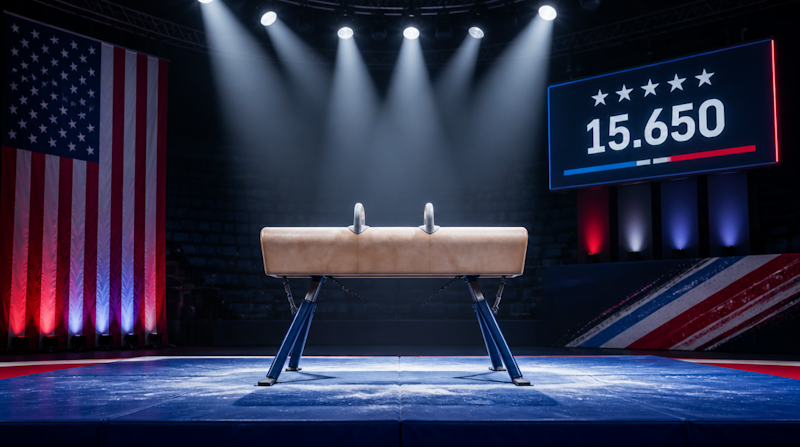
On June 29, 2026, the U.S. Men's National Qualifier was held at the Olympic and Paralympic Training Center in Colorado Springs. Paris Olympic pommel horse bronze medalist Stephen Nedoroscik pulled clear of the field on pommel horse, while Tokyo Olympian Shane Wiskus won the all-around. This article analyzes the results of that qualifier through the lens of the D-score (difficulty value) and reads what they tell us about the U.S. men heading into the Rotterdam World Championships in October.
Note: this article reflects information available as of July 12, 2026. All scores are based on the official USA Gymnastics results.
Overview of the 2026 U.S. Men's Qualifier
When, where, and what happened
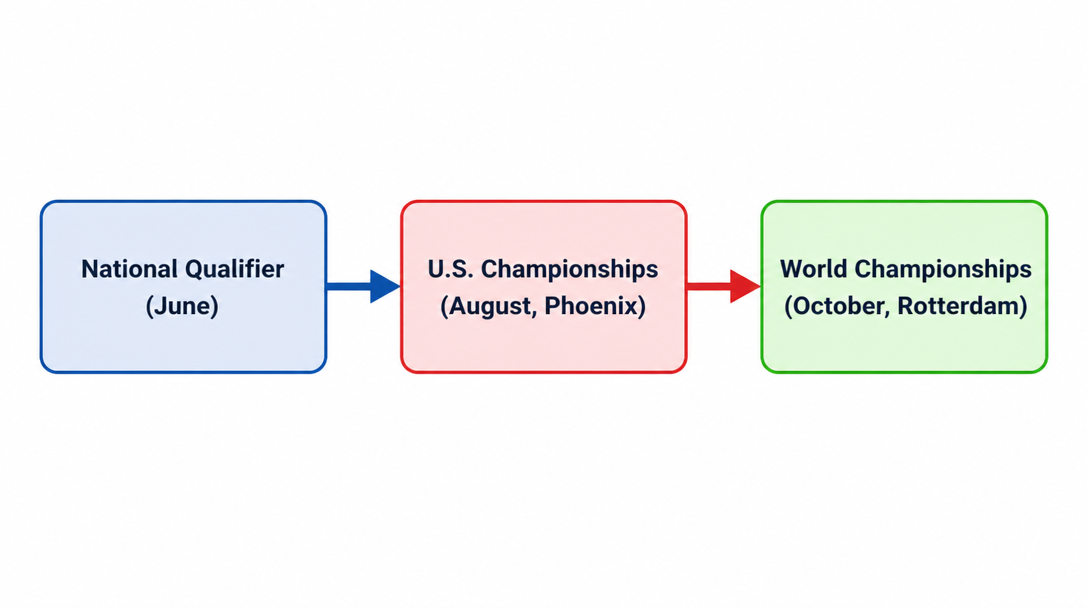
The meet took place on Saturday, June 29, 2026, at the USOPTC (U.S. Olympic and Paralympic Training Center) in Colorado Springs. Its role was that of a final selection event: the last chance to earn a spot at the Xfinity U.S. Gymnastics Championships held in Phoenix in August. A gymnast who fails to get through this qualifier cannot stand on the Nationals stage, and therefore cannot enter the fight for a World Championships team spot that lies beyond it.
In the end, a combined total of 19 athletes—15 seniors and 4 juniors—punched their tickets to the U.S. Championships. The event drew particular attention for two contrasting figures: Wiskus, who ran away with the all-around by a wide margin, and Nedoroscik, who carved out the top score by specializing in a single apparatus, the pommel horse.
Why this meet matters
In recent years the U.S. men have been lifted by young all-around talents such as Frederick Richard and Asher Hong, and they won team bronze at the Paris Olympics. The race for World Championships selection begins in earnest from here. This qualifier at the end of June is the entry point to a multi-stage process that runs from qualifier to Nationals to final team selection.
If you want a quick way to check routine composition and difficulty value, the Gymnastics AI D-Score Calculator is a handy tool. It follows the FIG 2025–2028 Code of Points and carries a database of more than 790 skills. Simply line up the elements of a pommel horse or floor routine and you can see how the D-score of that composition builds up.
How All-Around Champion Wiskus Competed
What the number 84.157 really means
Wiskus posted 84.157 points in the all-around (bonus included) and won by a margin of more than four points over second place. Second was Stanford's Nicolas Kuebler with 80.202, and third was Hasan Aydodu with 78.905. The fact that only Wiskus and Kuebler cleared the 80-point mark speaks volumes about how solid Wiskus was at this meet.
Wiskus placed in the top five on all six events and also took event titles on parallel bars (14.805) and floor exercise (13.950). For an all-arounder, what matters is not one standout apparatus but six events with no holes in them. Wiskus' result is the very model of that ideal.
The qualifier results at a glance
Category / Event | Gymnast | Score |
|---|---|---|
Senior AA 1st | Shane Wiskus | 84.157 |
Senior AA 2nd | Nicolas Kuebler | 80.202 |
Senior AA 3rd | Hasan Aydodu | 78.905 |
Pommel Horse 1st | Stephen Nedoroscik | 14.300 |
Parallel Bars 1st | Shane Wiskus | 14.805 |
Floor Exercise 1st | Shane Wiskus | 13.950 |
Junior AA 1st | Nixon Miles | 75.509 |
The figures are based on reporting from USA Gymnastics and Gymnastics Now. An all-around total is the sum of the D-score and E-score (execution score) on each of the six events. Once you understand how difficulty and errors accumulate, it becomes clear why these totals land where they do. The basics of scoring are explained in detail in our article on the fundamentals of the Code of Points.
Nedoroscik's Pommel Horse Specialist Strategy
The choice to stake everything on one event
Nedoroscik recorded 14.300 on pommel horse and stood at the top of the apparatus. In high school he realized that pommel horse was the only event in which he was truly improving, and he chose the path of specializing in it alone (Wikipedia). In 2021 he became the first and only American ever to win a world title on pommel horse, and during his time at Penn State he was also an NCAA pommel horse champion.
This "single-event specialization" strategy is tightly bound to the format of team competition. The team finals at the World Championships and Olympics use a four-up, three-count (4-3-3) system in which four gymnasts perform and the top three scores count. By adding to the roster not only all-around types but a specialist who can reliably deliver a high score on one apparatus, a team can prop up its score on that event. The U.S. team bronze in Paris owed a great deal to exactly this—the presence of Nedoroscik.
How a pommel horse D-score is built
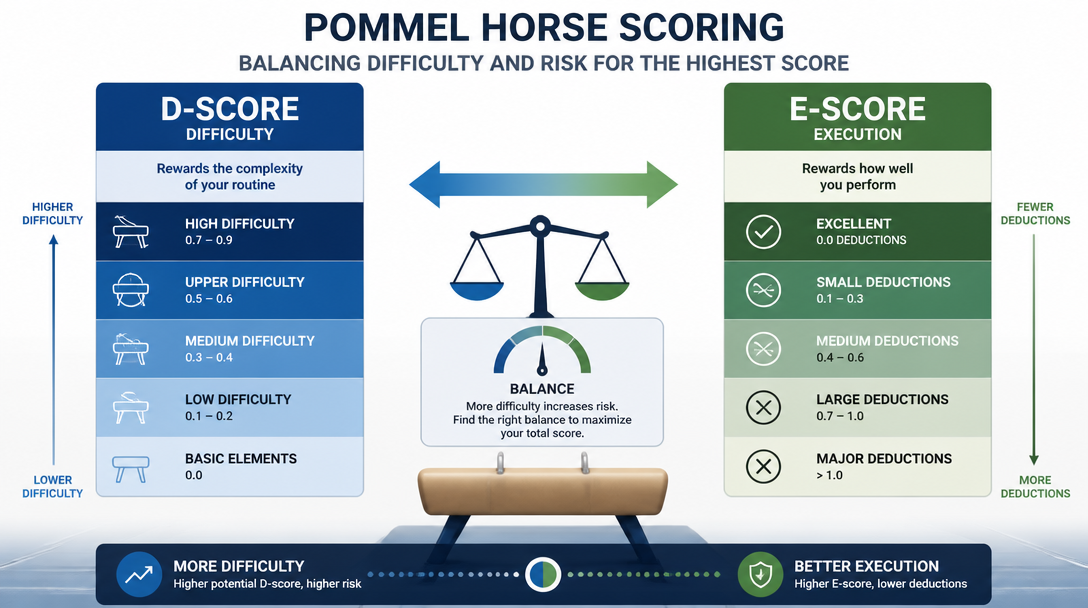
A pommel horse D-score is assembled by stacking the difficulty values of elements such as circles, travels, and spindles, then adding element-group requirements (EG) and the bonus for the dismount. In the Paris Olympic apparatus final, Nedoroscik performed a routine with a D-score of 6.4, and an exceptionally high E-score on top of that produced a mark of 15.300 (ESPN). For reference, in the same final Max Whitlock of Great Britain attempted an even higher difficulty with a D-score of 6.9, but took deductions for breaks in form.
Here the essence of the pommel horse as an event comes through. Raising the D-score lifts the theoretical ceiling, but pommel horse is an apparatus where the slightest wobble in a string of circles translates immediately into a deduction. Nedoroscik's strength lies in a deliberate "balance design between difficulty and risk": rather than chasing the very highest difficulty, he builds a routine he can finish cleanly and draws out a high E-score. His 14.300 at the qualifier can be read as a number that sits on the same line of thinking.
If you would like to try how the D-score changes with an actual routine, we recommend Gymnastics AI. Just select and arrange pommel horse elements and it automatically calculates difficulty values, group bonuses, and dismount bonuses. For the detailed mechanics of circle work, see our article on pommel horse circle technique and the basics of the Roth and Stockli, and for high-difficulty elements such as flops and Scissors, see flops and Scissors on pommel horse.
Reading the Qualifier Through a D-Score Lens
The meaning of holding down the D-score in qualifying
At selection events and qualifiers there is no need to throw out your maximum-difficulty competition routine. Since the goal is to get through reliably, many gymnasts choose a composition that dials the D-score down a little and lowers the risk of a mistake. Both Wiskus' 13.950 on floor and Nedoroscik's 14.300 on pommel horse may well be numbers that leave something in reserve for a peak later in the season.
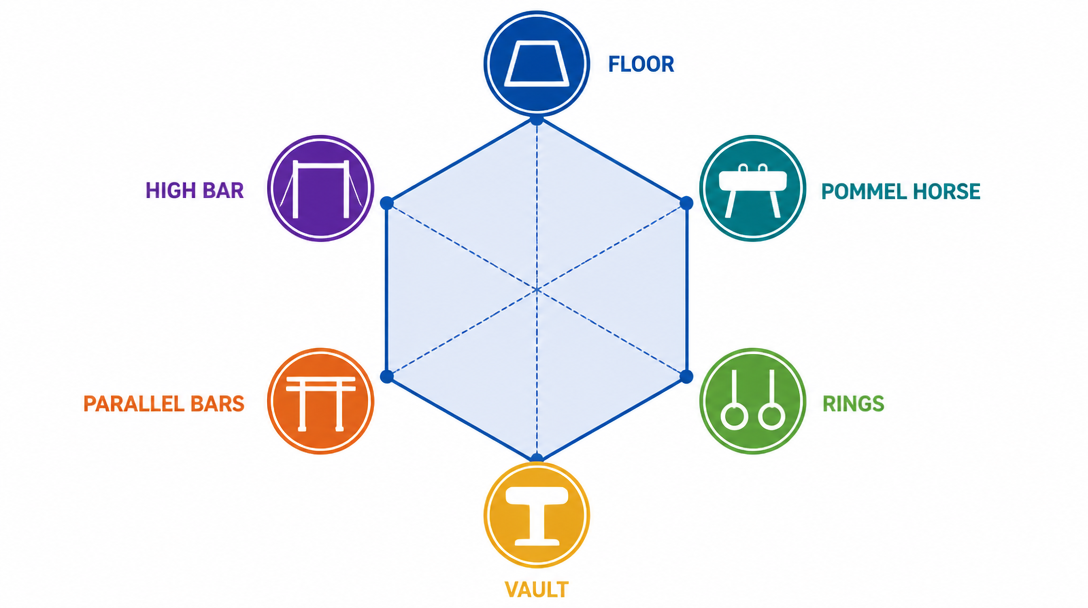
The idea of peaking—tuning your form to hit a target competition—is a key to reading these selection processes. How a gymnast raises or lowers the difficulty of a routine from meet to meet is a strategy in itself. Related thoughts on this kind of adjustment are also touched on in the characteristics of the six men's events and the physical abilities they require.
All-arounders versus specialists
When thinking about the strength of the U.S. men, gymnasts broadly split into two types. They can be organized as follows.
- All-arounders (all-round type): perform all six events at a high level. In team competition they can contribute on multiple apparatus and can also aim for an individual all-around medal. Examples include Wiskus, Richard, and Hong.
- Specialists (single-event type): deliver a world-class score on a specific apparatus. In team competition they lift the score on that event. Nedoroscik (pommel horse) is the classic case.
Building a team roster is a puzzle of how to combine these two types. Do you line up all-arounders for stability, or bring in a specialist to make a stand on a particular event? At the World Championships, how you fill the five-person team changes the whole approach to the competition. The thinking behind Japan's roster is explained in the 2026 World Championships men's Japan team: a five-man lineup and D-score outlook.
The difference between the U.S. and Japanese selection processes
The U.S. is characterized by a multi-stage and open selection running from qualifier to Nationals to selection trials. It is a system in which anyone can climb up from the qualifier, leaving the door open even to a specialist like Nedoroscik. Japan, by contrast, tends to run a selection centered on the All-Japan Championships and the NHK Cup, with an emphasis on all-around ability. The Japanese men's team of five, including Daiki Hashimoto and Shinnosuke Oka, has already been confirmed (Gymnastics Now).
Outlook Toward the 2026 Rotterdam World Championships
The next step is Nationals in August
The gymnasts who got through the qualifier advance to the Xfinity U.S. Gymnastics Championships, held August 6–9, 2026, in Phoenix, Arizona (at the Mortgage Matchup Center). On the men's side, the headline is said to be the clash between defending U.S. champion Asher Hong and Olympic and World team bronze medalist Frederick Richard—two 22-year-olds. The host-city details were announced by USA Gymnastics.
The World Championships come to Rotterdam in October
The 2026 World Artistic Gymnastics Championships will be held October 17–25 at Ahoy in Rotterdam, the Netherlands (official event site, Wikipedia). The primary source for the Code of Points can be checked on the official site of the International Gymnastics Federation (FIG). What kind of team the U.S. sends, and whether Nedoroscik's pommel horse once again plays the role of propping up the team score, will be the focus of this summer's selection.
Points Japanese fans should watch
For Japanese gymnastics fans, the movements of the U.S. men are far from irrelevant. They are a direct rival that competes with Japan for medals in the team event, the individual all-around, and the apparatus finals. Pommel horse in particular is one of the key events in which Japan contends with the world, and Nedoroscik's composition and score serve as a yardstick for measuring the target line of Japanese gymnasts. By following overseas selection events through a D-score lens, you should be able to enjoy the October World Championships on a deeper level.
Summary
The U.S. men's qualifier at the end of June 2026 became the starting point of the American men's campaign toward the Rotterdam World Championships in October. The key points are as follows.
- On June 29, 2026, the U.S. men's qualifier was held in Colorado Springs, and 15 seniors and 4 juniors earned spots at the U.S. Championships.
- Wiskus dominated the all-around with 84.157 points, taking event titles on parallel bars and floor. He showed the stability of a top-five finish on all six events.
- Nedoroscik topped pommel horse with 14.300. His hallmark is a single-event specialist strategy and a deliberate balance design between difficulty and risk.
- In team competition, the combination of all-arounders and specialists is the key. Next comes the Phoenix Nationals in August, and then the Rotterdam World Championships in October.
If you would like to easily simulate the D-score of a routine composition, please try Gymnastics AI. It follows the FIG 2025–2028 Code of Points, works on iOS and Android, and is free to use.