Gymnastics Floor Music Copyright: Can You Use Commercial Songs?
Can gymnasts use commercial songs for women's floor routines? Learn how copyright and master rights differ, and why custom music is the safest choice.
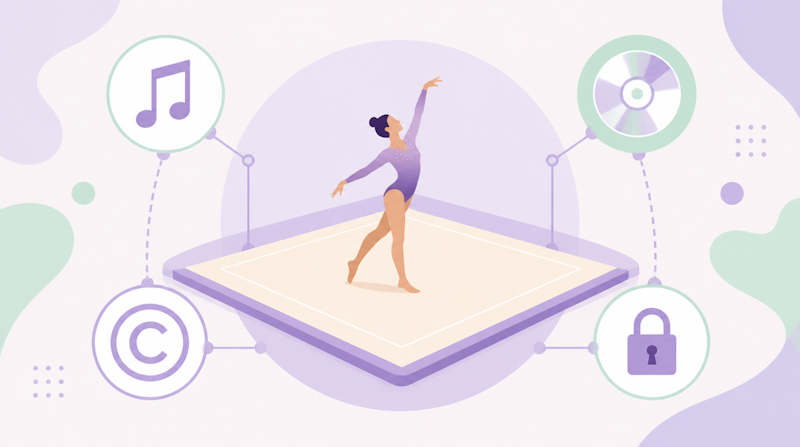
Can you use your favourite pop song for a women's artistic gymnastics floor routine? The first thing to check is floor music copyright. Many gymnasts assume that "paying a licensing fee makes any song fine," but in reality several separate rights are involved—including the master recording rights held by a record label—and whether a commercial song can be used at a competition depends on the situation. This guide explains, for female floor gymnasts, parents and coaches, how copyright works when using commercial music, what FIG's floor rules require, and why custom competition music is often the safest choice.
Floor Music Copyright: The Basics
Is Music Required in Women's Floor Exercise?
The women's floor exercise is performed to music over roughly 90 seconds. According to this 2025–2028 women's floor rules overview, performing without music results in a 1.0-point deduction. Music is therefore not optional decoration—it is a core part of how the routine is judged, which is exactly why song selection and editing are inseparable from copyright.
The music sets the mood, rhythm and dynamics of the routine, and how well movement matches the music affects the artistry score. Using an existing hit song "as is," however, runs straight into the rights issues explained below.
Copyright and Master Recording Rights Are Two Different Things
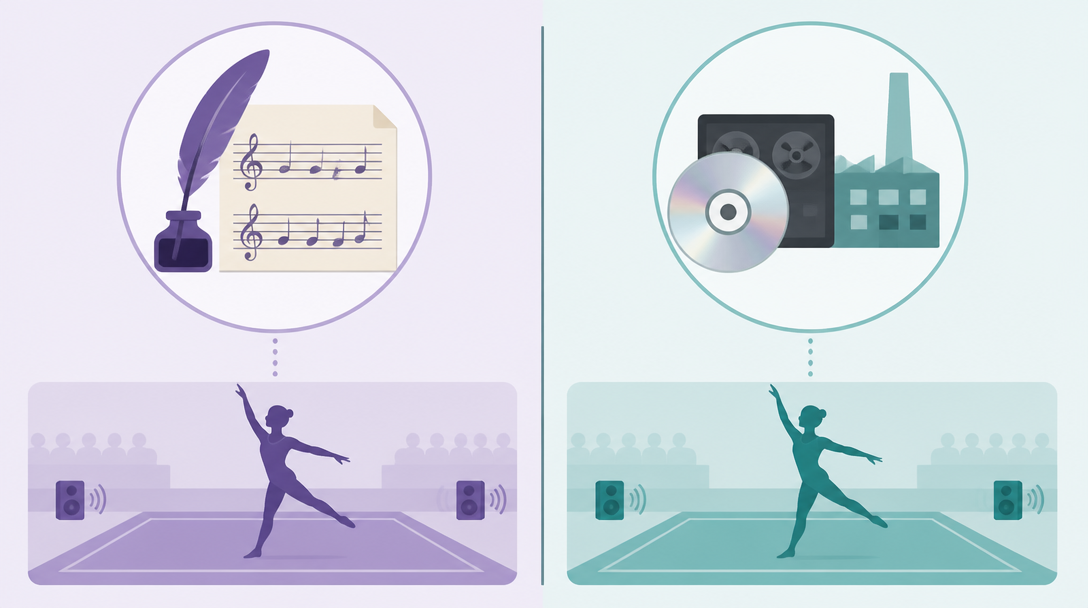
The first stumbling block is that more than one right is involved. A commercial song carries the copyright owned by the songwriter and composer, and the master recording right owned by the record label that produced that specific recording. As explained in this lawyer's overview of copyright vs. master rights, using a commercial recording requires permission not only from the copyright holder but also from the master rights holder.
The two protect different things: copyright covers the song itself (lyrics and melody), while the master right covers that particular recording. So using a commercial track for competition means dealing with at least two directions of permission.
Three Rights Involved When Using a Commercial Song
Which right becomes an issue depends on whether you simply play the track, edit and copy it, or publish it in a video.
Type of right | Main holder | When it matters | Where to clear it |
|---|---|---|---|
Copyright (performance, reproduction, etc.) | Songwriter / composer | Playback, editing, streaming | Collective societies (e.g. JASRAC) |
Master recording right | Record label | Editing, copying, streaming | Each record label |
Performers' rights | Singers / musicians | Editing, copying, streaming | Performers / collecting bodies |
If you would rather skip all of this and focus on the routine, one option is custom competition floor music. When a former gymnast and an artist build a fully original track that already respects the Code of Points, you avoid the clearance headaches that come with commercial songs.
What Happens When You Use a Commercial Song at a Competition?
Simply Playing It May Be Fine for Free, Non-Profit Events
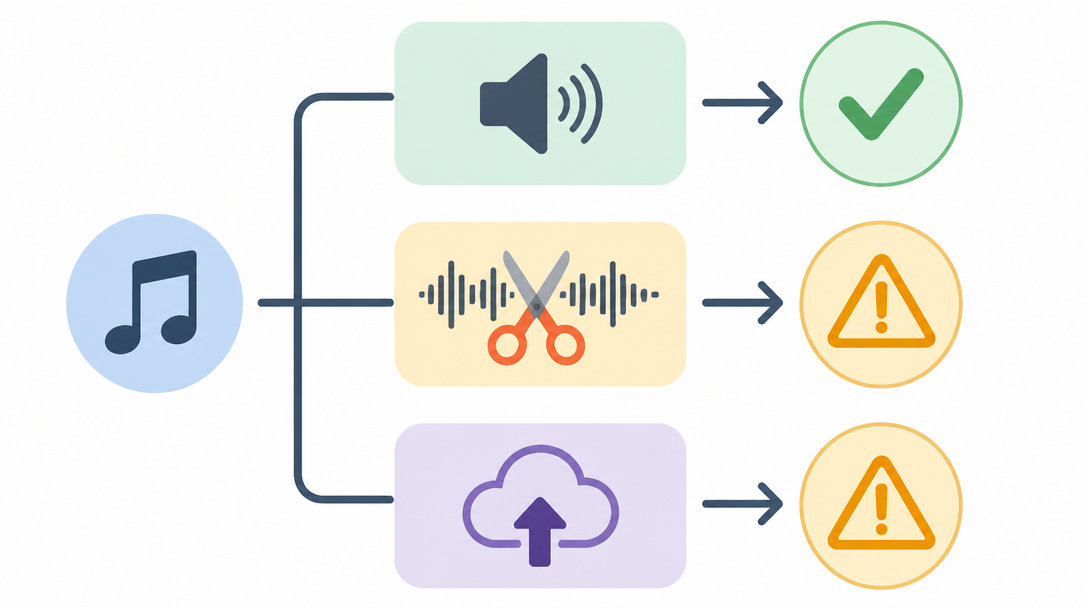
Playing a commercial recording at a venue counts as a "performance." Under many non-profit exemptions, if an event is free, non-commercial and no fee is paid to performers, playback can be allowed without prior clearance. Reference guidance on music at school sports events (JASRAC) illustrates this "free, non-profit, no payment" logic.
- No admission or usage fee is charged
- No fee is paid to the performers or presenters
- The event is not run for profit
Record labels also do not hold a "public performance right," so simply playing a track is generally less of a problem on the master-rights side.
Cutting Music to 90 Seconds Counts as "Reproduction"
This is where it gets complicated. Non-profit performance exemptions cover playing and presenting—not copying, editing (reproduction) or online distribution. Because floor music must be trimmed to the required length, editing almost always occurs. At that point, as legal commentary on using commercial CDs notes, you need permission from the copyright holder and the record label's master rights, plus performers' rights. "Playing" and "editing to use" are treated very differently.
School Events and Gymnastics Competitions Are Not the Same
A common misconception is "if it's fine at school, it's fine at a meet." Guidance notes that copying a CD for a school sports day can be exempt as part of "classwork," but explicitly states that a university-level festival is not counted the same way. Uses tied to school lessons and competitions run by outside clubs or federations start from different premises. When in doubt, confirm with the licensing body or the meet organiser. This article is general information, not individual legal advice.
The Overlooked Wall: Master Recording Rights

Paying a Copyright Society Does Not Clear the Master
"Pay the society and you can use any song" is only half true. Societies such as JASRAC manage the copyright (songwriter side) only; the master recording right stays with each record label. If you edit or distribute, you must clear the master separately.
Without understanding this two-layer structure, people pay the copyright fee, feel safe, and miss the master clearance entirely. The more you process a commercial track, the higher this wall becomes.
If you want to discuss a 90-second edit or an original composition, a competition music production service is the shortcut. It can handle rules-aware editing and clean, original composition—sidestepping the master-rights problem altogether.
Why Label and Performer Permissions Are Needed
A commercial recording layers together the writers' work, the performers' interpretation, and the label's production and investment. Slicing it into a new 90 seconds touches each of those interests, so editing, copying and uploading all presume permission. Posting routine videos to social media is "public transmission," requiring clearance on both copyright and master sides.
The "Lyrics" Question Is Separate From Copyright
Another mix-up: FIG's rule on lyrics is a scoring rule, while copyright is a legal matter—entirely different issues. Even a wordless vocal track still carries copyright and master rights. For the rules side, see whether lyrics are allowed in women's floor (FIG vs. NCAA).
FIG Floor Music Rules and Scoring Basics
Instrumental Base; Words Are Not Allowed (Voice Is)
Music is also governed by the Code of Points. Per the women's floor overview, the FIG 2025–2028 rules require instrumental music, allow vocals without words, and prohibit music containing lyrics. Other bodies differ: US collegiate (NCAA) gymnastics permits lyrics, as summarised in this 2026 floor music requirements guide. Always check which ruleset your meet follows.
The 90-Second Rule and Time Deductions
Floor music is time-limited—FIG uses roughly 1:20–1:30, with deductions for going over or under. For structuring the routine, see our 90-second time allocation template.
Item | Detail | Impact (varies by source) |
|---|---|---|
No music | Routine performed without music | 1.0 deduction (disqualification in some sources) |
Over/under time | Outside the ~90-second limit | Around a 0.10 neutral deduction |
Lyrics/words | FIG prohibits tracks with words | Treated as a rules violation |
Poor audio/editing | Distortion, abrupt endings | Possible artistry/execution deductions |
What to Watch When Cutting the Track
Whether or not you use a commercial song, the 90-second edit shapes the routine. Abrupt cuts or mismatched timing can cost artistry and audio-related marks. See common mistakes when editing floor music for natural transitions.
Practical Ways to Avoid Rights Trouble
Checklist for Using a Commercial Song
- Confirm the organiser's music rules (lyrics allowed? time limit)
- Decide whether you only play it, or also edit/copy/publish it
- If editing/copying, check both copyright and master clearance
- If it may appear on social media or a stream, check public-transmission rules
- When unclear, ask the society, the organiser, or a professional
Working through these—especially case-by-case master clearance with labels—is often impractical for athletes and parents to handle alone.
Choosing Original Competition Music
The way to avoid the clearance maze entirely is to start with original music. With an original track, rights are clean from the outset under your agreement with the composer, and there is no "ask the label afterwards" step. You can also build the piece to the 90-second limit from the start, avoiding awkward cuts.
Editing vs. Composing: Which to Commission
Requests fall into "editing an existing track" and "original composition." If you only need a track trimmed to length, editing suffices; if you also want originality and clean rights, composition fits. See our guide to commissioning competition floor music. To consult someone who combines an ex-gymnast's and an artist's perspective, consider custom floor music production.
Summary
- Floor music is essential; missing music is penalised, so selection and editing are inseparable from copyright
- Commercial songs carry both copyright (writers) and master rights (label)—two separate rights
- Simply playing music at a free, non-profit event may need no clearance, but editing to 90 seconds or publishing video counts as reproduction/transmission and needs permission
- Paying a copyright society does not clear the master; school events and outside meets differ
- FIG requires instrumental music and bans lyrics (voice is fine); rules vary by body, so check first
- To avoid clearance entirely, rights-clean original competition music is a strong option
Commercial or original, the first step is clarifying "how far you edit it and where you use it." To discuss editing or composition, consider custom floor music production.
Related Reading
- Are Lyrics Allowed in Women's Floor? FIG vs. NCAA
- The 90-Second Time Allocation Template
- A Guide to Commissioning Competition Floor Music
*This article is general information, not individual legal advice. Actual permissibility depends on organiser rules and each rights holder. Confirm details with the relevant society or a professional.