Rhythmic Gymnastics Music Rules & Song Selection Guide
A guide to rhythmic gymnastics music rules under the 2025-2028 Code: routine length, whether lyrics are allowed, and how it differs from floor exercise.
The music rules for rhythmic gymnastics differ significantly from the floor exercise in artistic gymnastics. Understanding routine length, whether vocals are allowed, and how to choose the right music—based on the 2025-2028 Code of Points—makes preparing a routine far easier for athletes, parents, and coaches. This guide walks through the fundamentals of rhythmic gymnastics music rules, how they compare with artistic floor exercise, and practical tips for selecting music.
The Basics of Rhythmic Gymnastics Music Rules (2025-2028 Code)
Rhythmic gymnastics is a judged sport in which athletes perform rhythmically to music while handling an apparatus, competing on artistry. Let's start with the essentials: routine time, number of pieces, and scoring.
Different Durations for Individual and Group
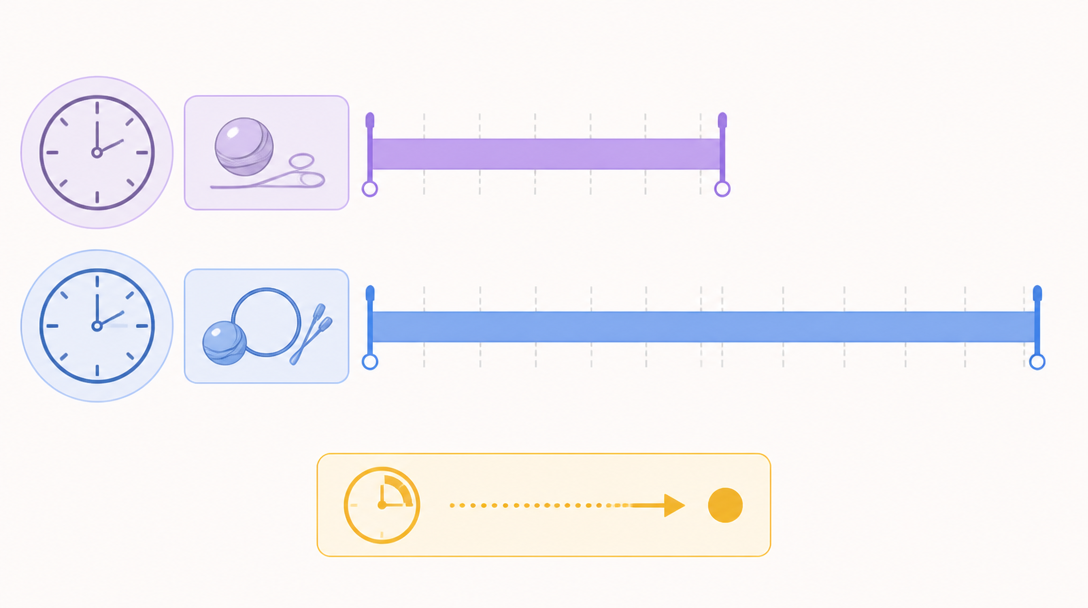
Timing is the first rule to master. According to the Japan Rhythmic Gymnastics Federation, individual routines run 1:15 to 1:30 (75-90 seconds), while group routines run 2:15 to 2:30. Going outside this window costs 0.05 points for every second over or under. That means the fade-out point must be managed down to the second when editing the track.
If you want a professional to handle music selection and editing, one option is a competition floor-music production service. Combining a former athlete's perspective with an artist's craft, it can help with timing management and composition built around the Code of Points.
One Piece per Routine and the 4-Second Rule
In rhythmic gymnastics, a routine uses one piece of music as a rule. Even when several tracks are stitched together, the result must feel like a single, cohesive work. A musical introduction without body or apparatus movement must not exceed four seconds, or a deduction applies. Where you place the start of the routine within the track is the first branching point of composition.
D, A, and E Scores and the Role of Music
Scores combine Difficulty (D), Artistic (A), and Execution (E). Music connects most deeply with the Artistic score. As USA Gymnastics explains, the artistic panel evaluates choreography, composition, and expression, so the unity of music and movement directly affects the score.
Score | What it evaluates | Link to music |
|---|---|---|
Difficulty (D) | Body and apparatus difficulty, risk | Indirect (accents highlight difficulty) |
Artistic (A) | Music-movement harmony, composition, expression | Direct (most important) |
Execution (E) | Technical accuracy and faults | Indirect (mistimed music hurts impression) |
Can You Use Music With Lyrics in Rhythmic Gymnastics?
"Can rhythmic gymnastics music have lyrics?" is a common stumbling block. The short answer: yes, under certain conditions—and this is a key difference from artistic floor exercise.
Up to 2 Individual and 1 Group Routine May Use Lyrics
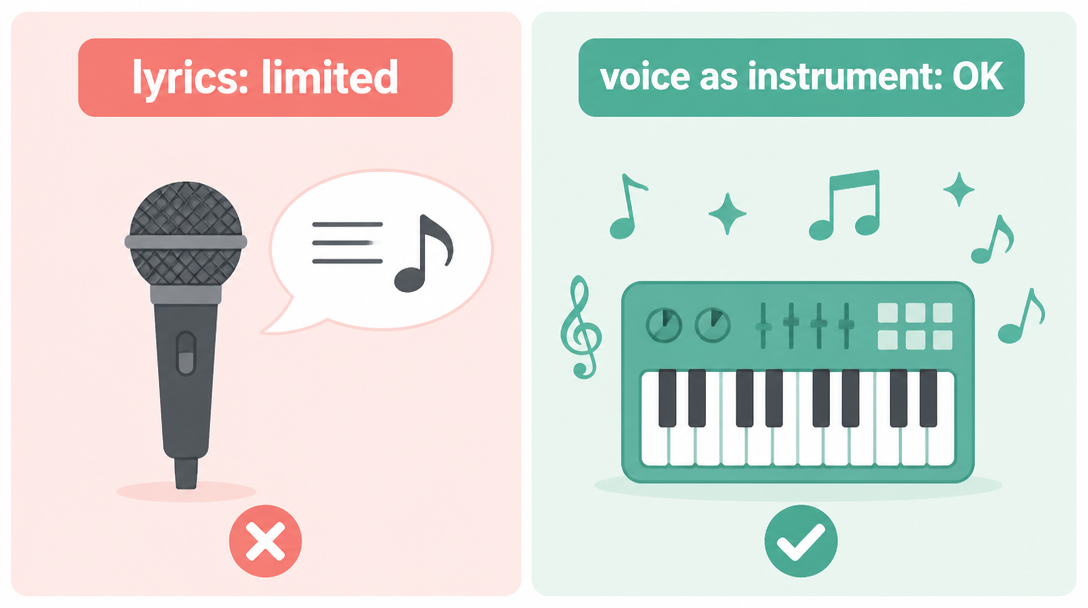
Under FIG rules, music with words may be used for up to two of an athlete's individual routines and one group routine. Which routines use lyrics is declared by each national federation. You cannot freely use vocals in every routine. Because this is easily confused with artistic floor, reading our article on whether lyrics are allowed in women's floor exercise makes the distinction clear.
Using the Voice as an "Instrument"
Even without meaningful words, using the human voice as an instrument—humming or scatting—is allowed separately from the piece-count limit. So the voice is not automatically banned; the dividing line is whether meaningful words are included. Understanding this greatly widens your music options.
The Federation Declaration System
Lyric routines are not decided arbitrarily by athletes; national federations declare them before competition. Local rules may apply at domestic events, so always check the specific competition's guidelines. Confirm the year's application through the Japan Gymnastics Association's latest rhythmic rules.
Music Rule Differences: Rhythmic vs. Artistic Floor Exercise
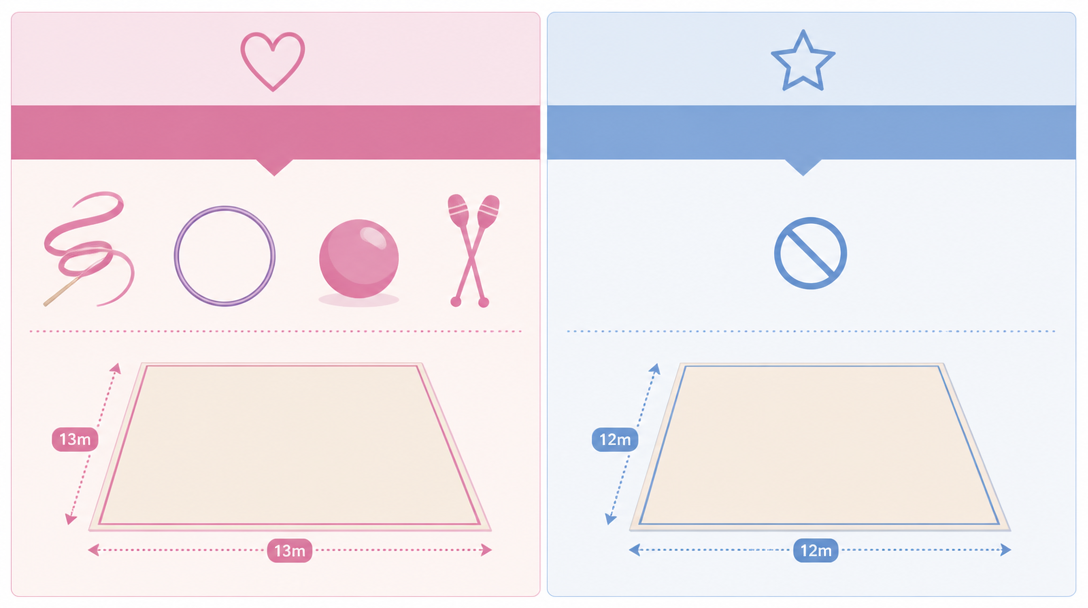
Both rhythmic gymnastics and artistic floor exercise are performed to music, but their music rules differ greatly. Confusing them leads to mistakes in selection and production.
Duration and Floor Size
An individual rhythmic routine is 1:15 to 1:30, whereas women's artistic floor is performed within 90 seconds on a 12m-square floor. The rhythmic floor is slightly larger at 13m square, with a longer time limit. Even for the same "floor routine to music," the length design differs.
The Decisive Difference in Lyrics
The biggest difference is whether lyrics are allowed. In women's artistic floor (FIG), music must be instrumental and lyrics are not permitted (the voice may be used as an instrument if there are no words). Rhythmic gymnastics, as noted, allows lyrics under conditions. This heavily affects whether a commercial song can be adapted for competition.
Apparatus and Its Impact on Music Composition
Because rhythmic gymnastics uses apparatus—rope, hoop, ball, clubs, ribbon—the timing of throws and catches must align with musical accents. This is fundamentally different from artistic floor, which uses no apparatus.
Item | Rhythmic (individual) | Artistic floor (women, FIG) |
|---|---|---|
Duration | 1:15-1:30 | Within 90 seconds |
Floor size | 13m x 13m | 12m x 12m |
Apparatus | Rope/hoop/ball/clubs/ribbon | None |
Lyrics | Up to 2 individual / 1 group (declared) | Not allowed (voice OK if no words) |
Pieces per routine | One as a rule | One as a rule |
When preparing rule-compliant music, you must edit with these differences in mind. A competition music production service that understands the Code of Points can handle selection, cut-editing, and original composition to match the event and rules.
Tips for Choosing Rhythmic Gymnastics Music
Once you know the rules, the next step is selection. Choosing purely by personal taste can obscure the routine's difficulty and expression. Think in terms of apparatus, structure, and tempo.
Match the Music to the Apparatus
Each apparatus suits different music. The ribbon pairs with flowing legato melodies, the clubs with rhythmic pieces that highlight asymmetric movement, and the ball with softer tones. The JOC's event guide also describes each apparatus's character; matching the texture of movement to the music is step one.
Build Structure With a Clear Arc
Within 75-90 seconds, contrast between stillness and motion makes a routine memorable. A classic structure presents the world early, places high-difficulty elements in the middle, and builds to a climax at the end.
Use Tempo and Accents to Highlight Difficulty
Changing tempo or adding an accent just before a throw or high-difficulty element makes the highlight clear to judges and audience alike. Lining up difficulty over a monotonous tempo buries the elements. Accent design connects directly to the Artistic score.
Selection by Age and Level
The best choice also depends on the athlete's age and level. For young children, music with a clear tempo and an easy-to-grasp world is easier to express and to convey to judges. For seniors and advanced athletes, pieces with wide dynamic range—music that shines in the quiet passages—showcase expressive depth. As apparatus handling becomes more secure, the body can express finer musical nuance, so increasing the "information density" of the music becomes the norm. Our age-by-age selection guide for floor exercise is a useful reference.
Music-Movement Harmony Drives the Artistic Score
A crucial lens for understanding rhythmic music rules is how "harmony" between music and movement is judged. Miss this, and even a great track won't earn points.
What the Artistic Score Evaluates
The artistic score rewards unity of music and movement, rhythmic expression, use of space, and dynamic contrast. It asks whether the body expresses the very structure of the music. USA Gymnastics likewise states that the artistic panel evaluates composition and expression.
Music Choices That Get Deducted
Music out of sync with movement, accents misaligned with elements, or a musical peak that doesn't match the routine's climax all hurt the artistic score. Designing "which element shows on which beat" during editing is the shortcut to avoiding deductions.
Prohibited Music and Cautions
Sounds outside the rhythmic style—sirens, car engines—are not permitted. Chasing novelty beyond the bounds of competition music can lower your evaluation. The skill is expressing individuality within the rules.
How to Prepare Competition Music: Editing vs. Production
Finally, how to prepare the actual track. Broadly, you can edit a commercial song or produce original music.
Editing Commercial Songs and Copyright
Cutting a commercial song to length is convenient but requires care regarding competition eligibility and copyright. Our article on floor music and copyright is a useful reference.
Original Music as an Option
If you want music that no other athlete shares and that fits the routine perfectly, original production is an option. It lets you design length per the Code, place accents to the apparatus, and craft the climax cohesively. To discuss selection through composition, consider competition music production by a former athlete and artist, which balances rules and choreography.
Points to Check When Submitting Your Track
When submitting music to a competition, confirm in advance that it meets the required file format and volume standards. Many events specify how to submit the track and ask you to bring backup media in case of playback trouble on the day. The gap between the starting signal and the first note, and the naturalness of fade-ins and fade-outs, also shape the overall impression. Music is not finished when it is produced; finishing it with the actual venue playback in mind supports performance on the day.
Summary
Understanding rhythmic gymnastics music rules—distinct from artistic floor—is the first step to selection and production. Key points:
- Individual routines run 1:15-1:30, groups 2:15-2:30; 0.05 deduction per second over/under
- One piece per routine as a rule; a movement-free intro must be within 4 seconds
- Lyrics allowed for up to 2 individual / 1 group routines (declared); artistic floor bans lyrics
- Music-movement harmony drives the Artistic (A) score
- Selection that accounts for apparatus, structure, and tempo raises the evaluation
To prepare rule-compliant music, make use of a competition music production service that handles selection, editing, and original composition around the Code of Points.