China's Asian Games 2026 Gymnastics Roster Row: A D-Score View
China's roster for the 2026 Asian Games gymnastics in Japan drew a fan backlash. Here is why veterans like Zou Jingyuan still anchor the team, in D-score terms.
As the 2026 Asian Games approach in Aichi-Nagoya, Japan, the selection of China's men's artistic gymnastics team has stirred a heated online backlash. This analysis comes from the perspective of a former competitive gymnast and the developer of a D-score calculation app, focusing on why China cannot simply bench its veterans.
*Information current as of August 26, 2026. Figures from local reporting are attributed to their sources.
The Asian Games 2026 Roster Controversy

The 20th Asian Games will be held in Aichi-Nagoya, Japan. According to the schedule published by Olympics.com, artistic gymnastics runs from September 20 to 24 at a gymnasium in Kasugai City. The Games run September 19 to October 4; see the 2026 Asian Games overview.
The Named Five and Reserves
China's Gymnastics Administrative Center publicized its roster for the Asian Games and World Championships in early August. Cross-referencing Chinese outlets such as Xinhua, the men's team is as follows.
Status | Athlete | Profile |
|---|---|---|
Main | Zou Jingyuan | Parallel bars specialist; two-time Olympic and four-time world champion |
Main | Zhang Boheng | All-around / high bar; 2021 world AA champion, Paris AA silver |
Main | Sun Wei | Experienced all-arounder |
Main | Tian Hao | All-around type |
Main | Lan Xingyu | Power-event specialist (rings) |
Reserve | Wang Chengcheng, Hong Yanming, Xie Chenyi | Named as reserves |
If you want to explore how a routine's difficulty is built, Gymnastics AI — the D-score calculator is handy. It follows the FIG 2025–2028 Code of Points and includes a database of 790+ skills.
The "Youth Development" Pledge vs. the List
The flashpoint was a perceived contradiction between an official pledge to prioritize young talent and the actual roster. According to the South China Morning Post, some fans argued the trial rules were applied inconsistently, and veteran Zou Jingyuan was even told online to retire. The gymnastics center issued a statement defending the process and announced legal steps against defamatory rumors, as covered across outlets including Gymnastics Now.
Why China Can't Bench Its Veterans: A D-Score View
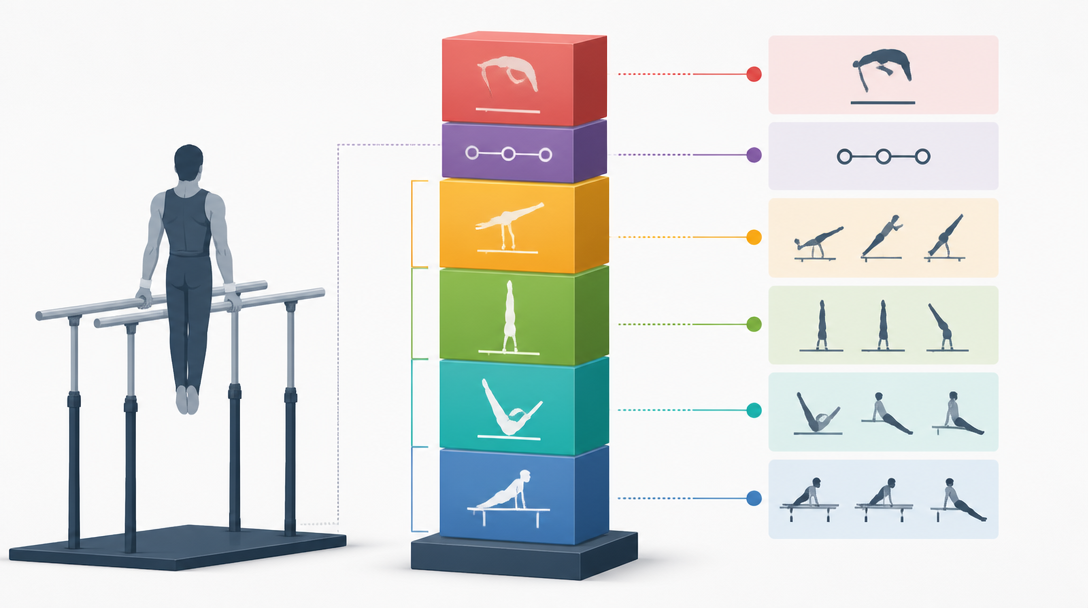
Here is the analytical core. Behind the "youth" narrative lies a structural truth of the sport: high D-scores take years to build, so any medal-oriented lineup leans on experience.
How the D-Score Works
A gymnast's score combines the D-score (difficulty) and the E-score (execution, starting from 10.0). The D-score sums the most valuable elements per apparatus, then adds element-group requirements, connection bonuses, and dismount value. See our primer on the Code of Points. Crucially, difficulty only counts when performed reliably—hence the enduring value of a polished veteran.
Zou Jingyuan and the Ceiling of Difficulty
Zou's parallel bars boast one of the world's highest D-scores. Per his record, he scored 16.233 on parallel bars at the Tokyo Olympics—the largest winning margin of those Games. To see how connection choices change a routine's difficulty, try Gymnastics AI; our piece on parallel bars construction covers the same idea.
Zhang Boheng and Team Balance
All-arounder Zhang Boheng can post solid D-scores across all six events. His ipedia.org/wiki/Zhang_Boheng" target="_blank" rel="noopener">record
includes 2021 world AA gold and Paris AA silver. In a 3-up-3-count team final, the sum of difficulty across events sets the ceiling—so blending specialists (Zou on p-bars, Lan on rings) with all-arounders (Zhang, Sun, Tian) maximizes team difficulty. An all-youth squad would likely lower that sum, which is the crux of the "renewal vs. gold" dilemma.