Men's Gymnastics: 6 Events, Skills & Physical Requirements
Explore the physical demands of all 6 men's artistic gymnastics events—floor, pommel horse, rings, vault, parallel bars, and high bar—including strength, flexibility, and body type.
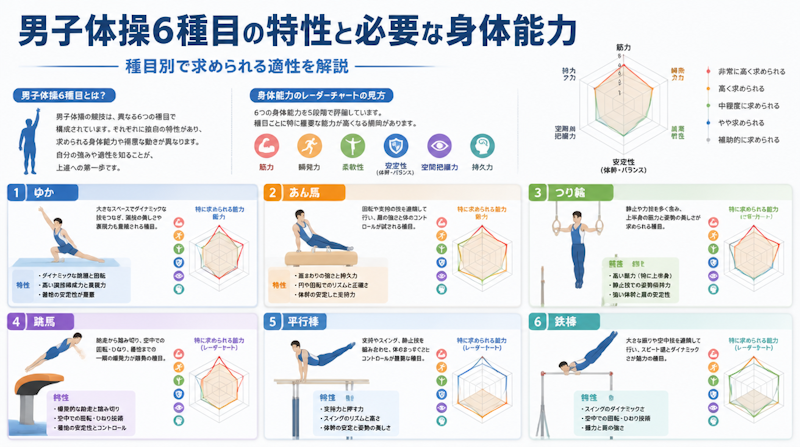
Men's artistic gymnastics is a multidisciplinary sport composed of six distinct events: floor exercise, pommel horse, still rings, vault, parallel bars, and horizontal bar. Each event demands a fundamentally different set of physical attributes and technical skills, which is why some gymnasts rise to prominence as event specialists rather than all-around competitors. This article provides a comprehensive breakdown of each event's characteristics and the specific physical qualities required to excel at the highest level.
The Six Events of Men's Artistic Gymnastics
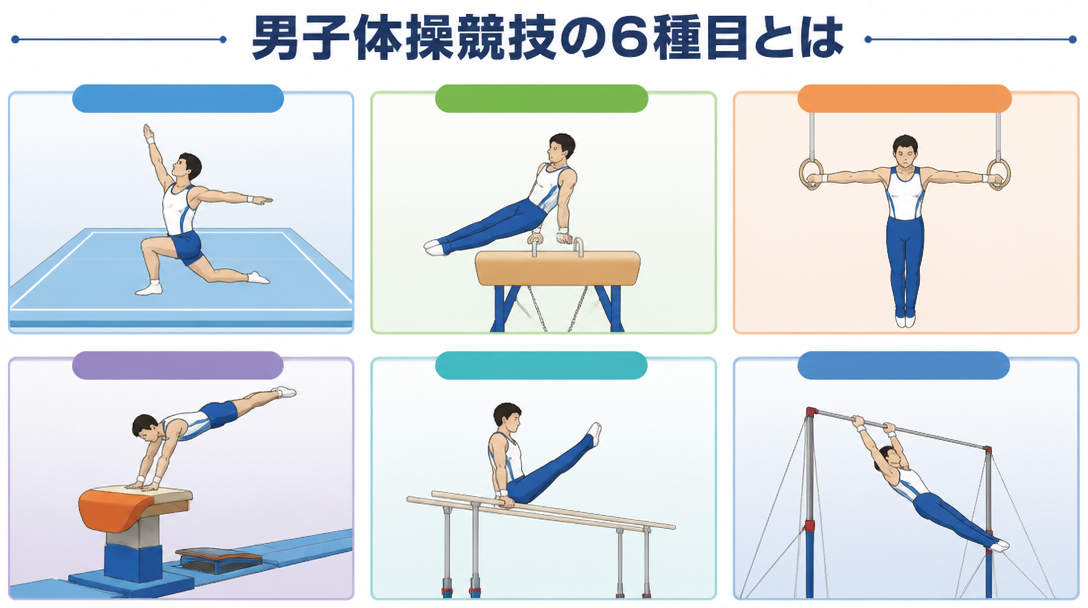
Four Events Exclusive to Men's Competition
According to the FIG (Fédération Internationale de Gymnastique), artistic gymnastics is a sport that demands a comprehensive expression of flexibility, strength, balance, and aesthetic quality. Men compete across six events, while women compete across four: floor exercise, uneven bars, balance beam, and vault.
Only two events are shared between men and women—floor exercise and vault—though the apparatus specifications and skill requirements differ between the two. The remaining four events—pommel horse, still rings, parallel bars, and horizontal bar—are exclusive to men's competition.
- Floor Exercise: Men and women (different composition requirements)
- Pommel Horse: Men only
- Still Rings: Men only
- Vault: Men and women (different apparatus height and skills)
- Parallel Bars: Men only
- Horizontal Bar: Men only
Team, All-Around, and Event Final Competition Formats
At international competitions, men's artistic gymnastics is contested in three formats: team final, individual all-around, and event finals. In the individual all-around, athletes are ranked by their combined score across all six events. In event finals, only one apparatus is performed, and athletes compete purely on the merit of that single event.
Event finals provide a stage where highly specialized gymnasts can shine. Events such as pommel horse, still rings, and horizontal bar demand such a degree of technical specificity that specialists often dominate those podiums. For more on how routines are scored, refer to the introduction to the Code of Points: D-score and E-score.
Men's Artistic Gymnastics Events: Apparatus Overview | |||
Event | Apparatus Dimensions | Defining Characteristic | Men/Women Shared? |
|---|---|---|---|
Floor Exercise | 12m × 12m sprung floor | Tumbling passes and acrobatic combinations | Shared (different composition rules) |
Pommel Horse | Height: 105 cm | Continuous arm-support swinging with no stops | Men only |
Still Rings | Height from floor: 280 cm | Greatest upper-body strength demand of all events | Men only |
Vault | Height: 135 cm | Explosive, brief burst of power—completed in seconds | Shared (different height and skills) |
Parallel Bars | Height: 200 cm, width: 42–52 cm | Diverse skills across two parallel rails | Men only |
Horizontal Bar | Height: 280 cm | Dynamic swinging and release skills using centrifugal force | Men only |
Floor Exercise: Event Characteristics and Physical Requirements
What Makes Floor Exercise Unique
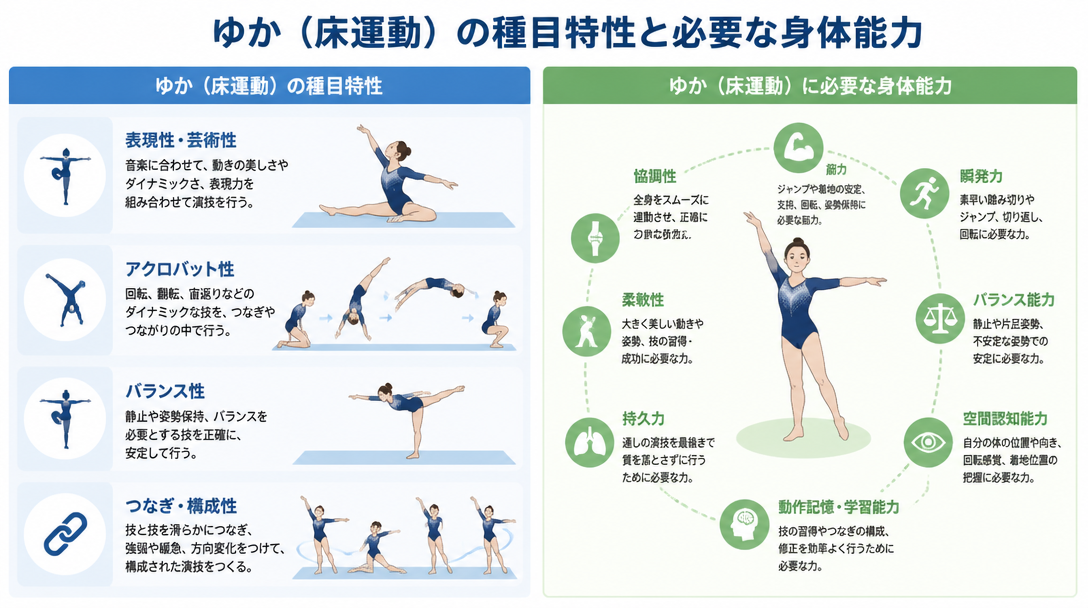
Floor exercise is performed on a 12m × 12m spring-loaded mat, commonly known as a tumbling floor. The elasticity of the surface allows gymnasts to generate significant height during acrobatic passes, enabling the execution of high-difficulty somersaulting skills in rapid succession. Men's floor routines last exactly 70 seconds, during which athletes must incorporate multiple tumbling passes alongside strength and flexibility elements.
A typical men's floor routine includes four tumbling lines—defined diagonal or straight paths across the mat where acrobatic combinations are performed. Each pass generally features a series of connected somersaults and twisting elements. Precise landings are also a key scoring factor; the ability to "stick" a landing cleanly after a high-difficulty pass can meaningfully impact the E-score. For more on how routine composition affects scoring, see the article on compositional requirements (CR) in men's gymnastics.
Physical Demands of Floor Exercise
The primary physical attributes required for high-level floor exercise include:
- Explosive lower-body power: Generating height and distance during tumbling passes requires exceptional leg power (quadriceps, glutes, and calves).
- Core stability: Maintaining body shape in the air and absorbing landing forces depends on a strong, stable core.
- Flexibility: Full range of motion in the shoulders and hips contributes to the aesthetic quality of leaps, jumps, and body positions.
- Speed and endurance: Sustaining high-difficulty execution across the full 70-second routine requires both speed and aerobic capacity.
- Coordination and rhythm: Seamlessly linking tumbling passes with transitional movements requires a well-developed sense of timing and body coordination.
Floor exercise rewards athletes who can combine spectacular tumbling with precision landings—two qualities that are not always found together and require extensive, targeted training to develop simultaneously.
Pommel Horse: Event Characteristics and Physical Requirements
The Most Technically Demanding Event in Gymnastics
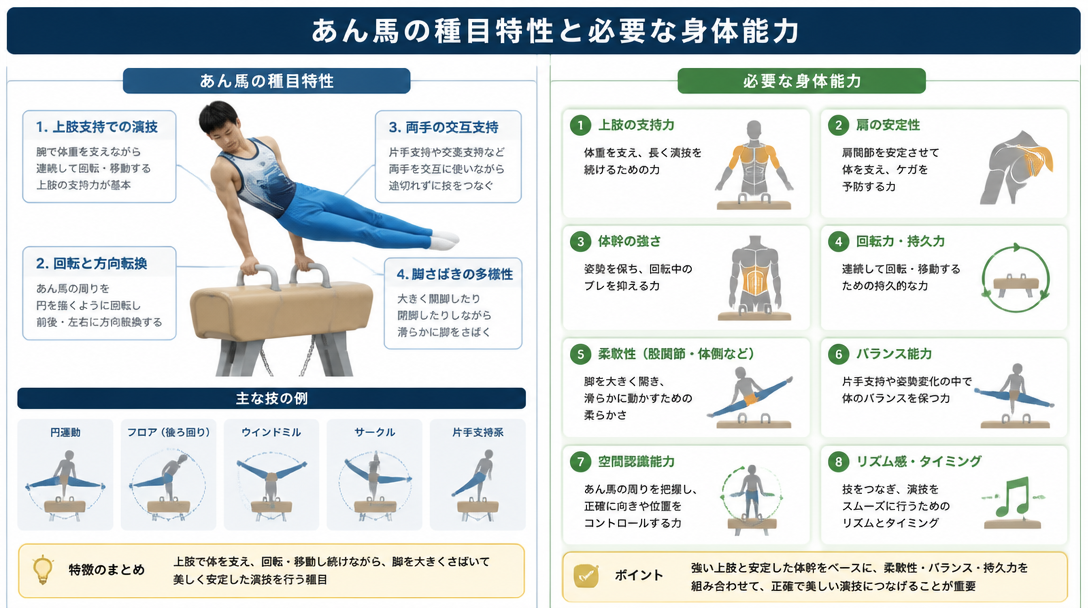
Pommel horse is widely regarded as the most technically challenging event in men's artistic gymnastics. Performed on a horse-shaped apparatus standing 105 cm high and equipped with two handles (pommels), this event requires the gymnast to move continuously without any pause, with feet never touching the floor and no contact with safety equipment permitted throughout the routine.
The defining challenge of pommel horse is its unforgiving continuity: once a routine begins, any break in the swinging rhythm results in a deduction or, worse, a fall. Simply learning the basic circular swinging motion can take a beginner a full year or more. Throughout the entire performance, the athlete must support the full weight of the body using only the arms and shoulders, making sustained upper-body endurance an absolute necessity.
Representative skills found in pommel horse routines include:
- Circles: The foundational swinging motion around and across the apparatus, performed with one or both legs.
- Flops (travel skills): Skills in which the gymnast changes body direction mid-circle, traveling along the length of the horse.
- Roth/Stockli combinations: High-difficulty travel skills that move between the pommels and the horse body.
- Scissors: Split-leg skills performed in a straddled position across the horse, requiring exceptional hip flexibility and coordination.
Physical Demands of Pommel Horse
- Arm and shoulder muscular endurance: Supporting full body weight continuously through the triceps, deltoids, and latissimus dorsi for the entire duration of the routine.
- Core and pelvic control: Coordinating the hips and lower body in a fluid circular motion while maintaining balance requires sophisticated neuromuscular development.
- Proprioceptive rhythm sense: Maintaining a consistent swinging rhythm and detecting micro-imbalances before they escalate into errors demands finely tuned body awareness.
- Shoulder joint stability: Holding handstand positions and supporting stresses during complex travel elements requires exceptional shoulder girdle strength and stability.
- Sustained concentration: Executing a non-stop routine under competition conditions demands a level of mental focus rarely matched by other events.
Unlike most other events, pommel horse is less about explosive lower-body power and almost entirely about sustained upper-body support endurance. A detailed breakdown of pommel horse circular technique and Roth/Stockli skills is available in this dedicated article.
Still Rings: Event Characteristics and Physical Requirements
The Greatest Test of Raw Strength in Gymnastics
Still rings is performed on two circular rings suspended 280 cm above the floor. Universally recognized as the event that demands the greatest pure upper-body strength in men's artistic gymnastics, it is also the most physically taxing event in terms of energy expenditure. The rings hang freely from cables, meaning they are not fixed—the gymnast must actively stabilize them throughout the routine, adding an additional layer of difficulty compared to fixed apparatus events.
Rings routines are built around three categories of skills:
- Swing elements: Dynamic swinging skills performed with controlled momentum, similar in concept to movements on horizontal bar.
- Strength holds: Static positions maintained purely through muscular force, held for a minimum of two seconds as required by the Code of Points. Classic examples include the iron cross (arms extended horizontally while the body hangs in a vertical position) and the Maltese cross (body held horizontally in a prone position).
- Press-to-handstand elements: Transitional skills requiring both strength and control to move between positions.
Physical Demands of Still Rings
- Absolute upper-body strength: Peak maximal strength in the chest, shoulders, and arms (particularly the pectorals, latissimus dorsi, and deltoids) is the foundation of every strength hold.
- Grip strength and forearm endurance: Maintaining a secure grip on the rings throughout an entire routine—including during high-stress strength holds—demands exceptional grip endurance.
- Full-body rigidity: During strength holds, the body must be maintained in a perfectly rigid, plank-like position, requiring elite-level core stiffness.
- Ring stabilization ability: The skill of damping unwanted ring movement while performing dynamic skills is a unique demand of this event that has no parallel elsewhere in the sport.
- Spatial awareness: Transitioning from dynamic swinging skills into held positions requires precise awareness of body position and timing.
Event specialists on still rings typically exhibit a body type characterized by a broad chest, wide shoulders, and exceptional upper-body mass relative to body weight. According to the FIG's overview of artistic gymnastics, the sport as a whole demands speed, strength, flexibility, and coordination—but still rings places these demands on the upper body in a uniquely concentrated way that distinguishes it from all other events.
Vault: Event Characteristics and Physical Requirements
An Explosive Event Completed in Seconds
Vault is the shortest event in artistic gymnastics, with the entire sequence—run-up, takeoff, repulsion phase, flight, and landing—completed within a matter of seconds. Yet within that brief window, gymnasts execute some of the most spectacular acrobatic skills in the sport. The quality of the aerial phase and the precision of the landing are the primary factors that determine the final score.
In men's competition, the vaulting table stands 135 cm high. Athletes sprint down an approximately 25-meter runway at maximum speed, take off from a springboard, place both hands on the table for a fraction of a second to generate repulsion (a phase called the "post-flight" launch), and then complete their chosen acrobatic elements before landing. The difficulty value of the vault is determined by the skill performed in the air, while the E-score reflects execution quality including body position, height, distance, and landing stability. For a full breakdown of vault skill categories and difficulty values, see the vault difficulty article covering Yurchenko, Tsukahara, and related vault families.
Physical Demands of Vault
Physical Requirements for Vault and Their Roles | ||
Physical Attribute | Role in Vault Performance | Primary Muscles Involved |
|---|---|---|
Explosive sprint speed and jumping power | Determines run-up velocity and takeoff height | Quadriceps, hamstrings, glutes |
Upper-body push-off power | Generates repulsion force during hand contact with the table | Pectorals, deltoids, triceps |
Spatial awareness | Controls body position and skill execution during brief flight | (Neurological/sensory) |
Landing stability | Prevents steps, hops, or falls upon landing to minimize deductions | Core, ankle stabilizers |
Flexibility | Contributes to body extension and aesthetic quality in the air | Hip flexors, shoulder complex |
Vault is uniquely demanding in that it requires an athlete to produce maximum power output in a compressed timeframe unlike any other gymnastics event. The entire action from board contact to landing demands that all available power resources are activated and coordinated within roughly three to four seconds—an extreme test of neuromuscular efficiency and explosive athleticism.
Parallel Bars: Event Characteristics and Physical Requirements
An Event Demanding Diverse Technical Mastery
Parallel bars is a men's-only event performed on two horizontal rails set approximately 200 cm above the floor, with the rails positioned 42–52 cm apart. The apparatus features a slight give or flex in the rails, and skilled gymnasts learn to exploit this elasticity to generate momentum for more powerful and dynamic skills.
Parallel bars routines demand a wide variety of technical skills, combining elements performed above the bars (support positions), below the bars (hang positions), and transitions between the two. The flow between these contrasting elements—moving from vigorous swinging above the bars to controlled suspension below them—gives the event its characteristic rhythm and complexity. Unlike pommel horse, routines on parallel bars are not strictly continuous; moments of controlled deceleration between elements are permitted, though seamless, flowing composition is rewarded by judges.
The primary skill categories in parallel bars include:
- Swing elements (forward and backward): The foundational dynamic movements that link other skills together and build momentum.
- Release elements: High-difficulty skills in which the gymnast leaves the bars entirely to perform a somersault before regrasping.
- Handstand elements: Static or transitional skills involving a held or passing handstand position on top of the bars.
- Undersomersault elements: Skills performed below the bars using a swinging motion in a hang position.
For a deeper look at how parallel bars routines are structured from a compositional perspective, see the article on parallel bars routine composition strategy.
Physical Demands of Parallel Bars
- Arm and shoulder support strength: Continuous support of body weight above the bars demands sustained strength in the triceps and deltoids throughout the routine.
- Core strength and stability: Holding the body in rigid positions during handstands and controlled swings requires elite core endurance.
- Swing control and bar feel: Learning to harness the natural flex of the rails to amplify skill execution—rather than fight against it—is a uniquely trainable skill specific to this event.
- Flexibility (particularly shoulders and hips): Movements such as back uprise to handstand and various transitions require substantial mobility in the shoulder complex and hip flexors.
- Fine motor precision: Bar-to-bar hand placements during dynamic skills, combined with the need to precisely control grip transitions, place high demands on fine motor coordination.
The handstand on parallel bars deserves special mention: it is a mandatory compositional requirement in competitive routines, meaning every athlete must demonstrate the ability to hold a stable, vertical handstand position on top of the rails. This single requirement underpins virtually all technical development on the event and is the benchmark against which core and shoulder strength are measured. For training methods to develop the core strength needed across gymnastics events, the article on core training for artistic gymnastics offers practical guidance.
Horizontal Bar: Event Characteristics and Physical Requirements
The Showpiece Event of Men's Gymnastics
The horizontal bar is frequently described as the showpiece or "crown jewel" of men's artistic gymnastics. Performed on a single steel bar mounted 280 cm above the floor, routines on horizontal bar are defined by relentless movement: the gymnast swings continuously, building and redirecting centrifugal force to execute one spectacular skill after another without interruption. The sheer dynamism and visual drama of high-level horizontal bar—featuring giant swings, dramatic release-and-regrasp skills, and complex grip changes—gives it a unique theatrical quality unlike any other event.
According to the FIG 2022–2024 Men's Code of Points, horizontal bar routines must satisfy specific compositional requirements, including the execution of release elements (Jaeger, Tkatchev, Kovacs, etc.), skills performed in different grip orientations, and a dismount of sufficient difficulty. The technical standards for elite horizontal bar composition are among the most demanding in the entire sport.
Physical Demands of Horizontal Bar
Horizontal bar is unique in that it is fundamentally a centrifugal force management event. The physical demands reflect this distinctive characteristic:
- Grip strength and forearm endurance: Maintaining a secure hold on the bar during high-speed giant swings and through the extreme forces generated by release-and-regrasp skills demands extraordinary grip endurance.
- Back and shoulder strength: A powerful, stable body line during giant swings depends on back extensors and the shoulder girdle to resist unwanted deformation in the swing arc.
- Spatial awareness (proprioception at speed): Knowing precisely where the body is in space while rotating at high velocity around the bar is a specialized perceptual skill that takes years to develop.
- Mental courage: Performing release skills—letting go of the bar at 280 cm above the floor and trusting the mechanics of the swing to bring the hands back to the bar—requires a unique form of athletic courage that is specific to this event.
- Release timing: The ability to release the bar at the optimal moment—neither too early nor too late—is a technically precise skill that determines the trajectory of the subsequent flight phase and the success of the regrasp.
Compositional requirements on horizontal bar also mandate the use of multiple grip orientations: the overgrip (palms facing away), undergrip (palms facing the gymnast), and mixed grip (one hand in each orientation) must all appear within a single routine. This requirement adds a layer of technical complexity that specialists spend careers mastering. A detailed guide to horizontal bar release elements including Tkatchev, Kovacs, and Rybalko variants is available in this article.
Body Type Characteristics of Male Gymnasts
Why Smaller Stature Is Generally Advantageous
Across all events in artistic gymnastics, an athlete's physical dimensions have a meaningful impact on performance. From a biomechanical standpoint, rotational acceleration is inversely proportional to the moment of inertia—meaning that a more compact body can rotate faster for the same amount of muscular effort. As a result, gymnasts tend to be smaller in stature than athletes in most other sports, with the majority of elite male gymnasts standing between approximately 160–170 cm tall.
A smaller, more compact body confers several specific advantages in gymnastics:
- Lower rotational inertia: Compact bodies rotate more quickly and efficiently during somersaulting skills.
- Higher relative strength: For a given level of absolute muscle strength, a lighter athlete generates more force relative to their own body weight, making self-propulsion and support tasks easier.
- Greater aerial control: A smaller body is more manageable to control and position precisely during flight phases.
Research published by sports science institutes examining Olympic-level athletes has consistently found relationships between limb segment lengths, body proportions, and performance outcomes in gymnastics, supporting the observation that certain physical configurations align more naturally with the demands of the sport.
Body Type Tendencies Among Event Specialists
Body Type and Muscle Group Tendencies by Event | ||
Event | Advantageous Body Type Tendency | Primary Muscle Groups Required |
|---|---|---|
Floor Exercise | Powerful, muscular build with high explosive leg power | Quadriceps, glutes, core |
Pommel Horse | Long arms relative to torso, high shoulder stability | Shoulders, upper arms, forearms |
Still Rings | Broad shoulders, deep chest, high upper-body mass | Pectorals, lats, deltoids |
Vault | Well-developed lower body, fast sprint mechanics | Quadriceps, calves, glutes |
Parallel Bars | Well-balanced, versatile physique | Shoulders, core, arms |
Horizontal Bar | Long arms, strong grip and forearm endurance | Back extensors, shoulders, forearms, grip |
All-around competitors must develop a balanced physical profile that supports competent performance across all six events—no single event's demands can be allowed to crowd out training for the others. Event specialists, by contrast, can dedicate a greater share of training time to amplifying the specific physical qualities that their chosen event demands, often aligning their training emphasis with their natural physical strengths and body type. For guidance on developing the core strength that underpins performance across all six events, the gymnastics-specific core training article provides practical programming recommendations.
Summary
Men's artistic gymnastics is a sport of remarkable internal variety. Each of its six events places a distinct set of demands on the human body, and the physical profile of an ideal specialist differs substantially from one event to the next. To summarize the key characteristics of each:
- Floor Exercise: Centers on explosive jumping power, core stability, and tumbling technique. Endurance across the full 70-second routine is also a critical performance factor.
- Pommel Horse: Demands exceptional arm and shoulder support endurance, sophisticated pelvic and hip coordination, and the mental capacity to maintain absolute concentration through a non-stop routine. Often cited as the most technically difficult event in the sport.
- Still Rings: Requires the greatest absolute upper-body strength of any event, combined with full-body rigidity for held positions and the ability to stabilize freely moving apparatus. The execution quality of strength holds is the focal point of judging.
- Vault: The sport's premier test of explosive power, sprint speed, and landing precision, all compressed into a performance lasting just a few seconds.
- Parallel Bars: Demands a composite of support strength, swing control, handstand technique, and bar feel—making it one of the more technically varied events in the program.
- Horizontal Bar: A uniquely sensory event built around centrifugal force, spatial awareness, and mental courage. Its dramatic release skills and continuous movement make it one of the most visually compelling events in all of gymnastics.
All-around gymnasts must develop genuine competency across the full breadth of physical and technical demands these events collectively present. Event specialists, in turn, focus on honing the particular attributes their chosen discipline rewards. In both cases, a clear-eyed understanding of each event's physical requirements—and how they relate to an individual athlete's strengths and body type—is foundational to effective training design and long-term athletic development.