How to Arrange Music: Turn a Melody Into a Finished Track
A beginner's guide to arranging music: how to turn a melody, chords, bass, and drums into a finished track, build song structure, and keep parts from clashing.
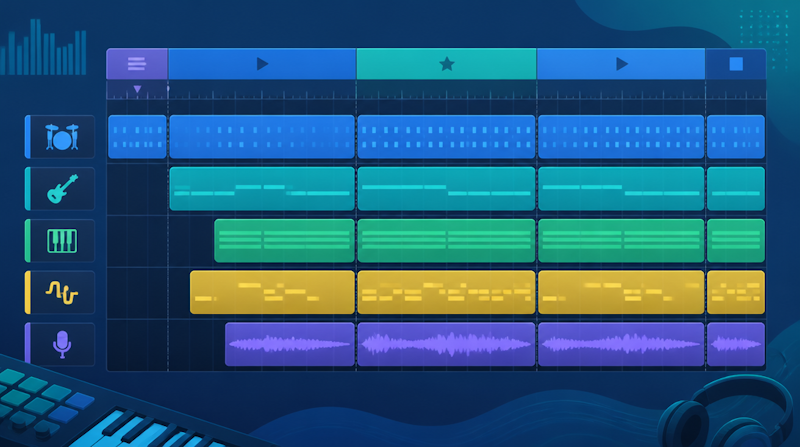
Arrangement is the process of taking your raw musical ideas—a melody and some chords—and building them into a finished track with drums, bass, and supporting instruments. Many producers can write a melody but get stuck on what comes next, and learning a repeatable arrangement workflow is the fastest way to actually finish songs. This guide walks through arranging music step by step: preparation, song structure, how to layer instruments, how to organize frequencies, and how to shape the energy of a track from start to end.
What Is Arrangement? How It Differs From Composing and Mixing
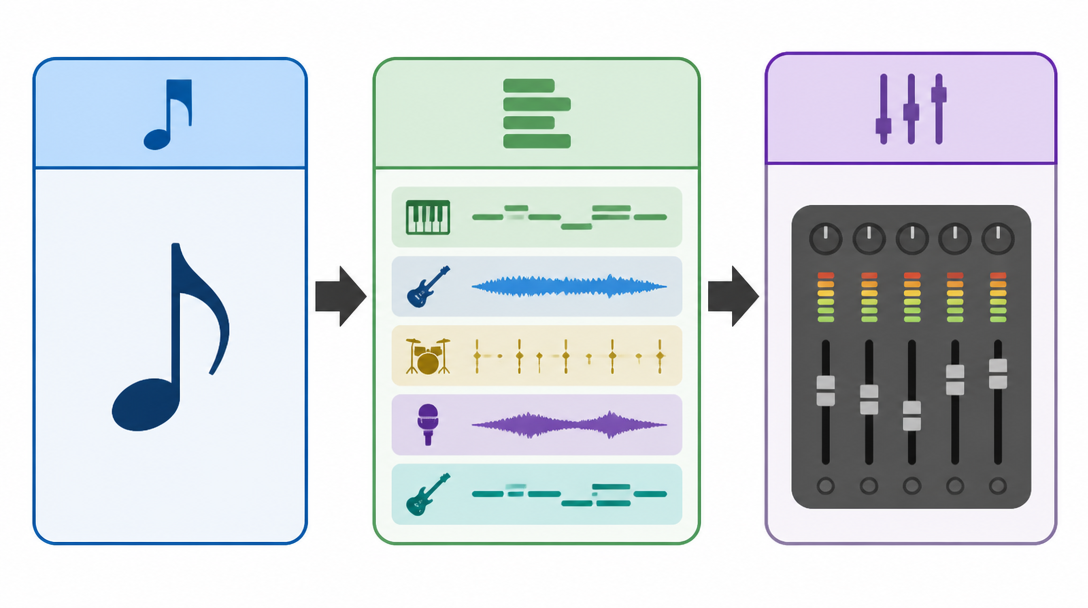
Before you dive in, it helps to know exactly which stage arrangement refers to. Composition, arrangement, and mixing are connected steps, but each has a different job. Separating them makes it clear what you should be working on right now.
Defining Arrangement
Arrangement is the work of deciding which instruments play which parts, and how, in order to build your material into a finished whole. Native Instruments defines it as the art of organizing and adapting a piece of music, built from five elements: form, instrumentation, rhythm, harmony, and texture. Splice calls arrangement the place where songwriting meets architecture—the stage where you implement a track's foundation, structure, energy, and emotional direction.
Arrangement vs. Composition
Composition is the act of creating melody and chords from nothing, whereas arrangement is the act of shaping material that already exists. Antares, the maker of Auto-Tune, describes arrangement as the process of reworking, adapting, and developing an existing piece of music to draw out appeal that the raw idea may not reveal on its own. If you still need to write the core material itself, our guides on how to write melodies and the basics of chord progressions are good starting points.
Arrangement vs. Mixing
Mixing is the stage where you balance the level, placement, and tone of each part that the arrangement laid out, blending everything into a single coherent sound image. Where arrangement decides what will play, mixing decides how it will be heard. In fact, a good arrangement is a prerequisite for a good mix: when the parts are already organized by frequency, mixing becomes far easier. We cover the fundamentals of mixing in our introduction to mixdown.
Before You Start: Genre and References
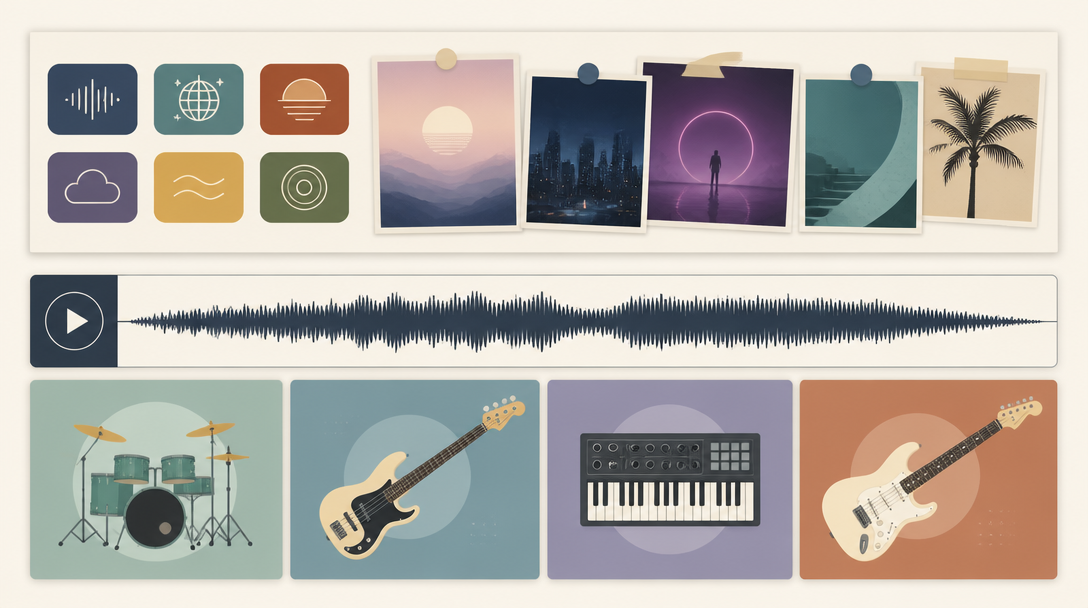
If you start stacking sounds right away, it is easy to lose your sense of direction and get lost partway through. The quality of an arrangement changes dramatically depending on the preparation you do before you touch a single instrument. Start by locking down the following three things.
Choose a Genre
Once you decide the genre of the song you are making, the instruments, tempo, and song forms you will use narrow down almost automatically. Rock, pop, EDM, city pop, and every other genre comes with a standard instrumentation and rhythmic template, and that template becomes your blueprint. If the genre stays vague, every decision about choosing instruments and building sections starts to wobble.
Pick Reference Tracks
Prepare two or three existing songs (references) that are close to the finished result you are aiming for. References are a map that lets you read instrumentation, song structure, and how the energy moves over time. iZotope describes analyzing a reference track with a spectrogram to build an "energy map," so you can see which sections raise the density and by how much. You should never copy a reference outright, but using it as a structural guide removes a lot of guesswork.
Decide Your Instruments (Sounds)
Once the genre and references are set, assign roles to the instruments that will make up the song. In arrangement, it is easier to stay organized if you think in terms of role divisions like these:
- Low-end foundation: kick and bass (they carry the song's center of gravity and groove)
- Rhythm: snare, hi-hat, and percussion (they create forward momentum)
- Harmony (accompaniment): piano, guitar, pads, and synths (they sound the chords)
- Melody / lead: vocal, lead synth, and guitar solo (the star melodic line)
- Decoration (texture): effects, ambience, and fills (they add space and expression)
Building Song Structure (Form)
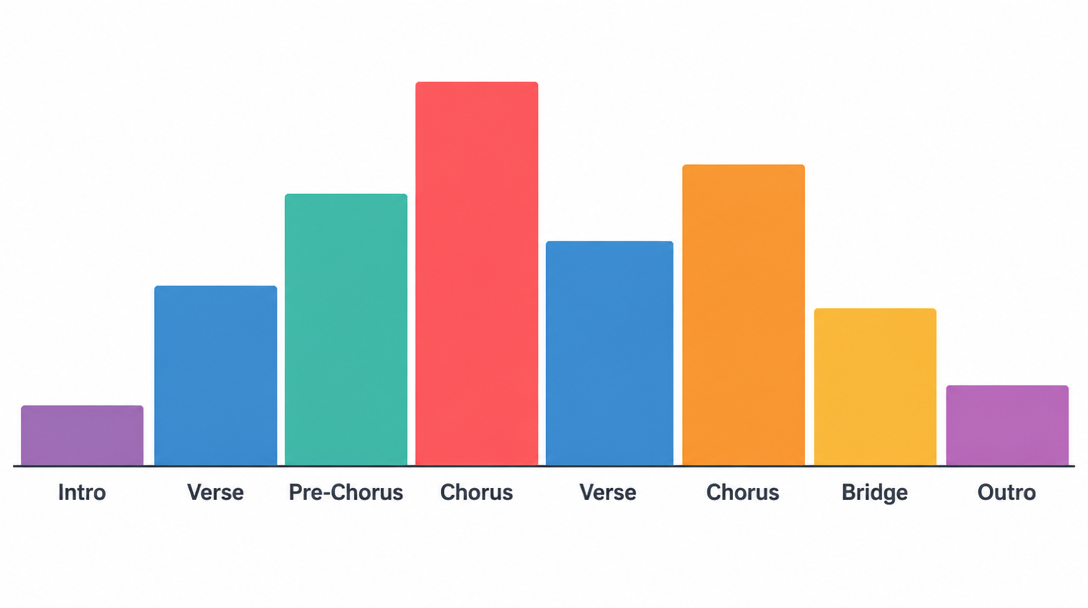
Before you layer instruments, decide the form that will serve as the map for the whole song. From intro to outro, the order in which you place each section becomes the skeleton of the listener's experience.
Roles of the Main Sections
Drawing on Native Instruments' guide to song structure and Splice's overview, the role of each section can be organized as follows. The table below sums it up.
Section | Role | Arrangement point |
|---|---|---|
Intro | Draw the listener in; present the tempo and tones | Keep elements sparse and build anticipation |
Verse | The foundation that unfolds the story | Hold the density back so the vocal stands out |
Pre-chorus | A bridge into the chorus; build tension | Add elements gradually to raise expectation |
Chorus | The climax; the part you most want to deliver | Maximize note count, range, and thickness |
Bridge | A change and a turning point | Use new elements to avoid monotony |
Outro | The close of the song | Reduce elements to leave a lingering impression |
Common Song Forms
Popular music has standard forms that get reused again and again. Native Instruments lists these as representative structures:
- Verse–chorus form (AB): the most common form in modern pop
- Verse–chorus–bridge form (ABABCB): the form Splice calls the most common in modern commercial music
- 32-bar form (AABA): eight bars times four, common in classic standards
- 12-bar blues: a form that cycles I–IV–I–V
How Long Should Sections Be?
Section lengths are built in basic units of 4, 8, and 16 bars. In pop and dance styles an 8-bar verse tends to hold attention well, while in hip-hop and R&B a 16-bar verse lets the lyrics be heard in depth. On bridges, Berklee Online explains that a bridge is best placed just once, right before the final chorus, to create a musical and lyrical turning point. Start by following a standard form, and once you are comfortable, begin to break it.
The Order of Layering Instruments: Additive Arranging
Once the structure is set, it is finally time to layer the instruments. There is no fixed order, but the less experienced you are, the less you will get lost if you build up from the foundation.
Start With the Rhythm Section
First, lock the song's center of gravity and groove with the rhythm section—drums and bass. If this does not settle, anything you stack on top tends to sound like a performance with no core. We cover how to build drum patterns in our introduction to beatmaking and bass in how to write basslines. iZotope likewise suggests that laying down drums, then bass, and then synths in that order is the natural flow.
Layer the Harmony and Melody on Top
On top of the foundation, add the accompaniment that sounds the chords (piano, guitar, pads) and the melody. According to Antares, adding instruments during arrangement is the most obvious way to raise energy. That said, more is not always better; the important thing is to give every part a clear, defined role.
Use Subtraction to Stay Clear
Addition alone leads to traffic jams in your sound. In arrangement, deciding where to take things away is just as important. Native Instruments suggests techniques such as introducing new harmony where a repeat is about to feel stale, and opening up the range between parts so each element cuts through clearly. Add and remove instruments section by section to create variation in density.
Frequency Separation and Dynamics
When you stack several instruments, the same range tends to collide and produce a muddy, cluttered sound. What prevents this is frequency separation together with the design of level and dynamics.
Avoid Frequency Clashes
Stay aware of where each instrument sits on the frequency spectrum—low, mid, or high—so that multiple parts do not compete in the same band. iZotope recommends arranging instruments so the bands do not conflict in the first place—moving a part up an octave, or thinning out parts that hold the low end—rather than forcing cuts with EQ later. The more you organize things in the arrangement, the easier the mix downstream becomes.
Leave the Low End to Kick and Bass
The low end where a song's energy concentrates (roughly 20–160 Hz) is the home of the kick and bass. When low content from other instruments creeps in here, the whole track turns muddy. Cut the low band of pads and synths, or move their phrases up into a higher range, and the foundation becomes clean. Organizing the low end directly affects the clarity of the groove.
Make Room for the Vocal (the Star)
In a vocal song, the voice is the star that should stand out most. Another iZotope article points out that in professional arrangements there is not a single instrument occupying the same band as the vocal. If the vocal lives in the mid to upper-mid range, deliberately split the accompaniment toward the low end (bass, low piano) and the high end (bright strings, high guitar) to open space in the middle. Beyond that, call-and-response—letting an instrumental phrase be heard in the gaps where the vocal is not singing—is also effective. For working with space-based effects, our guide on using reverb and delay is a useful reference.
Keeping Listeners Engaged: Tension and Release
A good arrangement moves its energy throughout. If the density stays the same the whole way, the listener gets bored. Design tension and release to give the track dynamics.
Balancing Repetition and Variation
Repetition creates familiarity, and variation keeps things fresh. The balance between these two is exactly what makes a song you never tire of. Splice argues that strategically contrasting elements—tension and release, density and space, live playing and programming—produces an arrangement that pulls the listener all the way through. Even the same eight bars change character when you simply add or drop one instrument on the second pass.
Tension Builds and Breaks
Use fills and risers (rising sounds) before the chorus to raise expectation, then release it all at once at the top of the chorus—this wave of tension and release is what gives a song drama. iZotope describes opening and closing a low-pass filter to change the texture, storing energy and then releasing it. Dropping in a break (a passage where the note count is sharply reduced) makes the next section feel far stronger.
Make the Chorus the Peak
In pop, design the chorus so it becomes the energy peak of the entire song. Maximize the thickness with means like increasing the note count, widening the range, and adding backing harmonies. Put another way, the trick to making the chorus stand out is to hold something back deliberately in the verse and pre-chorus rather than spending everything early.
Common Arrangement Mistakes and How to Fix Them
Finally, here are the points where beginners tend to stumble, along with the direction to fix them. If any of these apply to you, revisit them one at a time.
Too Cluttered and Muddy
Adding too many instruments with good intentions leads to what iZotope describes as a soup where the sound turns muddy and each instrument's tone becomes blurred. The fix is subtraction: cut parts whose roles overlap, and give every element its own band and place.
Flat and Monotonous
When the density stays constant throughout, the sense of climax never comes across. Add and remove instruments section by section, and create peaks and valleys that open up at the chorus. An arrangement whose energy moves sounds more finished for that reason alone.
Stuck Copying the Reference
A reference is something to use as a structural map, not something to copy as is. Once you borrow the form, rebuild the instruments and the development to fit your own melody and genre. Be careful not to lift phrases or arrangements from copyrighted songs directly.
Summary
Arrangement is the design work of building your material into a single song. Once you have the steps down, even a beginner can move a track toward completion without getting lost. Here are the key points:
- Arrangement is the stage that decides what will play; it sits between composition (making the material) and mixing (the finishing)
- Deciding the genre, references, and instrument roles before you start keeps you from getting lost
- Build the form from intro to outro first, and begin from a standard template
- Layer in the order of rhythm section, then the parts on top, and organize density through subtraction
- Separate frequencies, leave the low end to kick and bass, and open space for the star
- Move the energy with tension and release, and design the chorus as the peak
The fastest way to improve is to build just one song all the way through using a standard form. As one example of finished music built this way, try listening to Daito's released tracks for reference. As you repeat the process, you will keep adding to your own set of arrangement ideas.