How to Write a Melody: A Beginner's Step-by-Step Guide
Learn how to write a melody step by step: pick a scale, build a motif, balance steps and leaps, shape the contour, and fit notes to chords for memorable tunes.

You can hum a tune in your head, yet turning it into a finished song feels impossible. This is where most beginner composers get stuck. The good news is that writing a melody follows a repeatable process. Once you understand scales, motifs, contour, and how notes relate to chords, you no longer have to rely on inspiration alone. This guide breaks down how to write a melody into concrete, theory-backed steps.
What It Means to Write a Melody
A melody is a single "singable line" of pitches and rhythms unfolding over time. Before diving in, let's see where it fits in a song.
The Three Elements of Music
Music is built from melody, harmony, and rhythm. The melody is the star that listeners hum first, while chords and rhythm form the foundation beneath it. Understanding this relationship tells you where to look when a melody isn't working. For more on the harmonic side, see our guide to chord progressions.
There Is No Single "Correct" Melody
There is no absolute right answer when writing a melody, but memorable tunes do share common principles. As How To Write Songs puts it, "great melodies are made out of a well-balanced combination of repetition and variation." This article follows that same principle.
Two Approaches: Chords First or Melody First
You can either set a chord progression and write a melody over it (chords first), or capture a hummed tune and harmonize it later (melody first). Beginners often find the "chords first" route easier because the harmony narrows down which notes will sound good. Either way, understanding scales is the foundation. Here is how the two compare.
Approach | Process | Best for | Benefit |
|---|---|---|---|
Chords first | Progression → melody | Beginners, DAW users | Fewer note choices, harder to go wrong |
Melody first | Humming → harmonizing | Those with tunes in their head | Free, more original ideas |
The Five Steps of Writing a Melody
Before the details, here is the whole process at a glance. Repeat this loop and your melody takes shape.
- Choose a key and scale to limit your notes.
- Create a short two-to-five-note motif.
- Repeat and vary it through "present, develop, resolve."
- Favor stepwise motion, and build an arch contour with one peak note.
- Sort out chord tones and non-chord tones, add rhythm, and check it is singable.
Each of the following sections explores one of these steps in turn.
Choose a Scale to Limit Your Notes

The first practical step is deciding your scale — the pool of notes you'll draw from. Limiting the palette makes it far easier to write something coherent.
Major and Minor Scales
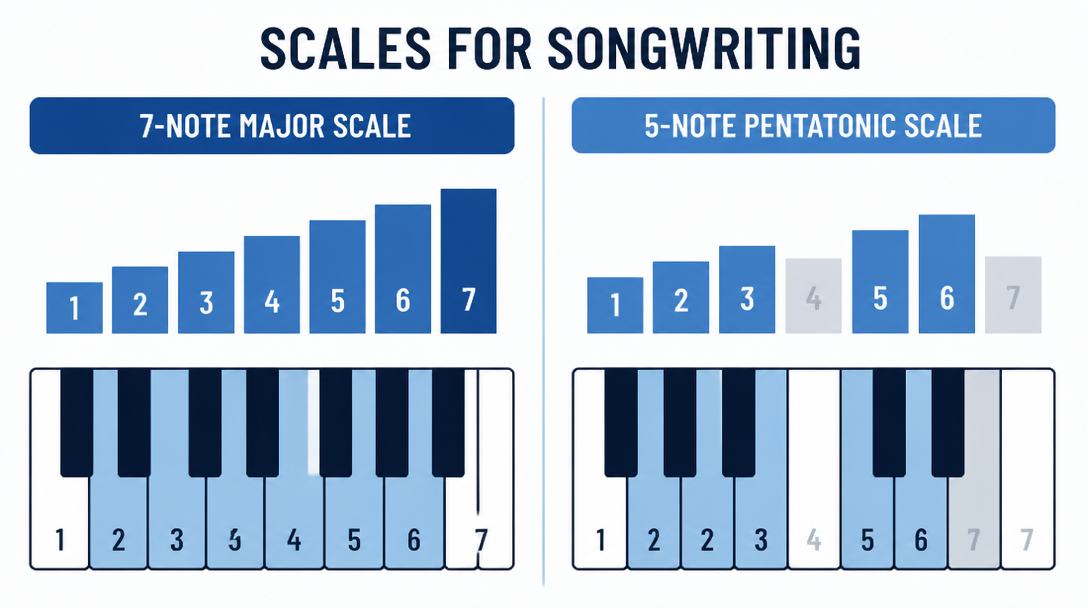
The two fundamentals are the bright major scale and the wistful minor scale. Piano With Jonny advises that "most of the notes in your melody should be drawn from a familiar 7-note scale, such as the major scale." Pick one key and stay within its seven notes to start.
Why the Pentatonic Scale Is Beginner-Friendly
If seven notes feel like too many, the five-note pentatonic scale helps. The major pentatonic removes the 4th and 7th degrees of the major scale, so it contains no half-step clashes. Because those tense semitones are gone, it's hard to hit a "wrong" note, which is why it appears in folk music worldwide and is a staple for beginner improvisers.
Picking a Key
Choose a key based on vocal range or how easy it is to play. For vocal songs, set the key so the highest note of the chorus sits comfortably in the singer's range — this prevents writing a melody nobody can actually sing. For programming in a DAW, C major (A minor) uses only white keys and is the easiest to visualize.
Build a Motif and Grow It

With a scale chosen, it's time to arrange notes. The key concept here is the motif.
What Is a Motif?
A motif is a short seed phrase, usually just two to five notes, that you repeat and vary to grow a full melody. As SoundQuest explains, a melody is made by presenting a small phrase, developing it through repetition, and finally releasing that repetition to land.
Present, Develop, Resolve
This "present, develop, resolve" arc is the backbone of melody writing. Introduce the motif, repeat it while gradually changing rhythm or pitch to build energy, then stop the repetition to conclude. Simply keeping this shape in mind gives a wandering line direction and momentum.
Balancing Repetition and Variation
The most important skill is balancing repetition with variation. Pure repetition is monotonous; total unpredictability sounds like an aimless exercise. How To Write Songs warns that "using all 7 notes will result in a melody sounding just like an exercise," so deliberately limit your notes and change only the ending or rhythm at first.
Shape the Melodic Contour
Beyond individual notes, the overall "shape" of a line — its contour — determines how memorable it feels.
Steps and Leaps
Melodies move by "steps" (to adjacent notes) or "leaps" (to distant notes). Ableton's melody course stresses that good contour balances two axes: rise versus fall, and stepwise versus leaping motion. Keep singable stepwise motion as your base and save leaps for moments of emphasis.
The Arch and Its Climax
The most reliable contour is the arch: start low, reach a peak near the middle, and descend in the second half. Ableton notes that "good melodies often have a single peak note...that peak note often occurs on a strong beat." Give each phrase one climactic high note and build toward it.
After a Leap, Step Back
After a large leap, moving stepwise in the opposite direction sounds natural — the tension of the jump resolves through the step. Following this "leap then step back" rule alone makes an awkward line far easier to sing. To add rhythmic variety, the ideas in our beatmaking guide apply here too.
Fit the Melody to the Chords
When writing chords first, understanding how notes relate to harmony helps you avoid muddy clashes — a common self-taught stumbling block.
Chord Tones and Non-Chord Tones
Notes that make up a chord are "chord tones"; everything else is a "non-chord tone." Placing chord tones on strong positions like downbeats and long notes creates stability, while non-chord tones add movement when used in passing.
Passing and Neighbor Tones
The most common non-chord tones are the passing tone (connecting two chord tones) and the neighbor tone (stepping away and back). Filling the gaps between chord tones this way turns a leap-heavy line into smoother, more singable stepwise motion.
Use Cadences to Shape Phrases
Piano With Jonny recommends structuring melodic phrases around harmonic cadences. Ending your melodic phrases where the chords reach half or full cadences helps listeners grasp the structure. To align lyrics with the tune, coordinate these breaks with the word phrasing from our lyric-writing guide.
Make It Truly Singable with Rhythm and Repetition
Even with the right pitches, a flat rhythm kills the appeal. Here are the finishing touches that bring a melody to life.
Add Character Through Rhythm
The same pitches feel completely different depending on note lengths and timing. Hold a long note then run with quick figures, or use rests to create space. To shape character through tone itself, see our synthesis basics guide.
Sing It Out Loud
Always hum your finished melody yourself. Problems like no room to breathe or a range too wide to sing are hard to spot on a piano roll. Whether a line is singable is a good proxy for whether it's memorable.
Release Your Melody as a Finished Work
Once you're happy with a melody, aim to finish the song and put it out into the world. Today anyone can distribute to streaming platforms; we compare the steps in our music distribution guide. As a reference, the author Daito Iwasaki's tracks are available on Daito's distribution page, where you can hear how a melody develops into a complete song.
Summary
Writing a melody is not pure guesswork — it can be reduced to a repeatable process. Here are the key points:
- Limit your notes: choose a scale first, and start with the pentatonic to avoid wrong notes.
- Grow a short motif through "present, develop, resolve," balancing repetition and variation.
- Base your contour on the arch, give it one peak note, and step back after every leap.
- When writing chords first, put chord tones on strong beats and fill gaps with passing and neighbor tones.
- Vary the rhythm, and always sing the line aloud to confirm it's singable.
Start by writing a single phrase from a four-note motif in C major. Theory is just a toolbox — the fastest route to writing great melodies is to keep your hands moving and internalize these ideas one at a time.