Chord Progressions Explained: Patterns & Modulation Tips
Learn chord progression fundamentals, diatonic harmony, 5 essential patterns used in pop music, and modulation techniques to make your compositions more dramatic.
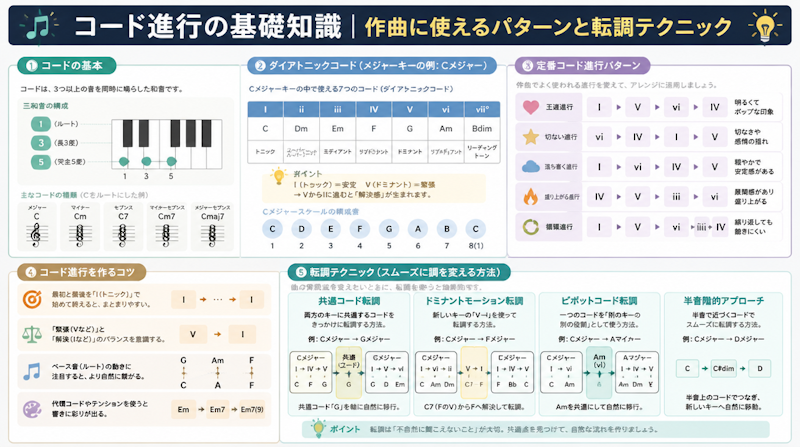
Chord progressions are one of the most fundamental building blocks of songwriting. The chords you choose and the order in which you arrange them determine the emotional arc and overall feel of a piece of music. This guide covers everything from the foundational music theory behind chord progressions to the most widely used patterns in pop songwriting, and finally to modulation techniques that can elevate a composition from ordinary to unforgettable.
What Is a Chord Progression? Understanding the Basics of Composition
The Difference Between a Chord and a Chord Progression
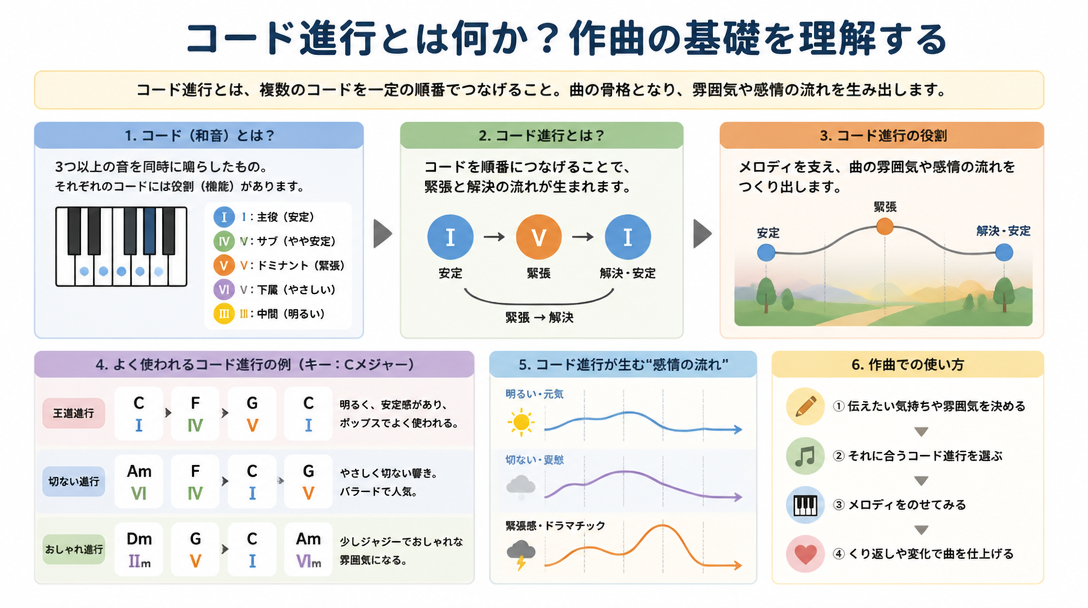
A chord is the sound produced by playing multiple notes simultaneously. A C major chord, for instance, is built from three notes — C, E, and G — played at the same time. A chord progression is simply a series of chords arranged in sequence across time.
On its own, a single chord produces a static sound with little sense of movement. But when chords change — say, from C to F, and then from F to G — the listener experiences a sense of emotional motion. Tension builds, releases, and transforms. This sense of harmonic movement is what gives music its narrative quality.
In composition, the chord progression functions as the skeleton of a piece. Melodies are built on top of chord progressions, and the progression itself sets the overall mood and emotional direction of the song. Choosing the right progression is one of the most impactful decisions a songwriter makes.
Why Chord Progressions Matter
Understanding chord progressions brings several practical advantages to any songwriter or producer. First, it removes the paralysis of starting from scratch — knowing established progressions means there is always a solid starting point for a new track, dramatically improving workflow and creative output.
Second, understanding which chords evoke which emotions allows for intentional emotional expression. Rather than relying purely on intuition, a composer can make deliberate harmonic choices that serve the song's narrative goals.
Finally, chord progression literacy allows composers to analyze existing music. Studying the progressions used in favorite songs is one of the most effective self-education tools available. Patterns that appear across genres reveal why certain musical moments feel satisfying, tense, or uplifting — and those insights can be applied directly to original compositions.
Music Theory Foundations: Diatonic Chords and Functional Harmony
What Are Diatonic Chords?
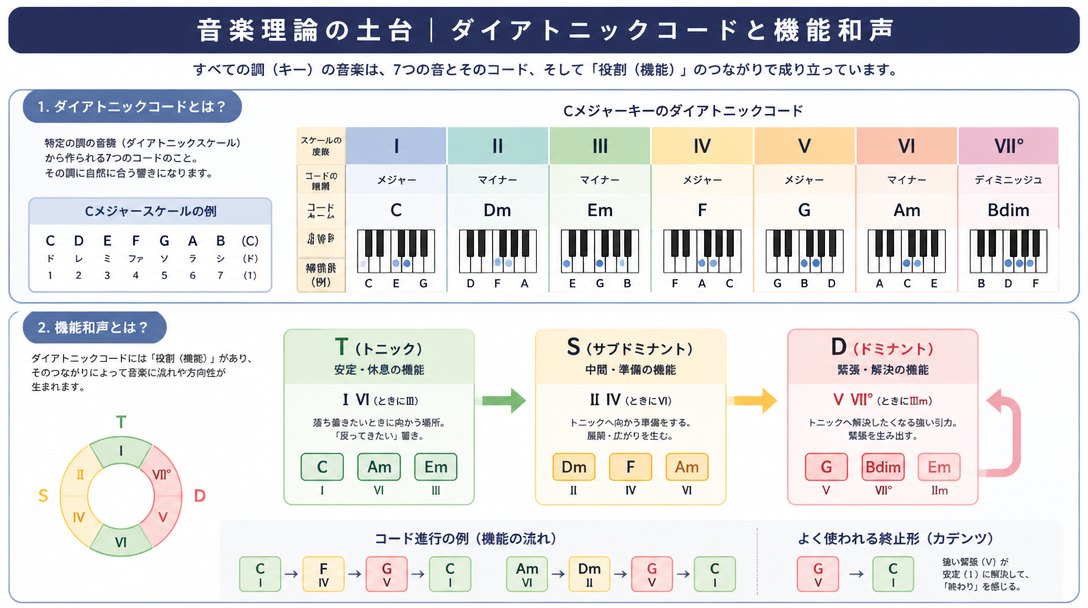
Diatonic chords are chords built exclusively from the notes of a particular key's scale. In the key of C major, the scale consists of seven notes — C, D, E, F, G, A, and B. By stacking notes from this scale in thirds, seven diatonic chords are generated, one built on each scale degree.
Music educators consistently identify mastery of these seven chords as the foundational step in learning songwriting. By labeling each chord with a Roman numeral (called a "degree name"), composers can describe a chord progression in a key-independent way. This means the same progression can be instantly transposed to any key simply by shifting the root note.
The table below shows the seven diatonic chords in C major, along with each chord's type and harmonic function:
Degree | Chord (Key of C) | Chord Type | Function |
|---|---|---|---|
I | C | Major | Tonic |
II | Dm | Minor | Subdominant leaning |
III | Em | Minor | Tonic leaning |
IV | F | Major | Subdominant |
V | G | Major | Dominant |
VI | Am | Minor | Tonic substitute |
VII | Bm(♭5) | Diminished | Dominant leaning |
The Roles of Tonic, Subdominant, and Dominant
Functional harmony — the system that assigns each chord a specific role or "function" — is the cornerstone of Western music theory. Each diatonic chord belongs to one of three functional groups: Tonic, Subdominant, or Dominant. Understanding these roles makes it possible to predict how chords will feel and how they interact with each other.
- Tonic (T): The harmonic "home" of the key. The I chord (C major) is the primary tonic. It conveys stability, resolution, and rest. Phrases often begin and end here, giving the listener a sense of arrival.
- Subdominant (SD): The chord of departure — a sound that suggests movement away from home without creating strong tension. The IV chord (F major) is the archetypal subdominant. It provides a gentle sense of forward motion and acts as a bridge between tonic and dominant.
- Dominant (D): The chord of tension and anticipation. The V chord (G major) creates an unmistakable pull back toward the tonic, a phenomenon known as the dominant motion. This resolution — V resolving to I — is one of the most powerful and satisfying moments in tonal music.
The foundational progression in tonal music follows a T → SD → D → T arc. Every classic chord progression can ultimately be understood as a variation of this basic harmonic narrative. Grasping this principle transforms chord choices from guesswork into intentional storytelling.
Building Progressions Using Harmonic Function
Once the three functions are understood, composing compelling progressions becomes a matter of managing tension and release. A few key principles guide this process:
- T → SD → D → T: The simplest "beginning, development, climax, resolution" arc — reliable and universally satisfying.
- Dominant resolving to Tonic: Whenever the V chord appears, the listener instinctively expects the I chord to follow. Fulfilling or deliberately withholding this resolution is a powerful expressive tool.
- Subdominant to Tonic (Plagal Cadence): Moving directly from IV to I — skipping the dominant — creates a softer, more peaceful resolution often associated with hymns and ballads.
- Tonic substitution with vi minor: Replacing the I chord with the vi chord (Am in C major) adds emotional depth and a slightly melancholic color while preserving the tonic function.
These principles explain why certain progressions feel instinctively satisfying. The emotional response listeners have to harmony is not arbitrary — it is rooted in the logical relationships between chord functions that Western music has developed over centuries.
5 Essential Chord Progression Patterns for Songwriters
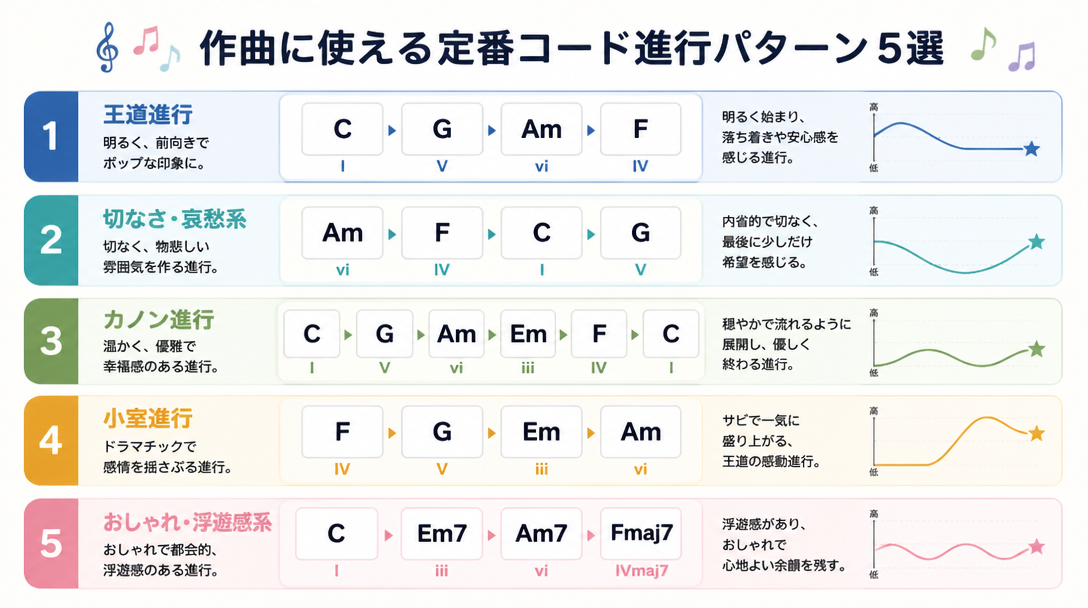
Dozens of useful chord progressions exist across genres, but the five below represent the most versatile and widely applicable patterns for modern songwriting. Mastering these gives any composer a powerful toolkit capable of covering the vast majority of popular music styles.
① The Three-Chord Progression (I–IV–V–I)
The three-chord progression — built on the I, IV, and V chords — is the absolute bedrock of popular music. In the key of C major, it is simply C → F → G → C. This progression forms the backbone of blues, rock, country, folk, and countless pop songs spanning decades.
Its power lies in its simplicity. The I–IV–V–I cycle encapsulates a complete harmonic journey: stability, departure, tension, and return. Despite its straightforwardness, it never feels tired because the emotional logic it expresses is universal. Changing the tempo, rhythm, instrumentation, or voicing is enough to make this same progression sound completely different across genres. It is the ideal starting point for anyone new to composition, and it remains endlessly useful for experienced songwriters as well.
Many legendary songs rely almost entirely on these three chords, proving that sophistication in music comes not from harmonic complexity alone, but from how the fundamentals are deployed.
② The Canon Progression (I–V–vi–iii–IV–I–IV–V)
Named after Johann Pachelbel's Baroque masterpiece Canon in D, this eight-chord cyclic progression has been used in popular music for over three centuries. In the key of C major, it unfolds as: C → G → Am → Em → F → C → F → G.
What makes the Canon Progression so enduringly effective is its descending bass line. The root movement traces a smooth stepwise descent through the scale, creating an underlying sense of flowing momentum that carries whatever melody is placed on top. Almost any melodic phrase sounds beautiful over this progression because the harmonic motion itself guides the ear so naturally.
The Canon Progression appears extensively in pop ballads, film scores, and anthemic choruses across Western and East Asian pop music alike. Its emotional character blends warmth, wistfulness, and forward motion — qualities that make it effective in both verses and choruses depending on arrangement.
③ The "Oukoku" (Royal) Progression (IV–V–iii–vi)
Known in Japan as the "ōdō" or "royal" progression, the IV–V–iii–vi pattern is one of the most recognizable harmonic sequences in contemporary J-pop. In the key of C major, it runs: F → G → Em → Am. This progression is also commonly referenced as the "4536 progression" based on its scale degree numbers.
The emotional character of this progression is its most distinctive quality: it manages to feel simultaneously bright, bittersweet, and emotionally stirring. The movement from the subdominant (IV) through the dominant (V) and then down through the minor chords (iii and vi) creates an arc that builds anticipation and then delivers a sense of tender emotional release. This quality makes it especially effective in choruses, where a song needs to reach an emotional high point.
The progression has become a staple not only in J-pop but also in anime themes, video game soundtracks, and various forms of electronic and acoustic pop. Its ability to feel simultaneously familiar and emotionally resonant has kept it relevant across decades of popular songwriting.
④ The vi–IV–I–V Progression
Sometimes called the "axis progression" or simply the I–V–vi–IV rearrangement, the vi–IV–I–V pattern — rendered in C major as Am → F → C → G — has been one of the most prevalent chord sequences in global pop music from the 1990s onward. It gained widespread recognition partly through its heavy use in Japanese dance-pop of that era.
Starting on the vi minor chord (Am) gives this progression an immediate emotional intensity. The minor beginning establishes a sense of longing or melancholy, while the resolution through the IV and I chords introduces warmth and hope. The dominant V at the end creates a sense of continuation, pulling the progression forward into the next cycle.
This progression is remarkably flexible. At a faster tempo with driving rhythms, it feels anthemic and energetic. Played slowly with sparse instrumentation, it becomes deeply emotional and introspective. The same harmonic material can support vastly different moods depending on production choices, making it one of the most versatile tools in a songwriter's arsenal.
⑤ The ii–V–I Progression
The ii–V–I (pronounced "two-five-one") is the single most important chord progression in jazz harmony. In C major, it takes the form: Dm7 → G7 → Cmaj7. The progression works by intensifying the dominant motion (V7 → I) with a preparatory subdominant chord (ii), creating a sense of harmonic gravity that pulls strongly toward the tonic resolution.
In jazz, ii–V–I patterns cycle continuously through a tune, often shifting keys with each iteration to create a sense of harmonic journey through different tonal centers. This is what gives jazz harmony its characteristic richness and sense of constant motion.
Beyond jazz, the ii–V–I turns up in sophisticated pop, soul, R&B, and the city pop genre that has seen a major global revival in recent years. When used as a transitional device between sections of a pop song — for example, linking a verse to a chorus — it creates an elegant sense of harmonic inevitability that feels both smooth and surprising. Adding seventh and ninth extensions to the chords in a ii–V–I instantly elevates the harmonic sophistication of any composition.
Progression | Degrees | C Major Example | Character / Genres |
|---|---|---|---|
Three-Chord | I–IV–V–I | C–F–G–C | Rock, blues, folk, country |
Canon Progression | I–V–vi–iii–IV–I–IV–V | C–G–Am–Em–F–C–F–G | Ballads, pop, film scores |
Royal Progression | IV–V–iii–vi | F–G–Em–Am | J-pop, anime themes |
vi–IV–I–V | vi–IV–I–V | Am–F–C–G | Pop, dance-pop, emotional anthems |
ii–V–I | II–V–I | Dm7–G7–Cmaj7 | Jazz, city pop, soul |
Techniques for Adding Variety to Chord Progressions
Using Tension Chords (Extensions)
Tension chords — also called extended chords — are built by adding notes beyond the basic triad or seventh chord. Adding extensions such as the 9th, 11th, or 13th introduces harmonic color and complexity that can make even a simple progression feel sophisticated and emotionally rich.
- Major 7th (maj7): Adds a dreamy, floating quality. Cmaj7 is a staple of pop, R&B, and city pop, giving chords a smooth, refined sound without feeling overly tense.
- Add9 (add9): Layers depth and openness onto a basic major chord without the harmonic complexity of a full ninth chord. Cadd9 feels airy and fresh — common in contemporary pop and indie music.
- Suspended 4th (sus4): Replaces the third of the chord with the fourth, creating a sense of unresolved anticipation. The classic Csus4 → C resolution is a go-to moment of gentle harmonic release.
- Diminished 7th (dim7): Produces an uneasy, suspenseful sound. Most effective as a passing chord — for example, placed between two diatonic chords to create chromatic movement — rather than as a destination chord.
Strategically incorporating these extended chords into an otherwise straightforward diatonic progression is one of the simplest ways to give a composition a distinctive harmonic personality without departing from the underlying key.
Slash Chords (Chords Over a Non-Root Bass Note)
A slash chord specifies both the chord voicing and the bass note when they differ. Written as "C/E," for instance, this indicates a C major chord played over an E in the bass. Slash chords are particularly powerful for creating smooth, stepwise bass lines that give a progression a sense of elegant motion below the surface harmony.
A practical example: the sequence C → C/B → Am → Am/G → F traces a bass line that descends chromatically — C, B, A, G, F — while the upper chord voices remain relatively stable. This technique produces a similar effect to the Canon Progression's descending bass line: a sense of graceful, inevitable forward motion that makes the progression feel simultaneously structured and flowing.
Slash chords are widely used in pop, film music, and progressive rock to create bass melodies that are as interesting as the chords above them. They also make it easy to voice-lead smoothly between chord changes, reducing any sense of abrupt harmonic jumps.
Chord Substitution
Chord substitution involves replacing one chord in a progression with another chord that performs the same harmonic function, adding variety while preserving the underlying harmonic logic. The most common type replaces the I chord with the vi minor chord (the "tonic substitution"), because both chords share two of their three notes and serve as harmonic home bases in the key.
- Tonic substitution: Replace C (I) with Am (vi) or Em (iii). Both maintain the tonic function while adding a minor, more introspective color.
- Subdominant substitution: Replace F (IV) with Dm (ii). Both function as pre-dominant chords but Dm introduces a slightly darker, more restless quality.
- Tritone substitution: Replace G7 (V7) with D♭7. The two chords share the same tritone interval (B and F / C♭ and F) and create the same sense of tension, but D♭7 resolves to C by half-step motion in the bass — a staple of jazz harmony and a source of unexpected chromatic richness in any genre.
Substitution is one of the most effective ways to personalize a well-known progression. By swapping out even one chord in a standard pattern, a composer can create something that sounds fresh and original while remaining harmonically coherent to the listener's ear.
Modulation Techniques: Making Songs More Dramatic
Modulation — the practice of shifting a song from one key to another during its course — is one of the most powerful tools available for generating emotional impact. A well-executed key change can elevate a chorus, signal a dramatic turning point, or give the impression that a song has suddenly opened up into a larger emotional space. There are several distinct approaches to modulation, each with its own character and level of complexity.
Direct Modulation
Direct modulation is the simplest form of key change: the song simply shifts to the new key without any harmonic preparation or transition. The most familiar version of this technique is the "last chorus key change," in which the final chorus of a song is transposed up by a half step or a whole step, creating an immediate surge of energy and excitement.
A half-step upward modulation — for example, from C major to D♭ major — delivers a striking, unmistakable lift. The abruptness of the change is part of its effect: the listener is not given time to anticipate the shift, so it arrives as a jolt of energy that reenergizes even a familiar-sounding chorus. This technique has been used extensively in pop, gospel, and musical theatre precisely because of how reliably it delivers an emotional payoff.
Direct modulation is best deployed when surprise is the goal. Because there is no smooth transition, the listener experiences the new key as a sudden shift in harmonic perspective — an effect that is most powerful when used sparingly and at a strategically important moment in the song's structure.
Pivot Chord Modulation
Pivot chord modulation uses a chord that belongs to both the original key and the destination key as a harmonic bridge between them. This shared chord — called the pivot chord — allows the modulation to feel smooth and organic rather than abrupt, because the listener hears the transition as a natural continuation of the harmony rather than a sudden break.
For example, modulating from C major to G major: the chord Em (E minor) exists in both keys. In C major, it functions as the iii chord (tonic-leaning); in G major, it functions as the vi chord (tonic substitute). By treating Em as the pivot point, the song can transition between the two keys without any sense of disruption. The listener may not even consciously notice the key has changed until the new tonal center is firmly established.
Pivot chord modulation is particularly effective for transitions between song sections — moving from a verse to a pre-chorus in a new key, or shifting from a pre-chorus to a chorus. Because the change is smooth rather than jarring, it creates a sense of harmonic evolution rather than interruption, making the song feel structurally sophisticated and thoughtfully crafted.
Secondary Dominant Modulation
A secondary dominant is a dominant seventh chord applied to a chord other than the tonic — essentially borrowing the V7 → I resolution mechanism and applying it to any chord in the key. Secondary dominants can be used for brief, temporary "tonicizations" that color a progression without fully committing to a new key, or they can serve as preparation for a full modulation.
A clear example: in C major, moving toward Am (vi) is standard. But inserting E7 — the dominant seventh of A minor — before the Am chord creates the progression C → E7 → Am. The E7 chord does not belong to the key of C major, but its function is immediately intelligible to the ear: it is a dominant chord that makes Am feel like a temporary tonic. The result is a striking sense of arrival on the Am chord that the plain diatonic progression would not achieve.
Secondary dominants can be chained together to create sequences that drift through several key areas before returning to the original tonic — a technique central to jazz harmony and useful in any genre where harmonic richness is a goal. Combining secondary dominants with pivot chord transitions creates the most flexible and musically sophisticated approach to modulation.
Modulation Technique | Character | Best Used For | Difficulty |
|---|---|---|---|
Direct (half-step up) | Bold, immediately dramatic | Final chorus, climax | ★☆☆ |
Pivot chord | Smooth, seamless | Verse → pre-chorus, pre-chorus → chorus | ★★☆ |
Secondary dominant | Colorful, temporary | Chord progression accents, tonicization | ★★☆ |
ii–V–I modulation | Jazz-influenced, refined | City pop, jazz, soul | ★★★ |
Applying Chord Progressions in a DAW
Entering Chords in the MIDI Piano Roll
Theory knowledge becomes genuinely useful only when it is translated into sound. The most direct path from understanding chord progressions conceptually to internalizing them musically is to enter them into a DAW's MIDI piano roll and listen critically to the results. Building a strong grasp of MIDI fundamentals first makes this process much more efficient.
- Start with one chord per measure at a slow tempo — this makes it easier to hear how each chord change feels in isolation before combining them at full speed.
- Enter each chord as four quarter notes and listen carefully to the voicing and texture, not just the harmonic change.
- Use separate MIDI tracks for the chord part and the bass line, assigning each a different instrument. This clarifies how the bass interacts with the harmony above it.
- Experiment with chord voicings — different arrangements of the same chord notes across different octaves produce dramatically different tonal effects. Closed voicings feel dense and full; open voicings feel spacious and airy.
As noted in the guide to choosing a DAW, whether working in Logic Pro, Ableton Live, FL Studio, or any other platform, the basic process of entering chords in a MIDI piano roll is essentially the same. The important thing is to start working in the DAW immediately rather than waiting until theory feels "fully understood" — theory and practice reinforce each other most effectively when pursued simultaneously.
Using Chord Assistant Plugins
For rapid chord progression prototyping, chord assistant plugins provide a highly efficient workflow. Tools like Scaler 2 allow composers to set a key and receive automatic suggestions for diatonic chords, common progressions, and even modulation pathways. This kind of tool does not replace theoretical understanding — it accelerates the exploration process once that understanding is in place.
Pairing chord assistant plugins with knowledge from the fundamentals of synthesizer sound design opens up even richer possibilities: designing pad sounds and lead tones that complement the harmonic character of a progression, rather than fighting against it, is a key step toward producing music that feels cohesive and intentional from the ground up.
The Role of Chord Voicings in the Mix
Once a chord progression is finalized, the choices made during mixing — particularly around chord voicings and the frequency ranges each instrument occupies — have a significant impact on how the harmony translates into the final mix. When chord instruments cluster too densely in the low-mid frequency range, the result is a muddy, indistinct sound that obscures both the harmonic clarity and the individual instruments.
Distributing chord voicings across different octaves, and being deliberate about which instruments cover which registers, keeps the harmony clear and the mix open. Combining these arrangement strategies with the proper use of EQ and compression ensures that the emotional impact of the chord progression comes through clearly in the finished recording — not buried beneath competing frequencies or blurred by excessive low-end buildup.
Summary
Chord progressions are the structural foundation of composition. Once internalized, this knowledge applies to virtually every aspect of songwriting and music production. Here is a recap of the key concepts covered in this guide:
- Diatonic chords and functional harmony: Understanding the three harmonic functions — Tonic, Subdominant, and Dominant — is the essential starting point for all chord progression work.
- Five essential progressions: The Three-Chord (I–IV–V–I), Canon (I–V–vi–iii–IV–I–IV–V), Royal (IV–V–iii–vi), vi–IV–I–V, and ii–V–I progressions cover the harmonic needs of the vast majority of popular songs across genres.
- Variation techniques: Extended chords, slash chords, and chord substitution add individuality and harmonic color to standard progressions without requiring departure from functional harmonic logic.
- Modulation: Direct modulation, pivot chord modulation, and secondary dominant techniques each offer distinct ways to shift key — from bold and dramatic to subtle and seamless — dramatically expanding the emotional range of a composition.
- DAW practice: Entering progressions into a MIDI piano roll and listening critically to the results is the fastest and most reliable path to genuinely internalizing the theory.