How Rhythmic Gymnastics Is Scored: D, A & E Scores Explained
How rhythmic gymnastics is scored under the FIG 2025-2028 Code: the D (difficulty), A (artistry) and E (execution) scores, and what changed in 2025.
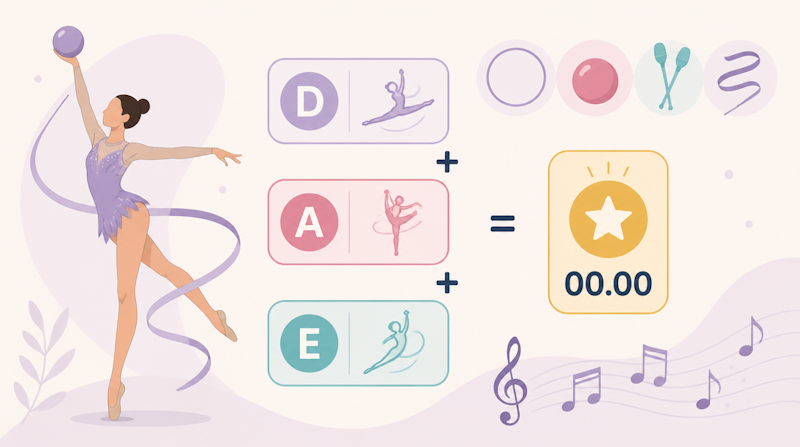
Rhythmic gymnastics scoring is never a single number. Every routine is judged by three independent panels, and the final result is the sum of a D-score (Difficulty), an A-score (Artistry) and an E-score (Execution), with penalties subtracted. This guide explains how rhythmic gymnastics is scored under the FIG 2025-2028 Code of Points, covering everything from the logic of body and apparatus difficulty to the differences between individual and group routines and the main rule changes introduced in 2025. Along the way it offers pointers for building competition music that works with the scoring system rather than against it.
How Rhythmic Gymnastics Is Scored: The Three Scores (D, A & E)
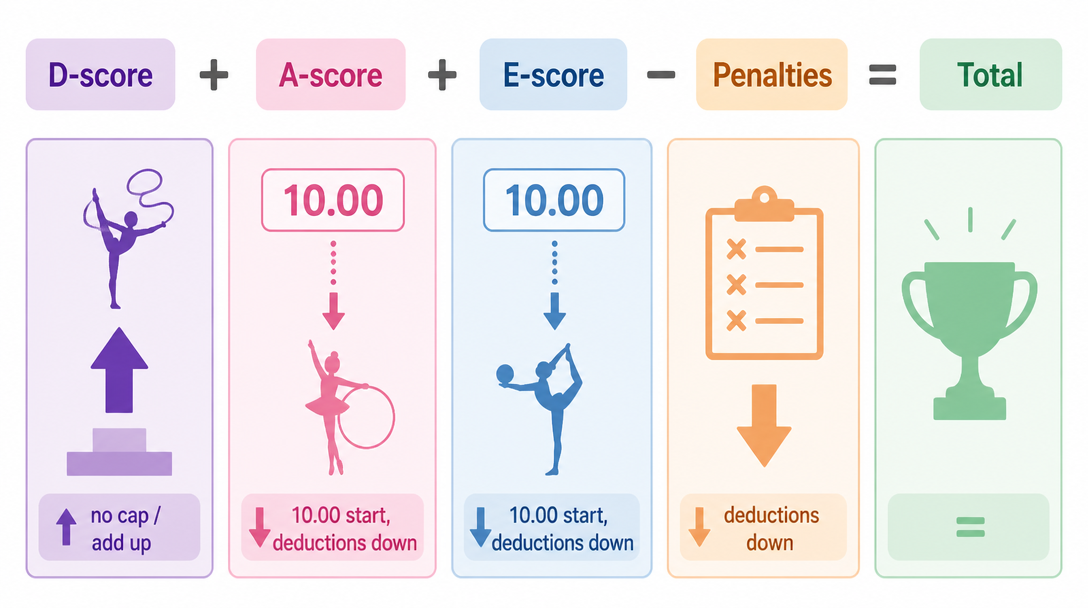
The first step in understanding rhythmic gymnastics scoring is to realise that the mark is not one figure but the sum of three separate scores. Packing a routine with hard elements is not enough: if the execution breaks down or the composition feels monotonous, the total will not climb. What makes rhythmic scoring distinctive is that it constantly tests the balance between difficulty, artistry and execution.
The Total-Score Formula
The total score in rhythmic gymnastics can be written as a single formula.
- Total score = D-score (Difficulty) + A-score (Artistry) + E-score (Execution) − Penalties
The D-score is an additive mark that stacks up the difficulty you build into the routine, and it has no upper limit. The A-score and the E-score, by contrast, are judged on a deduction basis that starts from a maximum of 10.00 points. In other words, you build points through difficulty while trying to keep deductions in artistry and execution as small as possible, and the interplay of the two sides decides the total. The regulations of the Japan Rhythmic Gymnastics federation likewise describe the score as being made up of the three D, A and E components.
The Role of Each of the Three Scores
D, A and E each evaluate something different. Once you grasp how their roles differ, it becomes much clearer where in a routine you can actually manufacture points.
Score | What it evaluates | Starting point | Cap |
|---|---|---|---|
D-score (Difficulty) | The difficulty of the routine: body difficulties, apparatus difficulties, dynamic elements and more | Built up from 0 | No cap |
A-score (Artistry) | Composition, expression, unity with the music, rhythm and use of the floor | 10.00 points | Deduction-based |
E-score (Execution) | Technical accuracy, posture and faults in apparatus handling | 10.00 points | Deduction-based |
This three-part framework is carried over in its broad shape by the revised 2025-2028 Code of Points. Whether a gymnast attacks through difficulty or competes on the polish of artistry and execution is a strategic choice that varies from one athlete or team to the next.
Why Music Is So Deeply Tied to the Score
Rhythmic gymnastics is a sport in which you must perform to music. The music is not mere background sound: it is the foundation for the rhythm, the build-ups and the expression of the movement, and it is tied especially closely to the A-score (Artistry). Whether the structure of the piece meshes with the development of the routine, and whether the elements are set off by the accents of the music, has a large influence on the impression that shapes the artistry mark.
For that reason, building a soundtrack with the scoring rules in mind feeds directly into competitive performance. If you want to discuss editing or song choice that is conscious of the "unity with the music" the judges reward, one option is to commission a creator who understands the Code, as with competition floor-music production. Understanding what the score actually measures first makes it far clearer what you should ask of your music. For how the music rules differ from those in artistic gymnastics (floor exercise), see our detailed guide on music rules and song selection in rhythmic gymnastics.
How the D-Score (Difficulty) Works
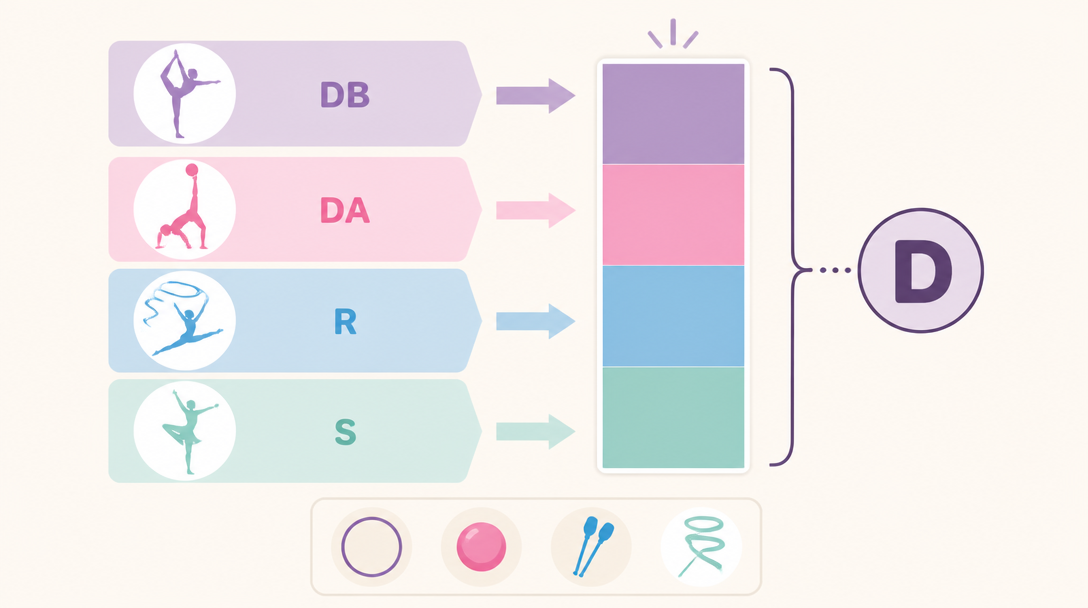
Within rhythmic gymnastics scoring, the D-score is the part that gymnasts assemble most strategically. It is an additive mark that stacks up the difficulty built into the routine, and it is made up largely of body difficulty (DB) and apparatus difficulty (DA), together with dynamic elements. According to JudgeMate's explanation, the final D-score is the body-difficulty block (DB) added to the apparatus-difficulty block (DA), and it has no upper limit.
Body Difficulty (DB)
Body difficulty evaluates the body elements such as jumps and leaps, balances and rotations. Of the body difficulties a gymnast builds into a routine, a set number of the highest-value ones are counted. Because the number of difficulties that count is defined by category (senior / junior) and by the FIG regulations, the surest way to confirm the exact limit is to check the official FIG Code.
Each body difficulty is assigned a difficulty value in points. Harder elements carry a higher value, but if the execution does not match, the E-score takes a deduction, so gymnasts weigh up which difficulties they can perform reliably when they build a routine. Chasing value you cannot deliver cleanly tends to cost more than it gains.
Apparatus Difficulty (DA)
Apparatus difficulty is the difficulty of handling the apparatus — the hoop, ball, clubs or ribbon. Throws and catches, passing the apparatus under the body, and handling it without the use of a body part are all among the many manipulations that are evaluated. Under the 2025-2028 Code, the evaluation of apparatus difficulty has broadened so that variations of handling that do not involve a large throw or rotation are also counted. The richness of apparatus work is now more readily reflected in the score.
Risk / Dynamic Elements (R)
R refers to dynamic elements that combine a large throw with rotation. While the apparatus is thrown high, the gymnast performs several body rotations and then catches it again — precisely the kind of showpiece unique to rhythmic gymnastics. The value changes with the number of rotations in the air and with the way the apparatus is caught; a success pushes the D-score up sharply, while a drop costs a deduction on the E-score, which makes it a high-risk, high-reward element.
Dance Step Combinations (S)
A dance step combination is a sequence of steps or dance matched to the character of the music, binding bodily expression to apparatus handling. It carries value as a difficulty and at the same time feeds into the A-score (Artistry). Steps that become one with the music are a source of points on both the difficulty and the artistry side. If you want to compare this with how the D-score is handled in artistic gymnastics floor exercise, reading our explanation of women's floor scoring (D-score and composition requirements) alongside this will make the differences clear.
How the A-Score (Artistry) Is Judged
The A-score evaluates the artistry and compositional quality of a routine. Starting from 10.00 points, deductions are taken according to faults on the artistic side. The reason rhythmic gymnastics is called "a scored sport and a sport of expression at the same time" lies precisely in the existence of this A-score.
A 10-Point Deduction System
The artistry judges watch the whole routine independently and decide the deductions on the artistic side. The targets of deduction include the character of the routine, expressiveness, dance steps, the connection of movements, rhythm and the use of the floor. Rather than simply lining up elements, what is asked is whether the routine is complete as a single work.
What Drives the Artistry Score
The main elements rewarded in the artistry score are as follows.
- The clarity of the character (personality or theme) that runs through the whole routine
- Unity with the music (matching rhythm and accents)
- The quality of the dance steps and bodily expression
- The smoothness of the transitions that connect the movements
- A spatial composition that uses the whole floor
All of these are tied directly to the quality of the chosen music and the composition. When the theme of the piece is vague, or when the build-ups and the placement of the elements are out of step, deductions in the artistry score come more easily.
Music and Composition Decide the Artistry Score
The quality and editing of the music are indispensable when it comes to raising the artistry score. Shaping a clear beginning-middle-end within the routine time (one minute fifteen to one minute thirty for individuals) and matching the showpiece elements to the climax of the music changes the impression of the artistry mark enormously. If you want to design a soundtrack with a firm grasp of the Code, discussing production and editing of competition music with a former athlete and artist makes it easier to build the composition and the music as a single whole. For the thinking behind song selection, our guide to choosing rhythmic gymnastics music is also worth a look.
How the E-Score (Execution) Is Judged
The E-score evaluates the accuracy of execution in a routine. As with the A-score, it starts from 10.00 points and is reduced according to technical faults. No matter how difficult a composition you put together, if the execution falls apart you lose points on the E-score and the total will not rise.
Deductions for Technical Faults
The execution judges take deductions only for technical errors in the execution itself. Rough apparatus handling, inaccuracy in body elements, and breakdowns in landings or posture are all targets. Deductions are applied in stages according to the size of the fault.
Common Examples of Deductions
The rhythmic gymnastics regulations and actual judging often show the following kinds of deductions.
- Dropping the apparatus: the deduction grows the further the gymnast has to travel to retrieve it
- Posture faults: a rounded back, bent knees, insufficiently pointed toes and the like (typically stacking up in units of 0.1)
- Rough apparatus handling: insufficient movement of the ribbon or tangling, and unstable catches
- Inaccuracy in elements: too few rotations, or a loss of balance
When small posture deductions pile up, the E-score drops more than you might expect. Day-to-day fundamental training is what supports the final mark.
A Training Perspective for Raising Execution
To raise the E-score, the shortcut is not to be greedy with difficulty but to "deliver the difficulty you already have reliably." Polishing apparatus handling and body difficulty separately, and then checking stability with full run-throughs to the music — this steady accumulation is what leads to a routine with few deductions.
Individual vs. Group: Routine Time and Apparatus
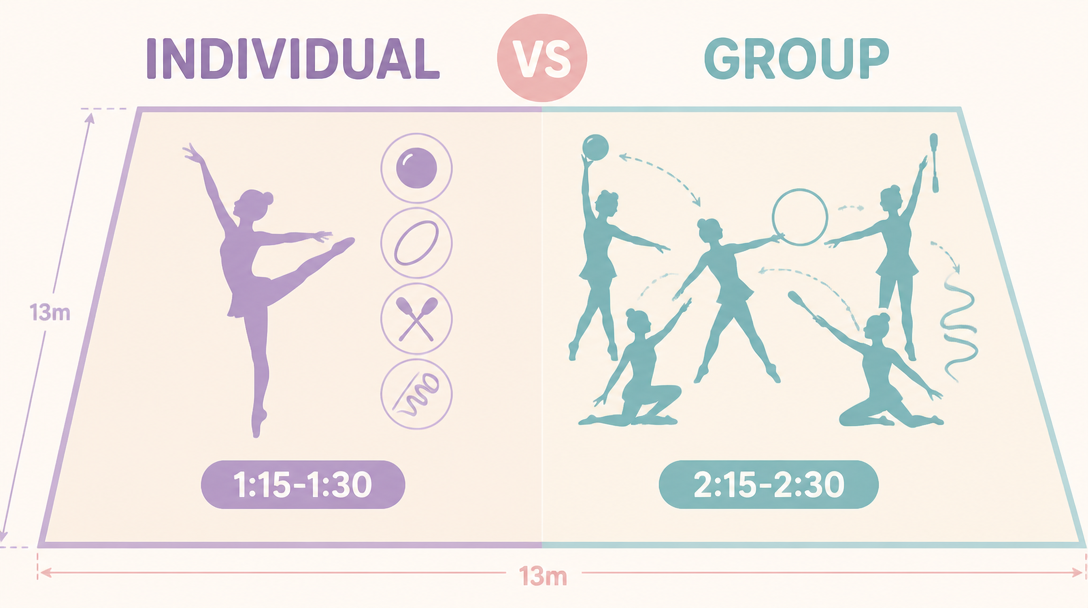
Rhythmic gymnastics has two events, individual and group. The basic scoring structure (D, A and E) is shared, but the routine time and the handling of the apparatus differ.
Individual (Four Apparatus, Routine Time)
In the senior individual event, gymnasts use four apparatus — hoop, ball, clubs and ribbon (there are five apparatus in rhythmic gymnastics including the rope, but the senior individual 2025-2028 program uses these four). The individual routine time is one minute fifteen seconds to one minute thirty seconds, with one gymnast handling a single apparatus throughout. Because each apparatus has its own handling characteristics, a composition suited to the apparatus is required.
Group (Number of Gymnasts, Exchanges, Routine Time)
The group event has several gymnasts performing at once, coordinating while exchanging apparatus. The routine time, at two minutes fifteen seconds to two minutes thirty seconds, is longer than the individual event, and the throws and exchanges between gymnasts and the changes in formation are the highlights, all of which feed into the difficulty and artistry evaluation. The apparatus set-up for the group is defined by the FIG each year.
Floor and Main Penalties (Out-of-Bounds, Time, Silence)
Rhythmic gymnastics takes place on a 13m × 13m floor. The main penalties related to a routine are as follows.
Item | Individual | Group |
|---|---|---|
Routine time | 1:15 to 1:30 | 2:15 to 2:30 |
Floor | 13m × 13m | |
Main penalties | Out-of-bounds (stepping outside the floor), going over or under time, and violations relating to the music, among others | |
Under the 2025-2028 Code, the penalty standards have also been reviewed, with the out-of-bounds deduction organised to 0.2, for example. The details of routine time and apparatus specifications can be checked on the regulations page of the Japan Rhythmic Gymnastics federation.
Key Changes in the 2025-2028 Code of Points
The rhythmic gymnastics Code is revised every four years, and from 2025 the new rules of the 2025-2028 cycle have applied. Knowing the main changes helps you understand the latest scoring trends.
Mandatory Throw-Tumbling
From 2025, "throw-tumbling" (an element in which the gymnast performs tumbling — rotational movements — while the apparatus is in the air) was introduced as a new element. Throwing the apparatus into the air, showing a dynamic movement in the meantime, and catching it again — it is attracting attention as an element that shows difficulty and expression at once.
Changes to Deductions and the Judging Panel
The 2025-2028 Code also reviewed the way events are run and scored. The main changes are as follows.
Item | What changed |
|---|---|
Out-of-bounds deduction | Organised to 0.2 (reduced from before) |
Replacing an apparatus | The deduction for substituting an apparatus was abolished |
Timing and records | Timekeepers reduced to one, with a secretary (record-keeper) newly added |
Apparatus difficulty (DA) | Handling without rotation also brought into the evaluation |
The judging panel is made up of four judges for the D-score (body difficulty DB1 and DB2, apparatus difficulty DA1 and DA2), four for the A-score and four for the E-score. Dividing the roles is intended to allow difficulty, artistry and execution to be evaluated more expertly.
The Expanded Apparatus-Difficulty Evaluation and Its Aim
As noted above, apparatus difficulty (DA) is now evaluated to include handling that does not involve a large throw or rotation. This reflects the way the centre of gravity in scoring has shifted from "the routine that is simply highest in difficulty wins" towards "evaluating the variation of handling and the quality of composition." A composition that shows varied apparatus work carried on the music is now more readily rewarded.
Use Your Understanding of Scoring in Routines and Music
Once you understand how the scoring works, you can build a strategy for "where to make points and where to prevent deductions." Finally, let us organise the perspective for translating scoring into building routines and music.
Points for Building a Composition
- D-score: build around body and apparatus difficulties you can execute reliably, then decide how far to include risk elements
- A-score: make the theme of the piece clear and match the showpiece elements to the build-ups of the music
- E-score: solidify the fundamentals of posture and apparatus handling, and check stability with full run-throughs
For how the thinking behind scoring differs across artistic gymnastics, rhythmic gymnastics and trampoline, we set it out in our comparison of scoring in the three disciplines. If you want to know how men's and women's artistic gymnastics differ, please also see the differences between women's and men's gymnastics.
How to Build Music That Reflects the Scoring
In rhythmic gymnastics the music is one with the artistry score. Fitting the routine time exactly, matching the placement of elements to the development of the music, and keeping the character consistent — this kind of editing becomes more precise the better you understand the Code. If you want to discuss original music that reflects the scoring, or the editing of an existing piece, try consulting the competition floor-music production handled by a former gymnast and artist. You can design the soundtrack together to match the gymnast's routine and the aim of the scoring.
Summary
Rhythmic gymnastics scoring is decided by the sum of the three scores, D (Difficulty), A (Artistry) and E (Execution). Let us organise the key points.
- Total score = D + A + E − penalties. The D-score is an uncapped additive mark, while the A and E scores are deduction-based from a maximum of 10 points.
- The D-score is made up of body difficulty (DB) + apparatus difficulty (DA) + dynamic elements (R) and the like.
- The A-score evaluates composition, expression and unity with the music, while the E-score evaluates the accuracy of execution.
- Individuals use four apparatus with a routine time of 1:15 to 1:30; groups run 2:15 to 2:30. The floor is 13m square.
- The 2025-2028 Code brought changes such as the introduction of throw-tumbling, an expanded apparatus-difficulty evaluation and a 0.2 out-of-bounds deduction.
Understanding the scoring is the first step towards a routine that can score and the music that supports it. From here, for those who want to discuss production and editing of competition music that reflects the Code, you can move forward with a soundtrack that is one with the routine.