2026 U.S. Championships: Picking the Men's Worlds Team
The 2026 U.S. Championships open August 6 in Phoenix to pick the men's team for the Rotterdam Worlds—a D-score look at the selection rules and five-man format.

Note: This article reflects information as of August 6, 2026. The 2026 U.S. Gymnastics Championships (officially the Xfinity U.S. Gymnastics Championships) run from August 6–9 in Phoenix, Arizona. The event doubles as the selection meet for the American men's team heading to October's World Championships in Rotterdam, with Paris Olympic medalists Frederick Richard and Stephen Nedoroscik among those chasing five roster spots. This piece explains the selection mechanics rarely covered in Japanese media, plus a D-score view of the five-man team format.
The 2026 U.S. Championships: When, Where, and What's at Stake
Dates and venue
The 2026 U.S. Championships take place August 6 (Thu) through 9 (Sun) at the Mortgage Matchup Center in Phoenix. The senior men compete across two days—Day 1 on Thursday, August 6, and Day 2 on Saturday, August 8—with final placements decided by the combined two-day total (USA Gymnastics). Roughly fifty senior men are entered, and junior-level gymnasts compete at the same event.
Domestic coverage in the U.S. is handled by NBC and Peacock, which air the senior sessions live on the evenings of Day 1 and Day 2 (NBC Sports preview).
A qualifying meet for Rotterdam
The meet's biggest significance is that it is the stage where the American men's team for the World Championships in Rotterdam (October 17–25) is selected. The United States has already secured its team berth through continental (Pan American) qualifying, so all that remains is to lock in "which five" based on the national-championship results. The world team is expected to be announced immediately after Saturday's finals (Forbes).
If you want an easy way to check routine construction and difficulty (D-scores), the Gymnastics AI D-score calculator is handy. It follows the FIG 2025–2028 Code of Points and carries a database of more than 790 skills, so you can estimate for yourself how much difficulty each gymnast can stack on each apparatus. For the framework of Japan's team, see our preview of the 2026 Japan men's team and its D-score outlook.
The Rules That Decide the Worlds Team
The all-around champion earns the first spot—conditionally
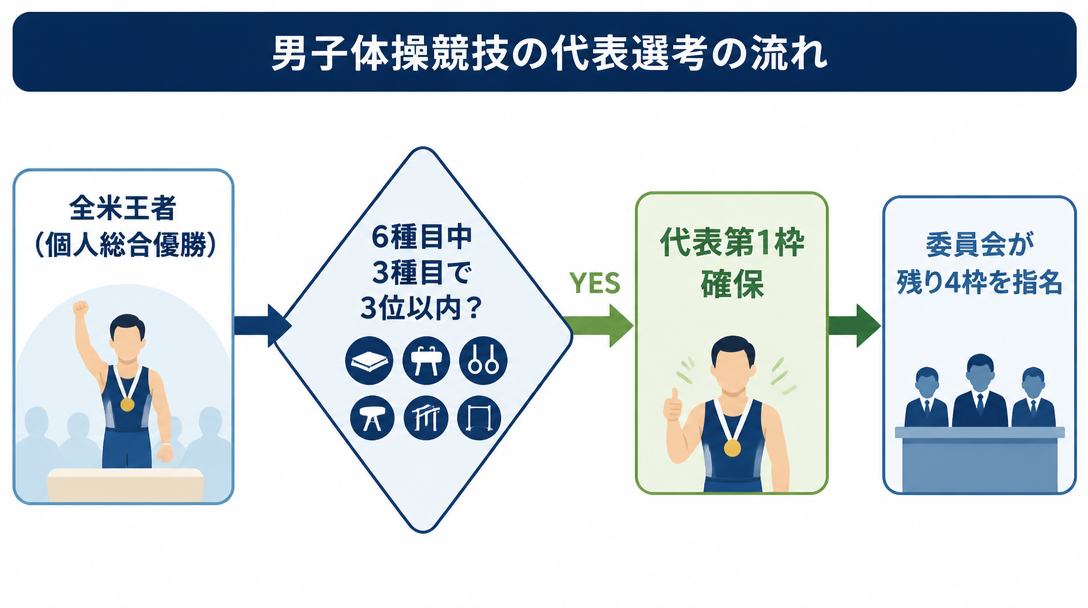
The most distinctive feature of the American selection method is that even the national champion (the all-around winner) is not automatically on the team. The gymnast who wins the all-around title can claim the first of the five spots only if he also finishes in the top three on at least three of the six apparatus (NBC Sports). In other words, beyond raw all-around strength, he must show routines that can compete with the world on multiple apparatus.
How the remaining four spots are decided
The other four spots are named by the selection committee after the meet, from the standpoint of maximizing the team's score in the team competition. Rather than simply following the all-around standings, it is a selection that solves the puzzle of "how to fill the six apparatus so the team score climbs the highest." The basic flow of the selection is as follows.
- If the all-around winner meets the condition (top three on three apparatus), he secures the first spot.
- The rest are named by the committee based on each apparatus score, consistency, and the balance of the team's composition.
- A specialist who is strong on a particular apparatus may be chosen to plug a gap in the team lineup.
The committee retains discretion precisely so it can weigh current form, injury status, and the potential scoring upside of each apparatus in the round. A gymnast can rank highly at nationals and still be left off because of how the team score has to be built, while another who ranks lower can slip in because he contributes heavily on a specific apparatus. The fact that the all-around standings do not translate directly into the final roster is the difficulty—and the appeal—of the American approach.
Why "national champion equals automatic lock" is not the rule
This conditional design reflects the fact that the United States wants versatility at the core of its team, the kind that can carry a team competition. Even if a gymnast is outstanding on a single apparatus, a gap elsewhere caps the team's total score. That is why even the all-around winner is required to back up his title with the proof of "podium-level on three apparatus." The thinking is close to how Japan measures all-around strength by stacking the All-Japan, NHK Cup, and apparatus events, and reading the differences in selection philosophy reveals the image each country wants for its team.
The Five-Man Team Format Shapes Selection (D-Score Analysis)
Rotterdam's team competition format
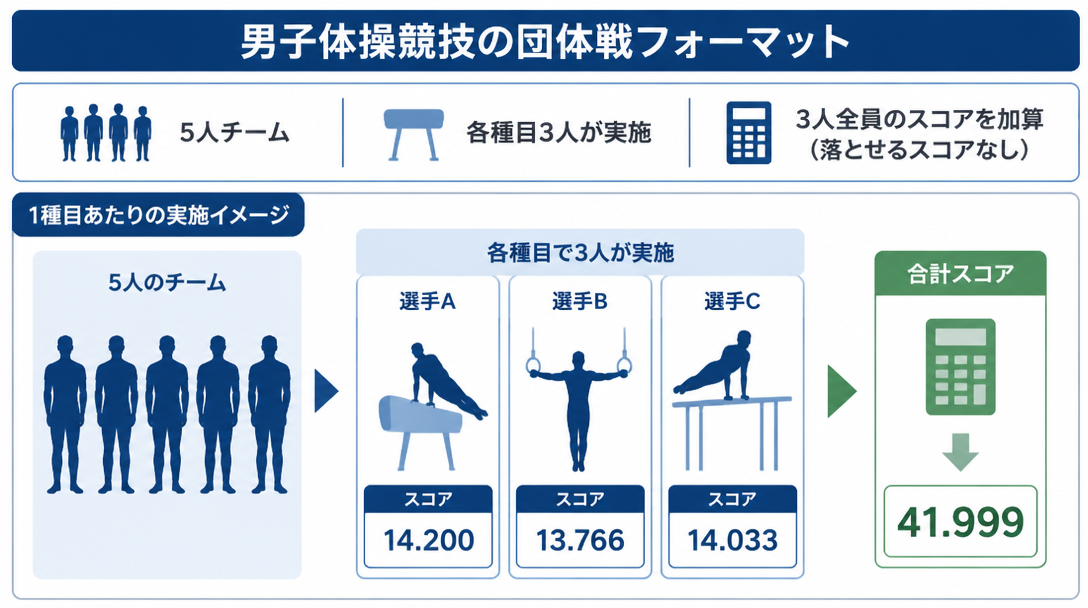
The 2026 World Championships are contested with a roster of five gymnasts per team. In the team final (October 20 for the men), three gymnasts compete on each apparatus, and all three of their scores are added to the team total. The top eight teams from qualification advance to the team final, and the leading nations also earn a path toward team places at the LA2028 Olympics (Wikipedia: 2026 World Artistic Gymnastics Championships, official competition schedule).
Item | 2026 World Championships (team) |
|---|---|
Gymnasts per team | 5 |
Gymnasts up on each apparatus | 3 |
Scores counted | All three (no score can be dropped) |
Advancing to the team final | Top eight teams in qualification |
Relation to the Olympics | Leading nations toward LA2028 team places |
"No score to drop" is the heart of selection
In the team final, three gymnasts perform on each apparatus and every one of their scores is counted. That means a single mistake becomes a direct loss of points, with no safety score to discard. In this "three up, three count" (3-3) system, the ability to stack a high D-score (difficulty) matters just as much as the E-score (execution) consistency to hit the routine cleanly every time. If a gymnast gets greedy with difficulty and falls, that entire minus lands squarely on the team.
For anyone who wants to test how the D-score shifts across different routine builds, we recommend Gymnastics AI. Just pick and arrange the skills, and it automatically calculates the difficulty value, element-group bonus, connection bonus, and dismount bonus, letting you compare how the score moves between an "attacking build" and a "safe build." For the difficulty of each skill, please also refer to our list of D-difficulty skills and a map of how hard they are to master.
Balancing specialists and all-arounders
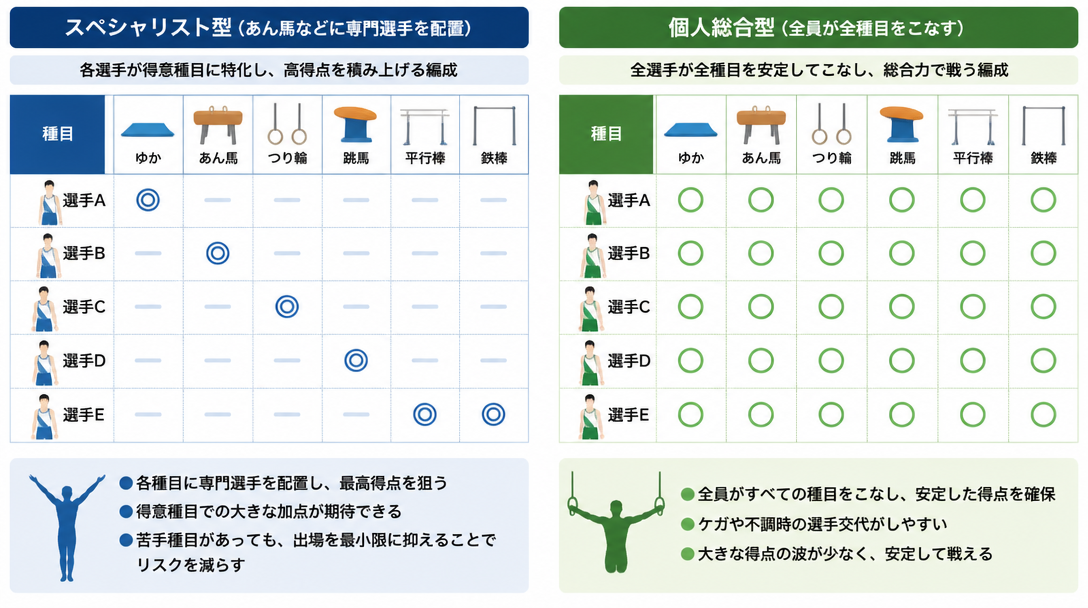
Because only five gymnasts have to cover six apparatus, it is a prerequisite that each gymnast can turn in multiple apparatus at a high level. On top of that, the standard approach is to place a reliable specialist on an apparatus like pommel horse, where falls happen easily, and fill the other events with all-around types. The reason the United States holds pommel-horse masters such as Nedoroscik and Hoopes lies exactly in this "leave no gap" strategy. The rule that imposes podium finishes on three apparatus on the national champion is likewise a design to secure a versatile axis that can support the team.
This format also brings out its own tactical battle in how the D-score is stacked. Difficulty can be added through connection bonuses and higher-value dismounts, but tightening the connections also raises the risk of a shaky execution or a mistake. In a team final where all three gymnasts' scores count, the design calls for placing an "attacker who chases a high D-score" and a "gymnast who dials the difficulty back one notch and hits it reliably" on each apparatus, maximizing the team score on an expected-value basis. Which gymnast goes up on which apparatus, and with what build—this optimization is the mind game of the five-man team.
Gymnasts to Watch and Their Apparatus Profiles
Frederick Richard—the all-around anchor
Frederick Richard, a Paris Olympic team bronze medalist and an NCAA champion, is the leading favorite. With former champion Asher Hong and world all-around champion Brody Malone sitting this meet out, Richard is expected to carry the core of the team around his all-around and high bar (Forbes). A gymnast with steady all-around ability holds high value as "a pillar who fits into any set of three" in a team competition that cycles six apparatus through five gymnasts, and he is the strongest candidate to clear the condition for the national champion's first spot.
Pommel-horse specialists—Nedoroscik and Hoopes
Stephen Nedoroscik, the Paris Olympic pommel-horse bronze medalist, is the kind of specialist who can become the keystone of the team on that apparatus. In addition, 2025 U.S. pommel-horse champion Patrick Hoopes is also in reserve, giving the United States multiple high-difficulty cards on pommel horse. Pommel horse is the classic "accident-prone apparatus," and whether a team can keep it stable is the lifeline of the team competition. For the circle skills on pommel horse, we cover them in detail in our explainer on pommel-horse circle technique: the Roth and Stockli.
All-around types and other contenders
Yul Moldauer and Shane Wiskus, both Olympic veterans of Rio and Tokyo, are also candidates. Specialist media report that Wiskus won the all-around at the June selection event (national qualifier) and matched the top American all-around total of the season (Neutral Deductions). On high bar there is also 2025 U.S. champion Taylor Burkhart, so the apparatus cards are deep. The main names can be organized as follows.
Gymnast | Main strengths / role |
|---|---|
Frederick Richard | All-around and high bar. Leading favorite, NCAA champion |
Stephen Nedoroscik | Pommel-horse specialist (Paris Olympic bronze) |
Patrick Hoopes | Pommel horse (2025 U.S. champion) |
Yul Moldauer | All-around, floor, parallel bars veteran |
Shane Wiskus | All-around. Won the June selection event |
Taylor Burkhart | High bar (2025 U.S. champion) |
You can also check the full picture of the field in Gymnastics Now's list of entrants. The primary source for the Code of Points, meanwhile, is the official site of the International Gymnastics Federation (FIG).
Comparison with Japan and the Road Ahead
Japan builds around five all-arounders
Japan heads to Rotterdam with a lineup built around Daiki Hashimoto and Shinnosuke Oka, in which nearly all five gymnasts can handle the all-around. In contrast to the United States, which folds in specialists, Japan's traditional strength is competing on the "depth of all-around ability," where it is hard for a gap to appear on any apparatus no matter which three go up. The difference in selection philosophy connects directly to a difference in how each team fights. For details, please see our preview of the 2026 Japan men's team composition and its D-score outlook.
Rotterdam as a prelude to LA2028 places
The 2026 World Championships are a crucial meet in which the leading nations in the team final connect to team places at the LA2028 Olympics. How each country assembles its strongest five at this moment is also a piece positioned with the Games two years away in mind. The U.S. Championships are the first step, and the composition here becomes the foundation of the team strategy in Rotterdam. With China and Japan running ahead on all-around strength, how far the United States can stack a team score built around specialists is a litmus test for reading the balance of power toward LA2028. The results of the U.S. Championships are not confined to a domestic roster race—they are also not to be missed for reading the shape of the world's team race.
The remaining berths decided at the European Championships (Zagreb)
The nations qualified for the men's team competition are set through Asia (China, Japan, Korea, Kazakhstan, Chinese Taipei), the Pan American zone (Canada, Colombia, the United States, Brazil), Africa (Egypt), and Oceania (Australia), but the European places are decided at the European Championships (Zagreb, Croatia) on August 19–23 (Wikipedia). The highlights of the Zagreb meet are covered in our preview of the 2026 European men's championships in Zagreb and its D-scores.
Summary
The 2026 U.S. Championships are an important selection meet that decides the men's team for the World Championships in Rotterdam. Here are the key points of this article.
- The meet runs August 6–9 in Phoenix. The senior men compete on the 6th and 8th, and the team is announced right after the finals on the 8th.
- Even the national champion cannot secure the first spot without meeting "top three on three of the six apparatus."
- Rotterdam's team event is five-man, three up per apparatus, all three counted—there is no score to drop.
- That makes combining a high D-score with consistency essential. Specialists (Nedoroscik, Hoopes) are placed on apparatus like pommel horse.
- Richard is the leading favorite. Japan, by contrast, fields five all-around types for a contrasting lineup.
If you want an easy way to simulate the D-score of a routine build, please try Gymnastics AI. It works on iOS and Android for free, and lets you estimate for yourself how much difficulty each gymnast can stack on each apparatus.