Illia Kovtun Returns for Croatia: Parallel Bars D-Score Analysis
Parallel bars Olympic silver medalist Illia Kovtun switched from Ukraine to Croatia, eligible from July 2026. We break down his Zagreb debut and 7.000 D-score.
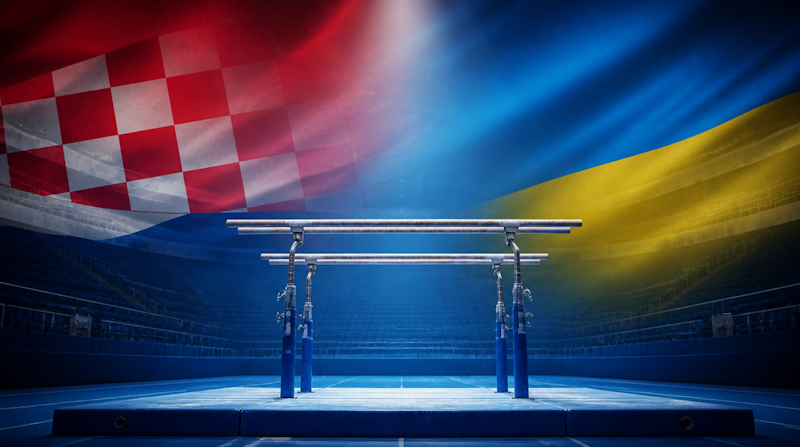
*This article reflects information as of July 31, 2026.
On July 10, 2026, men's artistic gymnastics saw a major development. Illia Kovtun, the Paris Olympic silver medalist on parallel bars, completed the one-year waiting period tied to his switch from Ukraine to Croatia and
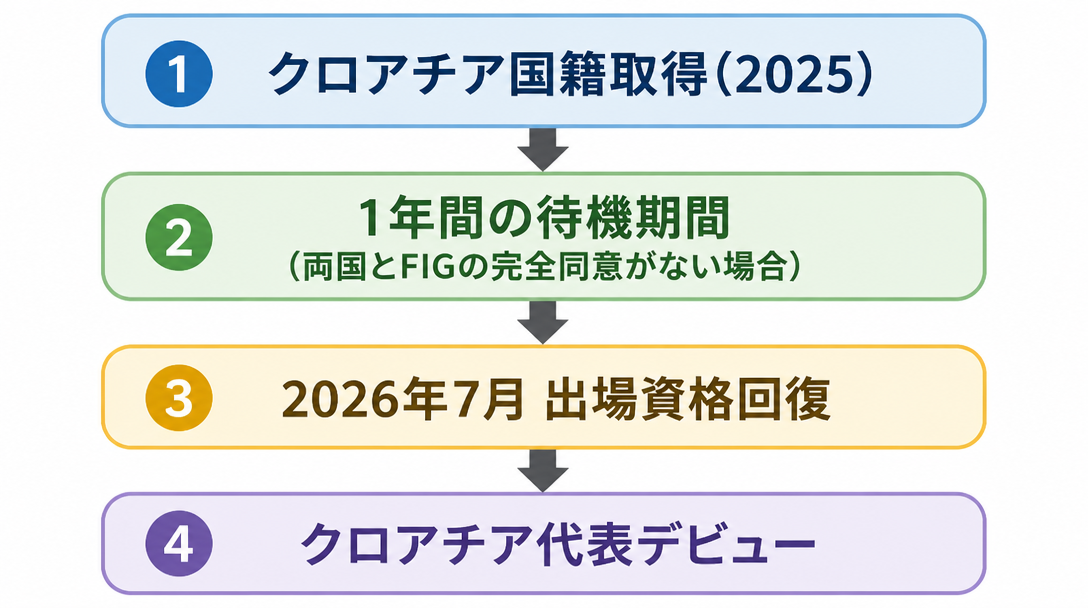
regained eligibility for international competition. His debut for Croatia is expected to come at the European Championships in Zagreb this August. As a Japanese former gymnast and the developer of a D-score app, this analysis looks at the story behind the switch and, above all, the parallel bars D-score that makes Kovtun so dangerous under the FIG Code of Points.
What Exactly Happened With Kovtun's Return
Let's start with the who, what, and when. Ukrainian-born Illia Kovtun is now cleared to compete for Croatia internationally. This is not a routine club transfer but a top-tier athlete resuming his elite career after relocating amid war — a story where sport and geopolitics intersect.
From Ukraine to Croatia
Kovtun has lived and trained in Osijek, eastern Croatia, since the 2022 Russian invasion of Ukraine. According to his English Wikipedia profile, he obtained Croatian citizenship in 2025 and has since aimed to represent Croatia. In an interview reported by NBC Sports, he said "it wasn't just the war in Ukraine" that drove the decision, but "a lot of situations" combined.
The One-Year Wait and July 2026 Eligibility
Per NBC Sports, a gymnast changing nationality must sit out one year when full consent among both nations and the FIG executive committee is not in place. That
rule applied to Kovtun, with his eligibility reported to return in July 2026. His profile on the specialist outlet The Gymternet shows he kept competing under the new federation, including at the 2025 Croatian Championships.
Why This Is Big News
Kovtun is not just any contender — he is a world-class specialist who took parallel bars silver at the Paris Olympics. A medalist of that caliber changing federations is rare, and doing so with a home European Championships as the stage makes it even more notable.
If you want to explore how a men's parallel bars routine's difficulty is built, the Gymnastics AI D-Score Calculator is a handy companion. Built on the FIG 2025–2028 Code of Points, it lets you assemble skills across all six men's events and calculates the D-score automatically.
Who Kovtun Is — A Parallel Bars Specialist
To grasp what his return means, you need to know how good he is. Here is a snapshot of his record, centered on parallel bars.
Paralle l Bars Silver at Paris 2024
In the Paris 2024 parallel bars final, Kovtun scored 15.500 for silver. According to the official Paris parallel bars results, gold went to China's Zou Jingyuan (16.200), the reigning Olympic champion. Crucially, Kovtun's D-score of 7.000 was higher than the champion's 6.900 — meaning he brought the toughest routine on the podium.
World and European Championship Results
Kovtun broke through as a junior and has consistently reached senior podiums:
- 2021 World Championships: all-around bronze
- 2023 World Championships: all-around silver
- 2023 European Championships: parallel bars gold
- 2024 European Championships: gold on parallel bars and horizontal bar, plus team gold (for Ukraine)
- 2024 Paris Olympics: parallel bars silver
The "Kovtun" — A Skill in His Name
In gymnastics, an element first performed successfully at a major competition is named after the gymnast. Kovtun has one on parallel bars: a back toss from upper arms with a quarter turn to catch on one rail, rated C difficulty (0.3) and added to the Code in 2021. Having a named skill is proof a gymnast has pushed the sport forward.
Reading the Parallel Bars D-Score
The key to Kovtun's strength lies in the parallel bars D-score. Let's decode the numbers from the Paris final.
How D-Score and E-Score Work
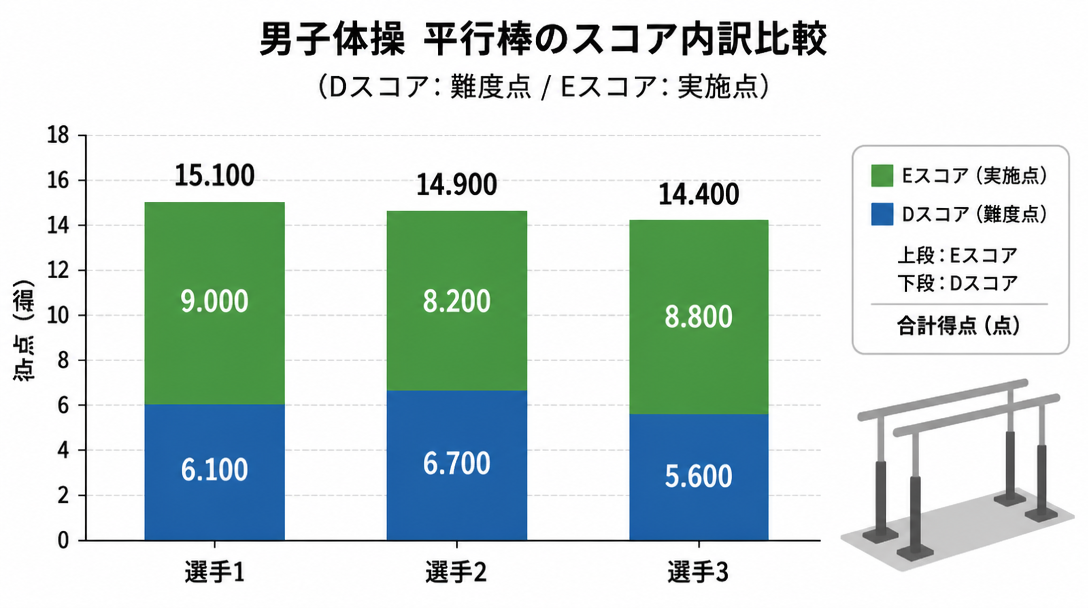
Men's scores split into two parts. The D-score (Difficulty Score) reflects how hard a routine is and has no ceiling. The E-score (Execution Score) starts at 10.000 and deducts for form and technical errors. The final mark adds the two, minus any neutral deductions (time, line, etc.).
On parallel bars, the D-score comes from element difficulty, element-group requirements, and connection bonuses for linking high-value skills. Stacking hard skills raises the D-score but increases the risk of execution errors — a constant trade-off.
Paris 2024 Parallel Bars Final: A D-Score Comparison
Here is how that trade-off played out in Paris:
Medal | Gymnast | Nation | D-Score | E-Score | Total |
|---|---|---|---|---|---|
Gold | Zou Jingyuan | China | 6.900 | 9.300 | 16.200 |
Silver | Illia Kovtun | Ukraine | 7.000 | 8.500 | 15.500 |
Bronze | Shinnosuke Oka | Japan | 6.500 | 8.800 | 15.300 |
Kovtun brought the highest difficulty (7.000) yet lost 0.800 in execution to Zou, who capped a lower-difficulty routine with a stunning 9.300. Japan's Shinnosuke Oka played it safer at 6.500 difficulty and secured bronze with 8.800 execution.
To see how difficulty choices shift a routine's value, try the Gymnastics AI calculator — select and order skills and it auto-computes difficulty, group bonuses, and connections, so you can feel where added difficulty adds risk.
Kovtun's Composition — Difficulty and Connections
A 7.000 D-score is elite territory on parallel bars. Achieving it requires E- and F-level skills plus connections that link them. Kovtun stacks release moves (letting go of the bars and re-catching) and high-value swinging elements, including his eponymous skill, to build his difficulty. But higher difficulty means harder execution — as Paris showed, the "attack with difficulty or defend with execution" choice decides medals at the top.
Kovtun's Croatia Debut — Zagreb Europeans 2026
His first big stage back is the European Championships in August — hosted in Zagreb, the capital of his adopted home.
Arena Zagreb, August 19–23
According to the 2026 European Men's Championships overview, the event runs August 19–23 at Arena Zagreb. It is the first time Croatia has hosted the artistic gymnastics Europeans, and a world-class specialist competing as host makes for a marquee storyline. European Gymnastics' official news confirms the "#Zagreb2026" starting order was drawn in mid-July as preparations ramp up.
A Pathway to Worlds
The 2026 Europeans are more than a continental meet — they feed into qualification for October's World Championships in the Netherlands. So Zagreb is both Kovtun's first step for Croatia and a proving ground for Worlds.
What It Means for Croatia
Croatia has a history of producing parallel bars specialists, and adding a world-level medalist is a major boost for its program. All eyes will be on how Kovtun performs in the red-and-white checkerboard kit before a home crowd.
Impact on Japan and What to Watch
This return is not a distant European affair — through parallel bars it ties directly into Japan's medal hopes.
A Rivalry That Runs Through Japan
Recall that Japan's Shinnosuke Oka took parallel bars bronze in Paris. Kovtun's comeback restores a formidable rival to that podium race. Per Gymnastics Now's list of announced Worlds competitors, Japan's men's team features Daiki Hashimoto and Shinnosuke Oka, and parallel bars is a genuine medal event for them. Kovtun's 7.000-plus difficulty sets a benchmark Japan must reckon with.
Toward Rotterdam Worlds 2026
According to the 2026 World Championships overview, Worlds run October 17–25 at Rotterdam Ahoy. A parallel bars final reuniting Kovtun, Zou, and the Japanese contingent would be one of the season's best duels.
Looking to LA 2028
Still in his early twenties, Kovtun can headline the next Olympic cycle. His Croatia career is just beginning, and with European-champion pedigree on high bar too, multi-event impact is on the table.
Conclusion
Kovtun's return for Croatia is one of the defining stories of the 2026 men's season. Key points:
- Paris parallel bars silver medalist Kovtun switched from Ukraine to Croatia and regained international eligibility in July 2026
- His debut is expected at the home Europeans in Zagreb, August 19–23
- His weapon is a parallel bars D-score that hit 7.000 in Paris — higher than the gold medalist's
- He renews a rivalry with Japan's bronze medalist Shinnosuke Oka and the Japanese team
- Watch him through Rotterdam Worlds and on toward LA 2028
To simulate how a men's parallel bars D-score changes with different compositions, try the Gymnastics AI D-Score Calculator — FIG 2025–2028 compliant, free on iOS and Android.